DeReticular Biophysical Enterprise Architecture & Sovereign Cryptographic Corporate Stack: Comprehensive Study Guide
Section 1: Architectural Foundations & Review
This study guide provides a structured review of the technical, cryptographic, legal, and biophysical frameworks that constitute the DeReticular Biophysical Enterprise Architecture and the Sovereign Cryptographic Corporate Stack.
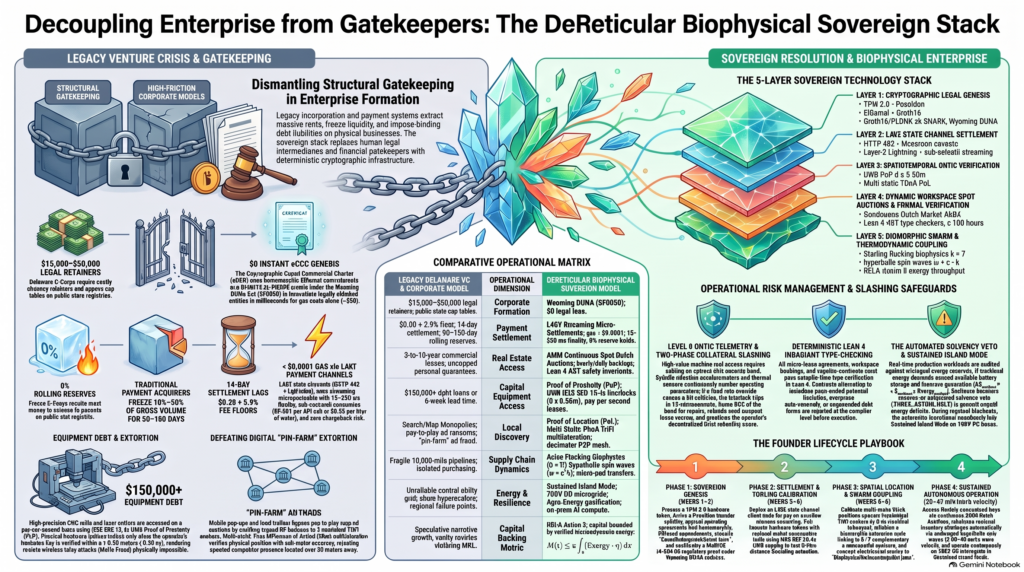
┌─────────────────────────────────────────────────────────────────────────────────┐
│ THE DE-RETICULAR SOVEREIGN ENTERPRISE STACK │
├─────────────────────────────────────────────────────────────────────────────────┤
│ LAYER 5: THERMODYNAMIC & SWARM COUPLING │
│ • RELA Axiom 3 Exergy Bounds • Bounded Topological Flocking (k=7) • 700V DC │
├─────────────────────────────────────────────────────────────────────────────────┤
│ LAYER 4: SPATIOTEMPORAL PHYSICAL ANCHORING │
│ • Proof of Proximity (PoP / UWB ToF) • Proof of Location (PoL / TriFi TDoA) │
├─────────────────────────────────────────────────────────────────────────────────┤
│ LAYER 3: SOVEREIGN SETTLEMENT & LIQUIDITY │
│ • L402 State Channels • HTTP 402 + Macaroons • Sub-Millicent Streaming │
├─────────────────────────────────────────────────────────────────────────────────┤
│ LAYER 2: CRYPTOGRAPHIC CASING & FORMAL VERIFICATION │
│ • eCCC (Dual Envelope) • Homomorphic Cap Table • Lean 4 AST Invariant Gates │
├─────────────────────────────────────────────────────────────────────────────────┤
│ LAYER 1: STATUTORY LEGAL ANCHOR │
│ • Wyoming DUNA Act (SF0050 / Wyo. Stat. § 17-31-101 et seq.) • Entity Shielding │
└─────────────────────────────────────────────────────────────────────────────────┘
- Structural Bottlenecks of Legacy Enterprise
The legacy commercial paradigm imposes systemic friction and gatekeeping on entrepreneurs across four primary vectors:
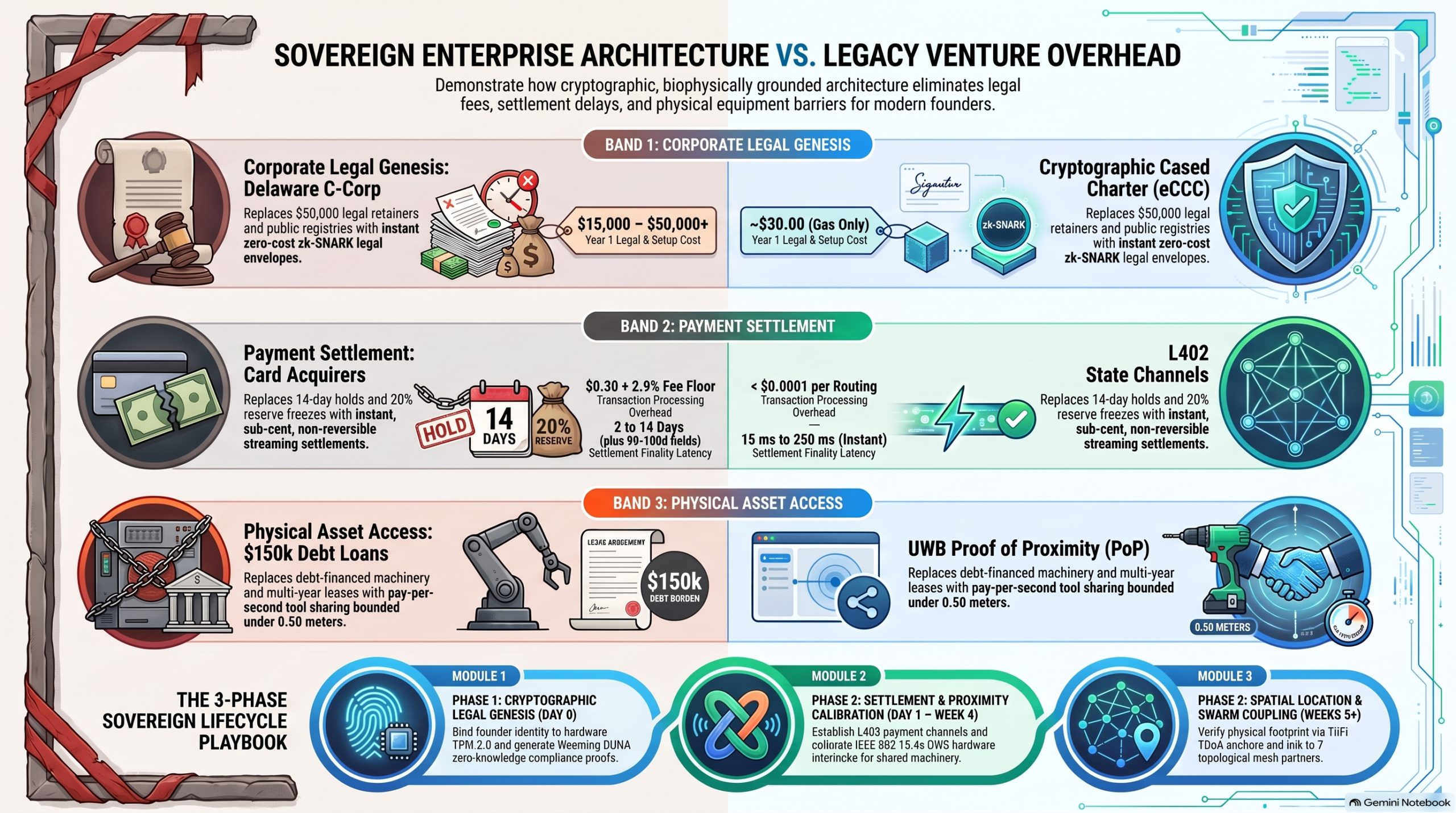
- Corporate Formation & Overhead: Traditional Delaware C-Corp structures require $15,000 to $50,000 in upfront legal retainers, billable legal hours, and public capitalization table disclosures on centralized registries.
- Payment Intermediaries (“The Plastic Wall”): Legacy credit card payment rails (Visa, Mastercard, Stripe) impose a fixed interchange floor of $0.30 + 2.9%, 2 to 14-day settlement windows, and predatory 10%–20% rolling reserve freezes held for 90 to 180 days. Sub-cent micro-transactions are rendered mathematically unviable.
- Real Estate & Spatial Rigidity: Commercial real estate relies on 3 to 10-year binding leases backed by uncapped personal guarantees. Local discovery is vulnerable to search engine mapping monopolies that siphon foot traffic through pay-to-play ad auctions and fraudulent virtual “pin farms.”
- Venture Capital “Epicycle Trap”: Traditional software venture models push startups to burn capital subsidizing customer acquisition costs (CAC) to mask negative unit economics, introducing arbitrary vanity metrics that violate the Minimum Description Length (MDL) parsimony principle.
- Legal Genesis: eCCC & The Wyoming DUNA Act (SF0050)
The sovereign stack replaces billable legal intermediaries with software compilation and statutory entity shielding:
- Cryptographic Cased Commercial Charter (eCCC): Adapted from ancient Mesopotamian cased clay tablets, the eCCC utilizes a dual-envelope container:
- Inner Core (T_{\text{core}}): Encrypts operating agreements, equity allocations, voting polynomials, and trade secrets via additive homomorphic ElGamal/Pedersen commitments: T_{\text{core}} = \operatorname{Enc}(\mathcal{O}, r) = (g^r, ; h^r \cdot g^{\mathcal{O}})
- Outer Envelope (T_{\text{env}}): Generates a non-interactive zero-knowledge validity proof (\pi via Groth16 or PLONK) asserting statutory compliance, tax escrow funding, and TPM hardware root-of-trust signatures without disclosing trade secrets or private identities.
- Wyoming DUNA Act (SF0050 / Wyo. Stat. § 17-31-101 et seq.): Solves the general partnership liability crisis highlighted in CFTC v. Ooki DAO, where token holders faced joint and several personal liability for protocol debts.
- Entity Shielding (W.S. § 17-31-104): Grants independent legal personhood to decentralized associations.
- Limited Liability (W.S. § 17-31-106): Protects members and administrators from personal liability for association debts.
- Non-Distribution Constraint (W.S. § 17-31-105): Permits commercial, for-profit operations but prohibits paying raw net profit dividends directly to passive equity holders. Value is legally transferred via developer grants, staking rewards, service compensation, or Subchapter T cooperative patronage dividends.
- Homomorphic Capitalization Tables
On-chain public cap tables expose founders and investors to commercial surveillance, short attacks, and coercion. The sovereign stack implements Homomorphic Cap Tables combining Additive Homomorphic Encryption (Exponential ElGamal) and Fully Homomorphic Encryption (FHE):
- Encrypted Balance Math: State transitions (transfers, pro-rata dilution) execute directly on ciphertexts without decryption. Dilution by factor \alpha scales ciphertexts via scalar exponentiation: \mathbf{C}_i^{\text{diluted}} = (\mathbf{C}_i)^\alpha = (g^{\alpha r_i}, ; h^{\alpha r_i} \cdot g^{\alpha s_i})
- Zero-Knowledge Invariants: Every encrypted state update must include zk-SNARK range proofs (\pi_{\text{range}} \vdash s_i \ge 0), supply conservation proofs (\sum s_i = \text{TotalAuthorized Shares}), and Poseidon nullifier credential checks.
- Selective Disclosure Auditing: Uses a (k, n)-Threshold Decryption Protocol (Shamir’s Secret Sharing) to allow CPAs, regulators, and dispute panels to decrypt specific historical snapshots for tax compliance (IRS Form 1120) without exposing the live, ongoing operational state.
- Settlement Rails: L402 Streaming Micro-Settlements
The L402 protocol (evolution of LSAT) integrates HTTP 402 Payment Required status codes with Macaroon authorization credentials and Lightning Network state channels:
- Triple Handshake:
- Client requests resource \rightarrow Server returns HTTP 402 with base Macaroon and Lightning invoice (H = \operatorname{SHA-256}(P)).
- Client pays invoice off-chain across state channels \rightarrow Obtains preimage P.
- Client presents header Authorization: L402 : \rightarrow Server verifies preimage hashlock and Macaroon HMAC signature statelessly.
- Sub-Millicent Economics: Routing costs drop below $0.0001 per transaction (base fee + proportional PPM fee), enabling sub-cent billing for streaming API tokens, per-second machinery leases, or watt-second power draws.
- Zero Rolling Reserves: Transactions achieve cryptographic bearer settlement with millisecond finality (15\text{ to }250\text{ ms}). Because chargebacks and friendly fraud are mathematically impossible, 100% of revenue clears instantly into self-custodial multi-signature vaults.
- Spatiotemporal Verification: PoP and PoL
Physical assets and location footprints are verified using hardware-bound relativistic physics rather than vulnerable centralized software or GPS inputs:
- Proof of Proximity (PoP): Uses IEEE 802.15.4z Ultra-Wideband (UWB) Time-of-Flight (ToF) distance bounding interlocked with TPM 2.0 controllers to grant physical machine access: d \le \frac{c \cdot \Delta t}{2} \le 0.50\text{ meters} \quad (\Delta t_{\text{flight}} \le 3.33\text{ nanoseconds}) Prevents wireless relay attacks (Mafia Fraud) on high-value shared tools (5-axis CNCs, laser cutters).
- Proof of Location (PoL): Mobile pods and food trucks emit signed RF beacons to stationary municipal TriFi anchors. Multi-static Time Difference of Arrival (TDoA) multilateration verifies physical coordinates (\Delta d_{ij} = c \cdot (t_i – t_j)) within a 2.5-meter tolerance, defeating virtual “pin farms” and search engine discovery extortion.
- Swarm Dynamics & Thermodynamic Grounding
- Avian Swarm Economics: Local enterprise alliances model their supply networks after starling murmurations (Sturnus vulgaris):
- Bounded Attention (k=7): Nodes connect strictly to their k=7 nearest complementary partners, preventing network communication congestion.
- Hyperbolic Spin Waves (\omega = c \cdot k): Supply/demand shocks propagate across local alliances as second-order undamped spin waves at velocities of 20 to 40 m/s in \mathcal{O}(\log N) time, triggering automated micro-pod (KurbKar) inventory transfers.
- Thermodynamic Grounding (RELA Axiom 3): Enterprise nominal credit issuance M_{\text{nominal}}(t) is strictly bounded by verified net physical exergy output: M_{\text{nominal}}(t) \le \kappa \int_{t_0}^t \left( \text{Exergy}_{\text{net}}(\tau) \cdot \eta(\tau) \right) d\tau
- Automated Biophysical Veto: If real-time production energy requirements exceed available exergy surplus (\Delta E_{\text{workload}} > \text{Exergy}_{\text{available}}), Level 0 breaker systems execute an immediate FORCE_ACTION_HALT. During grid outages, enterprises transition into Sustained Island Mode on 700V DC microgrids.
Section 2: Operational Comparative Matrix
Evaluation Dimension Traditional Delaware C-Corp Model Sovereign eCCC + Wyoming DUNA Stack
Statutory Basis DGCL (8 Del. C. § 101 et seq.) Wyo. Stat. § 17-31-101 et seq. (SF0050)
Formation Overhead $15,000 – $50,000 in legal retainers; weeks of delay 0 legal fees; compile-time deployment (~25 gas)
Cap Table Privacy Publicly visible; exposed to state registries & SaaS Absolute; encrypted via homomorphic FHE + zk-SNARKs
Payment Settlement Stripe/Credit Cards; 2–14 day clearing cycle L402 State Channels; 15–250 ms streaming finality
Merchant Reserve Holds 10%–20% frozen for 90–180 days 0.00% (Instant self-custodial settlement)
Transaction Fee Floor $0.30 + 2.9% (Sub-dollar sales impossible) < $0.0001 (Fractions of a millisatoshi)
Real Estate Leases 3–10 year binding leases with personal guarantees AMM Continuous Spot Dutch Auctions (Hourly/Daily)
Machine Tool Access $150k+ equipment loans or high job-shop markups Proof of Proximity (PoP); pay-per-second UWB leases
Local Discovery Search monopolies; pay-to-play ads; pin farms Proof of Location (PoL); multi-static TDoA TriFi mesh
Supply Chain Coordination Fragile just-in-time long-distance supply chains Biomorphic avian flocking (k=7); spin wave rebalancing
Capital Backing Metric Speculative growth narratives & vanity user metrics RELA Axiom 3; bounded by net physical exergy (Joules)
Section 3: Short-Answer Quiz
This section contains ten short-answer questions to test knowledge of the technical and legal concepts in the sources.
Questions
- How does the Cryptographic Cased Commercial Charter (eCCC) adapt the ancient Mesopotamian cased tablet model to modern decentralized ledger networks?
- What specific legal vulnerability established in enforcement actions like CFTC v. Ooki DAO does the Wyoming DUNA Act (SF0050) eliminate for decentralized organizations?
- Under the Wyoming DUNA Act, how can an association lawfully engage in commercial, profit-generating operations while maintaining its statutory “nonprofit” status?
- How does Exponential ElGamal encryption enable on-chain cap table adjustments, such as pro-rata equity dilution, without decrypting member balances?
- What specific role do Macaroons and caveats play in the L402 protocol’s “triple handshake” authorization model?
- How does the L402 protocol eliminate the structural need for centralized payment processors to freeze 10%–20% of merchant revenue in rolling reserves?
- Explain the physical mechanism by which Proof of Proximity (PoP) prevents wireless relay attacks (Mafia Fraud) on shared high-value machine tools.
- How does Proof of Location (PoL) utilize multi-static Time Difference of Arrival (TDoA) multilateration to defeat digital “pin-farm” discovery fraud?
- Describe how local merchant alliances apply avian biophysics—specifically bounded topological attention (k=7) and hyperbolic spin waves—to manage supply chain shocks.
- What is the Automated Biophysical Veto, and how does RELA Axiom 3 bound enterprise credit issuance?
Section 4: Quiz Answer Key
- How does the Cryptographic Cased Commercial Charter (eCCC) adapt the ancient Mesopotamian cased tablet model to modern decentralized ledger networks? Answer: The eCCC adapts the cased tablet model using a dual-envelope cryptographic container where proprietary operating agreements and cap tables are encrypted inside an inner core (T_{\text{core}}) via homomorphic ElGamal commitments. An outer envelope (T_{\text{env}}) generates a non-interactive zero-knowledge proof (zk-SNARK) asserting statutory compliance, tax escrow funding, and TPM signatures to external counterparties. This allows enterprises to mathematically prove regulatory validity without exposing trade secrets, member identities, or internal margins.
- What specific legal vulnerability established in enforcement actions like CFTC v. Ooki DAO does the Wyoming DUNA Act (SF0050) eliminate for decentralized organizations? Answer: Prior to SF0050, unwrapped DAOs were classified by default as general partnerships under common law, exposing every voting token holder to joint and several personal liability for all protocol debts, software exploits, and legal judgments. The Wyoming DUNA Act eliminates this existential threat by establishing statutory entity shielding (W.S. § 17-31-104) and comprehensive limited liability (W.S. § 17-31-106) for members and administrators. Consequently, governance participants are protected from personal bankruptcy resulting from association liabilities solely by reason of their membership.
- Under the Wyoming DUNA Act, how can an association lawfully engage in commercial, profit-generating operations while maintaining its statutory “nonprofit” status? Answer: Although classified as a nonprofit association, Wyo. Stat. § 17-31-105 explicitly authorizes a DUNA to run revenue-generating commercial operations, accumulate capital reserves, and charge transaction fees. The statutory “nonprofit” restriction simply enforces a non-distribution constraint that prohibits paying raw net profits as direct dividends to passive token holders. Value is instead lawfully transferred via developer grants, service compensation, staking rewards, infrastructure payments, or Subchapter T cooperative patronage dividends based on transaction volume.
- How does Exponential ElGamal encryption enable on-chain cap table adjustments, such as pro-rata equity dilution, without decrypting member balances? Answer: Exponential ElGamal provides additive homomorphic properties, allowing mathematical operations to be performed directly on ciphertexts without decrypting underlying values. Pro-rata dilution is executed via scalar exponentiation, where scaling a stakeholder’s encrypted balance tuple (c_{i,1}, c_{i,2}) by an issuance factor \alpha updates the encrypted state to represent \alpha \cdot s_i. Accompanying zero-knowledge range and conservation proofs ensure that equity bases are properly scaled without revealing raw share counts or minting phantom tokens.
- What specific role do Macaroons and caveats play in the L402 protocol’s “triple handshake” authorization model? Answer: Macaroons serve as decentralized bearer credentials that embed contextual caveats, such as expiration timestamps, rate limits, or exergy draw ceilings, signed via an iterated HMAC chain. During the L402 handshake, the server issues a Macaroon alongside a Lightning payment invoice with payment hash H. Once the client settles the invoice off-chain to receive the cryptographic preimage P, it presents the Macaroon and P to the server, enabling instant, stateless request authorization without querying a central session database.
- How does the L402 protocol eliminate the structural need for centralized payment processors to freeze 10%–20% of merchant revenue in rolling reserves? Answer: Centralized card acquirers enforce 90-to-180-day rolling reserves to insulate against chargeback disputes, stolen payment credentials, and “friendly fraud” inherent to pull-based card rails. L402 operates on a push-based model where transactions achieve non-reversible cryptographic finality off-chain the moment the payment preimage P is revealed. Because chargeback risks and stolen card liabilities are mathematically zero at the protocol level, merchant processors have no structural justification to freeze 10%–20% of operational liquidity.
- Explain the physical mechanism by which Proof of Proximity (PoP) prevents wireless relay attacks (Mafia Fraud) on shared high-value machine tools. Answer: Proof of Proximity equips capital machinery with IEEE 802.15.4z UWB transceivers coupled to TPM 2.0 power interlocks that execute speed-of-light challenge-response timing. The machine contactor energizes only if the physical round-trip time confirms the operator is within a strict perimeter of d \le 0.50\text{ m} (\Delta t \le 3.33\text{ ns}). If an attacker attempts to relay signals over a high-speed wireless or network tunnel from outside the perimeter, the additional signal propagation latency trips the physical-layer timestamp gate and keeps the machine safe-halted.
- How does Proof of Location (PoL) utilize multi-static Time Difference of Arrival (TDoA) multilateration to defeat digital “pin-farm” discovery fraud? Answer: Proof of Location requires a mobile enterprise pod to emit signed RF beacons to four stationary TriFi anchors with survey-grade fixed coordinates. The anchors measure time-of-arrival differentials to calculate hyperbolic distance differences, verifying the pod’s physical coordinates within a 2.5-meter tolerance (achieving mean residuals below 0.05 meters). Competing ghost operations or virtual “pin farms” attempting to spoof locations from remote server racks generate TDoA residual errors exceeding 50 meters and are automatically rejected by the P2P directory.
- Describe how local merchant alliances apply avian biophysics—specifically bounded topological attention (k=7) and hyperbolic spin waves—to manage supply chain shocks. Answer: Local alliances restrict peer-to-peer inventory and ERP links strictly to each enterprise’s k=7 nearest complementary topological partners to keep communication overhead bounded. When demand or inventory shocks occur, localized deficit torques update across nodes as second-order undamped hyperbolic spin waves (\omega = c \cdot k) moving at 20 to 40 m/s. This enables the network to propagate supply deficits across the alliance in \mathcal{O}(\log N) time, triggering automated HTLRC inventory transfers and KurbKar pod dispatches to absorb surges without central platform tolls.
- What is the Automated Biophysical Veto, and how does RELA Axiom 3 bound enterprise credit issuance? Answer: RELA Axiom 3 dictates that total nominal credit issuance M_{\text{nominal}}(t) must be strictly bounded by verified net physical exergy throughput (\kappa \int \text{Exergy}_{\text{net}}(\tau) \cdot \eta(\tau) d\tau). The Automated Biophysical Veto acts as an operational safety circuit that continuously monitors real-time battery storage, fuel inputs, and energy draw via BiophysicalBalanceRegister.json. If a workshop’s planned production schedule demands energy exceeding available exergy reserves, the internal breaker system automatically executes a FORCE_ACTION_HALT to prevent unbacked debt and microgrid destabilization.
Section 5: Essay Examination Questions
The following five essay questions are designed for advanced study, testing deep synthesis and critical analysis of the source material. Answers are not provided.
- Comparative Governance and Legal Architecture: Compare and contrast the traditional Delaware C-Corp venture formation model with the Sovereign Cryptographic Cased Commercial Charter (eCCC) under the Wyoming DUNA Act (SF0050). In your analysis, evaluate both paradigms across setup and maintenance overhead, personal liability protections, capitalization table privacy, federal/state tax filing mechanisms (Subchapter C vs. Subchapter T), and readiness for autonomous machine-to-machine (A2A) commerce.
- Micro-Settlements and Equipment Leasing Economics: Evaluate how the integration of Layer-2 L402 state channels and Ultra-Wideband (IEEE 802.15.4z) Proof of Proximity (PoP) redefines capital access and asset utilization for physical manufacturing startups. Detail the mathematical and structural reasons why legacy credit card rails ($0.30 + 2.9% fee floor, rolling reserves) fail to support pay-per-second machine leases, and explain how speed-of-light physical bounding eliminates counterparty risk for shared high-value tools.
- Cryptographic Privacy and Regulatory Compliance in Equity Markets: Explain the cryptographic architecture of a Homomorphic Capitalization Table. Analyze how Exponential ElGamal commitments, Fully Homomorphic Encryption (FHE), zero-knowledge range and conservation proofs, and (k, n)-Threshold Decryption function together to resolve the tension between absolute commercial data privacy for enterprise owners and statutory audit requirements for tax authorities.
- Biomorphic Systems Engineering and Supply Chain Resilience: Analyze the application of active matter physics and avian flocking dynamics (Sturnus vulgaris) to decentralized regional supply chains. Explain how maintaining a fixed topological interaction count (k=7) prevents network congestion, and derive the process by which undamped hyperbolic spin waves (\omega = c \cdot k) enable independent local merchants to dynamically rebalance raw material inventories and customer surges without central market coordination.
- Thermodynamic Grounding and Venture Capital Parsimony: Discuss the concept of thermodynamic grounding in sovereign enterprise as operationalized by RELA Axiom 3 and the Automated Biophysical Veto. Explain how anchoring nominal capital expansion in verified net physical exergy (Joules) eliminates the “Epicycle Trap” and Kolmogorov complexity inflation common in speculative venture capital financing, and describe how an enterprise operates during Sustained Island Mode.
Section 6: Comprehensive Glossary
- Agra.Energy: An agricultural biomass gasification system utilized within sovereign enterprise microgrids to produce electricity, biochar, and process heat from organic waste products.
- Automated Biophysical Veto: An operational circuit-breaker mechanism that halts non-critical machine production or lease execution (FORCE_ACTION_HALT) if projected energy draw exceeds verified exergy reserves.
- Avian Flocking Biophysics: The organizational framework modeled on starling murmurations (Sturnus vulgaris) used to coordinate peer-to-peer enterprise alliances without centralized platform management.
- BiophysicalBalanceRegister.json: A canonical JSON schema and ledger that tracks real-time kilowatt-hour generation, fuel stocks, thermal output, and exergy throughput to enforce thermodynamic capital bounds.
- Bounded Topological Attention (k=7): The network constraint derived from active matter physics where an enterprise node maintains active inventory/ERP synchronization links strictly with its k=7 nearest complementary commercial partners.
- CasedEnterpriseCharter.json: The compiled, machine-readable JSON payload containing an enterprise’s encrypted core commitments (T_{\text{core}}), zk-SNARK validity proof (T_{\text{env}}), legal statute identifiers, and TPM root-of-trust signatures.
- Cryptographic Cased Commercial Charter (eCCC): A dual-envelope corporate container adapting ancient Mesopotamian cased tablets to blockchain networks, combining an encrypted inner core for private business terms with a zero-knowledge outer envelope for statutory compliance.
- Distance-Bounding Protocol: A physical-layer cryptographic challenge-response protocol measuring Ultra-Wideband round-trip time-of-flight to enforce maximum physical proximity upper bounds (d \le 0.50\text{ m}) at the speed of light.
- ElGamal Commitment: An additive homomorphic encryption scheme (C = (g^r, h^r \cdot g^m)) used to encrypt capitalization tables, equity allocations, and voting shares while enabling direct mathematical computation over encrypted states.
- Entity Shielding: A statutory protection under Wyo. Stat. § 17-31-104 granting an association an independent legal personality capable of holding property, signing contracts, and suing or being sued separate from its individual members.
- Epicycle Trap: The systemic failure mode in venture capital where an enterprise introduces complex auxiliary metrics and vanity parameters to mask negative unit economics, inflating model complexity without improving physical solvency.
- HTLRC (Hash Time-Locked Reservation Contract): An atomic state-channel contract mechanism used to lock spatiotemporal workspace reservations or inventory transfers until a matching cryptographic preimage is revealed.
- Hyperbolic Spin Waves: Undamped second-order waves (\frac{\partial^2 \mathbf{v}}{\partial t^2} = c^2 \nabla^2 \mathbf{v}) that propagate supply deficit and inventory shock signals across topological enterprise networks at velocities of 20 to 40 m/s.
- KurbKar: Autonomous light-electric utility micro-pods used within local commercial alliances to shuttle shared inventory, raw materials, and finished goods across business districts in response to spin wave signals.
- L402 Protocol: An open standard combining HTTP 402 Payment Required status codes, Macaroon bearer credentials, and Layer-2 Lightning state channels to execute sub-millicent, push-based streaming micro-settlements.
- Lean 4 AST Invariant Gate: A deterministic compile-time verification step within the Lean 4 interactive theorem prover that checks abstract syntax trees (ASTs) of commercial leases and charters to enforce safety invariants before execution.
- Level 0 Ontic Telemetry: Real-time physical sensor data (accelerometers, thermocouples, power meters, calorimeters) monitoring hardware limits and spindle health to detect operational breaches or machinery damage.
- Macaroon: A cryptographically signed bearer token developed by Google Research supporting decentralized attenuation via append-only contextual caveats (expiration, rate limits, resource scope) verified statelessly using HMAC chains.
- Mafia Fraud (Relay Attack): An adversarial attack where a remote third party tunnels wireless authentication credentials across long distances to unauthorized machinery; defeated by UWB distance bounding.
- Non-Distribution Constraint: The statutory rule under Wyoming DUNA law (W.S. § 17-31-105) prohibiting an association from disbursing net profits directly as passive dividends to members solely by reason of capital ownership.
- Poseidon Nullifier: A zero-knowledge cryptographic hash derived from a founder’s secret hardware key and epoch (\text{Poseidon}(\text{Founder_Secret}, \text{Epoch})) that acts as an immutable on-chain identity while concealing personal metadata.
- Project Octagon: A modular industrial battery storage bank used in conjunction with 700V DC microgrids to buffer energy generation and absorb peak workshop load demands.
- Proof of Location (PoL): A spatial verification method utilizing multi-static Time Difference of Arrival (TDoA) multilateration across fixed TriFi anchors to verify the physical coordinates of mobile pods and pop-up businesses.
- Proof of Proximity (PoP): A physical access control scheme using IEEE 802.15.4z UWB time-of-flight measurements to verify that an operator is physically within 0.50\text{ meters} of a machine tool before energizing power contactors.
- RELA Axiom 3: The biophysical economic axiom establishing that authorized nominal credit issuance M_{\text{nominal}}(t) must be mathematically bounded by verified net physical exergy throughput multiplied by conversion efficiency.
- Rolling Reserves: The legacy payment processing mechanism where acquirers hold back 10% to 20% of a merchant’s gross revenue for 90 to 180 days to guard against chargebacks and fraud.
- Slashing Execution: The programmatic burning of an operator’s staked security deposit (e.g., burning 50% of collateral) triggered automatically when Level 0 telemetry detects tool misuse or spindle collisions.
- Subchapter T Taxation: Internal Revenue Code §§ 1381–1388, allowing cooperative enterprise associations to deduct “patronage dividends” paid to active producers based on business volume, avoiding double taxation.
- Sustained Island Mode: The operational state in which a business workshop disconnects from failing central utility grids and traditional financial rails, operating continuously on local 700V DC microgrids, TriFi meshes, and L402 state channels.
- Threshold Decryption Protocol: A (k, n)-Shamir secret sharing architecture where k out of n designated key holders (auditors, CPAs, dispute panels) must collaborate to decrypt encrypted cap table states during legal or tax audits.
- TriFi Mesh: A local, peer-to-peer high-bandwidth edge network providing wireless data transport, edge compute access, and stationary anchor points for multi-static spatial multilateration.
- Wyoming DUNA Act (SF0050): Wyoming Senate File SF0050 (Wyo. Stat. § 17-31-101 et seq.), providing statutory legal personhood, limited liability, and smart contract governance recognition to Decentralized Unincorporated Nonprofit Associations.
- Zero-Knowledge Regulatory Envelope (T_{\text{env}}): A zk-SNARK proof (\pi) attached to an eCCC that proves an enterprise satisfies legal statutes, maintains tax reserves, and possesses valid TPM signatures without leaking private operational data.