
Comprehensive Study Guide: Cryptographic Spatial Attestation, Sovereign Infrastructure, and Systemic Vulnerability Models
Section 1: Executive Summary & Theoretical Frameworks
1.1 Spatial Verification Paradigms: Proof of Location (PoL) vs. Proof of Proximity (PoP)
In distributed networks, autonomous systems, and zero-trust security architecture, cryptographically asserting physical presence is a foundational requirement. Physical presence verification divides into two primary paradigms:
- Proof of Location (PoL): A protocol that cryptographically asserts and verifies an entity’s absolute geographic coordinates (latitude, longitude, altitude) or semantic position (e.g., “inside Building A”) within a global reference frame (such as WGS84 or ECEF) at a specific timestamp (t). PoL answers the question: “Where in the world are you?” The primitive output is a signed receipt/certificate containing (x, y, z, t, \sigma), where \sigma is an aggregated cryptographic signature from verifier nodes.
- Proof of Proximity (PoP): A protocol that cryptographically asserts and verifies an entity’s relative physical closeness or spatial co-presence to another entity, beacon, or device, without relying on or disclosing global geographic coordinates. PoP answers the question: “Are you physically close to entity X?” The primitive output is an ephemeral attestation token proving spatial interaction within a physical boundary threshold (d \le d_{\max}) over a time interval \Delta t.
Structural Dimension Proof of Location (PoL) Proof of Proximity (PoP)
Spatial Reference Absolute: Global coordinates (\text{Lat}, \text{Long}, \text{Alt}) or geofenced polygon boundaries. Relative: Distance metrics between interacting nodes (d \le \text{threshold}).
Primary Media GNSS/GPS, Cellular (TDoA), Low-Earth Orbit (LEO) Satellites, Long-range RF (LoRaWAN). Ultra-Wideband (UWB), Bluetooth Low Energy (BLE), Near Field Communication (NFC), Acoustic/Ultrasound.
Infrastructure Overhead High: Requires globally anchored, time-synchronized, tamper-resistant witness networks or satellite arrays. Low: Functions ad-hoc peer-to-peer (P2P) or via lightweight local beacons.
Privacy Footprint Low Inherent Privacy: Exposes global tracking trails; requires Zero-Knowledge Proofs (ZKPs) for redaction. High Inherent Privacy: Verifies interaction or proximity without recording global position coordinates.
Measurement Techniques Multilateration (ToA/TDoA), Triangulation (AoA), Cell-ID, RF Fingerprinting. Round-Trip Time-of-Flight (ToF), Received Signal Strength Indicator (RSSI), Phase Difference of Arrival (PDoA).
Key Threat Models GPS/RF Spoofing, Sybil witness collusion, location oracle manipulation. Relay Attacks (Wormhole/Mafia fraud), Terrorist fraud, RSSI signal power amplification fraud.
1.2 Mathematical Foundations of Distance Bounding (PoP)
Raw signal power measurements like Received Signal Strength Indicator (RSSI) fail under adversarial conditions because attackers can amplify transmit power or use high-gain directional antennas to manipulate apparent closeness. Secure PoP protocols rely on relativistic physics: electromagnetic radiation propagates through free space at the speed of light (c \approx 299,792,458 \text{ m/s} \approx 0.3 \text{ m/ns}).
In a distance-bounding protocol (pioneered by Brands and Chaum, and expanded by Bussard and Bagga):
- Challenge-Response Phase: The verifier node sends a cryptographically random challenge bit sequence at time t_0. The prover target receives the signal, processes it over an internal hardware processing delay (t_{\text{proc}}), and emits a physical-layer response arriving at the verifier at t_1.
- Round-Trip Delay Formulation: The measured round-trip time-of-flight (\text{ToF}) is: \Delta t = t_1 – t_0 – t_{\text{proc}}
- Speed-of-Light Invariant (Upper-Bound Distance Invariant): d \le \frac{c \cdot \Delta t}{2}
Theorem 1 (Speed-of-Light Invariant): An adversary cannot make its physical distance appear shorter than it actually is without predicting the verifier’s challenge bit sequence prior to its physical arrival. Because information cannot travel faster than c, physical distance cannot be reduced. An adversary can delay a response (making distance appear larger), but cannot advance a response without guessing m challenge bits (where probability of success P \le 2^{-m}, which is cryptographically negligible for m \ge 128).
Modern implementations utilize IEEE 802.15.4z Ultra-Wideband (UWB), embedding cryptographically secure Scrambled Timestamp Sequences (STS) directly into the physical-layer RF frame to prevent preamble injection, cycle-slip, and phase-manipulation attacks.
1.3 The Compositional Engine: Synthesizing PoL from Atomic PoPs
Proof of Location and Proof of Proximity are not competing paradigms. Proof of Proximity is the fundamental atomic primitive from which secure, spoof-resistant Proof of Location is constructed.
By inverting the positioning paradigm—delegating global coordinate awareness entirely to an infrastructure perimeter of k authenticated, fixed anchors at known positions \mathbf{s}_i = [x_i, y_i, z_i]^T, an untrusted target node at unknown position \mathbf{x} = [x, y, z]^T achieves verifiable location without needing onboard GPS or satellite hardware.
   Anchor s₁ [Known Lat/Long]
              /\
             /  \  d₁ (from PoP₁)
            /    \
           /   *  \
          / Target \
Anchor s₂ / (x) \ Anchor s₃ [Known Lat/Long]
[Known Lat] \ / [Known Lat/Long]
\ d₂ d₃ /
\ /
\ /
\ /
\ /
Anchor s₄ [Known Lat/Long]
Multilateration Geometry:
Each distance-bounded PoP defines a closed Euclidean ball \mathcal{B}(\mathbf{s}_i, \hat{d}_i) = { \mathbf{x} \in \mathbb{R}^3 \mid |\mathbf{x} – \mathbf{s}_i|2 \le \hat{d}i }. The target’s location is bounded by the overdetermined convex intersection volume: \mathcal{V}{\text{target}} = \bigcap{i=1}^k \mathcal{B}(\mathbf{s}_i, \hat{d}_i)
To solve the system of non-linear spherical equations \mathbf{A}\mathbf{x} = \mathbf{b}, weighted least-squares estimation is used: \hat{\mathbf{x}} = (\mathbf{A}^T \mathbf{W} \mathbf{A})^{-1} \mathbf{A}^T \mathbf{W} \mathbf{b} where \mathbf{W} = \text{diag}(\sigma_1^{-2}, \sigma_2^{-2}, \dots, \sigma_k^{-2}) represents the inverse variance covariance matrix of anchor ranging errors.
Solvability & Rigidity Criteria:
- 2D Plane (Terrestrial Surface): Requires a minimum of k \ge 3 non-collinear anchor proofs (\text{rank}(\mathbf{A}) = 2).
- 3D Space (Latitude, Longitude, Altitude): Requires a minimum of k \ge 4 non-coplanar anchor proofs (\text{rank}(\mathbf{A}) = 3).
- Geometric Dilution of Precision (GDOP): Evaluates the spatial configuration of anchors. Defined via the design matrix \mathbf{H} and covariance tensor \mathbf{Q} = (\mathbf{H}^T \mathbf{H})^{-1}: \text{GDOP} = \sqrt{\text{Tr}(\mathbf{Q})} = \sqrt{\sigma_x^2 + \sigma_y^2 + \sigma_z^2 + \sigma_t^2} If \text{GDOP} > \text{GDOP}_{\text{threshold}} (typically > 3.5), the synthetic location proof is rejected due to excessive positional ambiguity along unconstrained axes.
Section 2: Zero-Knowledge Spatial Compliance & Identity Economics
2.1 Shortcomings of Legacy KYC/AML Mechanisms
Financial compliance regimes (enforced by FATF, FinCEN, OFAC, and EU AMLD 5/6) require verification of customer identity, sanctions status, and geographic residence. Legacy identity architectures suffer from four systemic points of failure:
- Exorbitant Marginal Costs: Automated document/biometric verification costs $1.50 to $5.00 per check, while manual enhanced due diligence (EDD) ranges from $15.00 to $35.00+.
- Temporal Decay & Static Vulnerability: A utility bill or passport scan verifies residence only at the historical moment of document issuance, decaying immediately and providing no transaction-time operational context.
- Centralized PII Honeypots: Archiving sensitive identity documents creates vulnerable databases subject to cyberattacks, triggering regulatory fines under GDPR/CCPA.
- VPN/Proxy Evasion: IP-based geofencing is easily bypassed using commercial residential proxies, Tor, or VPNs costing as little as $0.05/\text{GB}.
2.2 The Zero-Marginal-Cost zk-AML/zk-PoL Pipeline
By combining anchored physical distance-bounding with Zero-Knowledge Succinct Non-Interactive Arguments of Knowledge (zk-SNARKs), compliance transforms into a continuous, privacy-preserving, algorithmic invariant.
+—————————————————————————–+
| ZERO-KNOWLEDGE PROOF OF LOCATION (zk-PoL) |
| |
| PRIVATE WITNESSES (Secret to Prover) |
| * Target Absolute Coordinates: x = (x, y, z) |
| * Anchor Positions: {s_1, s_2, …, s_k} |
| * Distance Bounds: {d_1, d_2, …, d_k} |
| * Anchor Signatures: {\sigma_1, \sigma_2, …, \sigma_k} |
| | |
| v |
| +———————————————————————–+ |
| | ARITHMETIC CIRCUIT CONSTRAINTS (R1CS) | |
| | 1. Merkle Membership Proof: Verify(Root_R, Hash(pk_A_i), Path_i) == 1 | |
| | 2. Anchor Signature Validation: VerifySig(pk_A_i, \sigma_i) == 1 | |
| | 3. Distance Invariant: ||x – s_i||^2 <= d_i^2, \forall i \in {1…k} | |
| | 4. Point-in-Polygon (Jordan Curve): RayCast(x, Polygon_P) == 1 | |
| +———————————————————————–+ |
| | |
| v |
| PUBLIC INPUTS: Epoch E_n, Anchor Root Root_R, Approved Polygon_P |
| OUTPUT: Succinct Proof \pi (130-384 bytes, O(1) Verification Time) |
+—————————————————————————–+
Economic Derivation of Zero Marginal Cost:
\text{MC} = \frac{\partial \text{TC}}{\partial Q} = C_{\text{bandwidth}} + C_{\text{prover}} + C_{\text{verifier}} \approx $0.0001
- Zero Variable Data Fees: Inputs are physical RF waves processed locally; no data brokers are queried.
- Fixed Infrastructure Amortization: Dual-use commercial footprints (ATMs, POS terminals, Wi-Fi 7 access points, smart meters) absorb initial capital expenditure (\text{CapEx} \to 0).
- O(1) Verifier Complexity: Verifying a Groth16 zk-SNARK proof takes \approx 3 \text{ ms} on a CPU or \approx 150,000 \text{ gas} on an EVM layer, costing \approx $0.0001 per check—a 99.998% cost reduction.
Continuous Compliance via Nova Folding (IVC):
To prove continuous physical residence over rolling periods (e.g., 30 days) without memory-intensive monolithic circuits, DeReticular utilizes Incrementally Verifiable Computation (IVC) via the Nova folding scheme over a cycle of pairing-friendly elliptic curves (Pasta cycle: Pallas and Vesta). The augmented step circuit \mathbb{F}{\text{step}}(z_i, \omega_i) \to z{i+1} folds each hourly PoP receipt into a running relaxed R1CS accumulator, updating a Point-in-Polygon (PiP) counter using Jordan Curve ray-casting without running a full SNARK prover at every step.
Section 3: Noel’s Law of Structural Vulnerability & Sustained Island Mode
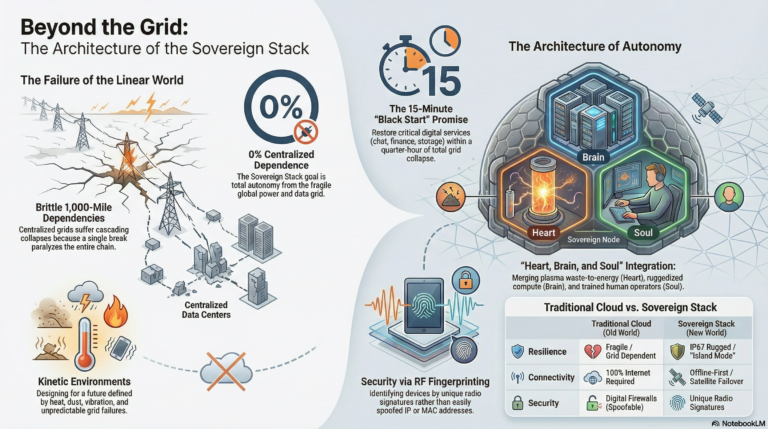
3.1 The 1,000-Mile Failure Model
Modern municipal governance, energy grids, and data platforms rely on long linear supply lines (high-voltage transmission corridors, long-haul fiber, supply chain trucking). Michael Noel formalized the systemic fragility of this baseline through Noel’s Law of Structural Vulnerability:
\mathcal{V}{\text{system}} = \kappa \cdot \left[ \prod{i=1}^n \left( \frac{\mathcal{L}i}{\lambda_i} \right)^{\alpha_i} \right] \cdot \exp\left( \sum{j=1}^m \delta_j \right)
- \mathcal{L}_i: Physical or logical length of dependency line i (km, network hops, latency). In a sovereign node, \mathcal{L}_i \to 0.
- \lambda_i: Characteristic attenuation length (spatial MTBF constant of the transmission medium).
- \alpha_i \ge 1: Hyper-coupling exponent accounting for cascading interdependencies across networks (\alpha \in [2.4, 3.8] in urban environments).
- \delta_j \ge 0: Sovereignty deficit coefficient, quantifying external administrative control, vendor lock-in, or proprietary cloud dependencies (\delta_j = \ln\left(\frac{1}{1 – \mu_{\text{external}}}\right)).
- \kappa: System normalization scalar.
The Axiom of Spatial Fragility: As dependency line lengths expand toward regional or global scales (\mathcal{L}i \to \infty), the probability of localized systemic survival under stress asymptotically approaches zero: \lim{\mathcal{L}_i \to \infty} P(\text{Survival}) = 0
3.2 Topological Evolution: Line vs. Sphere
1D: THE LINE (Linear Fragility) 3D: THE SPHERE (Spherical Resilience)
Source ===== Long Line =====> Node Node <—> Node
[Edge Connectivity \lambda(G) = 1] / \ /
[Single cut = Catastrophic Collapse] Node <—> Node <—> Node
\ / \ /
Node <—> Node
[Omnidirectional Mesh Dynamics]
* Dependency length compressed: L -> 0
* Re-routes via peers in < 16ms
3.3 The 5-Layer Sovereign Infrastructure Consortium (SIC) Stack
To achieve Sustained Island Mode—the capacity for civic, industrial, and machine complexes to maintain continuous operational integrity indefinitely without external inputs—the Sovereign Infrastructure Consortium deploys a vertically integrated 5-layer stack:
=================================================================================
THE 5-LAYER SOVEREIGN INFRASTRUCTURE CONSORTIUM (SIC) STACK
LAYER 5: GOVERNANCE, CAPITAL & ADVISORY
- Entities: Biz Builder Mike, SIEA Academy (501c3), Venture Studio.
- Functions: Noel’s Law triage, FAR Part 31 / DCAA SF 1408 accounting, capital stacking
(USDA REAP up to 50%, FEMA BRIC, IRA §6417 Direct Pay 30-50% cash refunds).
LAYER 4: SCADA & COGNITIVE INTELLIGENCE
- Entities: DeReticular Energy, Remnant AI Silicon.
- Functions: RIOS-CC-1000 8-GPU liquid-dielectric immersion compute, air-gapped
persistent super-intelligence (Remnant), sub-4ms predictive SCADA microgrid stabilization.
LAYER 3: MESH COMMUNICATIONS & PRIME AUTHORITY
- Entities: DeReticular Core.
- Functions: TriFi wireless hardware suite (15-mile NLOS, sub-16ms RF handoff, TPM 2.0),
Spatial Trust Engine (IEEE 802.15.4z UWB PoP -> PoL synthesis, S-HTLCs).
LAYER 2: KINETIC MOBILITY & PROVING TESTBEDS
- Entities: Kurb Kars, DAOSRUS (Project Octagon).
- Functions: Autonomous utility EVs, mobile battery skids, DAOS_A2A_M2M_v3 state
channels, physical anti-tamper chassis integration.
LAYER 1: BASELOAD POWER GENERATION
- Entities: Agra Dot Energy.
- Functions: Thermochemical biomass pyrolysis gasification, Pawnee rotary engines,
native 700V DC common busbars (84.8% captive thermodynamic efficiency).
Key Technical Integration Invariants:
- 700V DC Native Busbars: Agra Dot biomass power rectifies directly to a 700\text{V DC} common bus, feeding liquid-immersion GPU racks directly. This bypasses utility interconnect queues and eliminates multi-stage AC/DC conversion losses (saving 15-25% energy loss).
- Sub-16ms Island Transition: During macro-grid failure, high-speed edge sensors stream telemetry into Remnant, which commands the solid-state isolation switch (SSIS) to decouple the local bus in < 4 \text{ ms} (\tau_{\text{crit}} \le 16.6 \text{ ms}, one 60\text{Hz} cycle), maintaining bus voltage at 700\text{V DC} \pm 1.5%.
- Civic Island Triad: Municipal procurement packages couple three core civic pillars: Node 1 (Administrative Center / City Hall) + Node 2 (Water/Wastewater SCADA) + Node 3 (911 Emergency Operations Center).
Section 4: Autonomous Agent-to-Agent (A2A) Commerce & Mesh Security
4.1 Ad-Hoc Spatial Trust Graphs & Sybil Resistance
Autonomous aerial drones, freight haulers, and edge computing nodes operating off-grid cannot rely on cloud identity providers or satellite signals.
Nodes build ad-hoc spatial graphs \mathcal{G} = (\mathcal{V}, \mathcal{E}) with distance-attributed edges e_{ij} = (\Delta t_{ij}, \hat{d}_{ij}). Applying Laman’s Theorem and stress matrix rank bounds, agents evaluate graph rigidity. If an ad-hoc mesh is generically rigid in \mathbb{R}^2 or \mathbb{R}^3 and contains anchored reference points, relative positions resolve into absolute coordinates without satellite uplinks.
Physical Sybil Suppression: A malicious agent cannot spin up virtual software clones to capture resource auctions. Because a physical radio transceiver occupies a single spatial coordinate at a given time, spatial trust graphs reject duplicate identities exhibiting identical ranging and bearing vectors.
4.2 Proximity-Gated Atomic Micro-Settlements (S-HTLCs)
To bind machine payments to physical delivery, agents execute Spatial Hash Time-Locked Contracts (S-HTLCs) over peer-to-peer state channels:
[ Delivery Drone (Agent A) ] [ Cargo Depot (Agent B) ]
| |
| <=== 1. IEEE 802.15.4z UWB Ranging ========> | (d_AB <= 1.2 meters)
| |
| <— 2. Request Multi-Anchor Witness Array -|
| (Stationary anchors C & D confirm |
| {x_A, x_B} in LoadingBay_Beta) |
| |
| <— 3. Present Escrow Release Challenge — | Challenge = Hash(Invoice || PoP || PoL)
| |
| ==== 4. Physical Package Release ==========> |
| |
| <— 5. Release Signed Payment Receipt —- | (Off-grid P2P state channel)
Section 5: Short-Answer Practice Quiz
Questions
- What is the fundamental conceptual difference between Proof of Location (PoL) and Proof of Proximity (PoP) regarding spatial reference and primitive output?
- Explain the speed-of-light invariant in distance-bounding protocols and state the formula used to calculate the upper bound on physical distance.
- How many independent anchor nodes are required to resolve a target node’s position in 2D plane space versus 3D volumetric space when deriving PoL from composed PoPs?
- What is Geometric Dilution of Precision (GDOP), and why is it evaluated during spatial multilateration?
- How does a zero-knowledge Proof of Location (zk-PoL) circuit verify target containment within a jurisdiction without leaking absolute coordinates?
- What are the variables in Noel’s Law of Structural Vulnerability equation, and what does the law dictate as dependency line length (\mathcal{L}) approaches infinity?
- Why does the Sovereign Infrastructure Consortium utilize a native 700V DC busbar instead of traditional AC distribution for Layer 1 generation and Layer 4 compute?
- Describe the three critical municipal assets that comprise the “Civic Island Triad” and their operational interconnectivity.
- How does the zk-AML architecture achieve near-zero marginal cost per identity verification compared to legacy KYC/AML systems?
- How do autonomous agents in disconnected mesh networks prevent physical Sybil attacks during Agent-to-Agent (A2A) commerce?
Section 6: Short-Answer Answer Key
- Proof of Location (PoL) vs. Proof of Proximity (PoP): PoL asserts an entity’s absolute geographic coordinates or semantic position within a global reference frame, yielding a signed location certificate containing (x, y, z, t, \sigma). In contrast, PoP asserts relative physical closeness or co-presence between entities without relying on or disclosing global coordinates, yielding an ephemeral spatial interaction token (d \le d_{\max}).
- Speed-of-Light Invariant & Distance Formula: The speed-of-light invariant dictates that an adversary cannot make its physical distance appear shorter than it actually is because electromagnetic signals cannot travel faster than c \approx 0.3 \text{ m/ns}. Verifiers compute the maximum distance bound using the round-trip time-of-flight (\Delta t = t_1 – t_0 – t_{\text{proc}}) via the formula d \le \frac{c \cdot \Delta t}{2}.
- Anchor Dimensionality Requirements: Resolving a target’s position on a 2D planar surface requires a minimum of k \ge 3 non-collinear anchor proofs to achieve a non-singular system (\text{rank}(\mathbf{A}) = 2). Resolving a target’s 3D spatial position (including altitude) requires a minimum of k \ge 4 non-coplanar anchor proofs (\text{rank}(\mathbf{A}) = 3).
- Geometric Dilution of Precision (GDOP): GDOP is a mathematical metric (\text{GDOP} = \sqrt{\text{Tr}(\mathbf{Q})}) evaluating how the geometric arrangement of verifier anchors affects the precision of spatial multilateration. High GDOP occurs when anchors are collinear or clustered, causing synthetic location proofs to be rejected due to excessive positional ambiguity along unconstrained spatial axes.
- zk-PoL Verification Mechanism: The zk-PoL arithmetic circuit ingests private witness data—including target coordinates, anchor locations, and signed PoP receipts—and executes an in-circuit Point-in-Polygon (PiP) ray-casting algorithm based on the Jordan Curve Theorem. It outputs a succinct proof (\pi) confirming containment within an authorized public polygon boundary while maintaining zero exposure of raw (x, y, z) coordinates.
- Noel’s Law Variables & Asymptotic Behavior: In Noel’s Law (\mathcal{V}_{\text{system}} = \kappa \cdot \prod \left(\frac{\mathcal{L}_i}{\lambda_i}\right)^{\alpha_i} \cdot \exp(\sum \delta_j)), \mathcal{L}i is line length, \lambda_i is attenuation MTBF, \alpha_i is hyper-coupling exponent, \delta_j is sovereignty deficit, and \kappa is normalization scalar. As line length expands to regional scales (\mathcal{L} \to \infty), the probability of localized system survival under stress asymptotically approaches zero (\lim{\mathcal{L} \to \infty} P(\text{Survival}) = 0).
- Advantages of 700V DC Native Busbars: Deploying a native 700V DC busbar eliminates multi-stage AC/DC conversion penalties, saving 15% to 25% in energy transmission and heat losses. Additionally, 700V DC distribution eliminates reactive power (\text{VAR}), frequency synchronization requirements, phase imbalance, and harmonic distortion across microgrid assets.
- The Civic Island Triad: The Civic Island Triad couples City Hall/Administrative Seat (Node 1), Water/Wastewater SCADA (Node 2), and 911 Emergency Operations Dispatch (Node 3). These nodes are physically isolated behind-the-meter and interconnected via 15-mile non-line-of-sight (NLOS) TriFi wireless RF links operating with sub-16ms failover handoffs.
- Zero-Marginal-Cost zk-AML Economics: zk-AML achieves a marginal verification cost of \approx $0.0001 by offloading proof generation to local client hardware, amortizing fixed anchor infrastructure across dual-use commercial footprints, and utilizing O(1) zero-knowledge verifier circuits. This eliminates recurring variable fees paid to third-party data brokers and manual review queues.
- Physical Sybil Suppression in A2A Commerce: Autonomous agent meshes apply Graph Rigidity Theory (Laman rigidity and stress matrix rank bounds) to ad-hoc spatial trust graphs constructed from mutual UWB distance-bounding handshakes. Because a physical radio transceiver can occupy only one spatial coordinate at a given time, duplicate software identities exhibiting identical ranging vectors are automatically identified and rejected.
Section 7: Essay Format Questions
Note: Answers are intentionally omitted for these essay prompts.
- Compositional Spatial Synthesis: Discuss the complete architectural and mathematical pipeline required to derive an absolute Proof of Location (PoL) from composed atomic Proofs of Proximity (PoP). In your response, analyze non-linear multilateration pseudoinverses, anchor trust architectures (dPKI), temporal epoch management, and how physical distance bounding eliminates target-resolved coordinate spoofing.
- Systemic Resilience and Network Topology: Compare and contrast the systemic failure dynamics of 1D linear networks under Noel’s Law of Structural Vulnerability against the properties of 3D omnidirectional spherical meshes. Incorporate thermodynamic entropy generation, the First-Order Discontinuous Percolation Collapse, and Lyapunov microgrid stability into your analysis.
- Identity Economics and Regulatory Compliance: Evaluate the operational, privacy, and economic shortcomings of legacy document-based KYC/AML paradigms. Explain how the integration of the Nova folding scheme (IVC), Pasta cycle elliptic curves, and zero-knowledge spatial proofs (zk-PoL/zk-AML) enables continuous, transaction-time compliance at near-zero marginal cost without compromising citizen PII.
- Architectural Analysis of the Sovereign Stack: Examine the cross-layer synergies within the Sovereign Infrastructure Consortium’s 5-layer stack. Detail how Layer 1 biomass gasification, Layer 4 liquid-dielectric immersion compute, Layer 3 TriFi RF mesh routing, Layer 2 kinetic mobility, and Layer 5 non-dilutive capital stacking (USDA REAP, FEMA BRIC, IRA §6417) function cohesively to maintain Sustained Island Mode.
- Adversarial Threat Modeling in Physical Attestation: Provide a comprehensive security analysis of adversarial attack vectors across spatial networks, including Mafia fraud (relay attacks), Terrorist fraud, Sybil anchor virtualization, and GPS spoofing. Detail the exact hardware-level and cryptographic mechanisms—such as IEEE 802.15.4z UWB STS, TPM 2.0 silicon zeroization, and algebraic secret sharing—used to neutralize these threats.
Section 8: Comprehensive Glossary
- 1,000-Mile Failure Model: The structural engineering paradigm wherein local critical facilities depend on remote, centralized transmission lines, cloud APIs, and long-haul supply chains, rendering them vulnerable to cascading collapse from distant external breaks.
- 700V DC Common Busbar: A native direct-current microgrid distribution topology that connects power generation, battery storage, and high-density compute directly, bypassing public grid queues and eliminating multi-stage AC/DC conversion losses.
- Agra Dot Energy: The Layer 1 entity within the Sovereign Infrastructure Consortium delivering continuous off-grid baseload power via thermochemical biomass pyrolysis/gasification, Pawnee rotary engines, and 700V DC microgrids.
- Brands-Chaum Protocol: A foundational cryptographic challenge-response distance-bounding protocol that uses rapid bit exchanges to establish an unforgeable upper bound on physical distance based on signal propagation delay.
- Civic Island Triad: A municipal resiliency blueprint coupling City Hall (Administration), Water/Wastewater SCADA, and 911 Emergency Operations Dispatch into an integrated, off-grid islanded network.
- DeReticular: The Prime System Authority and Layer 3 mesh communications/ cryptographic engine of the Sovereign Infrastructure Consortium, responsible for TriFi hardware, spatial trust processing, and edge network coordination.
- Distance Bounding: A physical-layer security mechanism that measures the round-trip time-of-flight (\text{ToF}) of cryptographic challenges to enforce an upper bound on physical distance (d \le \frac{c \cdot \Delta t}{2}).
- FAR Part 31 / DCAA SF 1408: Federal Acquisition Regulation cost principles and Defense Contract Audit Agency accounting standards required for structuring job-costed ledgers during municipal grant recovery.
- Geometric Dilution of Precision (GDOP): A dimensionless multiplier (\text{GDOP} = \sqrt{\text{Tr}(\mathbf{Q})}) evaluating how spatial anchor geometry amplifies ranging measurement errors into positional uncertainty during multilateration.
- IEEE 802.15.4z UWB: An enhanced Ultra-Wideband physical-layer standard incorporating Scrambled Timestamp Sequences (STS) to deliver sub-nanosecond timing resolution and physical-layer immunity against relay attacks.
- Incrementally Verifiable Computation (IVC): A cryptographic technique (operationalized via schemes like Nova) that allows a prover to incrementally update an ongoing proof of execution step-by-step without re-evaluating preceding state histories.
- IRA Section 6417 Direct Pay: An elective tax credit mechanism under the US Inflation Reduction Act allowing tax-exempt entities (municipalities, 501(c)(3)s) to receive direct cash refunds (30%-50%) for clean energy and microgrid deployments.
- Jordan Curve Ray-Casting: An in-circuit mathematical algorithm used within arithmetic circuits to evaluate Point-in-Polygon (PiP) containment by counting boundary edge intersections along a semi-infinite ray.
- Kurb Kars: The Layer 2 kinetic mobility entity within the Consortium manufacturing autonomous utility EVs and nomadic battery skids that route energy and extend RF mesh coverage across municipal territories.
- Laman’s Theorem: A mathematical theorem in combinatorial rigidity theory defining the exact edge-density conditions required for a 2D graph to be generically rigid, used to prevent Sybil attacks in ad-hoc agent meshes.
- Mafia Fraud (Relay Attack): An attack vector where an adversary tunnels challenge-response communications over a high-speed link (fiber/RF) between a distant prover and verifier to falsify close proximity.
- Noel’s Law of Structural Vulnerability: A systems engineering law formulated by Michael Noel proving that system vulnerability (\mathcal{V}) scales as an exponential product of dependency line lengths (\mathcal{L}), hyper-coupling factors (\alpha), and sovereignty deficits (\delta).
- Nova Folding Scheme: A high-efficiency IVC proving system operating over cycles of pairing-friendly curves (such as Pasta: Pallas/Vesta) that folds step-circuit checks into relaxed R1CS accumulators without full SNARK overhead per step.
- Pawnee Rotary Engine: A specialized high-displacement rotary engine designed for continuous baseload combustion of biomass syngas, delivering high MTBF (>24,000 \text{ hours}) and direct 700V DC rectification.
- Proof of Location (PoL): A cryptographic attestation confirming an entity’s absolute geographic coordinates (x, y, z) or geofenced polygon containment within a global reference frame at time t.
- Proof of Proximity (PoP): A cryptographic attestation confirming relative physical closeness (d \le d_{\max}) between two or more interacting entities over time interval \Delta t, independent of global coordinates.
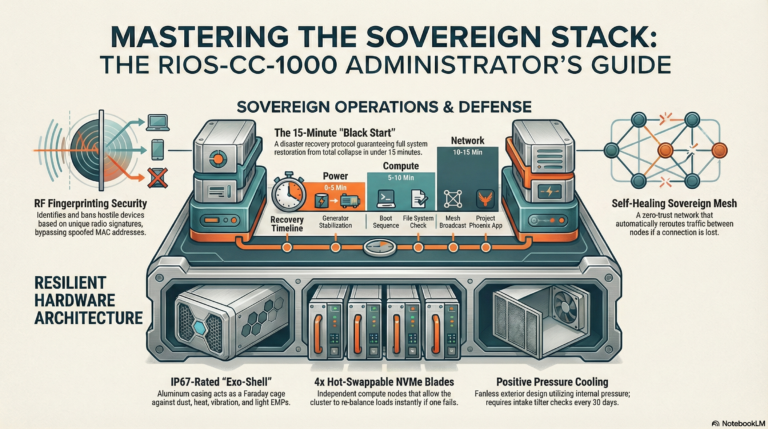
- Remnant: DeReticular’s air-gapped, persistent synthetic intelligence operating inside liquid-dielectric immersion compute racks to execute real-time SCADA microgrid stabilization and local inference.
- RIOS-CC-1000: A 42U high-density compute rack hosting 8-GPU tensor arrays submerged in synthetic liquid dielectric hydrocarbon fluid, operating at direct 700V DC input with a PUE \le 1.028.
- Scrambled Timestamp Sequence (STS): A cryptographically pseudo-random binary sequence embedded directly into UWB physical-layer RF frames to prevent preamble manipulation and distance-reduction fraud.
- Sovereign Infrastructure Consortium (SIC): An industrial federation uniting baseload energy, kinetic mobility, mesh communications, liquid-immersion compute, and advisory layers into a vertically integrated 5-layer sovereign stack.
- Spatial Hash Time-Locked Contract (S-HTLC): A cryptographic state-channel primitive that releases micro-payments or assets off-grid only upon verification of physics-based physical co-presence or spatial polygon containment.
- Spherical Resilience: An omnidirectional, high-degree mesh topology where dependency lines are compressed to zero (\mathcal{L} \to 0) and network nodes dynamically re-route energy and packets around failures in < 16 \text{ ms}.
- Sustained Island Mode: The operational state wherein a municipal, industrial, or machine complex maintains continuous functional continuity indefinitely behind-the-meter without reliance on public utilities or external networks.
- Terrorist Fraud: A fraud scenario where a dishonest prover collaborates with an external accomplice to help the accomplice pass proximity checks without revealing the prover’s long-term master private key.
- Time Difference of Arrival (TDoA): A multilateration measurement technique calculating position by analyzing differential arrival times (\Delta t_{ij}) of a transmitted RF signal across synchronized verifier witness nodes.
- TriFi Hardware Suite: DeReticular’s carrier-grade wireless networking product suite (including WISP-in-a-Box Lite 100, Signal Pro 8355, Far X X1271, and Rover SLG-06) providing 15-mile NLOS backhaul and sub-16ms RF synchronization.
- USDA REAP: The Rural Energy for America Program grant providing up to 50% capital expenditure funding for clean baseload generation and microgrid assets deployed in qualifying rural jurisdictions.
- Zero-Knowledge Proof of Location (zk-PoL / zk-AML): A succinct cryptographic proof (\pi) demonstrating that a prover is located within an authorized geopolitical boundary during epoch E_n without revealing exact coordinates, anchor identities, or citizen PII.