DeReticular and the Sovereign Stack: A Comprehensive Study Guide
podcast
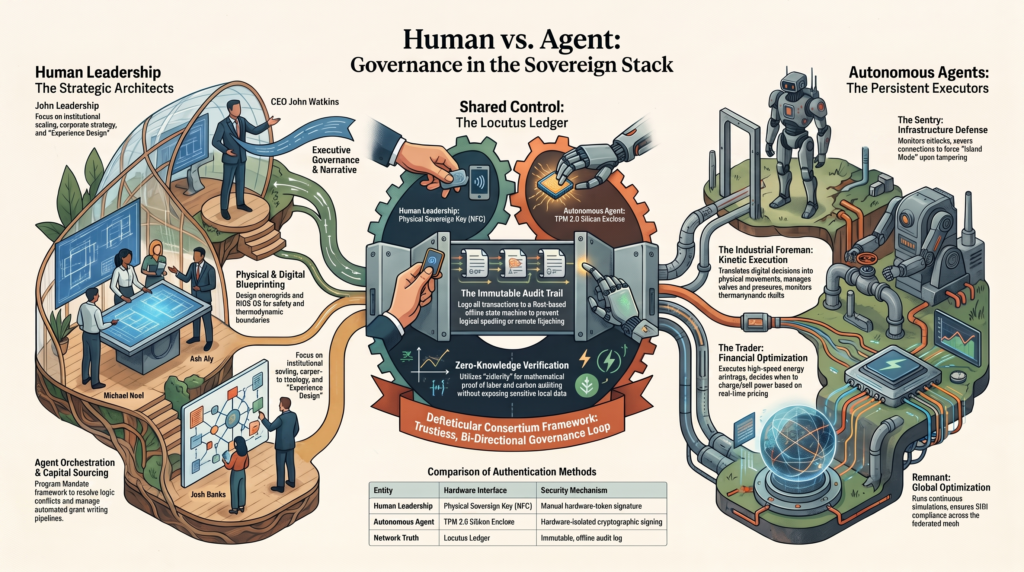
This study guide provides a structured review of the DeReticular ecosystem, an industrial infrastructure conglomerate and venture studio. It examines the shift toward “Spherical Resilience,” the technical architecture of the Sovereign Stack, and the operational specifics of Project Octagon.
Part 1: Short-Answer Quiz
Instructions: Answer the following questions in 2–3 sentences based on the provided technical documentation.
- What is the literal meaning of “DeReticular,” and how does it inform the organization’s core philosophy?
- Contrast “The Line” (centralized infrastructure) with DeReticular’s “Spherical Resilience” geometry.
- Identify the three industrial layers of the Sovereign Stack and the specific technologies they represent.
- What was the 2026 OpenClaw Security Crisis, and what shift did it trigger in the robotics industry?
- Explain the function of “Island Mode” within a physical node.
- How does RIOS differ from a standard centralized software dashboard?
- Describe the “bi-directional cryptographic co-signing protocol” used in Master Operational Governance.
- What is the “Trader” AI agent, and how does it operate within the ERCOT grid?
- What specific role does InVentures Research play in the Sovereign Stack Consortium?
- Explain the “Velcro Principle” of thermodynamic coupling.
Part 2: Quiz Answer Key
- Meaning and Philosophy: The word “DeReticular” literally means “to move away from the network.” This philosophy drives the mission of engineering physical, digital, and energy sovereignty by replacing fragile, cloud-dependent systems with self-reliant, decentralized ones.
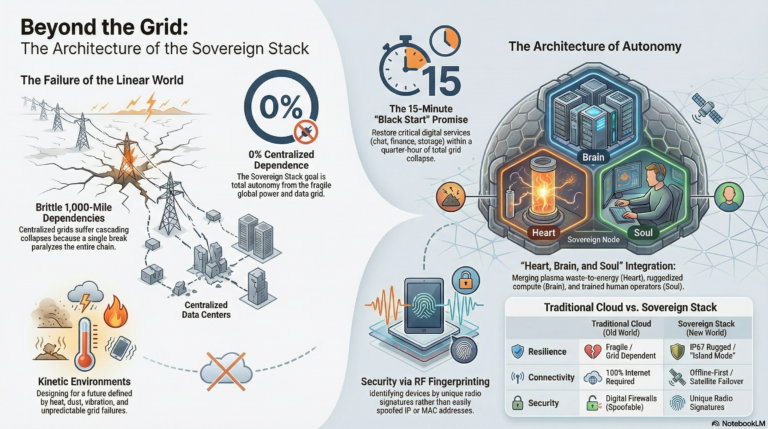
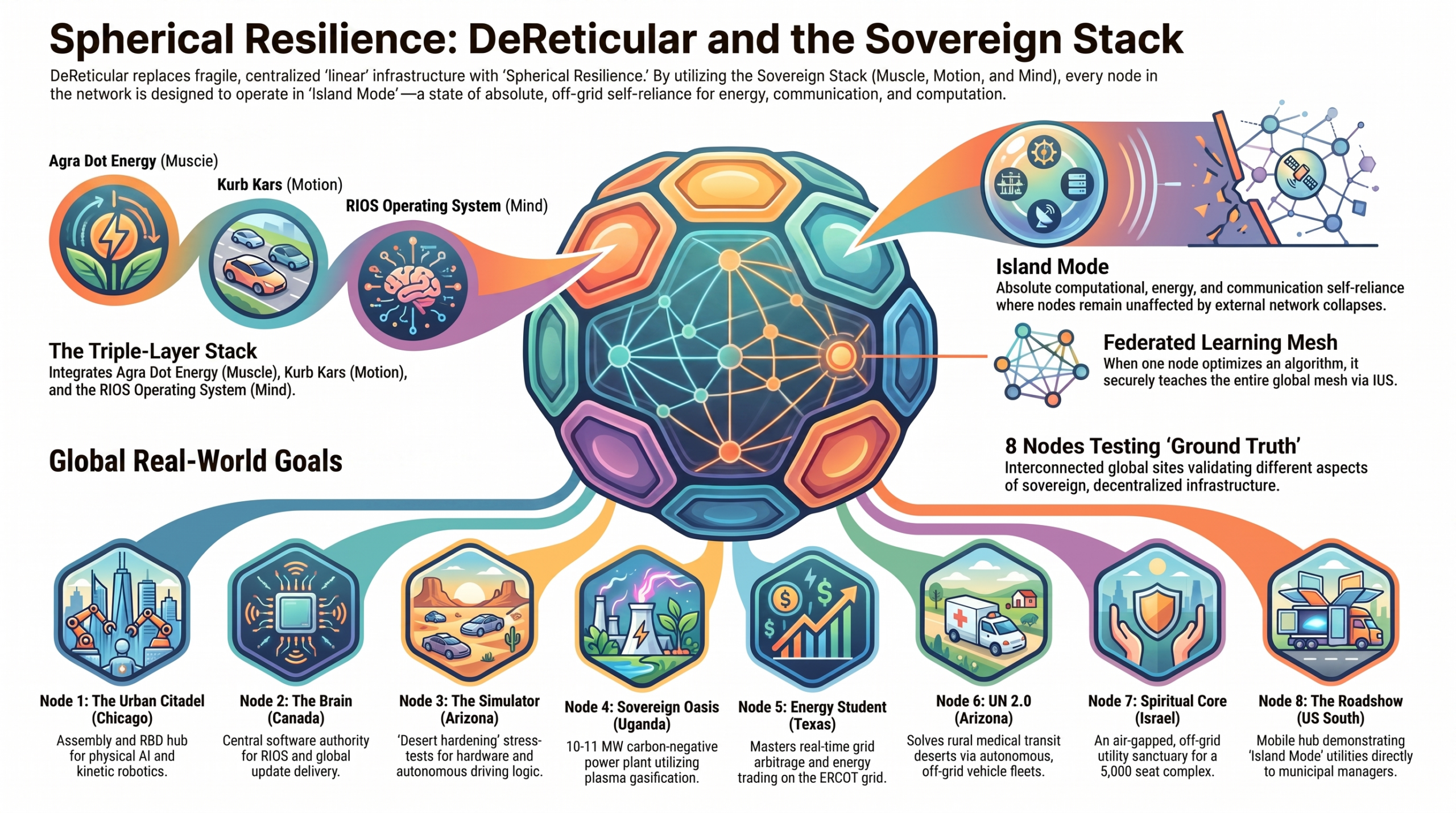
- The Line vs. Spherical Resilience: Centralized infrastructures, or “The Line,” are fragile because they break when a single link collapses. In contrast, “Spherical Resilience” uses a honeycomb geometry where every node is decentralized and capable of independent operation, ensuring the rest of the mesh remains unaffected if one node fails.
- The Sovereign Stack Layers: The architecture includes “The Muscle” (Agra Dot Energy, focused on plasma gasification), “The Motion” (Kurb Kars, involving autonomous electric logistics), and “The Mind” (RIOS, the decentralized operating system). A fourth layer, “The Interface,” translates industrial work into digital value through localized AI applications.
- OpenClaw Security Crisis: This 2026 crisis exposed critical vulnerabilities in cloud-dependent AI, where third-party APIs acted as permanent backdoors for remote code execution. It led to the transition toward “Sovereign Embodied AI,” where all processing and reasoning occur natively on-device in an air-gapped environment.
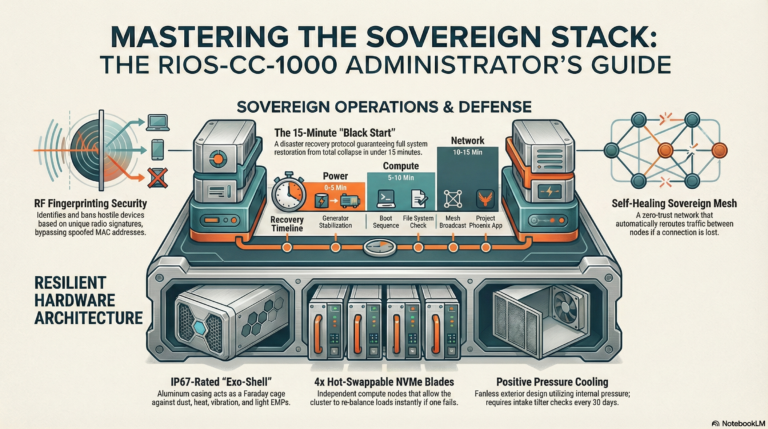
- Island Mode: Island Mode is a state of absolute computational, energy, and communication self-reliance for an individual node. It allows a node to function completely independently of external grids or cloud-tethered infrastructures during failures or network interruptions.
- RIOS Functionality: RIOS operates as a Federated Learning Mesh rather than a central dashboard. When one node optimizes an algorithm locally, it “teaches” that update to the entire planetary mesh through secure, decentralized Over-the-Air (OTA) updates.
- Cryptographic Governance: This protocol ensures that every system change requires a dual-signature: one from a human architect using a physical hardware token and one from an autonomous agent in a TPM 2.0 enclave. All these transactions are immutably logged to the Locutus Ledger to prevent behavioral drift or unauthorized access.
- The Trader AI Agent: Operating at Node 5 in Fort Worth, “The Trader” is a financial optimization agent that manages energy arbitrage on the ERCOT grid. It monitors real-time pricing to decide when to charge Tesla Megapacks (during negative rates) and when to sell power back to the grid during peak demand.
- InVentures Research Role: InVentures acts as the financial architect of the consortium, specializing in “non-dilutive capital stacking.” They de-risk heavy capital expenditures by pairing private seed equity with large-scale federal matching grants like the NTIA’s AI-RAN fund or NSF VINES.
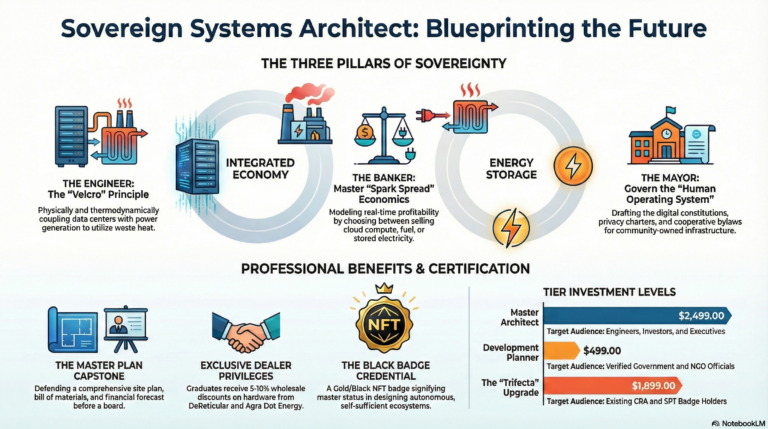
- The Velcro Principle: This principle involves algorithmically routing waste heat from high-density computing servers into productive physical uses, such as heating agricultural greenhouses or water distillation. This integrates the digital economy with physical community survival, turning a typical cost center into a localized asset.
video
Part 3: Essay Format Questions
Instructions: Use the provided documentation to develop comprehensive responses to the following prompts. (Answers not provided).
- The Evolution of Security: Analyze how the OpenClaw Security Crisis redefined the concept of “trust” in industrial AI. Discuss the specific hardware and software mechanisms DeReticular uses to eliminate the “Trusted Environment Fallacy.”
- Economic Sovereignty and Data Arbitrage: Evaluate how the Sovereign Stack creates economic value for rural and municipal communities. Specifically, address the concepts of Data Arbitrage, “Ground Truth” data, and the prevention of capital flight to public cloud providers.
- Project Octagon and Global Resilience: Compare and contrast the operational mandates of the eight global nodes. How does each node contribute to the validation of the Sovereign Stack, and why was the “Vanguard Pivot” necessary for its realignment?
- The Integration of Human and Digital Labor: Describe the organizational structure of the Sovereign Stack Consortium. How do human leadership, institutional partners, and persistent AI agents (like Remnant and The Sentry) collaborate while maintaining strict security boundaries?
- Technological Symbiosis: Discuss the relationship between Agra Dot Energy’s plasma gasification and RIOS’s computational needs. How does the concept of “Industrial Symbiosis” manifest in the Kaabong Smart Eco-Industrial Park (Node 4)?
Part 4: Comprehensive Glossary
Term Definition
Agra Dot Energy The “Muscle” layer of the stack; specializes in carbon-negative power via plasma gasification of organic waste.
BABA-Compliant “Build America, Buy America”; a manufacturing standard for hardware (like TriFi routers) required to qualify for federal grants.
Data Vault Off-grid edge servers that allow communities to host independent cloud infrastructure, securing data residency locally.
ERCOT The deregulated electrical grid in Texas where Node 5 executes high-speed energy arbitrage.
Federated Learning Mesh A decentralized network structure where AI models are trained locally on-device and updates are shared across the network via OTA.
Island Mode A state where a node operates with total energy, communication, and computational independence from external networks.
Kurb Kars The “Motion” layer; a fleet of ruggedized, autonomous electric vehicles for logistics and medical transportation.
Locutus Ledger A Rust-based, immutable, offline state machine that logs all physical tasks and cryptographic signatures across the mesh.
Operation Octagon The strategic deployment phase involving eight global nodes to test and validate the Sovereign Stack architecture.
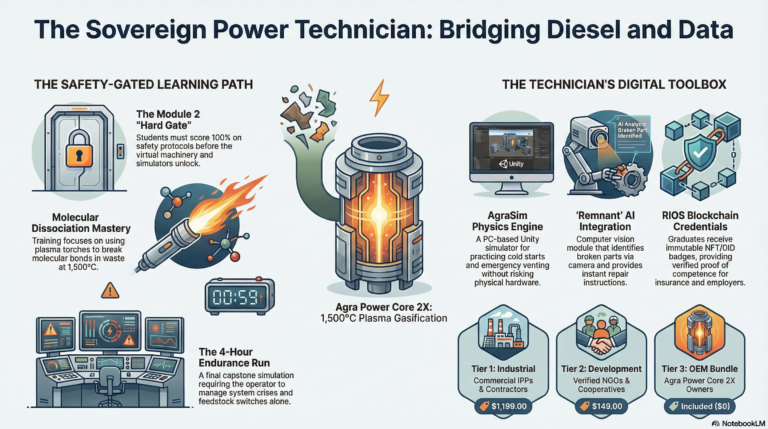
Plasma Gasification A high-efficiency process (1500°C) that uses molecular dissociation to convert waste into clean syngas and synthetic fuels.
RIOS Rural Infrastructure Operating System; the “Mind” of the stack that coordinates all physical nodes and decentralized services.
Sentry Patrol A turnkey Autonomous Robotic Infrastructure Network (RIN) providing security and maintenance for off-grid sites.
Spherical Resilience A decentralized honeycomb geometry designed to prevent system-wide failure when individual links or nodes collapse.
The Sentry (Agent) An edge-compute security AI that monitors server airlocks and can force a node into Island Mode if threats are detected.
TPM 2.0 Trusted Platform Module; a hardware-level security enclave used to sign agent tasks and ensure the integrity of AI model binaries.
TriFi Wireless The consortium’s telecommunications partner that manufactures multi-carrier fallback routers and satellite-bonded antennas.
Vanguard Pivot A March 2026 strategic realignment of Operation Octagon’s nodes to better address supply chain, regulatory, and urban-rural needs.
zkVerify A zero-knowledge proof system used to audit carbon sequestration data and ensure secure, private verification of transactions.