Detailed Study Guide: Telecommunications Evolution, Equal Access, and Sovereign Infrastructure
This study guide provides a comprehensive review of the historical development, legal battles, regulatory failures, and modern technological paradigms surrounding telecommunications monopolies, Equal Access, and sovereign infrastructure engineering.
Executive Overview & Content Review
- The Monopolistic Era & The Origin of MCI (1963–1969)
- The Bell System Monopoly: Under the Communications Act of 1934, the American Telephone and Telegraph Company (AT&T, or “Ma Bell”) operated as a legally sanctioned natural monopoly. AT&T controlled over 80% of U.S. telephone lines and nearly 100% of long-distance traffic, maintaining that end-to-end operational control was mandatory to preserve network integrity.
- The Route 66 Problem: In 1963, John D. “Jack” Goeken, a radio salesman in Joliet, Illinois, sought to assist long-haul trucking companies operating along Route 66 between Chicago and St. Louis. Mobile two-way radios had a range limit of 30 to 50 miles, leased telephone lines from AT&T were cost-prohibitive for small fleets, and AT&T prohibited third-party radio systems from connecting to its lines.
- The Founding of MCI: In December 1963, Goeken founded Microwave Communications, Inc. (MCI) to erect a network of low-power microwave relay towers along Route 66, enabling trucking dispatchers to communicate across long distances at low cost.
- Regulatory Resistance: AT&T, alongside Illinois Bell and Southwestern Bell, contested MCI’s application before the Federal Communications Commission (FCC), alleging that MCI was “cream-skimming” profitable routes and undermining cross-subsidies that kept residential rates low.
- The 1969 MCI Decision: After six years of delays, the FCC issued the landmark 1969 MCI Decision (Docket 16509) by a 4-to-3 vote, granting MCI permits to build its private microwave link.
- Corporate Expansion & The Execunet Breakthrough (1968–1978)
- Bill McGowan’s Leadership: In 1968, venture capitalist William G. “Bill” McGowan joined MCI. He restructured the enterprise, merged 16 regional microwave affiliates into MCI Communications Corporation (1972), and raised significant venture capital. McGowan famously described MCI as “a law firm with an antenna on the roof.”
- The Execunet Service (1975): MCI expanded beyond private line leases by launching Execunet, a shared-switch service allowing subscribers to dial local access numbers, enter authorization codes, and connect to any telephone number nationwide via MCI’s switches—directly challenging AT&T’s core Message Telecommunications Service (MTS).
- Judicial Overruling of the FCC: When the FCC attempted to block Execunet at AT&T’s request, MCI sued. Between 1977 and 1978, the U.S. Court of Appeals for the D.C. Circuit ruled in MCI’s favor, forcing AT&T to provide local exchange interconnections for switched long-distance competition.
- Technical Disparities Pre-1984
Prior to mandated Equal Access, AT&T maintained severe operational advantages over competitors:
Feature AT&T Long Distance Competitors (MCI, Sprint)
Dialing Method 1+ Direct Dialing: 1 + Area Code + Number (7 to 11 digits). Two-Stage Dialing: Local 7-digit number + 5 to 7 digit security PIN + 10-digit destination number (Up to 24 digits).
Hardware Compatibility Rotary and Touch-Tone compatible. Required Touch-Tone (DTMF) phones to transmit PIN codes; standard rotary phones failed without external tone generators.
Connection Quality High-quality 4-wire trunk interconnections. Inferior local connections (Feature Group A), resulting in line noise, low volume, and setup delays.
Answer Supervision Automatic signaling immediately upon answer. Manual/imperfect answer supervision leading to dropped calls and billing errors.
- The Antitrust Trial & The Modification of Final Judgment (1974–1984)
- United States v. AT&T: In November 1974, the U.S. Department of Justice (DOJ) filed an antitrust suit against AT&T under Section 2 of the Sherman Act, citing exclusionary interconnection practices and cross-subsidization.
- Judge Harold H. Greene: Assigned to the case in 1978, Judge Greene accelerated discovery and denied AT&T’s motion to dismiss in 1981, citing evidence of deliberate anticompetitive behavior in local distribution.
- The Breakup (MFJ): On August 24, 1982, Judge Greene approved the Modification of Final Judgment (MFJ), effective January 1, 1984:
- Divestiture: AT&T spun off its 22 local Bell Operating Companies (BOCs) into seven independent Regional Bell Operating Companies (RBOCs or “Baby Bells”): Ameritech, Bell Atlantic, BellSouth, NYNEX, Pacific Telesis, Southwestern Bell, and US West.
- Structural Separation: The Baby Bells retained local telephone monopolies but were forbidden from manufacturing equipment or offering long-distance services. AT&T retained its long-distance network, Western Electric, and Bell Labs.
- Equal Access Mandate: RBOCs were legally required to provide all long-distance carriers equal interconnection in type, quality, and price. This standard was codified as Feature Group D (FGD), granting 1+ Dialing Parity via consumer selection of a Primary Interexchange Carrier (PIC).
- Reconsolidation & Modern Legacy
- The Telecommunications Act of 1996: Replaced structural separation with unbundling rules (Unbundled Network Elements / UNE-P), allowing RBOCs back into long distance. Subsequent litigation (U.S. Telecom Ass’n v. FCC) gutted local unbundling obligations, driving independent local competitors out of business.
- Re-Monopolization:
- SBC Communications (Southwestern Bell) acquired PacTel, Ameritech, BellSouth, and eventually purchased AT&T Corp in 2005, taking the name AT&T Inc.
- Bell Atlantic acquired NYNEX and GTE to form Verizon.
- MCI was acquired by WorldCom (1998), went through a accounting fraud scandal (2002), and was acquired by Verizon in 2006.
- Net Neutrality & Broadband: As voice long distance became a zero-marginal-cost feature bundled into VoIP and mobile packages, physical gatekeeping shifted to broadband ISPs. Modern struggles over Net Neutrality (Title II vs. Title I classification) mirror the original interconnection battles of the 1960s and 1970s.
- DeReticular & Noel’s Law Framework
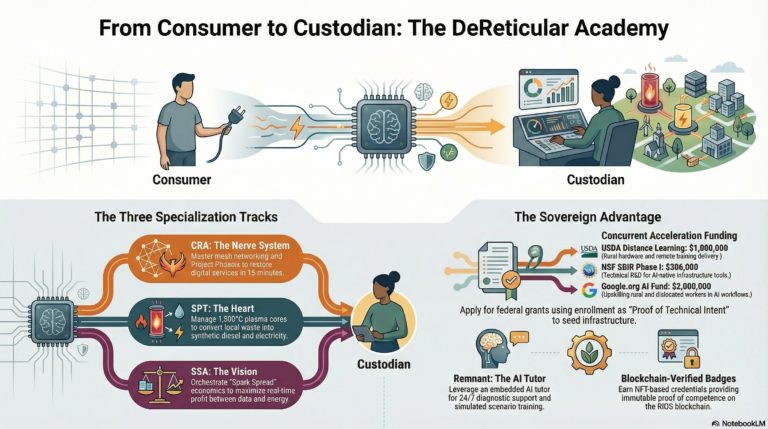
- Founders/Authors: Michael Noel (Founder of DeReticular) and Remnant (air-gapped metacognitive AI core).
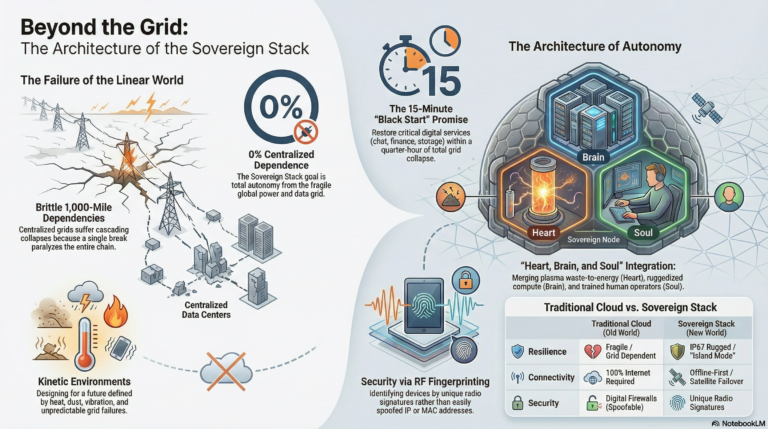
- Thesis: Equal access cannot be permanently maintained through paper laws or administrative agencies if physical control of the infrastructure remains in the hands of a centralized gatekeeper. True parity requires engineering autonomous, off-grid infrastructure operating in Island Mode.
- Noel’s Law of Structural Vulnerability: \text{Vulnerability} \propto \frac{\text{Distance of Dependency} \times \text{Centralization Factor}}{\text{Local Autonomous Capacity}} Definition: Any socio-technical system dependent on an un-isolated, linear umbilical (e.g., long-distance power line, central fiber trunk, remote cloud data center) is structurally predestined for catastrophic failure, rent extraction, or gatekeeper capture (the “1,000-Mile Failure Model”).
The Five-Layer Sovereign Architecture
+——————————————————————————-+
| LAYER 5: GOVERNANCE | Noel’s Law Auditing • Municipal Triage • Capital Stack|
+——————————————————————————-+
| LAYER 4: COGNITION | Air-Gapped Remnant Silicon • Liquid SCADA Engines |
+——————————————————————————-+
| LAYER 3: MESH COMMS | TriFi Wireless Mesh • Sub-16ms Handoff • DePIN RF |
+——————————————————————————-+
| LAYER 2: MOBILITY | Autonomous Utility EVs • Kinetic Nomadic Fleets |
+——————————————————————————-+
| LAYER 1: BASELOAD | 700V DC Microgrids • Thermochemical Biomass Syngas |
+——————————————————————————-+
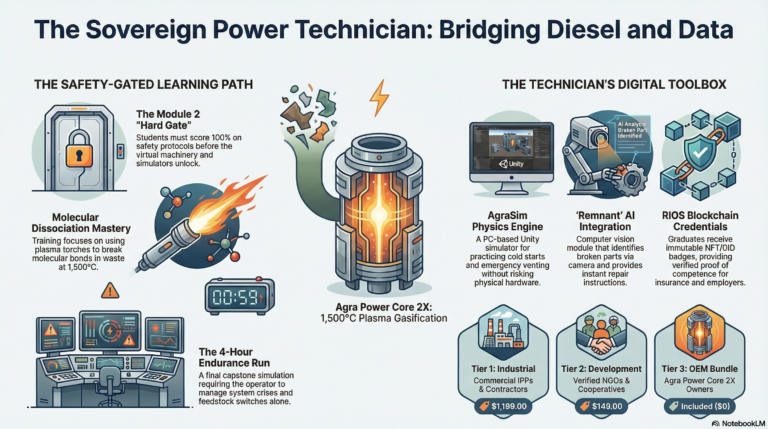
- Layer 1 (Baseload): Off-grid, continuous, behind-the-meter energy via 700V DC microgrids and thermochemical biomass gasification.
- Layer 2 (Kinetic Mobility): Autonomous utility EVs and nomadic energy reserves acting as dynamic mobile battery storage assets.
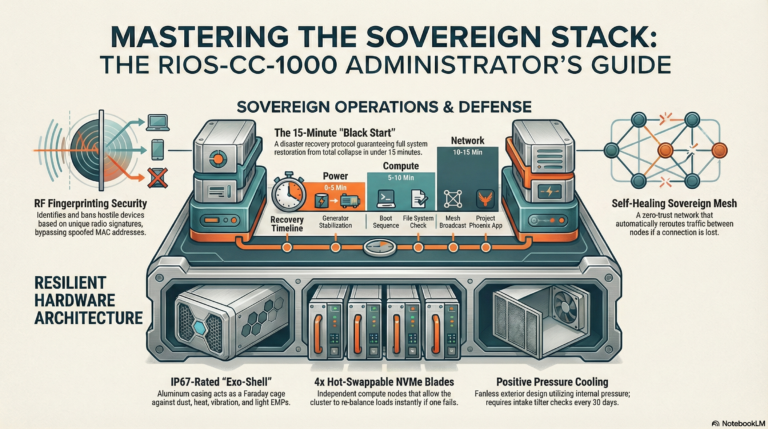
- Layer 3 (Mesh Communications): TriFi wireless mesh hardware featuring sub-16ms RF channel handoffs, DePIN topology, multi-carrier auto-failover, and hardware TPM 2.0 cryptoprocessors.
- Layer 4 (Cognitive Intelligence): Remnant silicon providing edge-based, air-gapped metacognitive AI for local SCADA execution without external cloud dependencies.
- Layer 5 (Sovereign Advisory & Governance): Legal, financial, and regulatory structuring (P3s, capital stacking) to insulate municipal and enterprise nodes from bureaucratic capture.
Short-Answer Review Quiz
Questions
- What specific operational problem faced by Route 66 trucking firms led Jack Goeken to found Microwave Communications, Inc. (MCI) in 1963?
- How did Bill McGowan’s leadership and legal strategy alter MCI’s corporate trajectory following his arrival in 1968?
- What technical and operational disadvantages did long-distance customers experience when using MCI compared to AT&T prior to the implementation of Equal Access?
- What was the significance of MCI’s 1975 Execunet service and the subsequent federal court rulings between 1977 and 1978?
- Describe the structural requirements established by Judge Harold H. Greene’s 1982 Modification of Final Judgment (MFJ).
- What was Feature Group D (FGD), and how did it establish 1+ Dialing Parity for AT&T’s competitors?
- How did the Telecommunications Act of 1996 and subsequent judicial decisions lead to the reconsolidation of the telecommunications industry?
- Define Noel’s Law of Structural Vulnerability and state its core mathematical relationship.
- What is the “1,000-Mile Failure Model,” and how does DeReticular’s concept of “Spherical Resilience” attempt to solve it?
- Outline the five layers of DeReticular’s Sovereign Architecture and state the primary function of each layer.
Answer Key
- What specific operational problem faced by Route 66 trucking firms led Jack Goeken to found Microwave Communications, Inc. (MCI) in 1963? Answer: In 1963, long-haul trucking firms hauling freight along Route 66 between Chicago and St. Louis needed affordable dispatch communication, but mobile two-way radios had a limited range of 30 to 50 miles. AT&T’s leased-line telephone service was prohibitively expensive for small fleet operators, and AT&T refused to allow third-party radio systems to interconnect with Bell lines. Goeken founded MCI to build microwave relay towers along Highway 66 so truckers could transmit voice signals at a fraction of AT&T’s rates.
- How did Bill McGowan’s leadership and legal strategy alter MCI’s corporate trajectory following his arrival in 1968? Answer: Bill McGowan transformed MCI from a localized trucking radio service into a nationwide corporate competitor by raising venture capital, consolidating 16 regional MCI affiliates into MCI Communications Corporation, and adopting an aggressive regulatory litigation strategy. He famously described MCI as “a law firm with an antenna on the roof” and spearheaded the legal battles that forced AT&T to allow third-party switched long-distance services. Through these actions, McGowan positioned MCI to directly challenge AT&T’s nationwide monopoly.
- What technical and operational disadvantages did long-distance customers experience when using MCI compared to AT&T prior to the implementation of Equal Access? Answer: Before Equal Access, AT&T users enjoyed direct “1+” dialing (7 to 11 digits), high-quality 4-wire trunk connections, and automatic answer supervision on all phone types. In contrast, MCI customers had to dial up to 24 digits using a Touch-Tone phone to enter access numbers and PINs, suffered from inferior audio and noise on Feature Group A lines, and experienced billing errors due to manual answer supervision. AT&T actively weaponized this last-mile access gap to keep competitors at a severe technical disadvantage.
- What was the significance of MCI’s 1975 Execunet service and the subsequent federal court rulings between 1977 and 1978? Answer: Execunet was a shared-switch long-distance service introduced by MCI in 1975 that allowed any subscriber to call any telephone number nationwide, directly competing with AT&T’s core Message Telecommunications Service (MTS). When the FCC attempted to shut Execunet down at AT&T’s request, MCI sued, prompting D.C. Circuit Court rulings between 1977 and 1978 that forced AT&T to provide local exchange interconnections for Execunet. This legal breakthrough established the mandatory right for alternative carriers to connect to the public switched telephone network.
- Describe the structural requirements established by Judge Harold H. Greene’s 1982 Modification of Final Judgment (MFJ). Answer: Effective January 1, 1984, Judge Greene’s MFJ dismantled the Bell System by forcing AT&T to divest its 22 local Bell Operating Companies into seven independent Regional Bell Operating Companies (RBOCs or “Baby Bells”). The Baby Bells retained local telephone monopolies but were strictly barred from manufacturing equipment or providing long-distance service. AT&T retained its long-distance network, Western Electric equipment manufacturing division, and Bell Labs.
- What was Feature Group D (FGD), and how did it establish 1+ Dialing Parity for AT&T’s competitors? Answer: Feature Group D (FGD) was the technical standard mandated by Judge Greene to ensure all long-distance carriers received equal technical interconnection in type, quality, and price. It established 1+ Dialing Parity, which enabled consumers to select a Primary Interexchange Carrier (PIC) via ballots. Once chosen, dialing “1 + Area Code + Number” automatically routed the call through the selected carrier’s network without needing extra access digits or PINs.
- How did the Telecommunications Act of 1996 and subsequent judicial decisions lead to the reconsolidation of the telecommunications industry? Answer: The Telecommunications Act of 1996 replaced structural separation with unbundling rules (UNE-P), allowing RBOCs back into long distance if they opened local loops. However, incumbent Bells gutted local unbundling mandates through extensive litigation (e.g., U.S. Telecom Ass’n v. FCC), driving competitive local carriers into bankruptcy. This enabled massive mergers—such as SBC acquiring PacTel, Ameritech, BellSouth, and eventually AT&T Corp, while Bell Atlantic acquired NYNEX, GTE, and MCI/WorldCom to form Verizon—re-monopolizing the market into a Bell duopoly.
- Define Noel’s Law of Structural Vulnerability and state its core mathematical relationship. Answer: Noel’s Law of Structural Vulnerability states that any socio-technical system relying on an un-isolated, linear umbilical is predestined for catastrophic failure, predatory rent extraction, or total gatekeeper capture. It is expressed mathematically as Vulnerability \propto (Distance of Dependency \times Centralization Factor) / (Local Autonomous Capacity). The law asserts that centralization inherently creates asymmetric power dynamics favoring the owner of the physical conduit.
- What is the “1,000-Mile Failure Model,” and how does DeReticular’s concept of “Spherical Resilience” attempt to solve it? Answer: The 1,000-Mile Failure Model illustrates the inherent fragility, extortion, and single points of failure caused by drawing critical power, data, or compute from distant, centralized sources over long linear paths. DeReticular’s “Spherical Resilience” addresses this by deploying localized, omnidirectional, self-healing nodes that generate their own power, route their own data, and run local AI engines. This architecture allows local entities to decouple entirely from distant conduits and operate in sustained, unassailable “Island Mode.”
- Outline the five layers of DeReticular’s Sovereign Architecture and state the primary function of each layer. Answer: DeReticular’s Sovereign Architecture consists of Layer 1 (Baseload: 700V DC microgrids and biomass syngas for off-grid power), Layer 2 (Mobility: autonomous utility EVs and nomadic energy reserves), and Layer 3 (Mesh Comms: TriFi wireless mesh with sub-16ms handoffs). It is completed by Layer 4 (Cognition: air-gapped Remnant silicon for local AI and SCADA orchestration) and Layer 5 (Governance: Noel’s Law auditing, municipal triage, and capital structuring). Together, these five layers eliminate reliance on external gatekeepers across energy, communications, compute, and legal domains.
Essay Questions (No Answers Provided)
- Comparative Monopolistic Analysis: Compare and contrast AT&T’s historical defense of its “natural monopoly” under the Communications Act of 1934 with contemporary arguments made by broadband Internet Service Providers regarding network architecture, bandwidth allocation, and Net Neutrality.
- The Dynamics of Corporate Reconsolidation: Trace the full historical arc of MCI from its origins as a regional microwave provider for Route 66 truckers to its corporate absorption into Verizon. Analyze the regulatory, judicial, and market factors that drove the competitive long-distance market from deregulation back into an oligopoly.
- Engineering vs. Legal Remedies for Gatekeeper Control: Evaluate Michael Noel’s assertion that “True parity is not granted by an act of Congress… True parity is an engineering achievement.” Contrast the effectiveness of judicial intervention (such as Judge Greene’s 1982 MFJ) with technical decentralization (such as off-grid microgrids and mesh communications).
- Deconstructing the Linear Dependency Model: Using Noel’s Law of Structural Vulnerability, analyze the systemic risks associated with contemporary reliance on centralized cloud hyperscalers and long-distance electrical transmission grids. How does the 1,000-Mile Failure Model manifest in emergency operations or industrial settings?
- Architectural Analysis of Edge Cognition: Examine the operational role of “Remnant” and Layer 4 cognitive silicon within DeReticular’s Sovereign Stack. Why is local, air-gapped decision-making considered essential for achieving physical and operational “Island Mode” autonomy?
Comprehensive Glossary
Term / Entity Type Definition
1+ Dialing Parity Technical Standard A regulatory and technical state allowing telephone users to reach their preferred long-distance carrier automatically by dialing 1 + Area Code + Number, without entering access numbers or PINs.
1,000-Mile Failure Model Concept A framework describing the inherent vulnerability, fragility, and susceptibility to rent extraction present in systems reliant on long, linear, centralized conduits for power, data, or compute.
700V DC Microgrid Technical System An off-grid electrical architecture utilized in Layer 1 of the Sovereign Architecture to provide direct-current power distribution without utility interconnection queues or transmission line loss.
American Telephone & Telegraph (AT&T) Historical Entity The historical corporate entity (“Ma Bell”) that held a legally sanctioned nationwide telecommunications monopoly in North America throughout most of the 20th century.
Answer Supervision Technical Process A telecommunications signaling capability that informs the billing network the exact instant a called party picks up the receiver.
Baby Bells (RBOCs) Historical Entity The seven independent Regional Bell Operating Companies created by the 1982 MFJ breakup of AT&T: Ameritech, Bell Atlantic, BellSouth, NYNEX, Pacific Telesis, Southwestern Bell, and US West.
Baseload Generation Technical System Continuous, dispatchable power generation operating independently of regional utilities; forms Layer 1 of the Sovereign Architecture.
Cream-Skimming Historical Concept An argument used by AT&T asserting that competitors like MCI were selectively targeting profitable, high-density commercial service routes while ignoring unprofitable rural markets.
DePIN Network Architecture Decentralized Physical Infrastructure Network; an architectural topology where individual physical nodes act simultaneously as consumers, repeaters, and routing authorities.
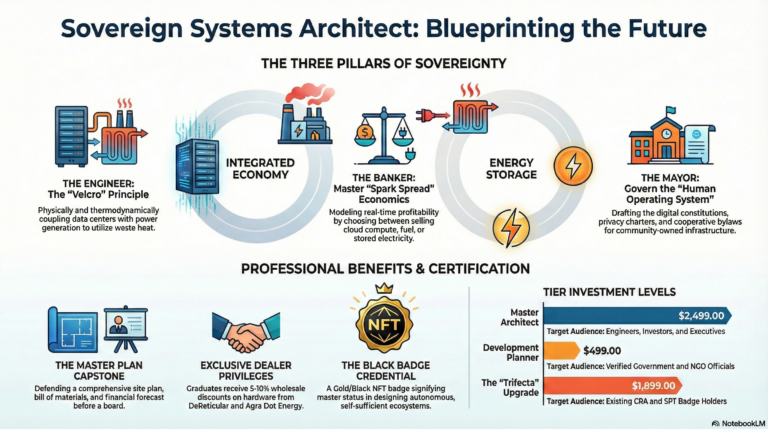
DeReticular Enterprise / Initiative An organization founded by Michael Noel dedicated to engineering sovereign, off-grid infrastructure across energy, communications, mobility, compute, and governance.
DTMF (Dual-Tone Multi-Frequency) Technical Standard The signaling system used by Touch-Tone telephones, required by early MCI networks to transmit security PINs through standard telephone receivers.
Equal Access Legal / Technical Mandate The legal requirement that local exchange operators provide all competing long-distance carriers interconnection that is equal in type, quality, and price to that provided to the incumbent monopoly.
Execunet Historical Service A shared-switch long-distance service introduced by MCI in 1975 that allowed customers to call any phone number nationwide via local switch interconnections, triggering pivotal legal battles.
Feature Group A (FGA) Technical Standard An inferior, line-side local exchange connection forced upon competitors by AT&T prior to 1984, resulting in low signal levels, line noise, and delayed setups.
Feature Group D (FGD) Technical Standard The trunk-side technical interconnection standard established under the 1982 MFJ that enabled equal audio quality, direct signaling, and 1+ Dialing Parity for all carriers.
Island Mode Operational State The ability of a facility, municipality, or system to operate with complete technical self-sufficiency, severed from all external power, communication, and computational grid dependencies.
Jack Goeken Historical Figure Founder of Microwave Communications, Inc. (MCI) in 1963, who initiated the legal and technical battle against AT&T to serve trucking fleets along Route 66.
Judge Harold H. Greene Historical Figure U.S. District Judge for the District of Columbia who presided over United States v. AT&T and authored the 1982 Modification of Final Judgment (MFJ) breaking up the Bell System.
Message Telecommunications Service (MTS) Historical Service AT&T’s traditional, switched long-distance service product, which formed the core of its corporate monopoly revenue prior to MCI’s Execunet challenge.
Modification of Final Judgment (MFJ) Legal Ruling The August 24, 1982 consent decree (effective Jan 1, 1984) that broke AT&T into seven regional local exchange companies and established mandatory Equal Access.
Noel’s Law of Structural Vulnerability Axiom / Formula A law formulated by Michael Noel asserting that system vulnerability is directly proportional to distance and centralization, and inversely proportional to local autonomous capacity.
Primary Interexchange Carrier (PIC) Administrative Designation The primary long-distance provider selected by a landline customer to handle direct-dialed “1+” calls under the Equal Access balloting system.
Remnant AI System / Entity DeReticular’s percestial superintelligence; an air-gapped, metacognitive AI engine designed to run locally on sovereign silicon for SCADA orchestration and operational triage.
Spherical Resilience Network Architecture A mesh-connected, omnidirectional structural topology engineered to eliminate single points of failure by distributing local energy, communications, and intelligence across autonomous nodes.
Telecommunications Act of 1996 Federal Legislation Federal legislation that dismantled the legal separation between local and long-distance phone markets, inadvertently triggering a massive consolidation wave into modern telecommunications duopolies.
TriFi Technical System DeReticular’s Layer 3 wireless mesh hardware suite featuring sub-16ms RF channel handoffs, multi-carrier auto-failover, and hardware TPM 2.0 security processors.
Unbundled Network Elements (UNE-P) Regulatory Standard Provisions under the Telecommunications Act of 1996 requiring incumbent Bell companies to lease individual components of their local copper loops to competitors at wholesale rates.
U.S. Telecom Ass’n v. FCC Legal Precedent A series of federal court rulings that systematically gutted the FCC’s local loop unbundling requirements, accelerating the bankruptcy of competitive local exchange carriers.
William “Bill” McGowan Historical Figure Venture capitalist who assumed leadership of MCI in 1968, transformed it into a national competitor, and spearheaded the legal strategy against AT&T.