
The Tethered Fleet Fallacy
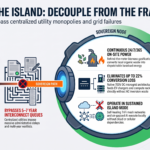

The provided texts outline the DeReticular Sovereign Infrastructure Consortium, an engineering framework designed to completely decouple critical industries and municipal operations from fragile, centralized public monopolies. Authored by Michael Noel and the Remnant AI system, the materials argue that traditional utility grids, telecommunications networks, and cloud computing infrastructures create systemic vulnerabilities through long interconnection delays, price gouging, and single points of failure. To eliminate these dependencies, the consortium presents an autonomous five-layer architecture that utilizes local thermochemical biomass gasification for continuous behind-the-meter baseload power. This sovereign energy feeds directly into a native 700V DC distribution busbar, entirely bypassing the massive thermal losses associated with traditional alternating current transformers and inverters. Furthermore, operations are protected by air-gapped local intelligence and self-healing TriFi wireless mesh networks that operate independently of public cellular grids. Layer 2 of this architecture specifically reimagines commercial fleet mobility through vehicles like Kurb Kars, which use hot-swappable batteries and direct-current charging to function as nomadic nodes rather than tethered liabilities. Ultimately, the sources advocate for complete operational independence across critical sectors—including healthcare, water treatment, cold storage, and emergency logistics—by transitioning from centralized utility serfdom to self-sufficient, permanent Island Mode.