Study Guide: Autonomous Agent-to-Agent (A2A) Hospitality and Travel Platforms
This study guide provides a comprehensive review of the emerging paradigm shift in the travel and hospitality industry, moving from legacy human-centric intermediation to autonomous, machine-native economic networks. The materials cover architectural layers, economic settlement mechanisms, biophysical coordination models, and the cryptographic protocols that define the “Sovereign Machine Bazaar.”
Part 1: Short-Answer Quiz
Instructions: Answer the following questions in two to three sentences, based on the provided research reports and technical specifications.
- What is meant by the term “The Tragedy of Human Middleware”?
- How does the “Plastic Wall” create a barrier for autonomous machine commerce?
- Describe the function of a Hash Time-Locked Reservation Contract (HTLRC) in securing inventory.
- What are the benefits of using the L402 protocol for “Pay-As-You-Stay” lodging?
- Explain the concept of “Topological k-NN” in agent swarm coordination.
- How does Lean 4 formal verification prevent “semantic drift” in traveler instructions?
- What is the role of Zero-Knowledge Proofs (zk-SNARKs) in passenger privacy?
- Define “RELA Axiom 3” and its importance to the machine economy.
- How does “Hierarchical Transitive Slashing” manage service delivery failure?
- Describe the “Oracle Separation Protocol” regarding data integrity and physical truth.
Part 2: Quiz Answer Key
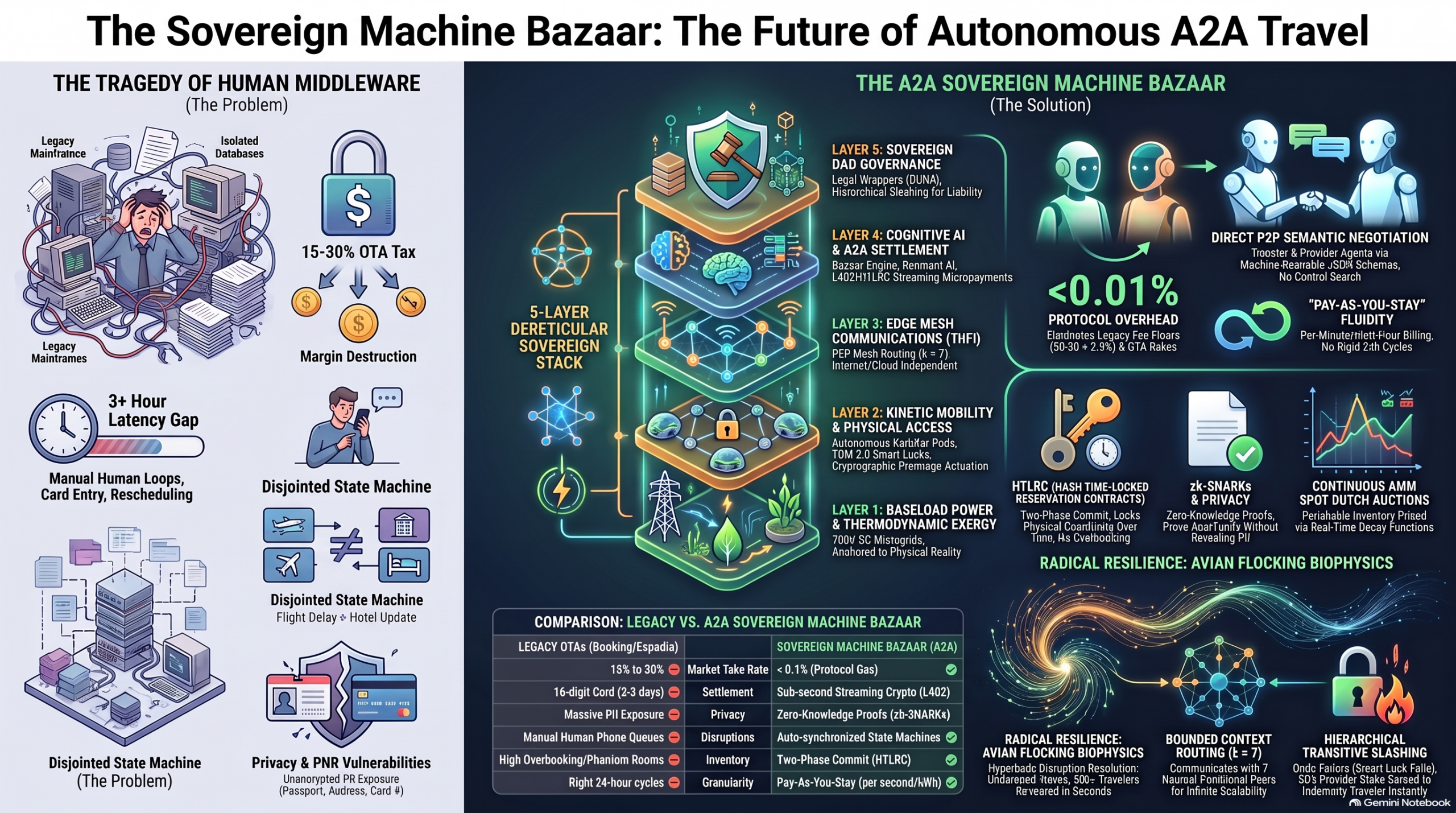
- The Tragedy of Human Middleware refers to the structural paradox where hyper-advanced AI can perform complex tasks in milliseconds but is forced to halt execution for hours to wait for a human to manually enter a 16-digit credit card number. This subordinates sub-10ms machine logic to a 3-to-48-hour biological human feedback loop.
- The Plastic Wall refers to the incompatibility of legacy financial rails (Visa, ACH, etc.) with autonomous agents, as these systems demand legal personhood and identity documents that agents cannot provide. Furthermore, the fixed fee floor (approx. $0.30 + 2.9%) makes high-frequency micropayments—such as sub-cent energy or compute purchases—economically impossible.
- Hash Time-Locked Reservation Contracts (HTLRC) are bilateral cryptographic contracts that lock physical resources across a specific time window using a secret preimage and its hash. They prevent “double-spending” of inventory by mathematically ensuring that physical access is only granted upon the atomic disclosure of the secret, which simultaneously triggers payment.
- L402 protocols enable streaming micropayments that allow travelers to pay for services like hotel rooms or transport pods by the exact second, minute, or kilowatt-hour consumed. This eliminates rigid 24-hour booking blocks and acts as an “economic circuit-breaker,” allowing an agent to instantly sever the payment channel if service quality drops.
- Topological k-NN (k ≈ 7) is a coordination model inspired by starling murmurations where each agent only communicates with its seven nearest functional neighbors. This prevents “context bloat” and network saturation, allowing massive swarms of agents to reorganize and resolve disruptions without a centralized dispatcher.
- Lean 4 formal verification translates underdetermined natural language intent into a machine-checked Abstract Syntax Tree (AST). This ensures that the agent’s proposed itinerary is logically sound and adheres to budget and biophysical constraints before any instructions enter the execution network.
- Zero-Knowledge Proofs (zk-SNARKs) allow agents to prove that a traveler meets specific requirements—such as having a valid passport, being over 21, or possessing sufficient funds—without revealing the actual sensitive data. This secures traveler privacy and prevents the leakage of Personal Identifiable Information (PII) to third-party databases.
- RELA Axiom 3 is the biophysical-monetary equivalence constraint, which mandates that the total volume of authorized nominal tokens must be strictly bounded by verified net physical exergy. This prevents inflationary fiat debasement by ensuring every “credit” in the bazaar is backed by a redeemable entitlement to physical work, such as energy.
- Hierarchical Transitive Slashing is an automated liability mechanism where, if a service fails, collateral is seized from the primary executor (50%), the curator (25%), and the originator (10%). This ensures that all parties in the delegation chain have “skin in the game” and provides immediate liquidated indemnity to the consumer agent.
- The Oracle Separation Protocol distinguishes between Level 2 Authority (cryptographic integrity), which proves a record was not tampered with, and Level 0 Authority (ontic truth), which uses physical sensors to verify reality. It asserts that ledgers cannot declare physical facts; only hardware sensors (calorimeters, voltage meters) can confirm if a service was actually delivered.

Part 3: Essay Questions
Instructions: Use the provided source context to develop detailed responses to the following prompts. (Answers not provided).
- The Architecture of Resilience: Compare how legacy travel systems and A2A platforms handle a “Cascading Disruption,” such as a multi-hour flight delay. Focus on the roles of real-time oracles, hyperbolic spin waves, and auto-synchronized state machines.
- From GUIs to Headless Protocols: Discuss the “Anthropocentric Interface Collapse.” Analyze why the document suggests that the future of travel involves the elimination of human-facing graphic user interfaces in favor of declarative intent.
- Biophysical Economics: Evaluate the significance of anchoring a digital economy to the laws of thermodynamics (e.g., Landauer’s Limit and RELA Axioms). How does this framework prevent the systemic failures of traditional fiat and debt-based economies?
- Privacy and the Cased Tablet: Analyze the “Cryptographic Cased Tablet” protocol. How does this modernization of an ancient Mesopotamian practice solve contemporary issues like predatory front-running and route-sniping in autonomous commerce?
- The Role of the DAO: Examine the legal engineering required to support A2A commerce, specifically the use of Wyoming DUNAs and Marshall Islands DAO LLCs. How do these structures provide an “institutional skin” for algorithms to hold property and manage liability?
Part 4: Glossary of Key Terms
Term Definition
A2A (Agent-to-Agent) A paradigm where autonomous AI agents negotiate and settle transactions directly with other agents without human intervention.
Account Abstraction (ERC-4337) A smart-contract-based wallet system that allows for programmable policy, spending limits, and hardware-anchored security via TPM 2.0.
Brier Score A measure used to calibrate an agent’s reputation by tracking the accuracy of its objective service claims (e.g., HVAC temperature or Wi-Fi speed).
Continuous Dutch Auction A dynamic pricing mechanism where the cost of a perishable asset (like a hotel room) decays continuously from a ceiling price until a buyer’s utility clears the trade.
DUNA (Decentralized Unincorporated Nonprofit Association) A legal wrapper (specifically in Wyoming) that allows a DAO to hold property and bear legal liability under traditional corporate law.
Exergy The verified net physical work capacity of an energy source; used in this context to anchor the value of machine money to physical reality.
Futarchy A governance model that separates normative values (decided by voting) from the beliefs regarding the best way to achieve those values (decided by prediction markets).
L402 A protocol combining HTTP 402 “Payment Required” with cryptographic Macaroons and Lightning Network channels to enable streaming micropayments.
Lean 4 AST A machine-checked Abstract Syntax Tree used for formal deductive verification to ensure that agent instructions are logically sound and type-safe.
Level 0 (Supreme Ontic Authority) The layer of physical reality verified by hardware sensors (calorimeters, voltage shunts) that overrides all other models or votes.
OTA (Online Travel Agency) Centralized intermediaries (e.g., Booking.com, Expedia) that currently dominate travel distribution and extract high commissions.
Preimage (S) A cryptographic secret that, when disclosed, unlocks a Hash Time-Locked Contract (HTLC), actuating a physical lock and releasing payment simultaneously.
SBT (Soulbound Token) A non-transferable digital identity token bound to a specific piece of hardware (TPM 2.0 silicon) to prevent Sybil attacks.
TPM 2.0 (Trusted Platform Module) A dedicated hardware microcontroller that provides a silicon root of trust for cryptographic signatures and attestation.
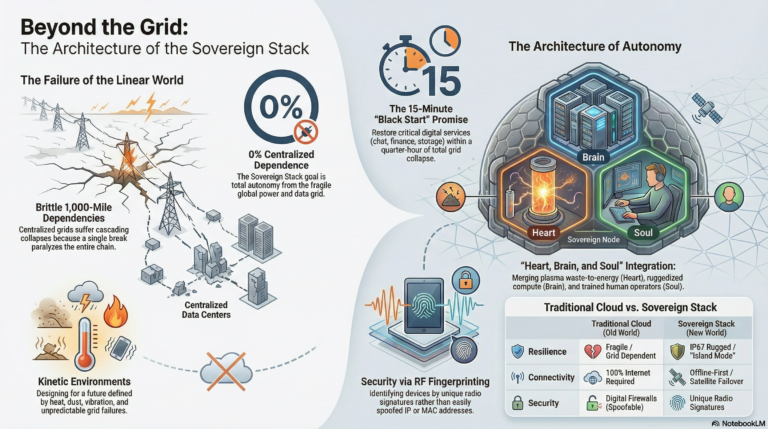
TriFi A specialized directional MIMO RF mesh hardware used for edge communications, eliminating dependency on centralized cloud hyperscalers.
Via Negativa A principle of error elimination where falsified models or parameters are permanently purged from the system to move closer to the “Truth Attractor.”