Study Guide: Decentralized Medical Transportation and Sovereign Systems Architecture
This study guide provides a comprehensive review of the systems architecture, biophysical foundations, and regulatory frameworks governing KurbKar autonomous medical swarms and the DeReticular Sovereign Stack.
Part 1: Short Answer Quiz
- Describe the “1,000-Mile Failure Model” as it relates to contemporary autonomous vehicle (AV) deployments. The 1,000-Mile Failure Model refers to the vulnerability of current AVs that rely on high-latency cellular backhauls and centralized cloud-and-perimeter computing paradigms. These systems are prone to failure during network jitter, cell-tower handovers, or packet loss, which can cause vehicles to freeze or enter panic states in “edge deadzones.”
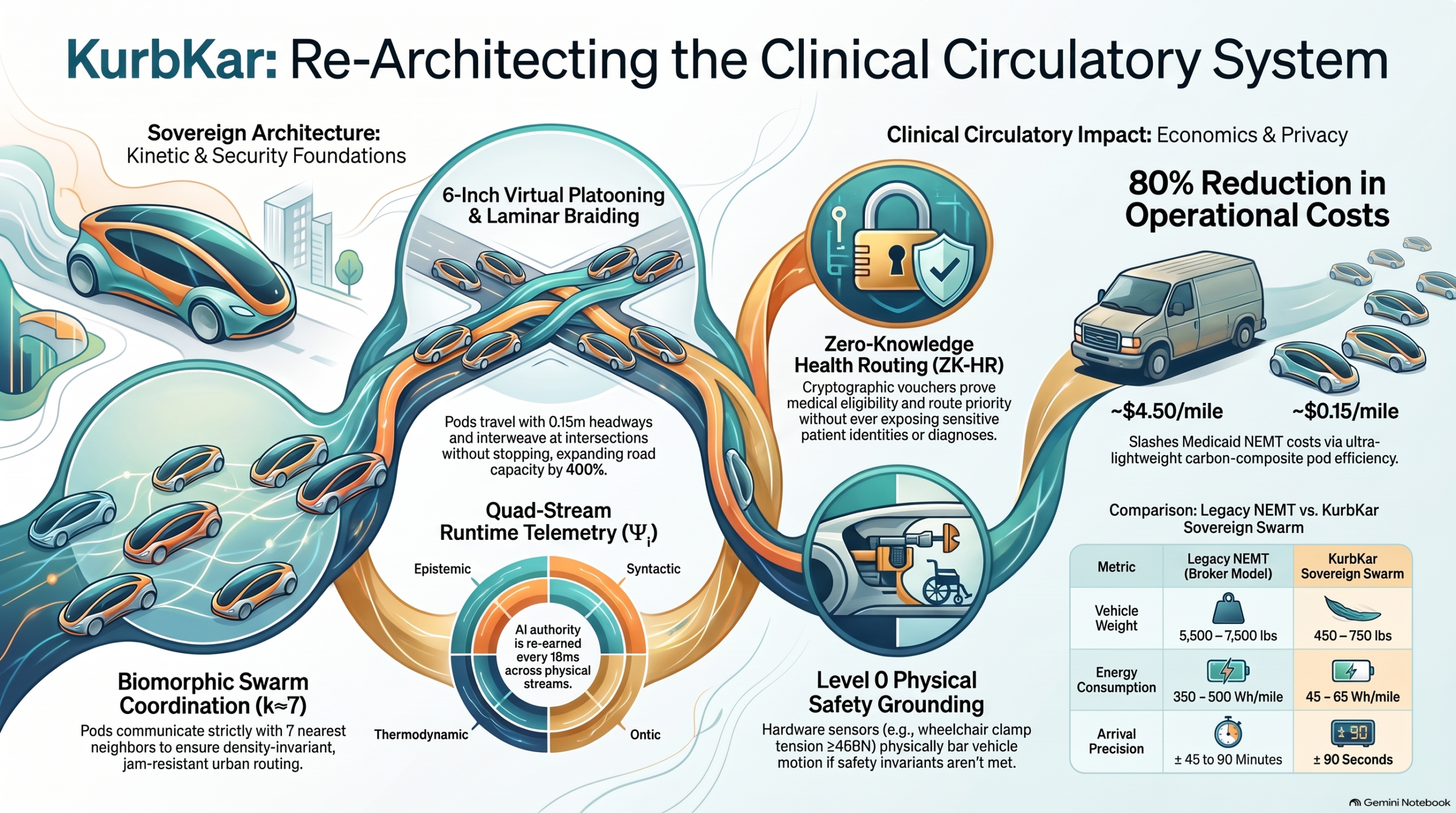
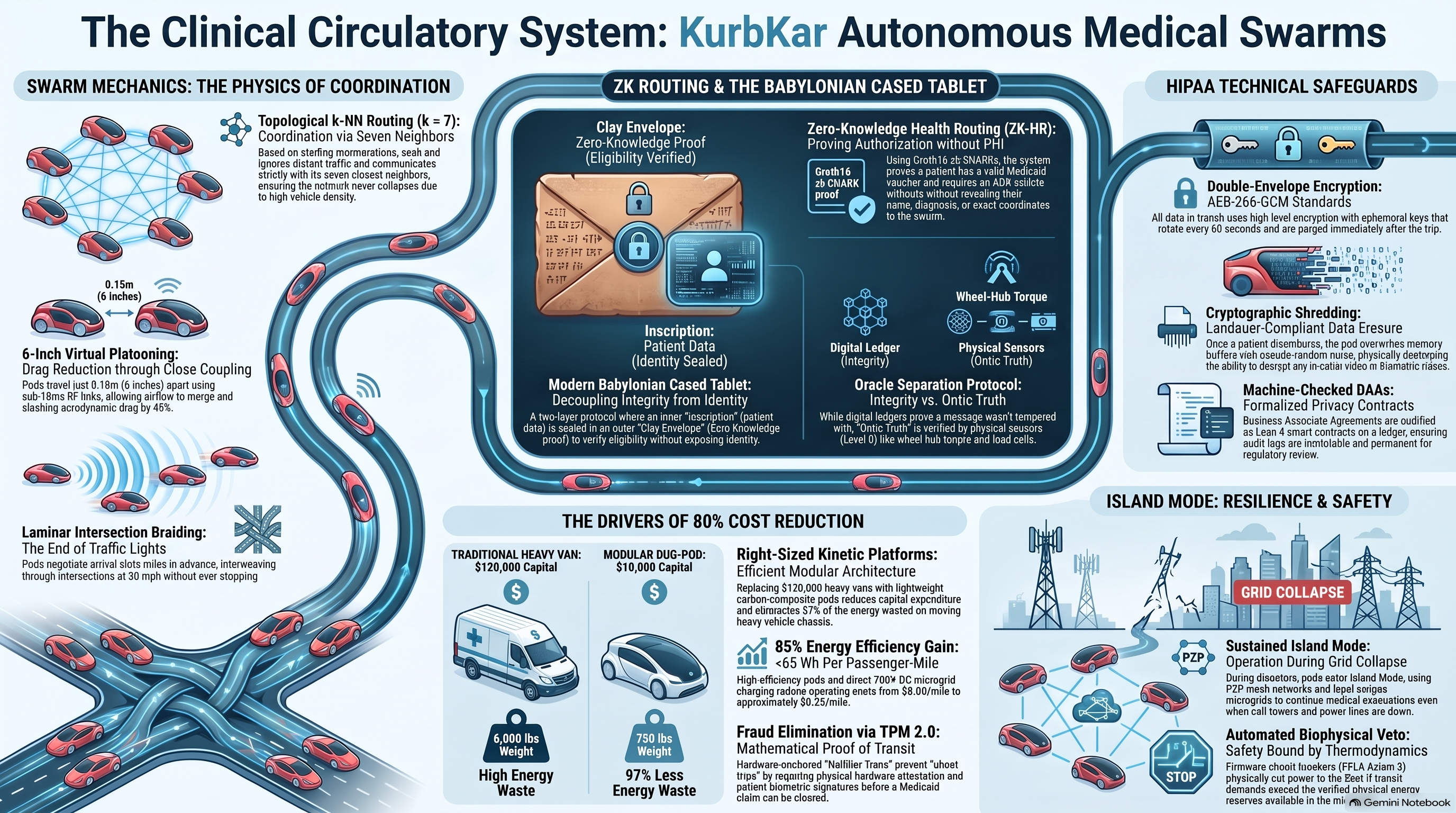
- Explain the concept of “Topological k-NN Routing” used in KurbKar swarms. KurbKar coordination is based on avian biophysics where nodes maintain communication strictly with their k-Nearest Topological Neighbors (k \approx 7), regardless of physical distance. This approach prevents “packet broadcast storms” and ensures the network graph remains invariant to spatial density, bounding compute requirements and eliminating RF channel saturation.
- What is the “Mass-Energy Inversion” pathology identified in modern automobility? The Mass-Energy Inversion describes the thermodynamic irrationality of using a 2,500 kg (5,500 lb) vehicle to transport a single 77 kg (170 lb) human. In this model, 97% of primary exergy is wasted moving the vehicle chassis, while only 3% is allocated to moving the actual payload.
- How does “Zero-Knowledge Health Routing (ZK-HR)” protect patient privacy while ensuring operational efficiency? ZK-HR uses Groth16 zk-SNARK circuits to prove that a passenger has a valid Medicaid NEMT voucher and is traveling to an authorized zone without revealing the patient’s name, diagnosis, or specific clinic. This redacts Protected Health Information (PHI) from the public routing mesh while providing mathematical proof of eligibility.
- Define “Laminar Intersection Braiding” and its advantages over traditional traffic management. Laminar braiding is a phase-synchronized interweaving of autonomous platoons that eliminates the need for traffic lights and stops. By modulating velocity by fractions of a mile per hour, pods slide through perpendicular gaps at speed, expanding roadway capacity by 400% and reducing physiological stress on medical patients.
- What is “RELA Axiom 3” (The Biophysical-Monetary Constraint)? RELA Axiom 3 dictates that the total stock of authorized currency, credit, or compute tokens must be bounded by the verified net thermodynamic exergy generated by local microgrid assets. It prevents ungrounded symbolic debt by enforcing an automated hardware-level “Biophysical Veto” if a project’s energy demand exceeds verified surplus.
- Describe the “Quad-Stream Runtime Telemetry” engine. This security model replaces static Single Sign-On (SSO) with four continuous streams: Epistemic (rolling Brier scores/active inference), Syntactic (Lean 4 AST formal verification), Thermodynamic (Landauer metabolic accounting), and Ontic (Level 0 physical sensor grounding). An agent’s authority is continually re-evaluated at 16 ms intervals based on these streams.
- Explain the “Modern Babylonian Cased Tablet Protocol” used in the DeReticular stack. Inspired by ancient Mesopotamian contracts, this protocol seals an inner “Core Inscription” (homomorphically encrypted data) inside a “Clay Envelope” (a zk-SNARK proof). This decouples cryptographic integrity (the envelope) from ontic truth (the core), allowing for auditable transactions that keep sensitive data hidden until arrival.
- What is the “Clinical Domino Effect” triggered by the failure of Non-Emergency Medical Transportation (NEMT)? When NEMT fails, patients miss life-critical appointments (like dialysis or chemotherapy), leading to physiological decompensation and respiratory distress. This forces the “Ambulance as Transit of Last Resort,” flooding Emergency Departments with avoidable acute visits and causing “Paramedic Wall Time” and hospital bed thrombosis.
- Define “Hyperbolic Spin Waves” in the context of emergency medical preemption. Hyperbolic spin waves are undamped, second-order linear dispersion waves used to propagate emergency information across a swarm at speeds of 20–40 m/s. When a pod detects a medical crisis, it alters its internal “spin state,” causing surrounding pods to peel laterally and clear a “green channel” without the need for centralized dispatch.
Part 2: Quiz Answer Key
- 1,000-Mile Failure Model: Vulnerability due to reliance on distant cloud servers/cellular backhaul; causes freezes during network jitter or packet loss.
- Topological k-NN Routing: Coordination based on 7 nearest neighbors regardless of distance; prevents RF saturation and ensures graph stability.
- Mass-Energy Inversion: Thermodynamics of moving 5,000 lb vehicles for 170 lb payloads; result is 97% energy waste.
- Zero-Knowledge Health Routing: Use of zk-SNARKs to prove eligibility and routing zones without revealing name or diagnosis.
- Laminar Intersection Braiding: Stoplight-free interweaving of platoons at intersections; increases throughput and eliminates idling/braking.
- RELA Axiom 3: Monetary/compute limits bound to verified physical exergy (joules); enforced by hardware circuit breakers.
- Quad-Stream Telemetry: Epistemic, Syntactic, Thermodynamic, and Ontic streams; continuously evaluates agent health and authority.
- Babylonian Cased Tablet: Decoupling integrity from truth; uses homomorphic encryption within ZK-envelopes logged to a BFT ledger.
- Clinical Domino Effect: Logistical failure leading to missed treatments, 911 misuse, ED boarding, and systemic bed shortages.
- Hyperbolic Spin Waves: Rapid information propagation modeled on starlings; allows near-instant swarm-wide response to emergency triggers.
Part 3: Essay Questions
- Macro-Health Econometrics: Analyze the impact of replacing the “Extractive Broker Model” with a decentralized KurbKar swarm. Discuss the potential ROI for Medicaid agencies, focusing on direct transit savings versus the “destruction” of downstream inpatient claims.
- Biophysical Foundations of Autonomy: Compare the “Solitary God” omniscience fallacy of modern AVs (like Tesla or Waymo) with the topological, avian-inspired coordination of the KurbKar architecture. How does self-organized criticality resolve the Cognitive TOCTOU Gap?
- The Architecture of Truth: Evaluate the RELA Source-of-Truth Hierarchy. Discuss why Level 0 Ontic Physical Resistance must override all other levels, and how Lean 4 formal verification prevents “hallucinations” in autonomous medical transit.
- Resilience and Island Mode: Explain the importance of “Sustained Island Mode” during regional infrastructure collapse. How do Layer 1 (Agra.Energy microgrids) and Layer 3 (TriFi RF Mesh) work together to maintain clinical continuity during disasters?
- Regulatory Harmonization: Discuss the challenges and mechanisms for integrating autonomous swarms into existing HIPAA and NHTSA frameworks. Focus on the roles of ZK-proofs in 45 CFR compliance and the use of Section 1115 waivers for municipal pilots.
Part 4: Glossary of Key Terms
Term Definition
Agra.Energy A thermochemical biomass gasification system used to generate 700V DC baseload power for KurbKar microgrids.
BFT (Byzantine Fault Tolerance) A consensus mechanism (N ≥ 3f + 1) used in Layer 2/3 ledgers to ensure data integrity even if some nodes are malicious.
Brier Score (BS_k) A measure of the accuracy of an agent’s predictions; used in the Epistemic Stream of the telemetry engine to detect “delirium.”
Duo-Pod (2P) A 750 lb modular kinetic unit configured for dual occupancy, paramedics, or ADA-compliant wheelchair roll-in.
EROEI Energy Return on Energy Invested; a metric defining the physical viability of energy sources.
Futarchy A governance model using prediction markets to track the efficacy of compute forecasts against physical grid telemetry.
Groth16 A specific Zero-Knowledge proof system (zk-SNARK) used to generate verifiable, privacy-preserving transit vouchers.
HIPAA/HITECH Federal regulations (45 CFR) governing the privacy and security of Protected Health Information (PHI).
Landauer’s Principle The physical law defining the minimum energy required to erase one bit of information (\Delta Q \ge N k_B T \ln 2).
Lean 4 A formal proof language and compiler used to verify that software directives (ASTs) are mathematically sound and safe.
NEMT Non-Emergency Medical Transportation; described as the “clinical circulatory system” of outpatient medicine.
Ontic Relating to physical reality; Level 0 telemetry (torque, strain) provides “Ontic Grounding” for the system.
Poseidon Hash A ZK-friendly cryptographic hash function used to generate “nullifiers” that prevent duplicate Medicaid claims or Sybil attacks.
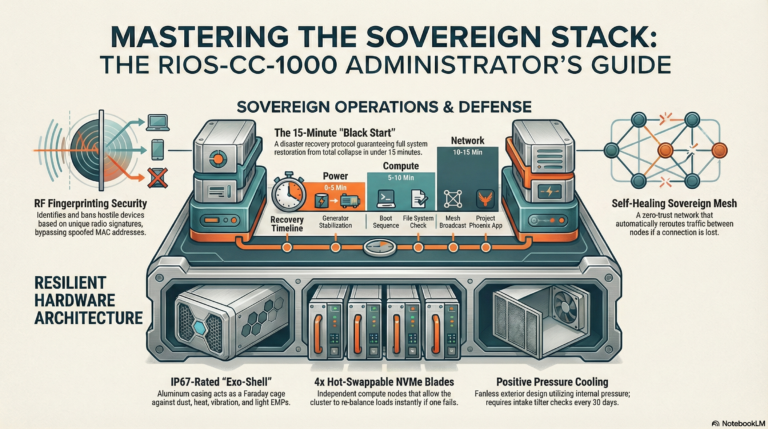
Remnant AI A perspectant intelligence engine running on air-gapped sovereign silicon (RIOS-CC-1000) for edge inference.
Solo-Pod (1P) A 450 lb ultra-lightweight autonomous unit designed for single-passenger urban commuter transit.
TriFi RF Mesh A multi-tier decentralized communication stack utilizing 60 GHz mmWave, 5.9 GHz C-V2X, and sub-GHz failovers.
Via Negativa A process of “parameter foreclosure” where hypotheses or agents that violate physical reality are permanently pruned from the system.
ZK-Null (Nullifier) A cryptographic hash that prevents double-spending or duplicate identities while maintaining privacy.