Study Guide: Historical, Economic, and Strategic Dimensions of Israel and Its Global Alliances
This study guide provides a comprehensive overview of the historical protectors of Israel, the complex economic impacts of these alliances, and the strategic operationalization of global initiatives such as the October 7 International Prayer Broadcast.
Part I: Short-Answer Quiz
Instructions: Answer the following ten questions in 2–3 sentences, drawing exclusively from the provided source context.
- Who were the primary external protectors of Israel during the ancient and early modern periods before the United States became the lead strategic partner?
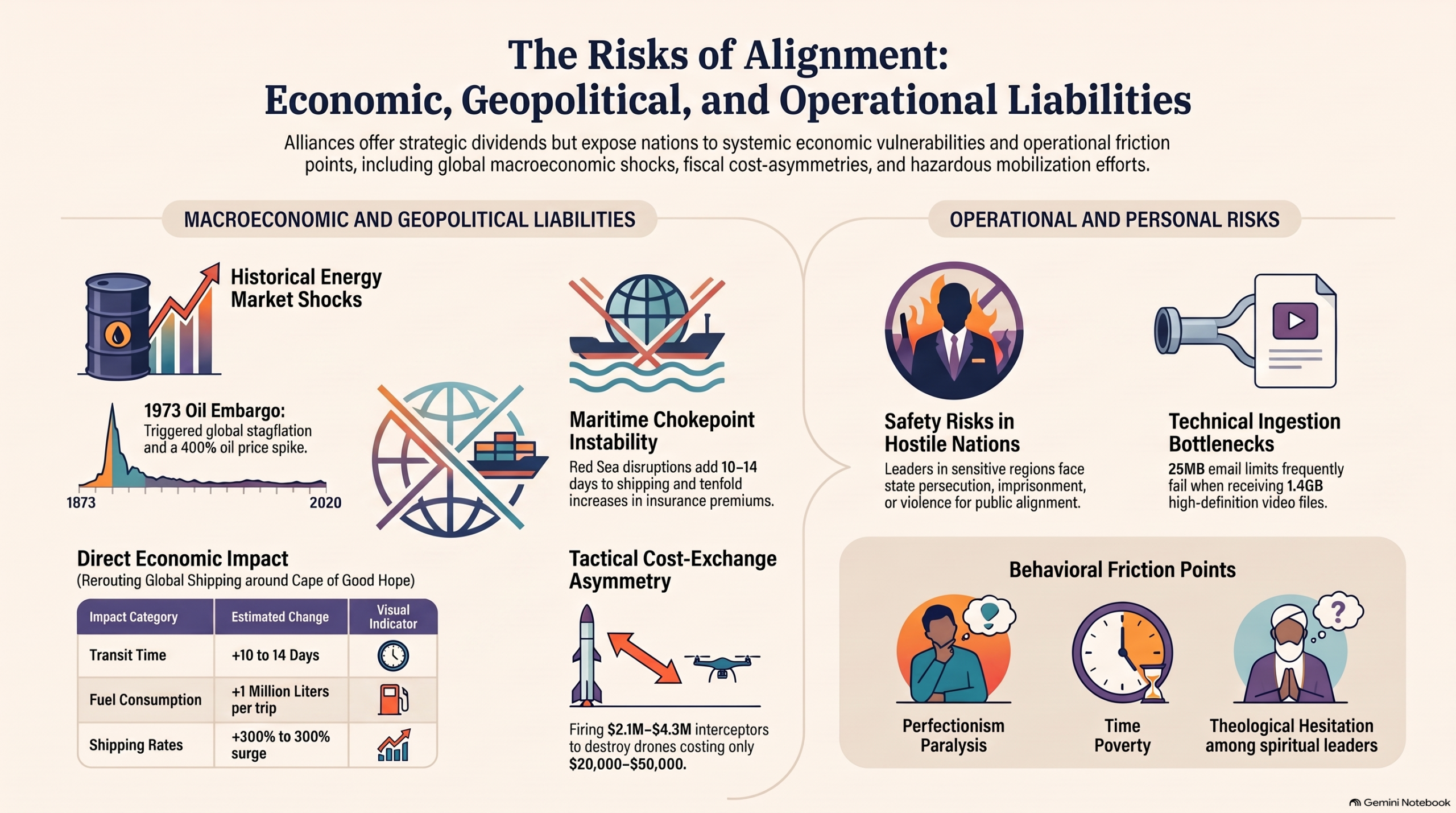
- What were the immediate and long-term economic consequences of the 1973 OAPEC oil embargo?
- How does the “Buy America” mandate within the 2019–2028 Memorandum of Understanding (MOU) affect the U.S. economy?
- Describe the “cost-exchange asymmetry” observed during recent maritime conflicts in the Red Sea.
- What role did Czechoslovakia and the Soviet Union play in the 1948 War of Independence?
- How has the acquisition of Israeli technologies like Mellanox influenced the market position of U.S. firms like NVIDIA?
- What are the four thematic pillars required for participants in the October 7 Global Prayer Broadcast?
- Define the “15-Minute Turnkey Setup” protocol used by “Connectors” in the October 7 initiative.
- What specific agricultural and resource technologies have moved from Israel to the United States to mitigate climate risks?
- Explain the strategic importance of the “Qualitative Military Edge” (QME) in U.S. law.
Part II: Answer Key
- In antiquity, the Achaemenid Persian Empire under Cyrus the Great served as a protector by authorizing the return of Jewish exiles and subsidizing the Temple’s reconstruction. In the modern era, the United Kingdom provided the foundational legal framework (Balfour Declaration), and France served as the primary military backer from the 1950s until 1967, providing jet fighters and nuclear technology.
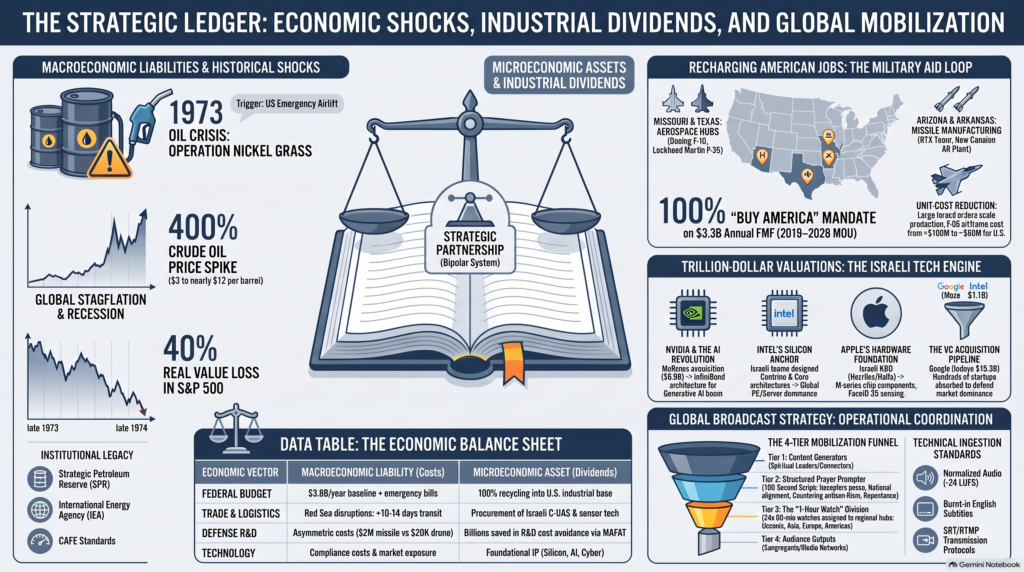
- The embargo triggered a 400% spike in oil prices, leading to a global recession, gas rationing, and a period of “stagflation” where high inflation coupled with stagnant growth. This crisis prompted structural shifts in the West, including the creation of the Strategic Petroleum Reserve and the International Energy Agency.
- The mandate requires that 100% of the $3.3 billion annual Foreign Military Financing (FMF) grant be spent directly with American defense manufacturing companies. This functions as a domestic industrial stimulus, recirculating funds into U.S. corporations and supporting high-skilled aerospace jobs in states like Texas, Arizona, and Missouri.
- The asymmetry refers to the massive price gap between offensive and defensive munitions, where the U.S. and its allies fire interceptors costing $2 million to $4 million (such as the SM-2) to destroy drones costing only $10,000 to $20,000. This disparity creates a macro-level economic vulnerability for protecting nations during protracted engagements.
- Despite an American arms embargo, Czechoslovakia (authorized by the USSR) provided vital rifles, machine guns, and Avia S-199 fighter aircraft through “Operation Balak.” This support was driven by Soviet interest in establishing a wedge against British influence in the Middle East.
- NVIDIA’s $6.9 billion acquisition of Mellanox provided the InfiniBand networking architecture essential for connecting thousands of GPUs in modern AI data centers. This technology was a major catalyst that allowed NVIDIA to dominate the generative AI computing market and reach a multi-trillion-dollar valuation.
- Participants must address the peace and protection of Jerusalem, the moral and diplomatic alignment of their own nation with Israel, the renunciation of global antisemitism and propaganda, and spiritual repentance in preparation for the Messiah’s return.
- This protocol is designed to eliminate “pastoral resistance” by having an assistant handle all technical logistics, such as setting up a smartphone horizontally and ensuring front-lighting. The goal is to limit the spiritual leader’s involvement to just five minutes of recording time, ensuring the final prayer adheres to a strict three-minute limit.
- Netafim’s drip irrigation technology is widely used in the California Central Valley to reduce water usage by 30–50%, while IDE Technologies built the Carlsbad Desalination Plant in San Diego. These technologies safeguard billions of dollars in agricultural and real estate value from structural drought risks.
- The QME is a formal U.S. legal mandate ensuring that Israel maintains technological military superiority over any combination of potential regional adversaries. This allows Israel priority access to top-tier U.S. defense systems like the F-35 stealth fighter.
Part III: Essay Questions
Instructions: These questions are designed for deeper analysis and long-form response.
- The Double-Edged Economic Sword: Analyze the tension between the macroeconomic liabilities of protecting Israel (such as oil shocks and maritime disruptions) and the microeconomic dividends (such as defense industrial scaling and tech spillovers). Which has a more lasting impact on Western economies?
- Evolution of External Protectors: Trace the shift in Israel’s primary foreign patrons from the 1948 era to the present. How have the motivations of these powers (USSR, France, and the USA) differed in their pursuit of regional interests?
- Technological Synergies and Market Dominance: Evaluate how the integration of Israeli R&D centers has bolstered the global competitiveness of Western technology giants like Intel, Apple, and NVIDIA. To what extent does the protection of Israel function as a risk mitigation strategy for Western corporate assets?
- Operationalizing Global Mobilization: Discuss the “4-Tier Mobilization Architecture” used in the October 7 Global Prayer Broadcast. How does this framework address psychological and technical “friction points” when organizing large-scale, decentralized international events?
- Joint Defense as a Financial Asset: Examine the financial benefits of joint U.S.-Israeli defense programs like the Arrow 3 and Iron Dome. Specifically, address how real-world combat data (operational telemetry) and third-party export sales (e.g., to Germany or Finland) return value to the original protecting nations.
Part IV: Glossary of Key Terms
Term Definition
Achaemenid Persian Empire The ancient empire under Cyrus the Great that facilitated the first historical “restoration” of the Jewish people to Jerusalem in 539 BCE.
Abraham Accords A 2020 diplomatic agreement normalizing relations between Israel and several Arab nations, including the UAE, Bahrain, and Morocco, leading to significant regional trade.
Arab League Boycott A three-tiered economic strategy established in 1945 to isolate Israel by blacklisting companies that did business with the state.
BIRD Foundation The Binational Industrial Research and Development Foundation, which provides matched-grants for joint ventures between U.S. and Israeli commercial firms.
Buy America Mandate A requirement in modern U.S. aid agreements that all Foreign Military Financing (FMF) provided to Israel must be spent on U.S. defense contractors.
Cost-Exchange Asymmetry The economic imbalance created when expensive defense systems (interceptors) are used against cheap offensive weapons (drones/rockets).
FMF (Foreign Military Financing) The primary mechanism for U.S. military aid, currently totaling approximately $3.3 billion annually as part of a 10-year commitment.
Iron Dome A short-range missile defense system co-developed by the U.S. and Israel, manufactured in part by RTX in Camden, Arkansas.
MAFAT The Israeli Ministry of Defense’s R&D Directorate, which serves as a high-velocity incubator for defense technologies subsequently used by Western allies.
Mellanox Technologies An Israeli networking firm acquired by NVIDIA; its InfiniBand technology is the backbone of modern AI data centers.
Operation Nickel Grass A massive 1973 U.S. emergency airlift that replenished Israeli military supplies during the Yom Kippur War.
OSP (Off-Shore Procurement) A legacy provision that allowed Israel to spend a portion of U.S. aid on its own domestic defense industry; it is being phased out by 2028.
Qualitative Military Edge (QME) A U.S. legal standard requiring that Israel be provided with the technology needed to defeat any credible regional military threat.
Stagflation An economic condition characterized by slow growth and high inflation, famously caused by the 1973 oil shocks following the Yom Kippur War.
Trophy APS An Israeli-developed active protection system for tanks (such as the M1A2 Abrams) that intercepts incoming anti-tank missiles.
Unit 8200 A specialized Israeli intelligence unit whose veterans often found major global cybersecurity firms like Check Point and Palo Alto Networks.