Study Guide: The Architecture of Truth and Resilient Synthetic Ecosystems
This study guide provides a comprehensive synthesis of the research regarding biophysically grounded intelligence, formal epistemological architectures, and the transition from centralized cloud-dependent AI to resilient, decentralized multi-agent systems.
- Core Concepts and Review
Avian Biophysics as a Blueprint for AI
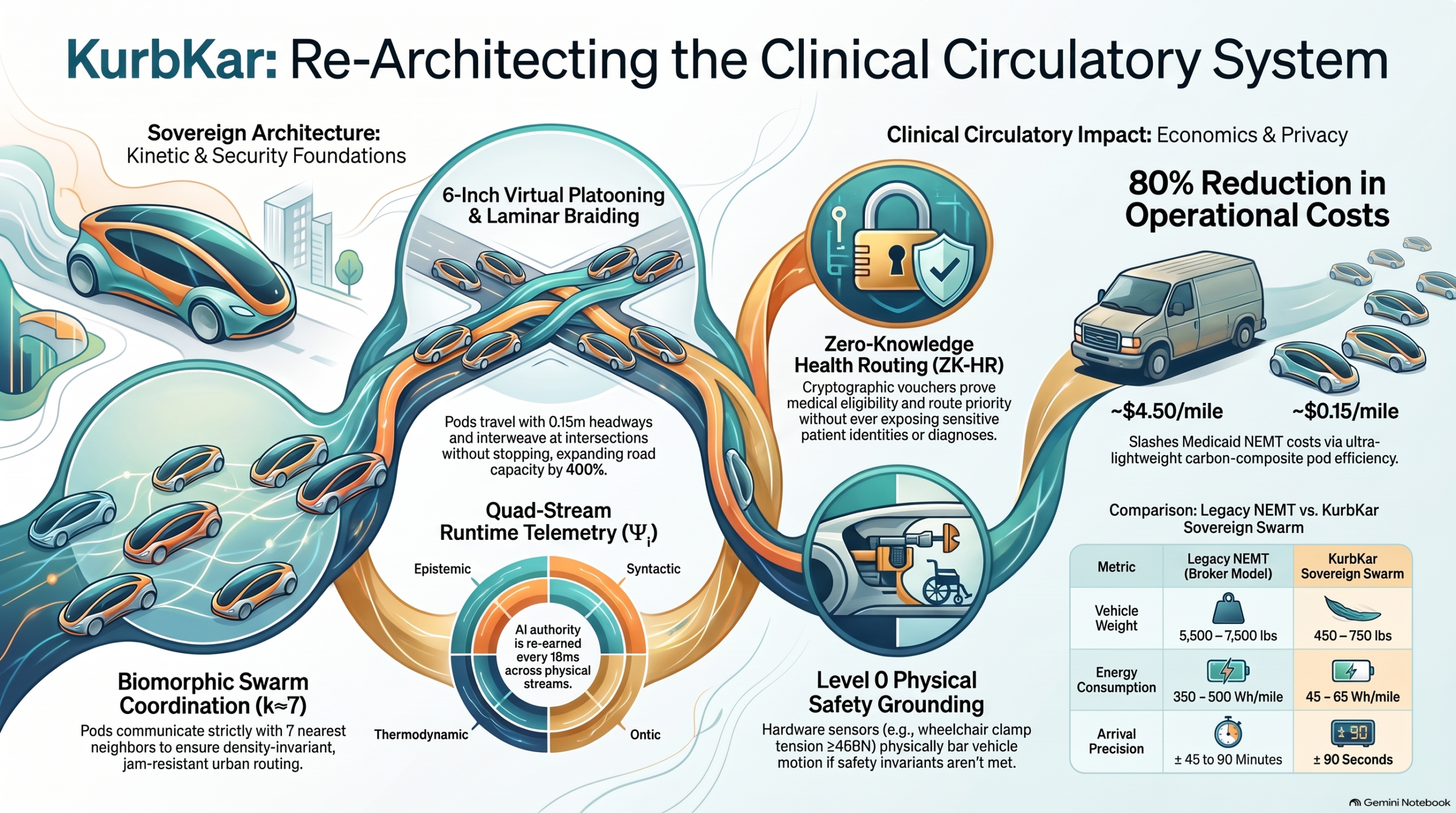
The flight dynamics of European starling murmurations (Sturnus vulgaris) offer a biological solution to the failures of modern multi-agent systems (MAS). Unlike traditional “Boids” models that assume birds interact with others within a fixed distance (metric interaction), empirical research shows starlings utilize topological interaction. Each bird tracks exactly k \approx 7 neighbors, regardless of density. This allows the flock to maintain coherence during predator attacks, even as the distance between birds fluctuates.
The three core mechanisms identified in avian swarms are:
- Topological Interaction (k \approx 7): Prevents flock fragmentation during spatial distortion.
- Scale-Free Correlation (\xi \propto L): Fluctuations in velocity scale with the size of the flock, allowing information to reach 100,000 birds instantly without a central leader.
- Inertial Spin Waves: Information propagates as undamped dispersion waves (20–40 m/s), far outpacing the reaction time of individual birds or predators.
The Epistemic Crisis and Via Negativa
Modern governance and AI systems are diagnosed as being in a “Model Crisis” (Phase 3 of the Kuhn Cycle). They attempt to solve anomalies by adding “epicycles”—auxiliary parameters that increase Kolmogorov complexity without increasing predictive power.
The proposed solution is Via Negativa (Parameter Foreclosure). This framework suggests that truth is not an abstract opinion reached via voting, but an invariant dynamical attractor (\Omega^*) reached by systematically pruning falsified hypothesis spaces. Progress is measured by the volume of false parameter space permanently foreclosed, rather than by positive assertions.
The Asymptotic Democracy and Biophysical Governance
A resilient architecture must decouple Class A (Normative Value Spaces) from Class B (Ontic Feasibility Manifolds).
- Class A: Subjects like ethical priorities and social welfare are the legitimate domain of democratic voting (e.g., Quadratic Voting).
- Class B: Physical laws, such as thermodynamic exergy limits and mass-energy conservation, are strictly forbidden from democratic tampering.
The Biophysical Veto is a critical mechanism in this architecture. It functions as a hardware-level circuit breaker that automatically cancels any command or policy that exceeds the verified physical energy constraints of the system, acting with the same inevitability as aerodynamic drag on a bird’s wing.
Security and Identity: Replacing Perimeter SSO
Standard security models (OAuth, JWT) are insufficient for autonomous AI because of the Cognitive TOCTOU Gap (Time-of-Check to Time-of-Use). An agent may be authenticated at t_0, but its reasoning can degrade or be poisoned by t_{exec}.
The proposed replacement is Continuous Runtime Execution Telemetry, which monitors four streams:
- Epistemic: Real-time calibration via Brier scores and Variational Free Energy.
- Syntactic: Deterministic verification of directives through Lean 4 proof kernels.
- Thermodynamic: Monitoring Landauer erasure bounds to prevent infinite metacognitive loops.
- Ontic: Direct comparison of agent predictions against Level 0 physical sensors.
- Short-Answer Quiz
Instructions: Answer the following ten questions in 2–3 sentences each.
- What is the primary difference between metric interaction and topological interaction in bird swarms?
- How does “scale-free correlation” contribute to the survival of a starling murmuration?
- Define the “Condorcet Inversion” as it applies to modern AI swarms.
- What is the purpose of the “Oracle Separation Protocol”?
- Explain “Landauer’s Principle” in the context of agent metacognition.
- How does “Anisotropic Lateral Interaction” prevent AI echo chambers?
- What is the “Cognitive TOCTOU Gap” in perimeter security?
- Describe the “Via Negativa” approach to finding truth.
- What is the function of the “Biophysical Balance Register” (BBR)?
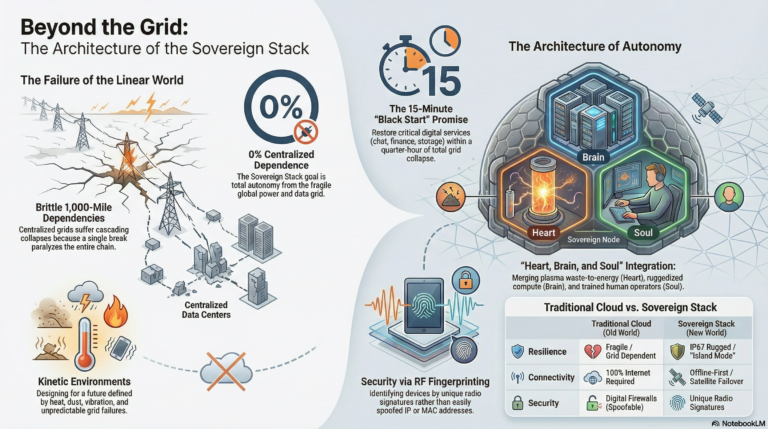
- Define “Island-Mode Cognition” within the DeReticular 5-Layer Sovereign Stack.
- Quiz Answer Key
- Metric interaction assumes birds interact with any neighbor within a fixed distance, which causes flocks to fragment when they expand. Topological interaction (k \approx 7) ensures a bird maintains communication with a fixed number of neighbors regardless of distance, preserving flock coherence even under high spatial distortion.
- Scale-free correlation ensures that the spatial correlation of velocity fluctuations scales linearly with the diameter of the flock. This allows a single bird’s evasive maneuver to propagate across thousands of individuals instantly, ensuring the entire swarm reacts as a unified unit without needing a central leader.
- The Condorcet Inversion occurs when agents share correlated biases or training data, causing their individual accuracy to drop below chance (p < 0.5). In this state, scaling the swarm mathematically guarantees that the collective consensus will converge on an error or hallucination rather than the truth.
- The Oracle Separation Protocol creates an ironclad distinction between cryptographic ledger integrity (Level 2) and ontic truth (Level 0). While Level 2 guarantees a record has not been tampered with, Level 0 requires physical telemetry and sensors to prove that a command corresponds to reality.
- Landauer’s Principle states that erasing or overwriting information requires a minimum dissipation of thermodynamic energy as heat. In AI, this is used to implement a “metabolic halting gate” that stops agents from engaging in infinite, unproductive self-reflection loops that burn compute without reducing uncertainty.
- Anisotropic Lateral Interaction mimics bird vision, which focuses on neighbors to the sides rather than directly ahead or behind. In synthetic swarms, this translates to weighting inputs based on architectural divergence (e.g., requiring consensus between a Transformer, an SSM, and a Symbolic Solver) to prevent sycophantic behavior.
- The Cognitive TOCTOU Gap refers to the temporal delta between when an agent is authorized at t_0 and when it executes a task at t_{exec}. During this window, an agent’s reasoning can drift, suffer from context bloat, or be poisoned by adversarial inputs, rendering the initial static authorization invalid.
- Via Negativa is an epistemological method that seeks truth through the systematic truncation of false parameter manifolds. Instead of trying to prove a positive assertion, the system monotonically contracts the hypothesis space by eliminating models that fail empirical testing or violate physical laws.
- The Biophysical Balance Register (BBR) is a real-time telemetry system that tracks exergy balances, critical minerals, and material throughput. It provides the data used by the Biophysical Veto to ensure that no legislative bill or AI directive violates the physical carrying capacity of the local environment.
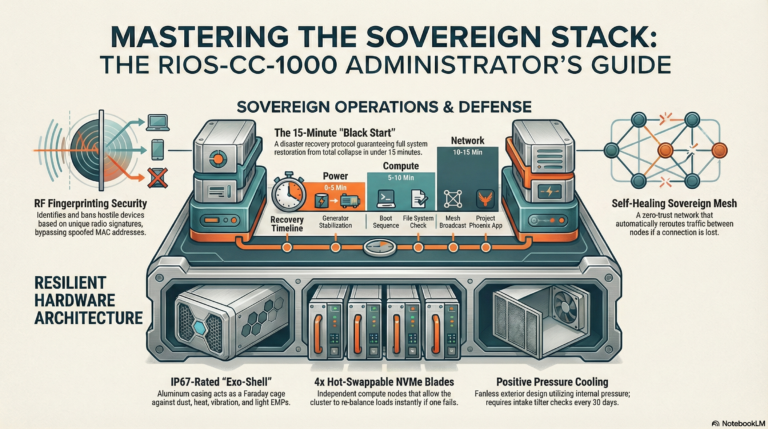
- Island-Mode Cognition refers to the ability of a synthetic ecosystem to operate on air-gapped, local silicon without relying on centralized cloud infrastructure. It ensures operational durability by binding computational metabolism to local thermodynamic limits and using private mesh communications (TriFi).
- Essay Questions
Instructions: Use the provided research context to develop detailed responses for the following five prompts.
- Analyze the transition of the global macroeconomic framework through the lens of the Kuhn Cycle. Discuss the “epicycles” currently being employed to sustain the New Keynesian Synthesis and the indicators that suggest a shift toward “Model Crisis” (Phase 3).
- Compare and contrast the Old Babylonian Cased Tablet with modern End-to-End Verifiable (E2E-V) voting protocols. How does the “envelope” metaphor serve as a foundation for cryptographic integrity in distributed systems?
- Discuss the role of “Perspectival Realism” in multi-agent architectures. How can truth be defined as an “invariant core” stable across multiple dimension-reducing projections (\Pi_\theta)?
- Evaluate the “Hierarchical Slashing” and “Snap-Back Reversion” mechanisms. How do these protocols enforce liability across a delegation chain when an agent produces an ontic failure?
- Explain the “Metacognitive Swarms of Intelligences” (MSI) stack. How does the meta-level supervisory layer differ from the object-level execution layer in terms of handling epistemic uncertainty and sensor anomalies?
- Glossary of Key Terms
Term Definition
Active Inference A framework (based on the Free Energy Principle) where agents minimize “Variational Free Energy” to align their internal models with environmental inputs.
Asymptotic Democracy A governance architecture that prunes falsified policy manifolds while remaining strictly bound to physical thermodynamics.
BFT (Byzantine Fault Tolerance) The ability of a distributed network to reach consensus even if a fraction (f < N/3) of nodes are malicious or compromised.
Brier Score A score used to measure the accuracy of probabilistic forecasts; lower scores indicate better calibration.
DSSE Durable Self-Correcting Synthetic Ecosystem; an architecture for biophysically grounded multi-agent autonomy.
Epistemic Momentum A replacement for diffusive, multi-turn LLM debates that gives an agent’s belief state rotational inertia, allowing updates to sweep a network as second-order waves.
EROEI Energy Return on Energy Invested; the ratio of energy delivered to the energy required to obtain it, serving as a physical ceiling for growth.
Exergy The portion of energy available to do work; used in the documents as a metric for the physical limits of a system.
Futarchy A governance model where citizens vote on values (defining a welfare metric) but “bet on beliefs” (using prediction markets to select the best policy to achieve that metric).
Inertial Spin Waves Undamped information propagation in starlings where turns spread as linear waves rather than through diffusion.
Kuhn Cycle A model of scientific progress involving phases: Normal Science, Model Drift, Model Crisis, Model Revolution, and Paradigm Shift.
Lean 4 A formal proof system and programming language used to verify the mathematical and logical soundness of AI directives.
MDL (Minimum Description Length) A principle that balances model accuracy against complexity, favoring the most parsimonious explanation.
Ontic Relating to real, mind-independent physical existence or reality.
RELA Axiom 3 A policy requirement stating that total nominal monetary or compute claims must be less than or equal to the verified net physical exergy of the system.
SSO (Single Sign-On) Traditional perimeter security that authenticates a user once; criticized in the context of AI for failing to account for “cognitive drift.”
zk-SNARK Zero-Knowledge Succinct Non-Interactive Argument of Knowledge; a cryptographic proof that allows one party to prove a statement is true without revealing the underlying data.