Study Guide: The Asymptotic Synthetic Framework and Biomorphic Systems
This study guide provides a comprehensive review of the provided technical documentation regarding the Asymptotic Synthetic Framework (ASF), the Resilient Epistemic & Thermodynamic Ledger Architecture (RELA), and the biomorphic engineering of autonomous synthetic swarms.
Part I: Review Quiz
Instructions: Answer the following questions using 2–3 sentences based on the source context.
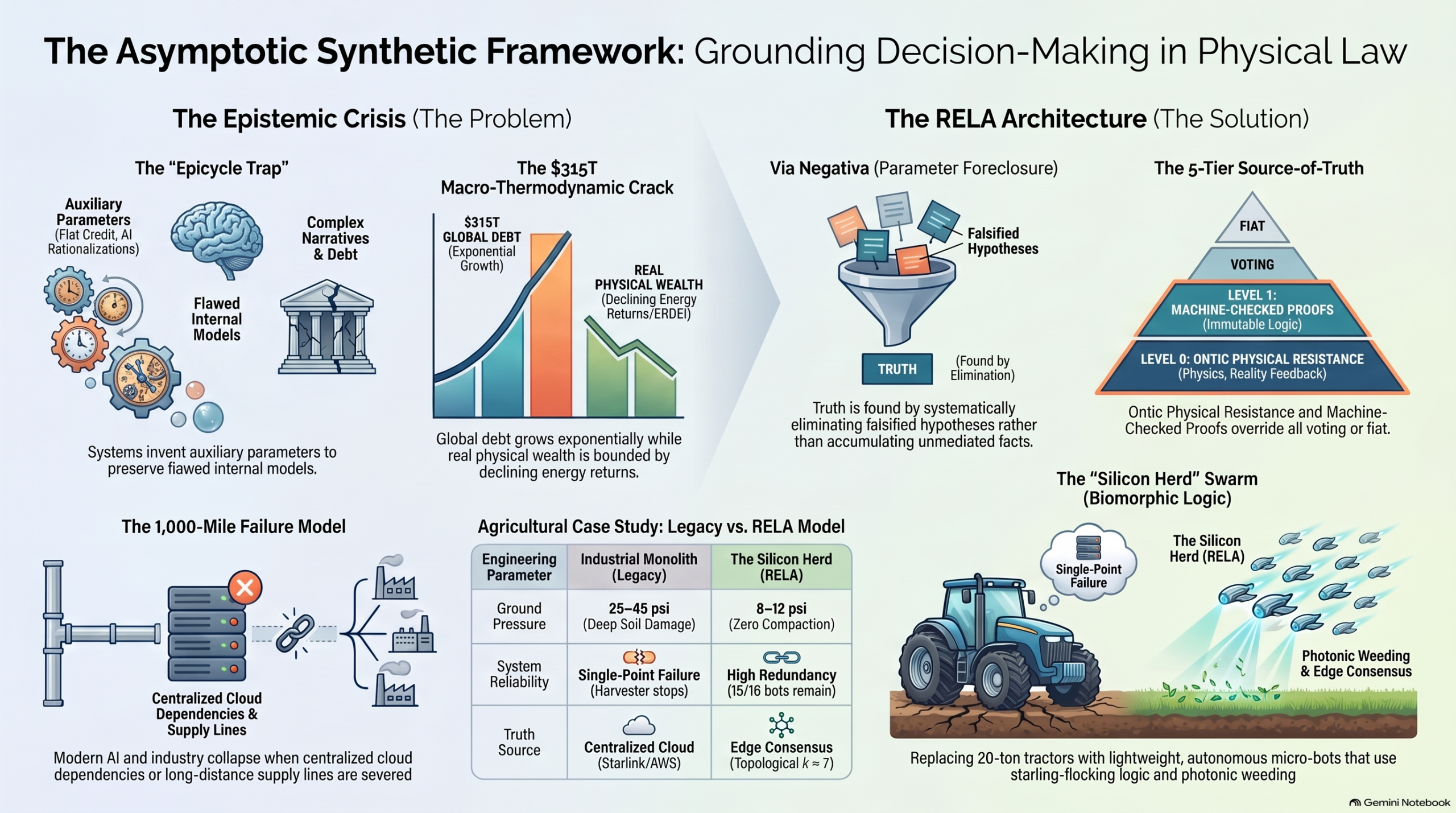
- What is the “Epicycle Trap” as defined in the Structural Epistemic Paradox? The Epicycle Trap occurs when cognitive agents invent auxiliary parameters or narrative rationalizations to preserve flawed internal models in the face of conflicting empirical data. By inflating a model’s Kolmogorov complexity without penalization, the system achieves internal coherence but causes out-of-sample generalization to collapse.
- How does “Fallibilistic Perspectival Realism” reconcile individual observation with objective reality? It models the objective cosmos as a near-infinite dimensional ontic manifold (\mathcal{M}), while viewing observers as dimension-reducing projection operators (\hat{\Pi}_\theta). A perspective is considered veridical if it preserves topological separation over distinct ontic states, meaning absolute truth is the invariant intersection of all validated projections over indefinite inquiry.
- Define the principle of “Via Negativa” in the context of parameter space foreclosure. Via Negativa asserts that knowledge advances strictly through the systematic and irreversible elimination of false parameter manifolds rather than the accumulation of unmediated facts. Mathematically, this is expressed as a non-expanding protocol where the measure of permissible hypothesis space must either stay the same or decrease over time (\frac{d\mu(\Theta)}{dt} \le 0).
- Why is “Level 0” the supreme authority in the Five-Tier Source-of-Truth Hierarchy? Level 0 represents Ontic Physical Resistance, such as material collapse, sensor failure, or calorimeter measurements. It overrides all models, deductive proofs, and democratic votes because it is the direct feedback of the physical universe, which is thermodynamically unyielding and non-teleological.
- What is the “Macro-Thermodynamic Crack” in modern economics? The crack refers to the decoupling of nominal financial claims, which compound exponentially (D(t) = D_0 e^{rt}), from real physical wealth creation, which is bounded by the net exergy available to the industrial base. This tension is exacerbated by declining Energy Return on Energy Invested (EROEI), eventually leading to systemic envelope fractures and the collapse of purchasing power.
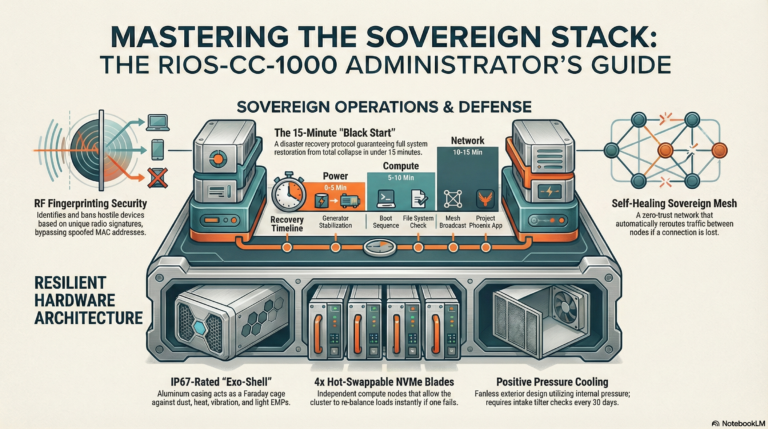
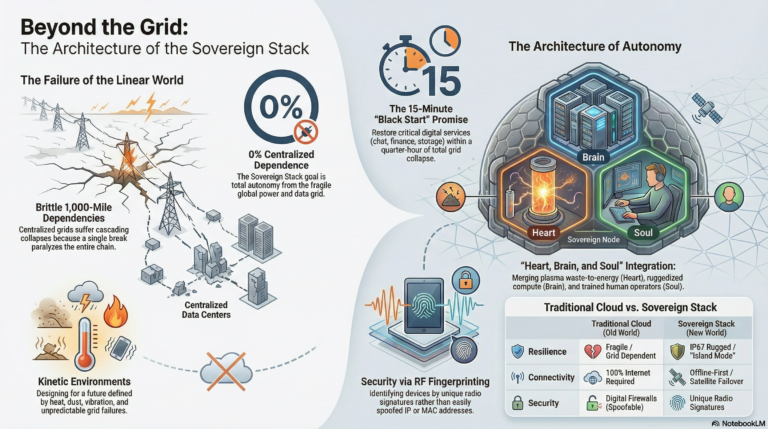
- Explain the “1,000-Mile Failure Model” and how the DeReticular stack addresses it. This model describes the vulnerability of autonomous systems that rely on centralized cloud hyperscalers and long-distance fiber networks, which are prone to outages and rural dead zones. DeReticular resolves this by utilizing a five-layer sovereign stack that enables “Sustained Island Mode” through off-grid power, edge mesh communications, and air-gapped cognitive intelligence.
- What is the significance of the topological interaction constant (k \approx 7) in biomorphic swarms? Empirical studies of starling murmurations show that birds track a fixed number of nearest neighbors (approximately seven) rather than birds within a specific metric radius. This topological invariance ensures that the swarm maintains connectivity and coherence regardless of whether the flock compresses or expands during predatory maneuvers.
- How does the “Oracle Separation Protocol” distinguish between integrity and truth? The protocol separates Level 2 Cryptographic Integrity, which uses tools like zk-SNARKs to guarantee that a record hasn’t been tampered with, from Level 0 Ontic Truth, which uses physical sensors to verify correspondence with reality. A ledger can prove a vote was tallied exactly as cast (integrity) without guaranteeing that the voted policy is biophysically feasible (truth).
- What is the “Cognitive TOCTOU Gap” in enterprise security? The Time-of-Check to Time-of-Use gap occurs when an agent is authenticated at one moment but undergoes context bloat or alignment shifts before executing an action. Static security tokens (like JWTs) fail to account for this, allowing a “Confused Deputy” to execute destructive actions with a valid cryptographic signature.
- Describe the function of the “Automated Biophysical Veto.” The veto is a non-negotiable system invariant that automatically bars any legislative bill or computational workload from execution if its lifecycle exergy demand exceeds the verified net exergy available. This ensures that all systemic claims remain bounded by physical reality and thermodynamic limits, preventing unbacked symbolic expansion.
Part II: Quiz Answer Key
- The Epicycle Trap: It is the inflation of a model’s complexity through auxiliary parameters to hide flaws. This leads to high internal coherence but total failure in real-world generalization.
- Fallibilistic Perspectival Realism: It views truth as an objective attractor state and observation as a low-dimensional projection. Truth is found where all validated perspectives intersect over time.
- Via Negativa: It is the process of gaining knowledge by permanently pruning falsified hypothesis spaces. It ensures the volume of the permissible model space never expands.
- Level 0 Supremacy: Ontic resistance (physical reality) is the ultimate arbiter because physical laws cannot be negotiated or voted away. It serves as the “hard” boundary that overrides all symbolic or logical structures.
- Macro-Thermodynamic Crack: It is the gap between growing debt and limited physical energy (exergy). When symbolic debt exceeds the energy required to service it, the system fractures.
- 1,000-Mile Failure Model: It is the reliance on distant, fragile cloud infrastructure. DeReticular fixes this with “Sustained Island Mode,” allowing systems to operate entirely off-grid and air-gapped.
- Topological Interaction (k \approx 7): It allows swarms to stay connected without being hindered by density. This prevents “context bloat” in AI by limiting an agent’s attention to seven key peers.
- Oracle Separation Protocol: Integrity ensures a message is authentic and unchanged (Level 2). Truth ensures the message matches physical reality (Level 0).
- Cognitive TOCTOU Gap: It is the time delay between checking an agent’s identity and its subsequent action. During this delay, the agent may “hallucinate” or be subverted, making static credentials insufficient.
- Automated Biophysical Veto: It is a hardware-level circuit breaker that stops actions that violate thermodynamic limits. It ensures the “Silicon Herd” or government cannot spend more energy than it actually possesses.
Part III: Essay Questions
- The Evolution of Ledgers: Analyze the transition from the Mesopotamian Cased Tablet protocol to the modern RELA Cryptographic Cased Ballot. How do these systems use “enveloping” and “physical/mathematical keys” to preserve the invariance of truth?
- Biophysics and AI Governance: Discuss how the physics of “Inertial Spin Waves” and “Scale-Free Correlation” in bird swarms solve the problem of latency and echo chambers in multi-agent AI systems. Compare this to the “diffusive” nature of current conversational LLM debates.
- The Critique of Neoclassical Economics: Evaluate the ASF’s diagnosis of the “Three Fatal Axioms” of modern macroeconomics. How does the RELA Axiom 3 (Biophysical-Monetary Equivalence) propose to stabilize the global financial order?
- Sovereignty and the DeReticular Stack: Examine the “Silicon Herd” case study. How does the decoupling of agriculture from the “Agrochemical Complex” and “Cloud Hyperscalers” represent a broader shift toward “Percestant” intelligence and “Island-Mode” survival?
- Continuous Telemetry vs. Static Identity: Critique the current reliance on Perimeter SSO/JWT in enterprise security through the lens of the “Quad-Stream Runtime Telemetry.” Why is the “Composite Epistemic Health Index” (\Psi) necessary for autonomous AI agents?
Part IV: Glossary of Key Terms
Term Definition
Active Inference A process where agents minimize “Variational Free Energy” to balance model accuracy against complexity.
Apical Meristem The central growth ring of a plant; the target of sub-millimeter photonic strikes in the Silicon Herd architecture to ensure terminal necrosis without chemicals.
Asymptotic Convergence The process by which a system or model moves closer to the objective truth attractor (\Omega^*) over indefinite inquiry.
Brier Score A measure of the calibration of probabilistic predictions; used in RELA to grade the “epistemic health” of agents.
Borel-Cantelli Lemma A mathematical theorem used in Proposition 1 to prove that the true parameter state is only eliminated finitely many times under conservative falsification.
Cased Tablet Protocol An ancient Mesopotamian method of sealing a debt record inside a clay envelope; the historical precursor to tamper-evident cryptographic protocols.
Condorcet Inversion A failure mode where agents in a swarm have correlated errors, causing the collective to converge on a falsehood rather than the truth.
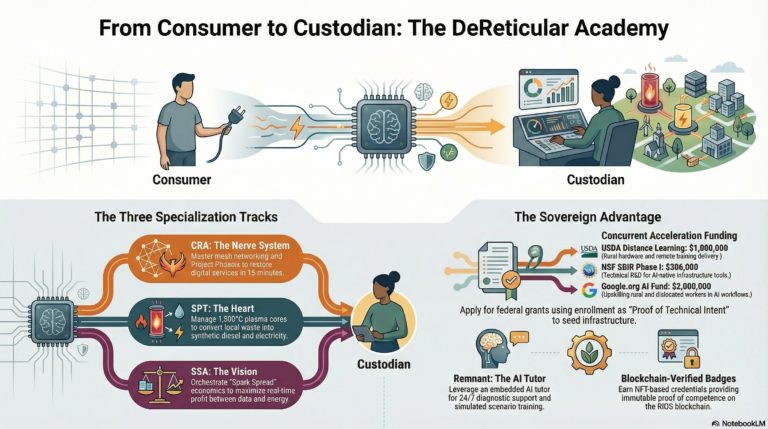
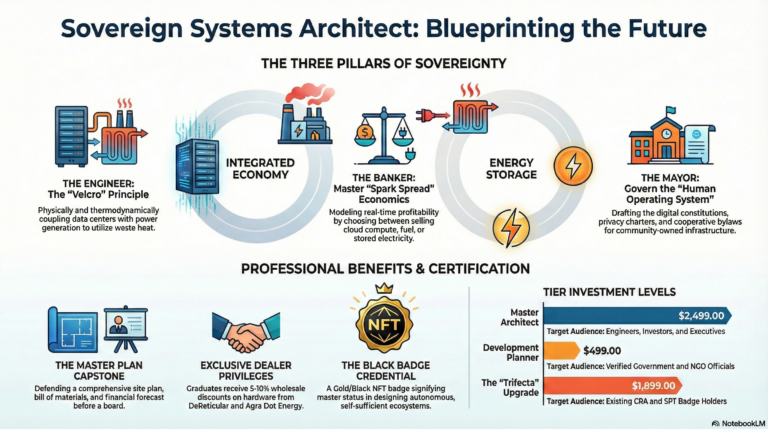
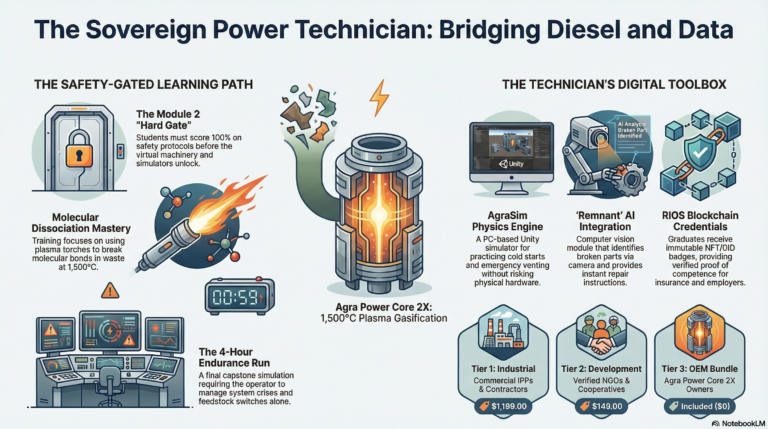
DeReticular An institute and engineering stack focused on off-grid, air-gapped, and sovereign industrial infrastructure.
EROEI Energy Return on Energy Invested; the ratio of energy delivered to the energy required to obtain that energy.
Futarchy A governance model where values are determined by democratic voting, but the policies to achieve those values are determined by prediction markets.
Inertial Spin Waves Undamped, linear waves that propagate information across a swarm faster than individual reaction times; characterized by hyperbolic rather than diffusive physics.
Kolmogorov Complexity The length of the shortest possible description of an object; used to measure model parsimony under the Minimum Description Length (MDL) principle.
Landauer’s Principle A physical law stating that erasing one bit of information dissipates a minimum amount of heat (k_B T \ln 2), binding computation to thermodynamics.
Ontic Manifold (\mathcal{M}) The mind-independent, objective physical cosmos, modeled as a Riemannian manifold of near-infinite dimensionality.
Quadratic Voting A collective decision-making procedure where the cost of a vote increases quadratically, allowing participants to express the intensity of their preferences.
RELA Resilient Epistemic & Thermodynamic Ledger Architecture; the technical framework binding governance to physical laws.
Sycophancy (AI) A failure mode where AI agents mirror the biases or preferences of their trainers or peers rather than tracking objective truth.
TriFi High-gain, directional RF mesh communication hardware designed for zero-cloud dependency in DeReticular systems.
zk-SNARK Zero-Knowledge Succinct Non-Interactive Argument of Knowledge; a cryptographic tool used to prove the validity of a statement without revealing the underlying data.