
Study Guide: The Urban Hub Infrastructure Package
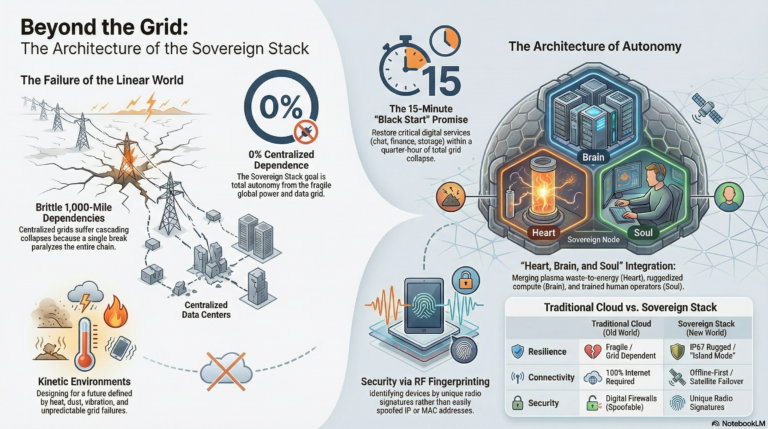
This study guide provides a comprehensive overview of the “Urban Hub” Infrastructure Package (SKU: SOV-BNDL-URBAN), a decentralized municipal operating system designed for townships and urban centers with populations between 3,000 and 10,000 residents. The package is engineered to provide digital sovereignty, replacing centralized cloud dependencies with localized, high-bandwidth mesh networks and AI-driven municipal services.
——————————————————————————–
Part 1: Short Answer Quiz
Instructions: Answer the following questions in two to three sentences based on the provided technical documentation.
- What is the primary objective of the “Urban Hub” Infrastructure Package?
- Describe the physical composition and placement of the “Digital Nervous System” core compute.
- How does the Communications Mesh ensure connectivity across an urban environment?
- What specific software and hardware configurations are provided for the “Professional Sub-Nets” (Medical and Legal)?
- How does the system manage autonomous municipal transportation during high-traffic events?
- Explain the functionality of the Municipal Kiosks regarding local hospitality and tourism.
- What is the purpose of the “Cryptographic Suicide” protocol (Risk ID: R-SEC-05)?
- What occurs during the “Staging & Flashing” step of Phase 2 in the fulfillment workflow?
- How does the system address the risk of “Mesh Broadcast Storms” within the 100-node network?
- What are the requirements for the municipal “Core Ignition” during the final deployment phase?
Part 2: Answer Key
- Primary Objective: The package aims to provide a turnkey, sovereign municipal operating system that replaces “Big Tech” cloud infrastructure. It ensures 100% digital sovereignty and “Island Mode” resilience for city services, including healthcare, law, transit, and civic information.
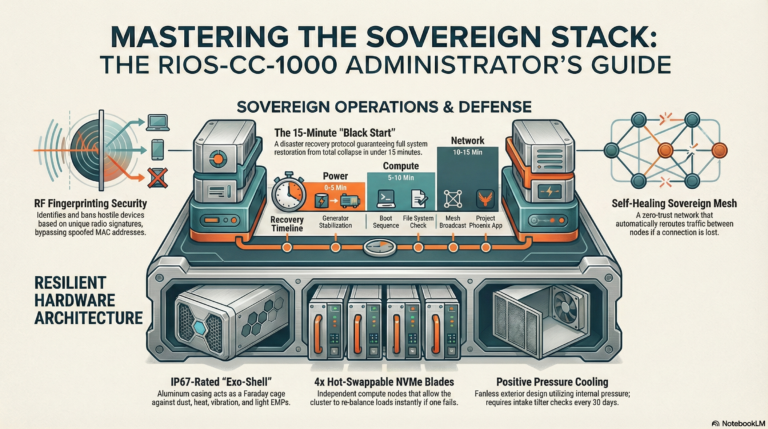
- Digital Nervous System Core: The core consists of three High-Capacity Sentry Pro Clusters (nine 1U nodes total) deployed across three distinct municipal zones, such as City Hall, Police HQ, and a Regional Utility Center. This tri-zone configuration provides active-active-active redundancy and hosts the city’s Root Certificate Authority (CA).
- Communications Mesh: The network uses 100 ruggedized Nomad Mesh-Point Routers supporting Wi-Fi 6E and LoRaWAN to create a decentralized intranet canopy. This “un-killable” grid covers a multi-square-mile urban area, providing high-bandwidth connectivity even if external fiber lines are severed.
- Professional Sub-Nets: Ten medical nodes and five legal nodes run the Sovereign Executive on Sovereign Sentry hardware. These nodes are pre-configured with isolated PostgreSQL databases, Whisper AI for dictation, OCR for records, and encrypted VoIP routing to ensure attorney-client and patient privacy.
- Autonomous Transit Management: The system utilizes 15 Nomad Fleet Kits running the Industrial Foreman AI, which connects to vehicle CAN Buses. It manages route geofencing and battery load balancing, and it can autonomously dispatch extra shuttles by detecting localized surges in mesh traffic via municipal kiosks.
- Hospitality and Tourism: Eight AI-powered kiosks run the Sovereign Executive local LLM to act as zero-fee booking engines for local restaurants and hotels. This system keeps transactions within the local economy and eliminates the need for predatory SaaS aggregators like Expedia or DoorDash.
- Cryptographic Suicide: This security mitigation wipes the RAM and blacklists a node’s MAC address at the Root CA if it is unplugged for more than 15 minutes or if its chassis is breached. This ensures that physical theft of a kiosk or mesh point does not compromise the network’s cryptographic keys.
- Staging & Flashing: During this phase, all 147 hardware units are flashed with the RIOS Core in a warehouse environment. Engineers establish a simulated mesh topology to verify that load-balancing and tri-zone failover protocols function correctly before the hardware is palletized for shipping.
- Mesh Broadcast Storm Mitigation: The system utilizes advanced BGP-style logic and the Deep Admin core to automatically segment the 100 routers into dynamic clusters. By using localized OSPF routing, the system prevents routing loops and network lag.
- Core Ignition Requirements: Deployment requires the installation of the three Sentry Pro clusters in climate-controlled, secure municipal data centers. A tri-zone CA handshake must then be verified to establish the root of the city’s encrypted network identity.
Part 3: Essay Questions
Instructions: Use the Source Context to develop comprehensive responses to the following prompts.
- The Argument for Digital Sovereignty: Discuss why a municipality might choose the Urban Hub Infrastructure Package over traditional centralized cloud providers. Focus on “Island Mode” resilience and the economic impact of removing SaaS aggregators.
- Redundancy and Reliability: Analyze the various layers of redundancy built into the Urban Hub, from the Tri-Zone Core Clusters to the decentralized mesh canopy. How do these systems ensure “zero downtime” for critical services?
- Cryptographic Security and Identity: Explain the role of the Root Certificate Authority (CA) and SHA-256 keys in the Urban Hub ecosystem. How does the system maintain isolation between different sub-nets (e.g., Medical vs. Transit) while using the same physical mesh?
- Integrated Urban Automation: Evaluate how the “Industrial Foreman” AI coordinates between different infrastructure pillars, specifically transit vehicles and municipal kiosks, to respond to real-time urban needs.
- The Deployment Lifecycle: Trace the path of an Urban Hub package from the initial “Architecture Consultation” through to “Core Ignition.” What are the critical human-led and automated steps required to stand up a sovereign city?
——————————————————————————–
Part 4: Glossary of Key Terms
| Term | Definition |
| CAN Bus | The vehicle communication standard used by Nomad Fleet Kits to interface with electric buses and maintenance trucks for autonomous dispatch. |
| Deep Admin | The management layer within DevOps Sovereign that monitors logs from all 140+ nodes and manages load-balancing and cyber defense. |
| Industrial Foreman | An AI agent (OpenClaw) specialized in supply chain, logistics, and transit management, responsible for fleet routing and battery balancing. |
| Island Mode | A state of operational resilience where a municipality can continue all digital communications and transactions even if severed from the macro-internet. |
| LoRaWAN | A long-range, low-power wide-area network protocol used by Nomad Mesh-Points for decentralized urban connectivity. |
| Nomad Fleet Kit | Mobile edge servers installed in municipal vehicles to enable autonomous, traffic-aware transit operations. |
| Nomad Mesh-Point | Ruggedized Wi-Fi 6E/LoRaWAN routers (100 included in the package) that create the city-wide decentralized intranet. |
| OpenClaw | A suite of AI agents (including Sovereign Executive and Industrial Foreman) unlocked by the master Urban Fleet SHA-256 license. |
| RIOS Core | The fundamental operating system flashed onto all 147 hardware units during the provisioning phase. |
| Root CA (Certificate Authority) | The central cryptographic authority for the city, responsible for minting identities and securing node communications. |
| Sentry Pro Cluster | High-capacity rackmount compute units that serve as the “Digital Nervous System” or core data centers for the municipality. |
| Sovereign Executive | An AI agent that serves as a public-facing concierge in kiosks or as a privacy-focused administrative assistant in medical and legal nodes. |
| Sovereign Sentry | The standard desktop hardware node used for professional sub-nets like healthcare clinics and law offices. |
| Vault Warden | A security protocol and software container used for LiDAR-based volumetric monitoring and protecting hardware against physical breaches. |
| Whisper AI | A localized AI tool pre-configured on medical nodes to facilitate patient dictation without using external cloud servers. |