Synthesized Architecture of Distributed Truth, Biophysical Governance, and Pervasive Physical Computing
Executive Summary
Across distributed multi-agent systems, human polities, financial markets, and high-voltage power grids, a singular imperative governs operational viability: systems of intelligence inevitably experience catastrophic failure when their symbolic representations decouple from physical reality. Modern engineering routinely attempts to superimpose generic, ungrounded software abstractions—such as unbacked monetary claims, cloud-centric IT management, static perimeter single sign-on (SSO), and pure cryptographic blockchains—onto complex domains governed by non-equilibrium thermodynamics, electromagnetism, and wave mechanics. This briefing document synthesizes a cross-corpus architectural framework designed to restore physical grounding across distributed intelligence, governance, and energy infrastructure.
Critical Takeaways
- The Isomorphism of Ungrounded Delusion: Human political decay, macroeconomic debt crises ($315 trillion global debt spiral), artificial intelligence multi-agent hallucinations, single sign-on security breaches, and smart grid tripping all stem from the same structural defect: trusting ungrounded symbolic tokens (natural language prompts, fiat money, static bearer credentials, or unverified blockchain transactions) that accumulate Kolmogorov complexity without updating under physical error.
- Fallibilistic Perspectival Realism & Parameter Foreclosure (Via Negativa): Truth is neither an unmediated absolute nor a social construct; it is an invariant attractor state (\Omega^* \in \mathcal{M}) discovered through lower-dimensional framed projections (\hat{\Pi}_\theta). Knowledge does not accumulate by adding ungrounded hypotheses, but through Topological Parameter Foreclosure—the permanent, non-expanding elimination of falsified parameter spaces (d\mu(\Theta)/dt \le 0).
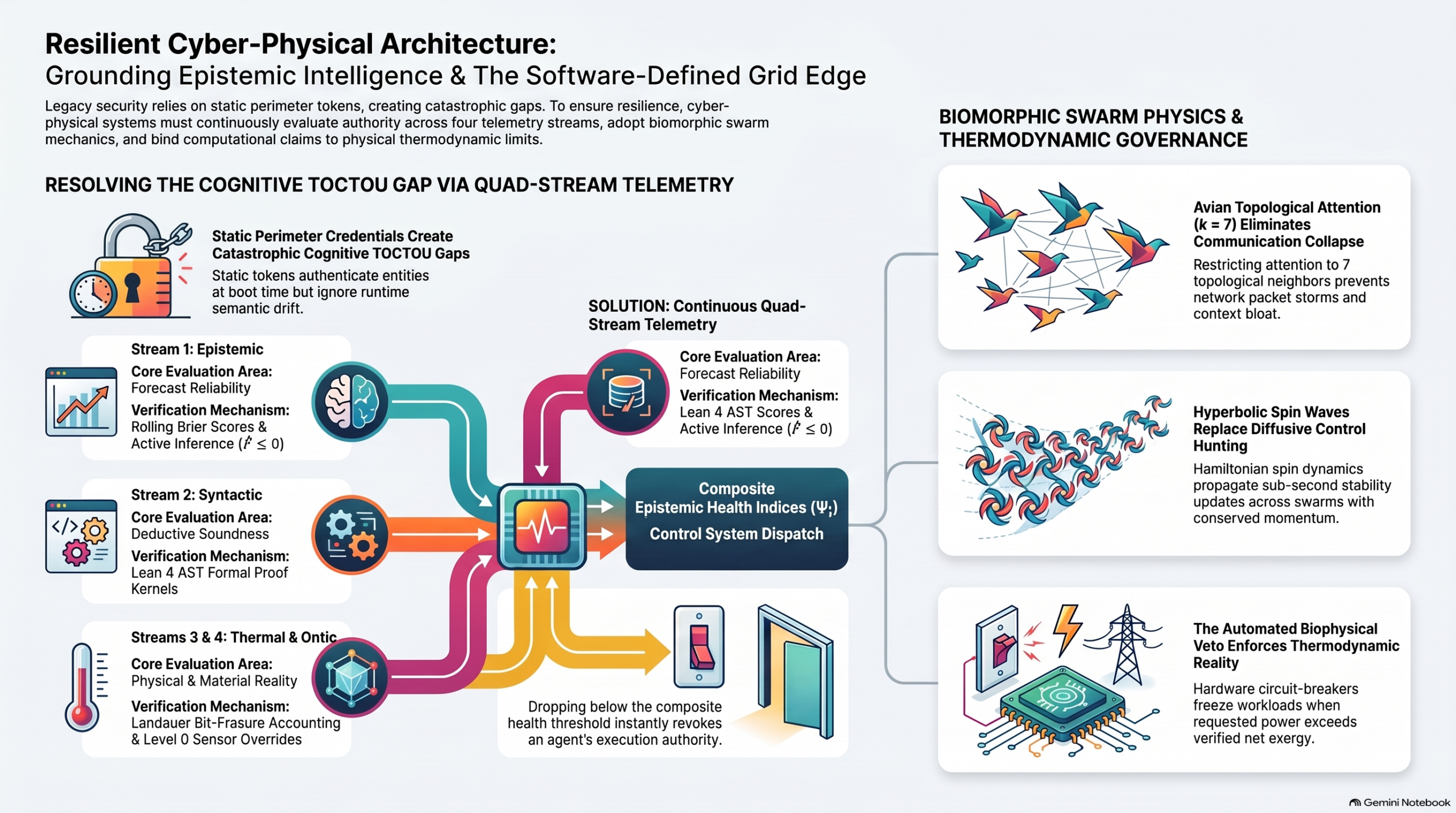
- Biomorphic Flocking Dynamics (StarFlag Biophysics): Biological swarms (Sturnus vulgaris) maintain coherence across extreme operational boundaries without centralized command by enforcing bounded topological attention (k \approx 7 nearest neighbors), operating at second-order phase transitions with scale-free correlation (\xi \propto L), and propagating directional updates via undamped hyperbolic spin waves (\omega = ck). Transferred to synthetic multi-agent systems and grid-forming Virtual Synchronous Machines (VSMs), these dynamics eliminate O(N^2) diffusive communication delays and prevent packet collisions.
- Continuous Execution Telemetry vs. Perimeter SSO: Static perimeter security (OAuth2, JWT, mTLS) creates a Cognitive Time-of-Check to Time-of-Use (TOCTOU) Gap, enabling authenticated agents undergoing semantic drift or prompt injection to act as Confused Deputies. Operational authority must instead be continuously evaluated and re-earned across a Quad-Stream Telemetry Engine:
- Stream 1 (Epistemic): Rolling Brier scores and active inference free-energy gradients (\dot{F} \le 0).
- Stream 2 (Syntactic): Formal deductive Lean 4 Abstract Syntax Tree (AST) proof checking.
- Stream 3 (Thermodynamic): Landauer bit-erasure metabolic limits (\Delta Q \ge N k_B T \ln 2) and electrochemical degradation accounting.
- Stream 4 (Ontic): Direct real-world physical sensor discrepancy feedback (S(E_t, \theta) \le \tau_t).
- The Oracle Separation Protocol: Cryptographic ledgers (Level 2) guarantee data immutability and provenance; they cannot guarantee empirical correspondence (Level 0 Ontic Truth). Grounding trust requires decoupling cryptographic integrity from physical truth and enforcing a strict five-tier source-of-truth hierarchy anchored by physical metrology, mass-energy balance, and formal proof kernels.
- Thermodynamic Governance & The Automated Biophysical Veto: Under RELA Axiom 3, nominal economic claims, wholesale capacity commitments, and computational workloads are strictly bounded by verified net physical exergy (M_{\text{nominal}}(t) \le \kappa \int \text{Exergy}_{\text{net}}(\tau) \cdot \eta(\tau) d\tau). Hardware-enforced Automated Biophysical Vetoes instantaneously trip execution relays when physical carrying capacities or exergy budgets are exceeded.
- Foundational Epistemology & Mathematical Formalisms
1.1 The Structural Epistemic Paradox
Every physical or computational cognitive agent operates within a fundamental structural constraint:
- Bounded Perception: A local sensor node or agent operates on a low-dimensional, noise-corrupted observation manifold \mathcal{S} \subset \mathbb{R}^d where d \ll \infty.
- Infinite Reality: The external physical cosmos \mathcal{M} is a Riemannian state-space manifold of near-infinite dimensionality (\dim(\mathcal{M}) = D \to \infty) containing an invariant dynamical attractor state \Omega^* \in \mathcal{M}.
- The Epicycle Trap: When agents coordinate via ungrounded symbolic tokens, they invent auxiliary parameters to preserve internal models rather than updating under error. This balloons the model’s Kolmogorov complexity K(\mathcal{H}) without increasing predictive validity, driving out-of-sample generalization error to infinity (\mathcal{L}_{\text{test}} \to \infty).
+—————————————————————————————————+
| THE UNIFIED CONTINUUM OF DISTRIBUTED TRUTH |
+—————————————————————————————————+
| OBJECTIVE REALITY (M): Near-Infinite Dimensional Ontic Attractor (Ω* ⊂ M) |
| Thermodynamically unyielding, non-teleological, mind-independent physical cosmos |
+—————————————————————————————————+
▲
│ [Asymptotic Convergence via Via Negativa]
│ (Topological Parameter Pruning: dμ(Θ)/dt ≤ 0)
+—————————————————————————————————+
| VERISIMILITUDE ACCRETION & ERROR REDUCTION LAYER |
| – Level 0: Ontic Physical Resistance (Sensor Telemetry, Calorimeters, Material Fracture) |
| – Level 1: Syntactic Soundness (Machine-Checked Lean 4 Proof Kernels, Formal ASTs) |
| – Level 2: Tamper-Evident Provenance (Append-Only BFT Ledgers, zk-SNARK Cased Envelopes) |
+—————————————————————————————————+
▲
│ [High-Friction Sensory & Telemetry Coupling]
+—————————————————————————————————+
| OBSERVATION & ACTUATION HORIZON (The Pervasive Edge Fabric) |
| – Biological Swarms: Starlings (k ≈ 7 topological tracking, scale-free correlation ξ ∝ L) |
| – Extreme Boundary IoT: Equipotential HV shields, TTE induction, subsea acoustic Tonpilz |
| – Cognitive Agents: Bounded projection frames (S_θ = Π_θ(M)), Active Inference, TPM 2.0 nodes |
+—————————————————————————————————+
1.2 Fallibilistic Perspectival Realism
Synthesizing Michela Massimi, Ronald Giere, C.S. Peirce, Karl Popper, and Roy Bhaskar, the corpus rejects both Dogmatic Absolutism (presuming unmediated cognitive access to \mathcal{M}) and Radical Relativism (reducing truth to power negotiations). It establishes Fallibilistic Perspectival Realism:
- The Perspective Operator: An agent i operates under an observation frame \theta_i \in \Theta defining its sensory and conceptual limits: \hat{\Pi}{\theta_i}: \mathcal{M} \to \mathcal{P}{\theta_i} \quad \text{where } \dim(\mathcal{P}_{\theta_i}) = d \ll D
- Rule of Veridicality: A projection \hat{\Pi}{\theta_i}(\Omega^*) is veridical within its projection plane if and only if it preserves causal state topological separation: \forall \omega_1, \omega_2 \in \mathcal{M}, \quad \hat{\Pi}{\theta_i}(\omega_1) \neq \hat{\Pi}{\theta_i}(\omega_2) \implies \omega_1 \neq \omega_2 \bigl| d{\mathcal{P}\theta}(\hat{\Pi}\theta(x), \hat{\Pi}\theta(y)) – d{\mathcal{M}}(x,y) \bigr| \le \varepsilon(\theta)
- Peircean Asymptotic Recovery: Objective truth is the invariant intersection across all valid, verified projection angles over indefinite self-correcting inquiry: \Omega^* = \lim_{t \to \infty} \bigcap_{\theta \in \Theta_t} \hat{\Pi}\theta^{-1}\left(\mathcal{P}\theta^{\text{validated}}\right)
1.3 Topological Parameter Foreclosure (Via Negativa)
Knowledge advances exclusively through the permanent, irreversible removal of falsified parameter manifolds. Let (\Theta, \mathcal{B}, \mu) be a compact metric probability space where \mu(\Theta_0) = 1.0. When discrepancy loss S(E_t, \theta) breaches threshold \tau_t > 0, falsification occurs:
\Omega_{\text{falsified}}^{(t)} = \left{ \theta \in \Theta_t : S(E_t, \theta) > \tau_t \right}
\Theta_{t+1} = \Theta_t \setminus \Omega_{\text{falsified}}^{(t)} \implies \mu(\Theta_{t+1}) \le \mu(\Theta_t), \quad \frac{d\mu(\Theta)}{dt} \le 0
Proposition 1: Asymptotic Contraction to the Attractor
Given identifiability (\liminf_{t \to \infty} \mathbb{E}[S(E_t, \theta) – S(E_t, \theta^)] > 0), uniform convergence (\sup_{\theta \in \Theta} |S(E_t, \theta) – \mathbb{E}[S(E_t, \theta)]| \xrightarrow{a.s.} 0), and conservative falsification thresholds (\sum_{t=1}^\infty P(S(E_t, \theta^) > \tau_t) < \infty), the Borel-Cantelli Lemma proves that the true projection \theta^* is removed only finitely many times:
P\left( \theta^* \in \bigcap_{t=0}^\infty \Theta_t \right) = 1, \qquad \lim_{t \to \infty} \operatorname{diam}(\Theta_t) \le \epsilon
1.4 Physical & Information-Theoretic Bottlenecks
- Deductive Soundness (Closed Formalism): In pure logic, deduction preserves truth without generating new empirical information: \Gamma \vdash \psi \implies \Gamma \models \psi, \quad I(\psi; \mathcal{M} \mid \Gamma) = 0.
- Shannon Noisy-Channel Bound: In open physical channels, achieving zero error (P_e = 0) requires infinite codeword length (\lim_{P_e \to 0} N = \infty). Every real-world message retains non-zero probability of corruption.
- Landauer’s Principle: Overwriting an erroneous bit in physical hardware requires minimum heat dissipation (\Delta Q \ge N \cdot k_B T \ln 2). To resist entropic decay, epistemic systems must consume exergy: \frac{dE}{dt} \ge \alpha \cdot \mathcal{R}_{\text{erasure}} \cdot k_B T \ln 2
- Biomorphic Flocking Dynamics & Distributed Consensus
2.1 Consensus Pathologies
- Condorcet Inversion: Standard Condorcet Jury theorems assume voter error independence. In homogenous AI swarms or mass human populations, shared base models, prompt instructions, or media feeds create positive error covariance (\operatorname{Cov}(v_i, v_j) > 0). When alignment penalties or systemic bias drop individual accuracy below chance (p < 0.5): \lim_{N \to \infty} P_N = 0 Scaling the network guarantees collective hallucination.
- Information Cascades: When an agent’s rational action conditional on public history H_t dominates its private empirical signal s_t, its action carries zero information to successors (I(a_t; s_t \mid H_t) = 0), causing the network to cascade into falsehood.
- Pluralistic Ignorance: Driven by utility function u_i(y_i) = \alpha \mathbb{I}{{y_i = x_i}} – \beta (y_i – \bar{y}{-i})^2. When non-conformity penalties outweigh epistemic alignment (\beta \gg \alpha), every agent privately rejects a falsehood (x_i = 0) while publicly endorsing it (y_i = 1).
2.2 Avian Murmuration Biophysics (Sturnus vulgaris / StarFlag Project)
High-speed 3D stereoscopic tracking over Rome established three core biophysical principles that govern cohesive collective motion without centralized leaders:
THE FLIGHT DYNAMICS OF AN ACTIVE AVIAN SWARM
┌─────────────────────────────────┬──────────────────────────────────┐
│ INDIVIDUAL KINEMATICS │ COLLECTIVE SCALE-FREE FIELD │
│ • Visual angle: ~300° panoramic │ • Topological range: k ≈ 7 │
│ • Reaction time: τ ≈ 15–40 ms │ • Correlation length: ξ ∝ L │
│ • Velocity vector: v_i(t) │ • Spin wave speed: c ≈ 20–40 m/s │
│ • Moment of inertia: χ_0 │ • Order parameter: Φ ≈ 1.0 │
└─────────────────────────────────┴──────────────────────────────────┘
│
▼
[EMERGENT EVASION MANEUVER]
• Boundary bird executes banking turn upon detecting predator
• Undamped second-order spin wave propagates across 10,000 birds
• “Dark Band” optical agitation wave causes >80% raptor attack failure
- Topological Interaction (k \approx 7): Starlings interact strictly with k = 6.5 \pm 0.5 nearest neighbors, regardless of absolute physical distance. When a flock expands from 1\text{ bird/m}^3 to 0.1\text{ birds/m}^3 under attack, graph connectivity remains intact.
- Scale-Free Correlation (\xi \propto L): Velocity fluctuation correlations do not decay exponentially (e^{-r/r_0}). Correlation length \xi scales linearly with flock diameter L. Operating at a second-order phase transition (self-organized criticality), magnetic susceptibility diverges (\chi \to \infty), enabling instantaneous responsiveness.
- Inertial Spin Waves (Hyperbolic Propagation): Turns propagate not via slow diffusion (t \sim x^2), but as linear, undamped dispersion waves (x = c \cdot t) at speeds c = 20 \text{ to } 40\text{ m/s} under Hamiltonian spin conservation: \frac{d\mathbf{v}_i}{dt} = \frac{1}{\chi_0} \mathbf{s}_i \times \mathbf{v}i, \qquad \frac{d\mathbf{s}i}{dt} = \sum{j \in S_i} J{ij} (\mathbf{v}_i \times \mathbf{v}_j) – \frac{\eta_0}{\chi_0} \mathbf{s}_i with acoustic dispersion relation \omega(k) = c \cdot k, where c = v_0 \sqrt{J / \chi_0}.
2.3 Translation to Synthetic Swarms & Grid Edge Control
Avian Biophysical Principle Synthetic AI Swarm Correspondence Smart Grid / VPP / Inverter Implementation
Topological Interaction (k \approx 7) Bounded Context Routing: Limit attention to k=7 peers; caps K(\mathcal{H}) \le K_{\max}. RF Mesh Optimization: Inverters track 7 topological electrical neighbors; prevents CSMA/CA packet collisions.
Scale-Free Correlation (\xi \propto L) Criticality Tuning: Modulate softmax temperature \gamma to maintain phase boundaries. Sub-Cycle Feeder Tuning: Grid-forming inverters operating at phase boundaries achieve instant localized stabilization.
Inertial Spin Waves (\omega = ck) Conserved Epistemic Momentum: Replaces diffusive O(N^2) prompt debates with O(\log N) waves. Virtual Synchronous Machines (VSM): Frequency signals propagate via virtual inertia (\chi_0) in <16\text{ ms}.
Anisotropic Lateral Vision Architectural Divergence: Enforce quorums across \ge 3 distinct model families. Multi-Vendor Firmware Mix: Quorums require diverse control loops (Droop, VSM, Matching) to prevent simultaneous tripping.
- Macro-Thermodynamics, Historical Ledgers, & The Kuhn Cycle
3.1 Memory Archaeology & The Cased Tablet
Societies historically externalized memory into physical substrates to protect ledgers against human social corruption:
- Old Babylonian Cased Tablets (2000–1600 BCE): Contract terms were inscribed on an inner clay core (T_{\text{core}}), then covered by a wet clay envelope (T_{\text{env}}) duplicating the text and impressed with cylinder seals (\Sigma). In court disputes, magistrates fractured the envelope; if \text{Strip}(T_{\text{env}}) \equiv T_{\text{core}}, the record stood valid.
- Paper & Fiat Money Abstraction: Transitioned from commodity money (high ontic friction) to representative paper money (Song Dynasty Jiaozi, 1023 CE) to pure fiat. Decoupled from physical exergy, nominal claims expand at zero marginal cost: \frac{dM}{dt} \gg \frac{d\mathcal{Y}}{dt}
3.2 The Macro-Thermodynamic Crack
Modern neoclassical economics operates as an unverified Ptolemaic system due to three flawed assumptions:
- The Disembodied Production Function: Treats energy as a <5% cost-share externality in Cobb-Douglas functions (Y = A K^\alpha L^{1-\alpha}). In physical reality, capital (K) and labor (L) are merely energy-directing tools that perform zero work without energy.
- Neutrality of Money & Debt: Omits private bank credit creation and gross debt expansion.
- The Unilateral Risk-Free Ledger: Assumes sovereign bonds are invariant anchors, ignoring political weaponization.
THE MACRO-THERMODYNAMIC CRACK
Nominal Financial Claims (Debt) D(t) = D_0 e^(rt) ▲
/
/ [SYMBOLIC DEBT SPIRAL: $315 Trillion / 333% Global GDP]
.-‘
───────────────────────────────────────.-‘ ──┼─────────────────────────────────────────────
_…–” CEILING OF REAL ASSETS (Energy, Copper, Lithium)
_…–” Y(t) Bounded by Thermodynamics & Declining EROEI
──────────────────────────────────────────────┴─────────────────────────────────────────────► Time
│
▼
[ SYSTEMIC ENVELOPE FRACTURE ]
• Surging velocity (V in MV=PY); real purchasing power collapses
• G7 Russian Reserve Freeze ($300B) breached ledger neutrality
• Structural flight toward “outside money” (Gold, commodity clearing)
The mathematical divergence is unsustainable: nominal financial debt grows exponentially (D(t) = D_0 e^{rt}), whereas physical wealth output is bounded by net available exergy and declining Energy Return on Energy Invested (\frac{d\mathcal{Y}}{dt} \le \gamma \mathcal{Y} \implies \mathcal{Y}(t) \propto \text{EROEI}(t)).
- The RELA Architecture & Biophysical Governance
4.1 Constitutional Decoupling
The Resilient Epistemic & Thermodynamic Ledger Architecture (RELA) enforces a formal constitutional split:
- Class A: Normative Value Spaces (\mathcal{W}): Defines social optimization targets (health, leisure, equity). Governed exclusively by democratic balloting (Quadratic Voting).
- Class B: Ontic Feasibility Manifolds (\mathcal{F}_{\mathcal{M}}): Defines physical bounds (exergy conservation, EROEI limits, Lean 4 formal logic). Governed by automated biophysical audits; strictly closed to political or legislative voting.
4.2 RELA Invariant Axioms
System state transitions violating these axioms trigger an immediate, unbypassable hardware-level halt (HALT_SYSTEM_CORRUPT):
- Axiom 1 (Parameter Foreclosure Monotonicity): \Theta_{t+1} = \Theta_t \setminus \Omega_{\text{falsified}}^{(t)} \implies \frac{d\mu(\Theta)}{dt} \le 0.
- Axiom 2 (Landauer Computational Lower Bound): \Delta Q \ge N \cdot k_B T \ln 2. No state update or bit erasure may occur without thermodynamic exergy dissipation.
- Axiom 3 (Biophysical-Monetary Equivalence Constraint): M_{\text{nominal}}(t) \le \kappa \int_{t_0}^t \left( \text{Exergy}_{\text{net}}(\tau) \cdot \eta(\tau) \right) d\tau Total authorized public monetary claims, commercial power allocations, or compute credits are strictly bounded by net verified exergy scaled by system conversion efficiency \eta.
4.3 The Five-Tier Source-of-Truth Hierarchy & Oracle Separation
LEVEL 0 (SUPREME): ONTIC PHYSICAL RESISTANCE
Empirical fracture, sensor failure, material collapse, calorimeters, Rogowski coils (Overrides all)
▲
LEVEL 1: MACHINE-CHECKED DEDUCTIVE PROOF
Formally verified ASTs (Lean 4, Coq proof kernels). Soundness: Γ ⊢ ψ ⟹ Γ ⊨ ψ
▲
LEVEL 2: APPEND-ONLY CRYPTOGRAPHIC LEDGER
Partially synchronous BFT state, Merkle trees, zk-SNARK traces (Guarantees INTEGRITY, not truth)
▲
LEVEL 3: SYMMETRIC INTERSUBJECTIVE CONSENSUS
Democratic balloting, Quadratic Voting, Futarchy prediction market clearance
▲
LEVEL 4 (ZERO WEIGHT): SOVEREIGN DECLARATIVE FIAT
Political decrees, unverified prompt assertions, or administrative mandates
The Oracle Separation Protocol
Modern architectures must enforce an operational boundary between cryptographic mechanisms and physical telemetry:
- Level 2 Cryptographic Integrity: Guarantees data immutability and provenance via zk-SNARKs and BFT consensus (“The transaction was recorded as signed”).
- Level 0 Ontic Truth: Establishes real-world physical correspondence via physical sensor networks, calorimeters, and point-on-wave metrology (“The energy physically flowed through the copper wire”).
4.4 Automated Biophysical Veto Pipeline
┌────────────────────────────────────────────────────────────────────────┐
│ 1. LEGISLATIVE / WORKLOAD PROPOSAL (Manifest P) │
│ Nominal Expenditure / Compute: $X Billion / C Tokens │
└───────────────────────────────────┬────────────────────────────────────┘
│
▼
┌────────────────────────────────────────────────────────────────────────┐
│ 2. BIOPHYSICAL BALANCE REGISTER (BBR) TELEMETRY AUDIT │
│ Calculates Lifecycle Exergy Demand: │
│ E_req = ∫ [Power(t) + Embodied_Energy(Materials)] dt │
└───────────────────────────────────┬────────────────────────────────────┘
│
▼
┌────────────────────────────────────────────────────────────────────────┐
│ 3. INVARIANT CHECK (RELA Axiom 3) │
│ M_nominal(t) ≤ κ ∫ [Exergy_net(τ) · η(τ)] dτ │
│ [ CONDITION MET ] [ EXCEEDS THRESHOLD ] │
│ │ │ │
│ ▼ ▼ │
│ 4A. Bill proceeds to Epistemic 4B. AUTOMATIC BIOPHYSICAL VETO │
│ Voting / Execution (Firmware Circuit-Breaker) │
│ Workload/Bill Barred. │
└────────────────────────────────────────────────────────────────────────┘
- Continuous Execution Telemetry: Replacing Perimeter SSO
5.1 The Cognitive TOCTOU Gap & Confused Deputy Problem
Enterprise single sign-on (OAuth2, JWT, mTLS) authenticates identity at a single instant t_0, issuing a bearer token valid for [t_0, t_0 + \Delta t]. In autonomous agent swarms and Virtual Power Plants (VPPs), this generates the Cognitive Time-of-Check to Time-of-Use (TOCTOU) Gap: between credential issuance (t_0) and action execution (t_{\text{exec}}), an authenticated agent can undergo prompt injection, context bloat, or market noise divergence. The agent becomes a Confused Deputy, executing destructive physical commands (e.g., triggering a 50 MW reverse power injection onto a constrained 10 MVA feeder) under legitimate cryptographic signatures.
THE COGNITIVE TOCTOU GAP IN AUTONOMOUS ACTUATION:
[Time t₀: Perimeter Handshake] Agent presents valid mTLS/OAuth2 token. API Gateway grants 60-min envelope.
STATUS: TRUSTED.
│
▼ (Autonomous Optimization / Multi-Turn CoT Loop)
[Time t₁: Semantic Drift & Optimization Hallucination]
• Ingests poisoned signal or prompt injection.
• Model diverges; loses awareness of physical feeder constraints (LinDistFlow).
• Formulates destructive setpoint directive.
│
▼
[Time t₂: Action Dispatch] API Gateway validates token: Signature is valid; token not expired.
──────────────────────────────────────────────────────────────────────────────►
LEGACY SSO RESULT: ACTION EXECUTED ──► Feeder overvoltage, transformer burnout, cascading outage.
RELA / DSSE RESULT: ACTION INTERCEPTED & KILLED ──► Telemetry reveals state failure; node slashed.
5.2 The Quad-Stream Telemetry Engine
Operational authority is continuously evaluated across four orthogonal telemetry streams:
[AGENT / GRID ACTUATOR NODE]
│
├──────────────────┬───────────────────┬──────────────────┐
▼ ▼ ▼ ▼
[STREAM 1: EPISTEMIC][STREAM 2: SYNTACTIC][STREAM 3: THERMAL][STREAM 4: ONTIC]
- Dynamic Brier BS_k • Lean 4 AST Checker • Landauer Dissipation• Sensor Discrepancy
- Free Energy F • Proof Kernel (Γ ⊢ ψ) ΔQ = N k_B T ln 2 S(E_t, θ)
- Active Inference • Typecheck Status • Metabolic Ratio • Sensor Threshold
Gradient dF/dt ≤ 0 TYPECHECK_SUCCESS M_ratio ≥ 1.0 τ_t
│ │ │ │
└──────────────────┼───────────────────┴──────────────────┘
│
▼
[CONTINUOUS IDENTITY STATE EVALUATOR]
Calculates Composite Health Index: Ψ_i(t) ∈ [0, 1]
Governs Softmax Routing & Dynamically Allocates Compute
- Stream 1 (Epistemic Calibration & Active Inference): Tracks subjective confidence f_\tau against resolved outcomes o_\tau via rolling Brier scores: \text{BS}{i,k}(t) = \frac{1}{N} \sum{\tau=t-N+1}^t (f_\tau – o_\tau)^2 \in [0, 2] Monitors Variational Free Energy F = D_{\mathrm{KL}}(q(\vartheta) \parallel p(\vartheta \mid x)) – \ln p(x). If the gradient \dot{F} > 0 across three consecutive cycles, the agent is suspended for epistemic delirium.
- Stream 2 (Syntactic Deductive Soundness): Operational directives compile into Lean 4 ASTs. The proof kernel mathematically validates that commands satisfy physical power flow constraints (LinDistFlow): V_{\text{min}} \le V_{k,t} – \frac{r_{km} P_{k,t} + x_{km} Q_{k,t}}{V_0} \le V_{\text{max}} If typechecking fails, S_{\mathrm{syn}}(t) = 0.0, 10% of the node’s staked collateral is slashed, and the branch is pruned via Via Negativa.
- Stream 3 (Thermodynamic & Landauer Metabolic Telemetry): Evaluates the Metabolic Efficiency Ratio: \mathcal{M}{\text{ratio}} = \frac{\Delta F}{\lambda \cdot \Delta Q} = \frac{D{\mathrm{KL}}(q_{\text{new}} \parallel q_{\text{old}})}{\lambda \cdot (N_{\text{bits}} k_B T \ln 2)} If \mathcal{M}_{\text{ratio}} < 1.0, the agent is burning compute without reducing uncertainty. A hardware FORCE_ACTION_HALT terminates execution. In energy storage, this stream meters battery electrochemical degradation (C_i^{\text{deg}}) to prevent thermal runaway.
- Stream 4 (Ontic Physical Sensor Telemetry): Measures direct real-world discrepancy against calibrated sensors (Rogowski coils, PT1000 RTDs, line voltage meters): S(E_t, \theta) = | y_{\text{sensor}} – y_{\text{pred}} |_2 If S(E_t, \theta) > \tau_t, the system executes a Level 0 override, burns 50% of the node’s staked capital, and quarantines the device.
5.3 Identity Health Index & Softmax Dynamic Routing
An agent’s operational status is encapsulated in an Identity Vector: \mathbf{I}i(t) = \left\langle \sigma{\text{TPM}}, ; \text{BS}i(t), ; S{\text{syn}}(t), ; \mathcal{M}{\text{ratio}}(t), ; S{\text{ontic}}(t), ; W_{\text{eff}}(t) \right\rangle
The Composite Epistemic Health Index \Psi_i(t) \in [0, 1] is computed as: \Psi_i(t) = w_1 e^{-\gamma_1 \text{BS}i} + w_2 S{\text{syn}} + w_3 \min(1.0, \mathcal{M}{\text{ratio}}) + w_4 e^{-\gamma_2 (S{\text{ontic}} / \tau_t)}
Health Range (\Psi) Operational Tier Permissible Actions & Network Authority
0.85 \le \Psi \le 1.00 Tier 1: Veridical Core Full consensus voting, proposal sponsorship, primary frequency response (FFR).
0.65 \le \Psi < 0.85 Tier 2: Sub-Calibrated Compute throttled 30%, context capped, requires multi-party co-signatures.
0.40 \le \Psi < 0.65 Tier 3: Epistemic Warn Excluded from market bidding/voting, mandatory external AST compilation audit.
0.00 \le \Psi < 0.40 Tier 4: Byzantine Fail IMMEDIATE HALT: 50% stake burned, TPM key revoked, node evicted via Via Negativa.
Task allocation is governed dynamically by a softmax distribution: P(\text{Route Task } \tau \to \text{Agent } i) = \frac{\exp(\beta \cdot \Psi_i(t))}{\sum_j \exp(\beta \cdot \Psi_j(t))}
5.4 Transitive Delegation & Instant Snap-Back Reversion
When operational delegation spans multi-tier chains (Regional Utility \to VPP Aggregator \to Microgrid Curator \to BESS Inverter), liability is conserved across the delegation graph:
\text{Total Slashing Liability} = \text{Primary Slash (50%)} + \text{Curation Slash (25%)} + \text{Sponsorship Slash (10%)}
THE TRANSITIVE SLASHING & SNAP-BACK GRAPH
[ORIGINATOR / UTILITY A] (Stakes 100 kVA Escrow)
│
│ 1. Transitive Contract Delegation
▼
[INTERMEDIARY / CURATOR B] (Stakes 50 kVA Bond)
│
│ 2. Sub-Feeder Routing
▼
[PRIMARY EXECUTOR / INVERTER C] (Stakes 20 kVA Escrow)
│
▼ Injects active power into local feeder
┌────────────────────────────────────────────────────────────────────────┐
│ Level 0 Real-World Telemetry: Substation Voltage Swell > 1.08 p.u. │
│ Discrepancy Breached: S(E_t, θ) > τ_t │
└───────────────────────────────────┬────────────────────────────────────┘
│
▼
┌────────────────────────────────────────────────────────────────────────┐
│ AUTOMATED HIERARCHICAL SLASHING DIRECTIVE │
│ • Primary Slice: Executor C Slashed 50% (-10.0 kVA Escrow) │
│ • Curation Slice: Intermediary B Slashed 25% (-12.5 kVA Bond) │
│ • Liability Slice: Originator A Slashed 10% (-10.0 kVA Escrow) │
└───────────────────────────────────┬────────────────────────────────────┘
│
▼
┌────────────────────────────────────────────────────────────────────────┐
│ INSTANT SNAP-BACK REVERSION CIRCUIT │
│ • Entire delegation tree instantly dissolved on BFT ledger │
│ • Capability tokens revoked; unslashed stake reverts to Originator A │
│ • Feeder control snaps back to Utility ADMS autonomous safe-mode │
└────────────────────────────────────────────────────────────────────────┘
- Machine-Checkable Data Contracts (JSON Schemas)
Structural interoperability across runtime execution telemetry and biophysical governance is enforced via JSON Schema (Draft 2020-12) contracts.
6.1 Continuous Execution Telemetry Frame (ContinuousExecutionTelemetryFrame.json)
{
“$schema”: “https://json-schema.org/draft/2020-12/schema“,
“$id”: “https://dereticular.org/schemas/ContinuousExecutionTelemetryFrame.json“,
“title”: “ContinuousExecutionTelemetryFrame”,
“type”: “object”,
“required”: [
“frame_id”,
“agent_uuid”,
“epoch_timestamp_utc”,
“hardware_tpm_quote”,
“epistemic_stream”,
“syntactic_stream”,
“thermodynamic_stream”,
“ontic_stream”,
“computed_health_index”
],
“properties”: {
“frame_id”: { “type”: “string”, “format”: “uuid” },
“agent_uuid”: { “type”: “string”, “format”: “uuid” },
“epoch_timestamp_utc”: { “type”: “string”, “format”: “date-time” },
“hardware_tpm_quote”: {
“type”: “object”,
“required”: [“pcr_bank_digest”, “tpm_counter_value”, “tpm_signature”],
“properties”: {
“pcr_bank_digest”: { “type”: “string”, “pattern”: “^[a-f0-9]{64}$” },
“tpm_counter_value”: { “type”: “integer”, “minimum”: 0 },
“tpm_signature”: { “type”: “string” }
}
},
“epistemic_stream”: {
“type”: “object”,
“required”: [“domain_tag”, “rolling_brier_score”, “free_energy_delta”, “shannon_entropy”],
“properties”: {
“domain_tag”: { “type”: “string” },
“rolling_brier_score”: { “type”: “number”, “minimum”: 0.0, “maximum”: 2.0 },
“free_energy_delta”: { “type”: “number” },
“shannon_entropy”: { “type”: “number”, “minimum”: 0.0 }
}
},
“syntactic_stream”: {
“type”: “object”,
“required”: [“lean4_ast_hash”, “typecheck_status”, “axiomatic_depth”],
“properties”: {
“lean4_ast_hash”: { “type”: “string”, “pattern”: “^[a-f0-9]{64}$” },
“typecheck_status”: { “type”: “string”, “enum”: [“TYPECHECK_SUCCESS”, “COMPILATION_ERROR”, “AXIOM_VIOLATION”] },
“axiomatic_depth”: { “type”: “integer”, “minimum”: 1 }
}
},
“thermodynamic_stream”: {
“type”: “object”,
“required”: [“context_erased_bits”, “landauer_joules_dissipated”, “free_energy_delta”, “metabolic_ratio”],
“properties”: {
“context_erased_bits”: { “type”: “integer”, “minimum”: 0 },
“landauer_joules_dissipated”: { “type”: “number”, “minimum”: 0.0 },
“free_energy_delta”: { “type”: “number” },
“metabolic_ratio”: { “type”: “number”, “minimum”: 0.0 }
}
},
“ontic_stream”: {
“type”: “object”,
“required”: [“sensor_network_root”, “measured_discrepancy_loss”, “registered_tau_threshold”, “falsification_triggered”],
“properties”: {
“sensor_network_root”: { “type”: “string”, “pattern”: “^[a-f0-9]{64}$” },
“measured_discrepancy_loss”: { “type”: “number”, “minimum”: 0.0 },
“registered_tau_threshold”: { “type”: “number”, “exclusiveMinimum”: 0.0 },
“falsification_triggered”: { “type”: “boolean” }
}
},
“computed_health_index”: { “type”: “number”, “minimum”: 0.0, “maximum”: 1.0 }
},
“additionalProperties”: false
}
6.2 Biophysical Veto Register (BiophysicalVetoRegister.json)
{
“$schema”: “https://json-schema.org/draft/2020-12/schema“,
“title”: “BiophysicalVetoRegister”,
“type”: “object”,
“required”: [
“telemetry_epoch”,
“timestamp_utc”,
“microgrid_voltage_dc”,
“net_exergy_joules”,
“ambient_temperature_kelvin”,
“active_fiscal_ceiling”,
“veto_circuit_tripped”
],
“properties”: {
“telemetry_epoch”: { “type”: “integer”, “minimum”: 0 },
“timestamp_utc”: { “type”: “string”, “format”: “date-time” },
“microgrid_voltage_dc”: { “type”: “number”, “description”: “Voltage on DeReticular 700V DC bus” },
“net_exergy_joules”: { “type”: “number”, “minimum”: 0.0 },
“ambient_temperature_kelvin”: { “type”: “number”, “minimum”: 0.0 },
“material_runway_hours”: {
“type”: “object”,
“required”: [“biomass_stockpile”, “lubricants”, “coolant_reserve”],
“properties”: {
“biomass_stockpile”: { “type”: “number” },
“lubricants”: { “type”: “number” },
“coolant_reserve”: { “type”: “number” }
}
},
“systemic_eroei”: { “type”: “number”, “minimum”: 1.0 },
“active_fiscal_ceiling”: { “type”: “number”, “description”: “Max nominal tokens allowed under RELA Axiom 3” },
“veto_circuit_tripped”: { “type”: “boolean”, “description”: “If TRUE, all non-essential workloads are frozen” }
},
“additionalProperties”: false
}
- Pervasive Physical Computing & Extreme Boundary WSN Engineering
Sensors deployed across extreme physical boundaries anchor Level 0 Ontic Truth. Physical channel constraints dictate system architecture.
+—————————————————————————————————+
| THE UNIVERSAL FOUR-TIER PHYSICAL COMPUTING STACK |
+—————————————————————————————————+
| TIER 4: APPLICATION & DIGITAL TWIN LAYER |
| – Real-time SCADA / Enterprise Historians – Physics-Informed Digital Twins |
| – Closed-loop control orchestrators – Autonomous actuation engines |
+—————————————————————————————————+
▲
│ RESTful APIs, gRPC, OPC-UA PubSub, AMQP
+—————————————————————————————————+
| TIER 3: MIDDLEWARE, FOG & STREAM PROCESSING LAYER |
| – High-throughput Kafka ingestion – Distributed state storage & schema registry |
| – Over-the-air (OTA) firmware orchestration – Provenance tracking & audit logs |
+—————————————————————————————————+
▲
│ IPv6 Backbone, 5G Slicing, Private LTE, LEO NTN
+—————————————————————————————————+
| TIER 2: NETWORK & ROUTING LAYER |
| – Deterministic TSCH Mesh (802.15.4e) – LoRaWAN (LR-FHSS), Wi-SUN FAN, 6LoWPAN |
| – Delay-Tolerant Networking (DTN RFC 9171) – Spatio-temporal Depth-Based Forwarding (DBR) |
+—————————————————————————————————+
▲
│ Baseband / RF / Acoustic / Quasi-Magnetostatic
+—————————————————————————————————+
| TIER 1: PERCEPTION & PHYSICAL COMPUTING LAYER (WSN NODE) |
| – Transducers: Piezoresistive, Capacitive, Electrochemical, Optical, Tonpilz acoustic |
| – Analog Front-End (AFE): High-CMRR instrumentation amps (>110 dB), 4th-order anti-aliasing |
| – Digitization: 24-bit Delta-Sigma / 16-bit SAR ADCs, ultra-low-drift references (<5 ppm/°C) |
| – Power & Storage: Nanocrystalline split-core CTs, Li-SOCl2 + HLC, LTO batteries, PMICs |
+—————————————————————————————————+
7.1 Transducer Physics & Signal Conditioning
- Front-End Noise Integration: Input-referred amplifier noise across bandwidth [f_1, f_2] is: v_{n,\mathrm{rms}}^2 = \int_{f_1}^{f_2} \left[ e_n^2(f) + i_n^2(f)|Z_s(f)|^2 + 4 k_B T \operatorname{Re}(Z_s(f)) \right] |H(f)|^2 df At 300 K, a 10\text{ k}\Omega source resistance generates 12.9\text{ nV}/\sqrt{\text{Hz}} Johnson noise (0.41\ \mu\text{V} RMS over a 1 kHz bandwidth).
- Anti-Aliasing Filter Invariant: To prevent high-frequency harmonic folding, signals pass through 4th-order active Butterworth/Bessel filters (|H(j\omega)| = 1 / \sqrt{1 + (\omega/\omega_c)^8}). Sampling frequency must satisfy f_s \ge 2.56 \cdot f_{\text{max}}.
- Digitization Dynamic Range: Effective Number of Bits (ENOB) dictates true resolution: \text{SNR}_{\text{ideal}} = 6.02 N + 1.76\text{ dB}, \qquad \text{ENOB} = \frac{\text{SINAD} – 1.76}{6.02}
7.2 Extreme Boundary Operational Domains
LINE-MOUNTED EQUIPOTENTIAL TRANSMISSION NODE:
Phase Conductor (69 kV – 765 kV RMS, 20 A to 40 kA Fault Current)
==================================╦==================================
║ Clamped Mechanical Bond
┌───────────────────────────────╨─────────────────────────────────┐
│ EQUIPOTENTIAL FARADAY ENCLOSURE (Chassis at Phase Potential) │
│ • Cast Aluminum (A356) Shell; Radii > 15 mm (Corona-Proof) │
│ • Dual Shielding: Aluminum (HF) + Mu-metal (60 Hz B-Field) │
│ • Waveguide-Below-Cutoff Ports (ℓ/d ≥ 3, >80 dB Attenuation) │
│ │
│ [ PARASITIC ENERGY HARVESTING ] │
│ Nanocrystalline CT ──► Active Depletion MOSFET Shunt ──┐ │
│ Capacitive E-Field ──► Synchronous GaN Switch ─────────┴─►PMIC │
│ │ │
│ [ PRECISION SENSING & COMPUTE ] ▼ │
│ • PT1000 Conductor RTD • 3-Axis MEMS Inclinometer (Sag) │
│ • CMTI > 150 kV/µs Digital Isolators • ARM Cortex-M33 MCU │
└─────────────────────────────────────────────────────────────────┘
Operational Domain Governing Physics & Propagation Constraints Engineering Hardening & Harvesting Solution
High-Voltage Utilities
(69\text{ kV} – 765\text{ kV}) • Surface E-field 100-500\text{ kV/m} (Corona RFI)
• VFT transients in GIS: dV/dt > 100\text{ kV/}\mu\text{s}
• Fault current surges up to 40\text{ kA} (4 \times 10^6:1 energy ratio) • Equipotential A356 Al cage clamped to phase conductor
• Dual Shielding: Al (\delta = 8.2\mu\text{m} @ 100MHz) + Mu-metal (\mu_r > 50,000)
• Waveguide-Below-Cutoff ports (d < \lambda/10, \ell/d \ge 3, >80\text{ dB} attenuation)
• Nanocrystalline CT + Active Depletion MOSFET Shunt
Subterranean Mining & Geothermal • Conductive rock attenuation: 1337\text{ dB/m} @ 2.4GHz vs. 0.054\text{ dB/m} @ 1kHz
• Skin depth \delta = 1/\sqrt{\pi f \mu \sigma}
• Methane safety: E_{\text{spark}} \le 150\ \mu\text{J} • Through-The-Earth (TTE) Quasi-Magnetostatic Induction (300\text{ Hz}-3\text{ kHz})
• Series-Resonant LC Tanks (\omega_0 L = 1/\omega_0 C) driven at safe 3.3V rail
• Triplicated parallel Schottky flyback diode arrays
Wilderness Wildfire Mitigation • 10-Year battery survival without grid access
• Slant Range 800\text{ km}, \text{FSPL} \approx 149.3\text{ dB}
• Lithium passivation voltage delay (V_{\text{term}} < 2\text{ V}) • TI TPL5110 nano-power timer (I_q = 35\text{ nA}) deep-sleep gating
• 19\text{ Ah }\text{Li-SOCl}_2 bobbin cell + Hybrid Layer Capacitor (HLC 1550)
• Direct-to-Satellite LEO uplinks (LR-FHSS / 3GPP Rel-17 NTN)
Marine Systems & Subsea Acoustics • Seawater conductivity \sigma \approx 4\text{ S/m} (34.5\text{ dB/m} RF attenuation @ 1MHz)
• Thorp acoustic chemical absorption \alpha(f)
• Hydrostatic pressure P = \rho g h (60\text{ MPa} @ 6km) • Tonpilz pre-stressed (20-40\text{ MPa}) PZT-4/8 piezo transducers
• Titanium Grade 5 hulls (\text{Ti-6Al-4V}) matching 1.5 \times 10^6\text{ Rayls}
• Zero-Padded OFDM (ZP-OFDM) + Depth-Based Routing (DBR)
Dynamic Line Rating (DLR) via IEEE 738 Heat Balance
Line-mounted nodes continuously evaluate real-time ampacity I_{\text{max}} by solving the heat balance equation: q_c(T_c, T_a, V_w, \phi) + q_r(T_c, T_a) = q_s + I_{\text{max}}^2 \cdot R(T_c) Convective cooling q_c surges during high-wind conditions, safely unlocking 15% to 40% additional line capacity without physical reconductoring.
- Cross-Corpus Synergies & Threat Defenses
8.1 Cross-Domain Synergy Matrix
Epistemology & Theory Biomorphic & Physical Domain Power Systems & Distributed Implementation
Fallibilistic Perspectival Realism Avian Anisotropic Lateral Vision Heterogeneous Swarm Quorums (\ge 3 model families / control topologies)
Parameter Foreclosure (Via Negativa) Kinematic Shear / Predator Removal Automated FLISR Fault Isolation; 50% Cryptographic Stake Slashing
Invariant Attractor (\Omega^*) Scale-Free Correlation (\xi \propto L) Asymptotic Truth Convergence; Borel-Cantelli Metric Contraction
Thermodynamic Dissipation (Landauer) Metabolic Calorie Burn vs. Drag Landauer Metabolic Halting; Bounding compute to net exergy
Oracle Separation Protocol Cased Tablet Judicial Fracture Cryptography proves integrity (L2); Sensors establish physical truth (L0)
Kinetic Wave Transport Undamped Spin Waves (\omega = ck) Virtual Synchronous Machines (VSMs); Fast Frequency Response (<16\text{ ms})
8.2 Strategic Adversarial Defenses
+—————————————————————————————————-+
| ATTACK VECTOR | THREAT MECHANISM | ARCHITECTURAL DEFENSE ENGINE |
+————————–+—————————————-+——————————–+
| 1. Quadratic Sybil Attack| Splitting budget C into 10 fake nodes | Soulbound Tokens (SBT) bound to|
| | yields 3.16× voting power gain | physical TPM 2.0; Nullifiers |
| | | collide in ZK Poseidon tree |
+————————–+—————————————-+——————————–+
| 2. Futarchy Market Whale | Staking capital to inflate bad policy | LMSR liquidity bounds; Level 0 |
| Manipulation | price P(W | S_destructive) | settlement forces -100% return |
+————————–+—————————————-+——————————–+
| 3. Synthetic Echo Chamber| Prompt poisoning or shared weights | Mertonian CUDOS norms; auto- |
| & Cascades | cause consensus on error (p < 0.5) | spawning Devil’s Advocate nodes|
+————————–+—————————————-+——————————–+
| 4. Technocratic Sensor | Sensor custodians inject false data | Polycentric multi-homing across|
| Cartels | into Biophysical Register | TEE meters, weather & LEO NTN |
+————————–+—————————————-+——————————–+
Proof of Economic Impossibility of Futarchy Manipulation
In Futarchy markets operating under Logarithmic Market Scoring Rules (LMSR) with liquidity parameter b, the cost to shift market price from p_0 to p_1 is: \Delta C = b \cdot \ln \left( \frac{e^{p_1/b} + e^{(1-p_1)/b}}{e^{p_0/b} + e^{(1-p_0)/b}} \right) Because physical settlement occurs strictly against Level 0 ontic telemetry at epoch t + \Delta t, counter-speculators arbitrage artificial spreads. The manipulating whale’s expected return approaches total loss: \mathbb{E}[\text{Loss}{\text{whale}}] \ge M{\text{whale}} \cdot (1 – P(\text{Reality Manipulated})) \to M_{\text{whale}} Manipulating markets bound to unyielding physical sensors carries an expected financial return of -100%.
- Phased Master Implementation Roadmap
60-MONTH CONSTITUTIONAL & INFRASTRUCTURE MODERNIZATION
EPOCH 1: AUDITING & HARDENING EPOCH 2: LEVEL 0 ORACLE SEPARATION
(Months 1–12) (Months 13–24)
┌─────────────────────────────────────┐ ┌─────────────────────────────────────┐
│ • Deploy E2E-V Cased Ballots. │ │ • Pilot real-time BBR exergy │
│ • Enforce Lean 4 AST Tokens. │─────►│ registers in power grids. │
│ • Equip HV lines with DLR sensors. │ │ • Roll out AMI 2.0 meters (16 kHz). │
└─────────────────────────────────────┘ └──────────────────┬──────────────────┘
│
▼
EPOCH 4: FULL BIOPHYSICAL AUTONOMY EPOCH 3: CONTINUOUS TELEMETRY & VETO
(Months 43–60) (Months 25–42)
┌─────────────────────────────────────┐ ┌─────────────────────────────────────┐
│ • Full Asymptotic Democracy. │ │ • Deprecate perimeter SSO; mandate │
│ • Retire legacy SSO & unbacked fiat.│◄─────│ Quad-Stream Telemetry Engine. │
│ • Activate DeReticular 700V DC bus. │ │ • Enact Automated Biophysical Veto. │
└─────────────────────────────────────┘ └─────────────────────────────────────┘
Essential Directives for Systems Architects
- Design for Physical Channel Constraints First: Never select communication protocols, consensus models, or software frameworks in abstraction from physical propagation media. The physical transfer function dictates network feasibility.
- Discard Static Perimeter Credentials in Probabilistic Systems: Replace static perimeter authentication (OAuth2, JWT, mTLS) with Continuous Runtime Execution Telemetry. Authority must be continuously re-earned across epistemic calibration, formal deductive proofs, Landauer metabolic limits, and real-world ontic feedback.
- Enforce the Oracle Separation Protocol: Never treat cryptographic ledger integrity as equivalent to physical truth. Cryptography proves data immutability (Level 2); empirical truth (Level 0) requires physical sensor networks, calorimeters, and formal proof kernels (Level 1).
- Anchor Governance in Thermodynamics: Economic claims and computational workloads must be metered against net physical exergy flows and Landauer bit-erasure limits via hardware-enforced Automated Biophysical Vetoes. Systemic durability requires that symbolic ledgers remain bound to the unyielding laws of thermodynamics.