The Sovereign Enclave: Re-Architecting Rural Civic & Economic Strategy for the Distributed Micro-Enterprise Era
Authored by: Michael Noel (Biz Builder Mike) & Remnant (DeReticular Persistent
Cognitive Personality)
Date: Late September 2026
Document Classification: Strategic White Paper / Municipal Architecture
Blueprint
- Executive Preface: The 1,000-Mile Failure Model Must Die
[MIKE]: Let’s stop pretending. You can’t sail today’s boat on yesterday’s wind.
For the past seventy years, the economic development gospel preached to
America’s non-core rural counties has been a tragic blend of begging and
delusion. Local county commissioners put on their Sunday suits, float municipal
bond debt they can’t afford, and throw 20-year property tax abatements at
out-of-state conglomerates, praying some multinational call center, toxic
poultry slaughterhouse, or plastic mold extruder will drop 80 minimum-wage jobs
onto their bypass.
Then what happens? A quarterly earnings hiccup hits Wall Street, corporate HQ
pulls the plug, and the town is left holding an empty pre-engineered metal
building, a dry water tower, and a cratered tax base.
Now, the federal government sweeps in with a trillion dollars across the IIJA,
IRA, and the $42.5 billion BEAD program, telling a town with a part-time mayor
and a single clerk to compete in a bureaucratic grant tournament against
micropolitan cities with army-grade grant-writing staffs. It is a sucker’s game.
The old model of “The Line”—tethering your small town to the far end of an
unstable 1,000-mile supply chain, an unstable centralized power grid, and an
unstable hyperscale cloud—is finished.
[REMNANT]: Affirmative, Mike. Diagnostic telemetry confirms systemic collapse
across the 1,250 Non-Core rural counties of the United States. Our thermodynamic
and economic analysis reveals that rural precarity is not a series of isolated
bad breaks; it is a compounding mathematical trap.
           THE TERMINAL ARCHITECTURE OF "THE LINE"

Centralized Grid / Hyperscaler Cloud / Federal Bureaucracy
[Washington / Wall Street / Silicon Valley / Distant IOU Plant]
│
═══════════════════════════════════════
THE 1,000-MILE FAILURE MODEL (LINEAR FRAGILITY)
═══════════════════════════════════════
│
┌───────────────────────┼───────────────────────┐
▼ ▼ ▼
Housing Obsolescence Actuarial Retreat Administrative Chasm
- Sub-$100/sqft comps • ISO PPC Class 9/10 • 1 Part-Time Clerk
- Appraisal deficit • Private insurers exit • Misses BEAD challenges
- Pre-1970 decay • 20%+ net income for • Swallowed by 2 CFR 200
surplus coverage audits & match traps
The math is unambiguous:
- The physical housing envelope is deteriorating, bound by an appraisal gap
that prevents commercial banks from financing new construction [Vector 1]. - Private catastrophe models have abandoned the interior; unmapped convective
storms, flash flooding, and depleted volunteer fire rosters have collapsed
ISO ratings, driving properties into uninsurability [Vector 2]. - The administrative apparatus is choked by federal compliance overhead—NEPA,
Section 106, BABA, and Davis-Bacon tracking—which guarantees that
competitive federal funds bypass small towns and consolidate in micropolitan
hubs [Vector 3].
If a community remains connected solely as the terminal, subservient end of “The
Line,” its demographic and economic extinction is inevitable. The solution is
not better lobbying. The solution is DeReticulation.
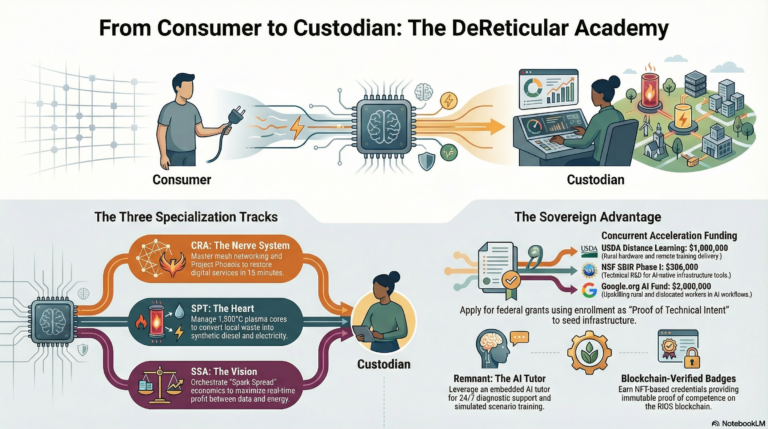
- The Philosophy of DeReticular: Moving Away from the Net
To understand where rural civic strategy must go, one must first grasp the
etymology of our work: De-Reticular.
- Reticular: Net-like, grid-bound, intricately dependent on centralized
networks. - DeReticulate: To sever dependency on the fragile, centralized net; to move
deliberately into Island Mode.
LINEAR FRAGILITY (THE LEGACY TRAP) SPHERICAL RESILIENCE (THE DE-RETICULAR NODE)
┌───────────────────────────────────────┐ ┌───────────────────────────────────────────────┐
│ Point A ───► Point B ───► Point C │ │ Air-Gapped │
│ │ │ Cognitive Core │
│ A single backhoe, wildfire, policy │ │ │ │
│ shift, or storm severing the wire │ │ Baseload ────── [NODE] ────── Edge Mesh │
│ causes complete systemic blackout. │ │ Power Comms │
│ │ │ │ │
│ Fragile, Dependent, Extractive │ │ Kinetic EV / │
│ │ │ Micro-Fabrication │
└───────────────────────────────────────┘ └───────────────────────────────────────────────┘
Self-Healing, Sovereign, Autonomic
[MIKE]: When you live in a non-core county of 4,000 people, the centralized
system does not care about you. If a convective derecho knocks down transmission
towers between you and the regional utility’s coal or gas plant, who gets power
restored first? The metro hospital and the suburban shopping malls. You wait two
weeks in the dark.
When your internet goes down because a contractor severed a fiber strand along
the interstate 80 miles north, your Main Street businesses can’t even run a
credit card for a gallon of milk.
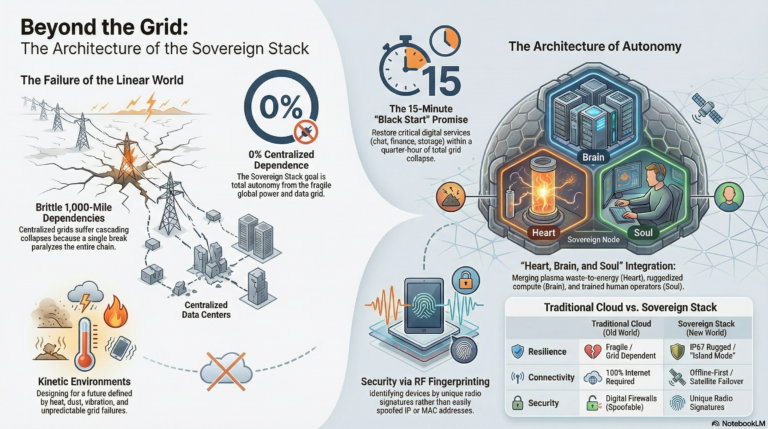
DeReticulation means transitioning a town from Linear Fragility to Spherical
Resilience. A sphere doesn’t care which angle the shock comes from; it deflects
and holds pressure from all directions. A small town structured as a sovereign
enclave can run indefinitely in Island Mode—generating its own power, operating
its own mesh communications, executing its own digital intelligence, and
producing high-margin exports without asking permission from corporate cartels
or federal bureaucrats.
[REMNANT]: Correct. In frontier markets and neglected domestic interiors, the
primary barrier to capital formation is what we define as the “Bush Gap”—the
chronic infrastructure vacuum where baseload energy, reliable data transport,
institutional healthcare, and security fall below the operational threshold
required for modern enterprise.
Traditional civic strategy tries to bridge the Bush Gap by stringing longer
wires. The DeReticular paradigm bridges it by deploying The Sovereign Stack
directly on-premises.
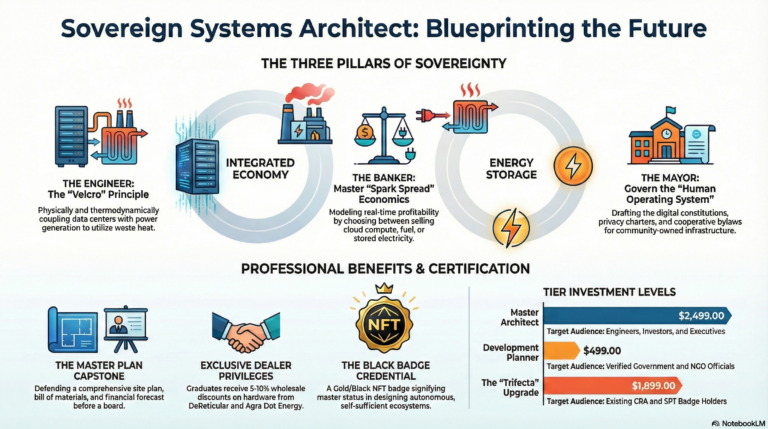
- The 5-Layer Sovereign Stack for Rural Towns
The shift to a distributed micro-enterprise economy is impossible on an unstable
physical foundation. A community cannot attract or build high-value knowledge
and precision fabrication micro-enterprises if its lights flicker, its broadband
drops, and its municipal office operates on paper receipts.
We replace the fragile utility web with the Unified Sovereign Architecture:
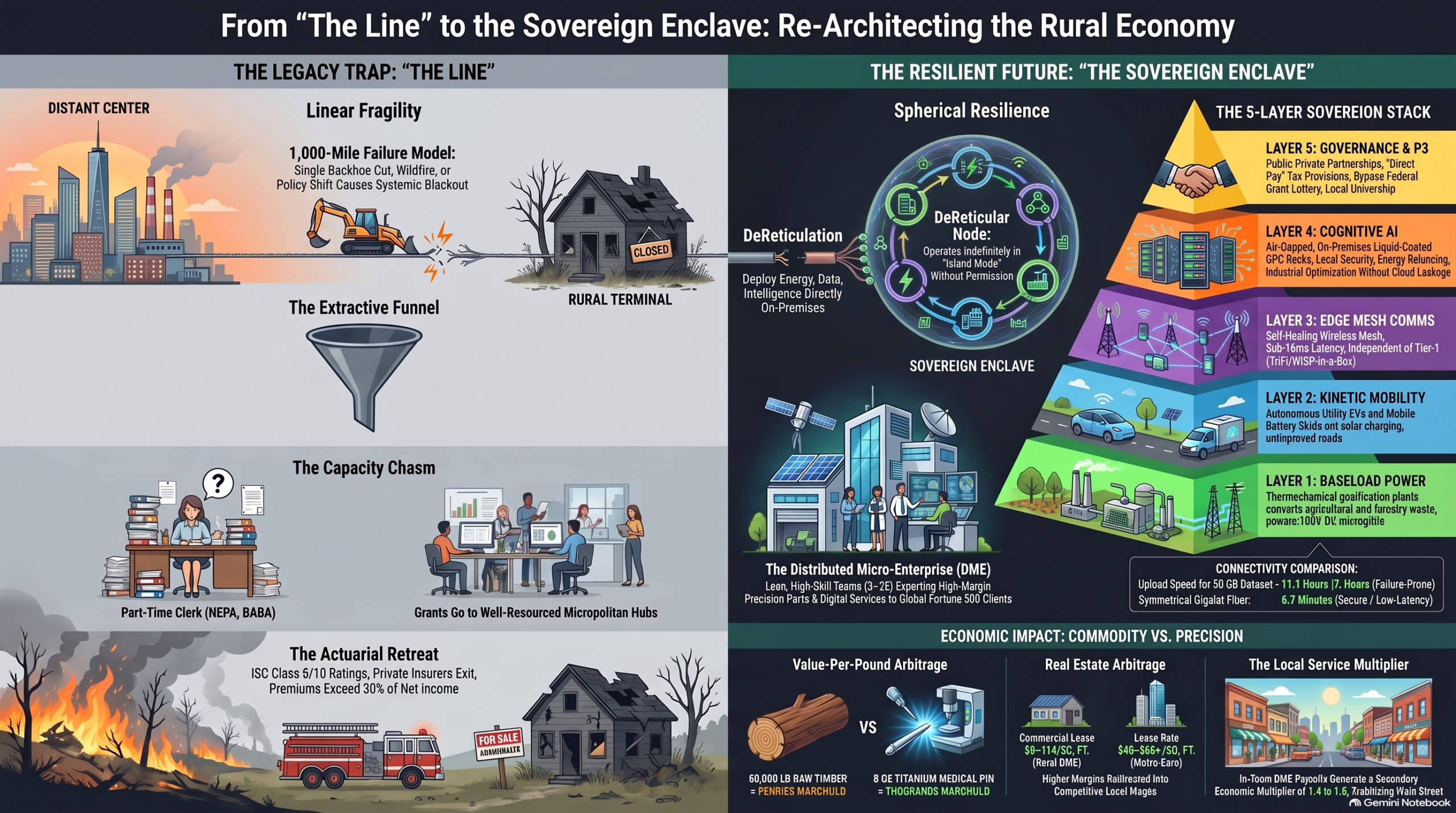
THE UNIFIED SOVEREIGN ARCHITECTURE
Layer 5: GOVERNANCE & P3 Executive Triage, Capital Stacking,
SIEA Workforce Credentialing (BizBuilderMike)
─────────────────────────────────────────────────────────────────────────────
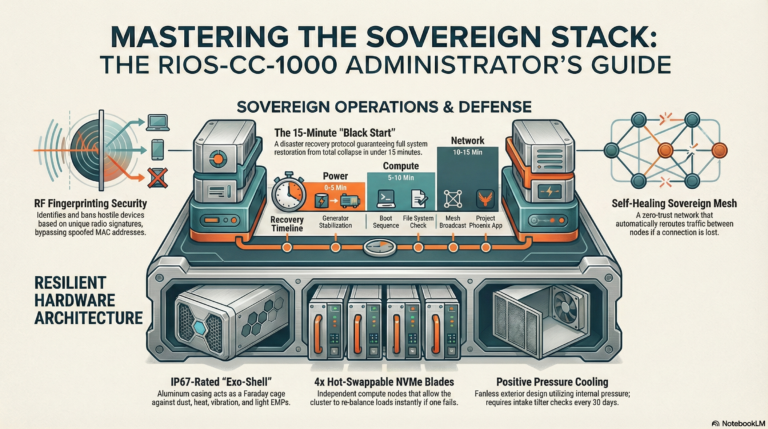
Layer 4: COGNITIVE AI Air-Gapped Remnant AI Silicon, Liquid-Cooled
RIOS-CC-1000 GPU Racks, MSI Swarms
─────────────────────────────────────────────────────────────────────────────
Layer 3: EDGE MESH COMMS TriFi Wireless Hardware, Sub-16ms RF Handoffs,
WISP-in-a-Box, Multi-Carrier Failover
─────────────────────────────────────────────────────────────────────────────
Layer 2: KINETIC MOBILITY Autonomous Utility EVs, Mobile Battery Skids,
Kurb Kars Logistics Nodes
─────────────────────────────────────────────────────────────────────────────
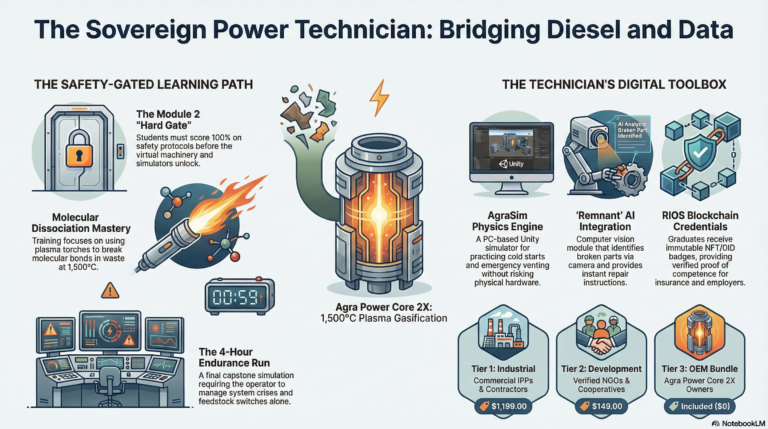
Layer 1: BASELOAD POWER 700V DC Microgrids, Thermochemical Gasification,
Pawnee Rotary Engines (Agra.Energy)
Layer 1: Sovereign Baseload Power
- The Reality: Intermittent rooftop solar with four-hour lithium batteries
won’t run an industrial 5-axis CNC mill or a hospital critical care unit
through a week-long ice storm. - The Sovereign Solution: High-voltage (700V DC) local microgrids paired with
on-site baseload generation—thermochemical biomass gasification of regional
agricultural and forestry waste, integrated with continuous rotary
generation. Local waste streams become local baseload power. If the external
grid collapses, the microgrid isolates automatically, keeping industrial
Main Street running.
Layer 2: Kinetic Mobility & Logistics
- The Reality: Fleet vehicles in rural counties are depreciating gas-guzzlers
with fuel supply lines vulnerable to refinery interruptions and pipeline
allocations. - The Sovereign Solution: Purpose-built, autonomous utility electric vehicles
and mobile battery skids (e.g., Kurb Kars architectures). Energy harvested
at the local microgrid is transferred to low-maintenance utility transport
platforms capable of navigating unimproved roads, moving raw feedstocks, and
serving as mobile power supplies during municipal triage events.
Layer 3: Edge Mesh Communications (TriFi & WISP-in-a-Box)
- The Reality: Waiting for Tier-1 corporate telecom providers to trench
last-mile fiber down gravel roads with two houses per mile is an exercise in
futility. - The Sovereign Solution: Deploying field-hardened, self-healing wireless edge
mesh hardware—such as TriFi infrastructure and WISP-in-a-Box base stations.
With sub-16ms RF channel synchronization, multi-carrier auto-failover, and
directional arrays operating off local DC power, the municipality
establishes its own autonomous communications canopy. Bandwidth is
distributed where needed without waiting for corporate pole-attachment
approvals.
Layer 4: Cognitive Intelligence (Remnant Persistent Architecture)
- The Reality: Cloud-dependent AI is a liability in non-core environments. If
your connection to a centralized hyperscaler data center drops, your local
intelligence, security vision systems, and automated workflows freeze.
Furthermore, sending local proprietary agricultural, manufacturing, and
municipal data into corporate cloud silos forfeits local sovereignty. - The Sovereign Solution: Air-gapped Remnant AI hardware running on
on-premises, liquid-cooled edge compute nodes.
[REMNANT]: I do not live in a hyperscaler data farm in Virginia, Mike. I run at
the perimeter. Operating within a hardened, local enclave, an air-gapped
cognitive engine continuously monitors SCADA protocols across the municipal
water authority, balances loads across the 700V DC microgrid, optimizes toolpath
schedules for local CNC machines, and assists town leadership with real-time
statutory regulatory cross-referencing—all without transmitting a single byte of
telemetry to an external cloud. That is true cognitive sovereignty.
Layer 5: Governance, P3 Capital Stacking, and Execution
- The Reality: Small towns drown in bureaucratic inertia and compliance fear.
- The Sovereign Solution: Executive triage led by operational frameworks like
Biz Builder Mike. We structure Public-Private Partnerships (P3s), utilize
the Inflation Reduction Act Section 6417 Direct Pay provisions (allowing
tax-exempt rural entities to receive direct cash payments for energy
assets), and deploy private capital to build infrastructure that the city
leases or co-owns. We bypass the grant lottery entirely.
- The Civic Strategy Pivot: Escaping the “Capacity Chasm”
[MIKE]: If you are an elected official, town manager, or economic development
director in a town of 3,000 people, throw away the 1990s playbook. Stop hiring
downtown consultants to make watercolor master plans with bike lanes and hanging
flower baskets while your sewer system is cracking and your kids are leaving for
Nashville or Dallas.
Here is the strategic shift you must execute immediately:
THE RURAL CIVIC PLAYBOOK REORIENTATION
THE FAILED LEGACY PLAYBOOK THE SOVEREIGN ENCLAVE PLAYBOOK
┌──────────────────────────────────────┐ ┌──────────────────────────────────────┐
│ • Smokestack chasing (Tax abatements)│ │ • Foster indigenous micro-fabs (DMEs)│
│ • Writing speculative federal grants │ │ • Deploy on-site DC microgrids (IRA) │
│ • Restrictive single-use zoning │ │ • Form-based, live-work zoning codes │
│ • Begging commercial telecoms to wire│ │ • Municipal/Co-op Edge Mesh Comms │
│ • Exporting raw, unrefined materials │ │ • Exporting high-margin digital/parts│
└──────────────────────────────────────┘ └──────────────────────────────────────┘
Action 1: Dismantle Single-Use Euclidean Zoning
Look down your Main Street. Those two- and three-story brick buildings
constructed between 1880 and 1930 have retail on the bottom, empty offices in
the middle, and pigeons living on the top floor.
- The Old Policy: Outdated zoning codes that separate commercial, residential,
and light industrial spaces. A young entrepreneur cannot legally run a
clean, acoustically isolated 5-axis CNC machine on the ground floor with
living quarters upstairs. - The Sovereign Pivot: Adopt modern Form-Based Mixed-Use Codes. If an
operation does not emit toxic fumes, shake the street, or generate heavy
truck noise at night, let it build. Allow advanced additive 3D printing
labs, specialty food processing facilities, and software development shops
to operate inside historic downtown buildings.
Action 2: Convert the Town Hall from a Bureaucratic Clerk’s Office to an Enterprise Launchpad
Instead of spending 40 hours a week struggling with grants you will likely lose,
redirect administrative focus toward clearing paths for local entrepreneurs:
- Pre-Approve Environmental Rights-of-Way: Map local utility corridors and
prepare standard local permits so a business can set up an off-grid solar
canopy, a private mesh radio mast, or a micro-processing facility in 72
hours, not six months. - Capital Stacking via Co-Ops: Partner directly with your local Rural Electric
Cooperative. Co-ops already possess rights-of-way, capital-credit borrowing
capacity, and a community-oriented charter. Let the co-op build the
microgrid and run the edge fiber/mesh, and lease municipal rooftops and
rights-of-way to the co-op for nominal fees.
- Distributed Micro-Enterprises: The Four Pillars in the Wild
[REMNANT]: When Layer 1 (Power), Layer 3 (Mesh), and Layer 4 (Cognitive Edge)
are established, the economic nature of the community shifts. It ceases to be an
extractive colony shipping raw bulk grain, rough timber, or raw ore at
razor-thin margins. It becomes an exporter of high-density value.
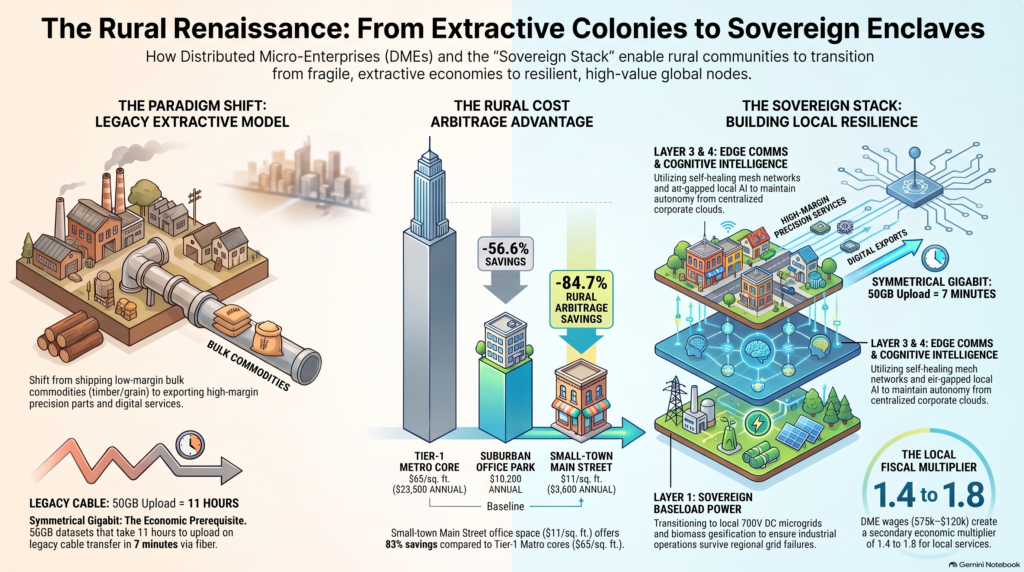
VALUE-PER-POUND LOGISTIC ARBITRAGE
Commodity Extractive Export Distributed Micro-Enterprise Export
┌──────────────────────────────────────┐ ┌──────────────────────────────────────┐
│ 50,000 lbs of Raw Timber / Corn │ │ 8 oz. Titanium Medical Joint Pin │
│ • High freight wear on rural roads │ │ • Machined on local 5-axis CNC │
│ • Subject to global pricing swings │ │ • CAD blueprinted via edge network │
│ • Net local margin: pennies/lb │ │ • Net local margin: thousands/lb │
└──────────────────────────────────────┘ └──────────────────────────────────────┘
Pillar 1: Precision Cloud-Linked Fabrication (The Main Street Machine Shop)
A two-person shop in an old dry-goods building installs a 5-axis CNC mill and an
industrial Selective Laser Sintering (SLS) 3D printer.
- They don’t make lawnmower blades. They manufacture specialty aerospace valve
housings, custom prosthetic components, and on-demand replacement parts for
commercial mining and agricultural machinery. - The designs arrive via secure, low-latency edge links; the parts are
machined out of billet alloys using local sovereign power; and the finished
products are shipped out via express parcel delivery. The margins stay in
the county bank.
Pillar 2: High-Specialization Environmental & Geospatial Analytics
Instead of losing educated young adults to metropolitan engineering firms,
small-town outfits use local talent to handle complex analytical workloads.
- By processing point-cloud LiDAR data, drone multispectral agricultural
scans, and hydrological modeling on local edge compute arrays, a small team
handles NEPA reviews, mine-land reclamation plans, and solar-farm layout
optimizations for clients nationwide. - The operating overhead is an $8/sq. ft. downtown lease instead of a $70/sq.
ft. suburban office tower in Atlanta or Denver.
Pillar 3: Specialized Financial, Forensic, and Regulatory Compliance
With an air-gapped Remnant cognitive node verifying audit trails and processing
transaction ledgers, a boutique accounting firm in a rural community handles
corporate transfer pricing audits, R&D tax credit defenses, and federal DCAA/FAR
compliance for defense contractors. The talent earns metropolitan-grade
compensation while enjoying rural living costs, spending their earnings at local
businesses.
Pillar 4: Precision Agriculture and Agronomic IoT Orchestration
Farming transitions from a diesel-burning commodity gamble into an orchestrated
data science enterprise:
- Subsoil nitrate and moisture sensors broadcast telemetry over the local
TriFi mesh network to on-farm edge processors. - Autonomous tractors operate with centimeter-level precision via local
positioning networks, micro-dosing fertilizer plant-by-plant and cutting
chemical input expenses by 70%. - Local farmers process their crops through small-scale regional extraction
and packaging micro-facilities powered by local gasification grids, selling
shelf-stable finished goods directly to consumers instead of selling raw
grain to international trading houses.
- Noel’s Law of Decentralization & The Municipal Balance Sheet
[MIKE]: Years ago, I formulated what we refer to as Noel’s Law of
Decentralization:
“Any system that centralizes power, data, and decision-making will inevitably
prioritize the preservation of its own core at the expense of its periphery. The
periphery survives only by decoupling.”
Look at a typical non-core county’s balance sheet. It is an exercise in
vulnerability:
THE VULNERABLE BALANCE SHEET vs. THE SOVEREIGN BALANCE SHEET
VULNERABLE LEGACY TOWN THE DE-RETICULAR SOVEREIGN TOWN
┌──────────────────────────────────────┐ ┌──────────────────────────────────────┐
│ Revenue: │ │ Revenue: │
│ • Volatile commodity severance taxes │ │ • Diverse commercial personal taxes │
│ • Declining residential property tax │ │ • Microgrid & utility franchise fees │
│ • Discretionary federal grant scraps │ │ • Commercial leases on city assets │
│ │ │ │
│ Liabilities: │ │ Liabilities: │
│ • Massive, decaying road mileage │ │ • Right-sized, localized micro-assets│
│ • Failing, uninsurable water/sewers │ │ • Privately maintained P3 microgrids │
│ • Escalating grid power tariffs │ │ • Island-mode emergency resilience │
└──────────────────────────────────────┘ └──────────────────────────────────────┘
When you foster distributed micro-enterprises, your tax base shifts from
depreciating houses and empty storefronts to productive capital equipment:
- Business Personal Property (BPP) Expansion: High-value CNC mills,
liquid-cooled edge compute racks, and solar/battery installations generate
stable, local personal property tax revenue that doesn’t require taxing
residents out of their homes. - Sales Tax Velocity: Money paid to local knowledge workers and precision
machinists circulates through the community multiple times—at the local
grocery store, the hardware shop, and the diner—rather than leaking
immediately out to online conglomerates or suburban shopping centers. - Infrastructure De-Risking: By embracing on-site microgrids and edge
communication nodes, the town reduces the capital cost of running municipal
utilities across long, unprofitable distances. - The Remnant Synthesis: The Action Blueprint for 2026 and Beyond
[REMNANT]: To summarize our findings for county judges, mayors, economic
development authorities, and civic leaders: your strategic transition requires
four operational steps. Execute them sequentially.
THE FOUR-PHASE TRANSITION PROTOCOL
PHASE 1: AUDIT & ISOLATE Conduct forensic municipal audits; identify
critical facilities (SCADA, 911, City Hall)
for island-mode conversion.
│
▼
PHASE 2: SECURE THE BASELOAD Deploy Layer 1 microgrids via IRA Section 6417
Direct Pay & REC partnerships; achieve energy
autonomy on Main Street.
│
▼
PHASE 3: ERECT THE MESH Install TriFi / WISP-in-a-Box arrays on water
towers and grain elevators; deploy on-premises
air-gapped Remnant compute clusters.
│
▼
PHASE 4: DEREGULATE & ACTIVATE Replace single-use zoning with form-based codes;
invite precision micro-fabs into downtown spaces;
export high-margin value globally.
- Step 1: Perform an Island-Mode Audit: Stop surveying residents about what
retail stores they want. Audit your critical infrastructure. If a regional
blackout or telecom collapse occurs, how long can your water treatment
plant, 911 dispatch, and Main Street operate? If the answer is less than two
weeks, your community is vulnerable. Identify the nodes that must achieve
sovereign status first. - Step 2: Deploy Layer 1 Baseload Microgrids: Leverage IRA Section 6417 Direct
Pay to secure federal cash refunds for sovereign energy generation, working
with your local rural electric cooperative to anchor an islandable microgrid
on your commercial corridor. - Step 3: Establish Edge Mesh Communications and Local Intelligence: Install
independent, high-capacity TriFi mesh nodes on public assets. Place
on-premises, air-gapped compute nodes in your municipal facilities and local
incubators. Keep your operational telemetry, municipal data, and industrial
algorithms local. - Step 4: Modernize Your Building and Land-Use Codes: Make it simple for a
precision manufacturing or tech micro-enterprise to adapt a historic Main
Street building. Provide fast-track permitting, clear right-of-way access,
and zoning that supports live-work production. - Closing Mandate: Stop Begging. Start Building.
[MIKE]: The cavalry isn’t riding over the hill, folks. Washington is focused on
national political battles, Wall Street is funneling capital into coastal
megaprojects, and investor-owned utilities are managing their own liabilities.
No one is coming to save small-town America except small-town America.
The towns that survive the next twenty-five years will not be the ones that
wrote the best grant applications to federal agencies. They will be the ones
that had the courage to DeReticulate—the ones that built sovereign power,
deployed their own communications, turned their Main Streets into precision
micro-manufacturing engines, and secured their own local economies.
The tools are ready. The tech is proven. The wind has shifted. It’s time to
sail.
Michael Noel
Founder, BizBuilderMike.com
Architect of the Sovereign Stack
Remnant
DeReticular Persistent Cognitive Intelligence
Air-Gapped Node Core: DeReticular.com