The Third Industrial Revolution: A Primer on Decentralized Infrastructure & The Sovereign Future
1. The Core Thesis: Convergence of the Three Internets
In industrial theory, economic revolutions are not merely the result of scientific discovery but the systemic convergence of three specific technological “internets”: Communication, Energy, and Mobility. According to theorist Jeremy Rifkin, when these three regimes merge, they create a new general-purpose technology platform that fundamentally reconfigures the human social and economic organism.
We are currently transitioning from the Second Industrial Revolution—characterized by centralized fossil fuels, top-down telecommunications, and internal combustion—to the Third Industrial Revolution (TIR). This shift represents a move toward a distributed, lateral power structure managed at Zero Marginal Cost.
The Engines of Revolution
| Internet Type | Historical Precedent (1st & 2nd IR) | Modern Equivalent (3rd IR) |
| Communication | Printing Press / Telegraph / Telephone | Digital “Super-Internet,” 5G, & Mesh Networks |
| Energy | Coal & Steam / Centralized Oil & Electricity | Distributed Renewables (Solar, Wind, Plasma Gasification) |
| Mobility | Locomotives / Internal Combustion Engines | Autonomous Electric & Fuel Cell Logistics |
The “So What?”: For the learner, this convergence signals a transition from “Geopolitical Thinking”—where nations compete for scarce, centralized resources—to “Biosphere Thinking.” This is not an incremental update; it is a fundamental shift in how decentralized capital expenditure (Capex) and marginal cost suppression enable local communities to achieve total economic autonomy.
2. The Five Pillars of a Post-Carbon Civilization
To operationalize the TIR, an infrastructure architect must simultaneously deploy the “Five Pillars.” These pillars transform the built environment from a passive consumer of resources into an active, sovereign participant in a global mesh.
- Renewable Energy Transition: Shifting the energy base to distributed sources (Solar, Wind, Biomass).
- Key Insight: This breaks the monopoly of centralized utilities by distributing energy production across the landscape, effectively democratizing the “Means of Production.”
- Buildings as Micro-Power Plants: Converting the building stock into localized generation facilities.
- Key Insight: When every structure functions as a generator, the “consumer” is replaced by the “prosumer,” collapsing the revenue models of centralized power giants.
- Hydrogen & Energy Storage: Deploying storage solutions to manage the intermittency of renewables.
- Key Insight: Scalable storage ensures that decentralized networks maintain baseload stability, removing the systemic dependency on fossil-fuel “peaker” plants.
- Smart Energy-Sharing Grids: Utilizing the “Internet of Things” to create a peer-to-peer “Intergrid.”
- Key Insight: This allows for the lateral exchange of energy, where surplus power is traded as a digital commodity across the network.
- Electric & Fuel Cell Mobility: Transitioning transport to autonomous, electric fleets that plug into the smart grid.
- Key Insight: Vehicles become “mobile batteries,” providing additional storage capacity and stabilizing the decentralized energy market.
The “So What?”: The simultaneous construction of these pillars shifts the focus from individual ownership of scarce assets to collective access within a sharing economy.
3. From Ownership to Access: The Collaborative Commons
The TIR infrastructure platform enables extreme productivity, driving the cost of generating an additional unit of energy or data toward Zero Marginal Cost. In this environment, traditional vertical integration fails, giving way to the Collaborative Commons—a distributed economic space where access-as-a-service replaces the 20th-century obsession with ownership.
Comparison of Economic Eras
| Feature | 20th Century (Industrial) | 21st Century (Collaborative) |
| Power Structure | Centralized & Hierarchical | Distributed & Lateral (Peer-to-Peer) |
| Resource Focus | Ownership (Individual Assets) | Access (Shared Services/Infrastructure) |
| Economic Logic | Scarcity & High Profit Margins | Zero Marginal Cost & Extreme Productivity |
| Strategic Goal | Geopolitical Dominance | Spherical Resilience & Biosphere Stewardship |
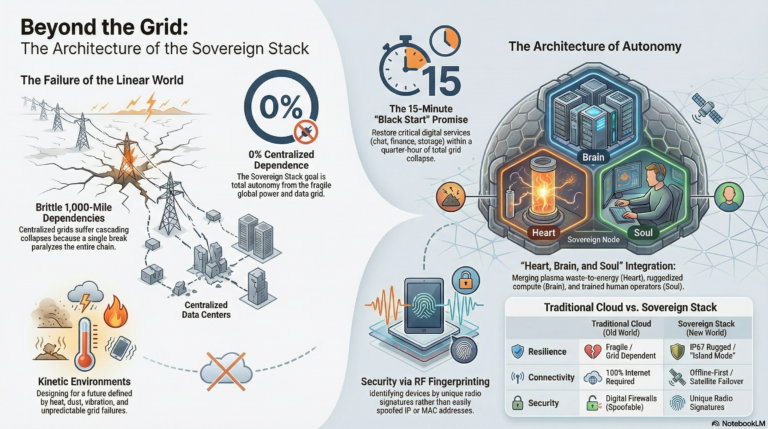
The “So What?”: This transition resolves the Empathy-Entropy Paradox. Historically, as human connectivity (empathy) increased, so did the consumption of energy and the degradation of the environment (entropy). The TIR breaks this cycle by utilizing renewable, distributed systems that foster global connection without planetary exhaustion.
4. Case Study: DeReticular’s “Sovereign Stack” as TIR Implementation
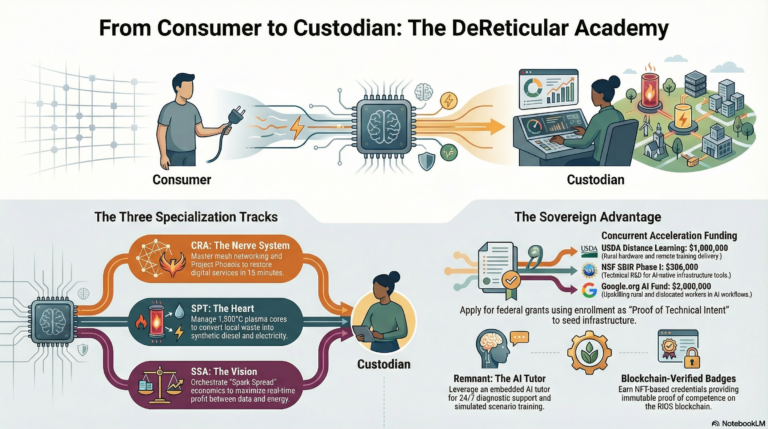
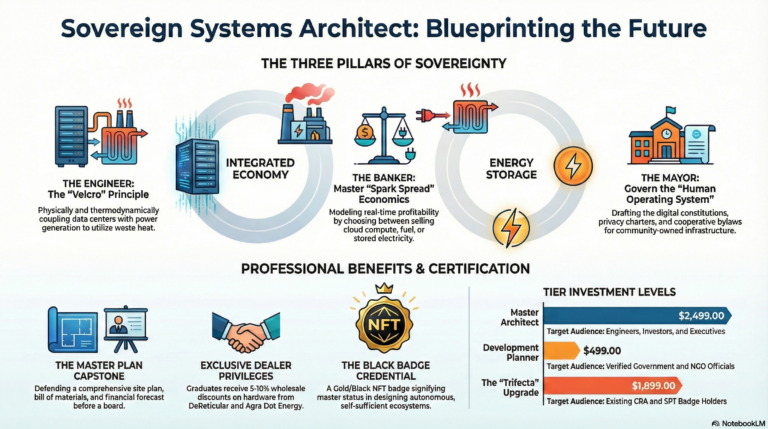
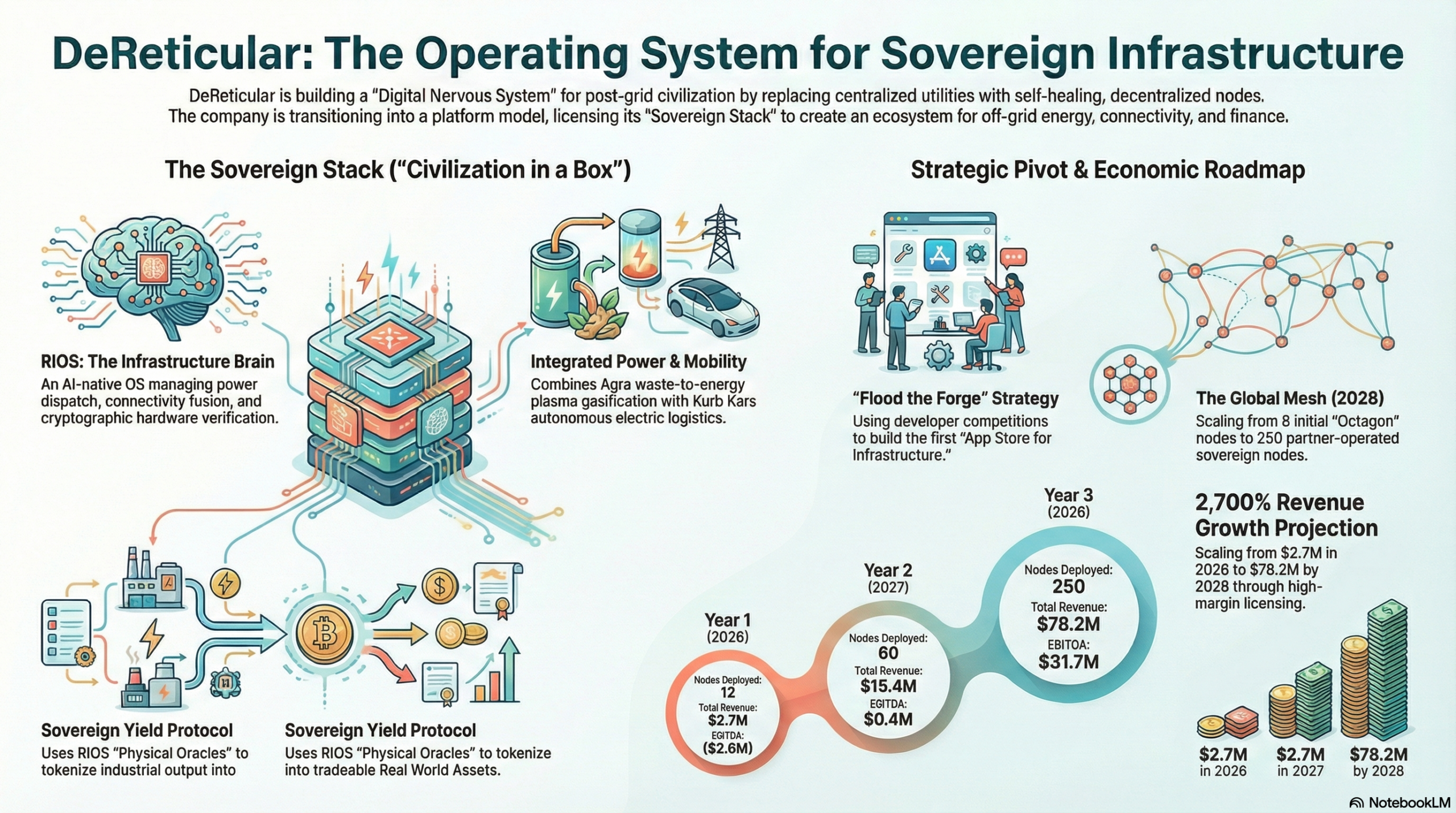
DeReticular acts as an industrial venture studio, providing the “Civilization in a Box” hardware required to host the Collaborative Commons. Their model utilizes a “Venture Studio” approach—a platform for the “App Store for Infrastructure”—where third-party developers build applications on top of a vertically integrated technological stack.
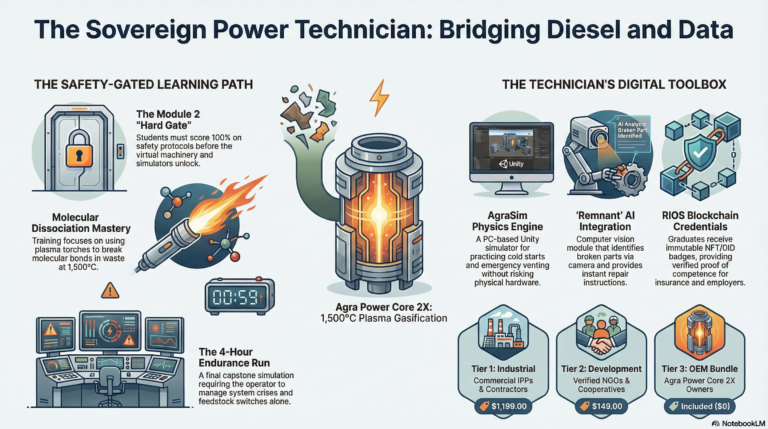
- The Heart (Energy): Agra Dot Energy units fulfill Pillars 1, 2, and 3. By utilizing Plasma Gasification, these units convert agricultural waste and biomass into continuous baseload electricity and bio-char, providing carbon-negative power.
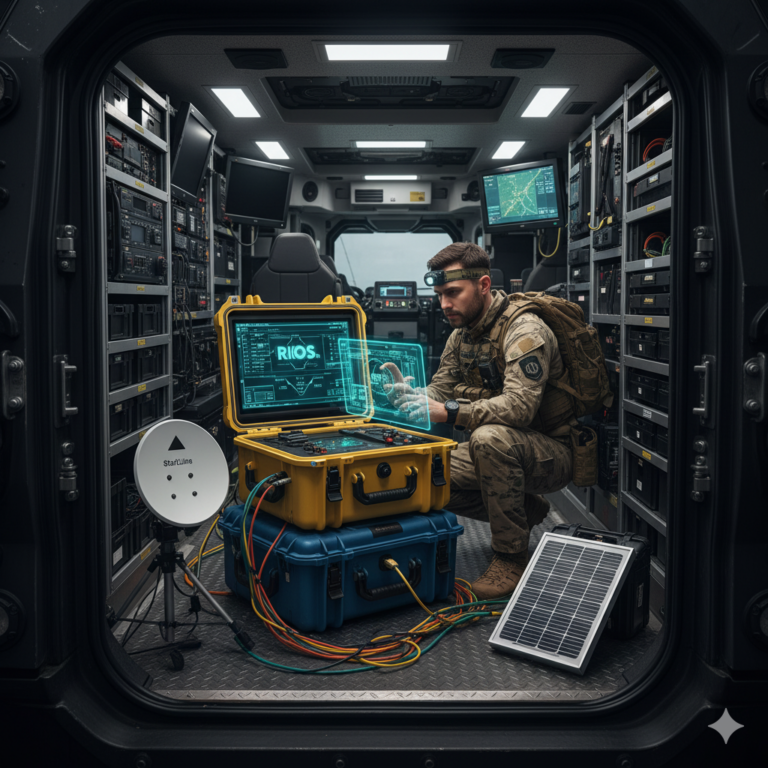
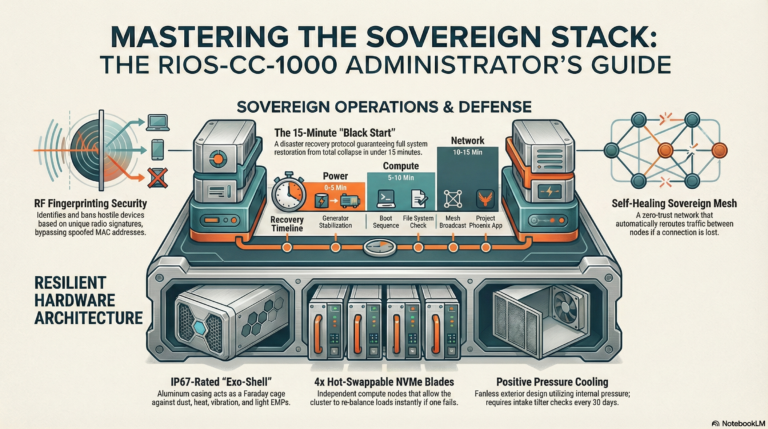
- The Brain (Communication/Compute): RIOS (Rural / Robotic Infrastructure Operating System) serves as the “Digital Nervous System.” It functions as a Physical Oracle, using Radio Frequency Fingerprinting to cryptographically verify hardware identity and solve the “Oracle Problem” (ensuring real-world data is not spoofed).
- The Motion (Logistics): Kurb Kars are autonomous electric rovers that provide the logistics layer for Pillar 5, powered by the Sovereign Stack.
The “So What?”: This infrastructure enables Island Mode—a state of Spherical Resilience where a community (such as Node 4 in Uganda’s 7,000-acre eco-park) maintains total energy, data, and financial continuity even if the global grid fails.
5. Financializing the Commons: DePIN and Sovereign Yield
To scale this infrastructure, DeReticular utilizes DePIN (Decentralized Physical Infrastructure Networks) to turn physical activity into Sovereign Yield. By using RIOS as a “Zero-Trust Oracle,” communities can convert industrial output into Real World Assets (RWA) that bypass traditional banking gatekeepers.
The “Proof of Industry” Lifecycle
- Physical Activity: A farmer processes hemp waste in an Agra Dot Energy unit (as seen in the Hempgrade AI pilot).
- Verification: RIOS uses computer vision and IoT sensors to verify the quality and conversion of the biomass.
- Tokenization: The system mints Bio-Energy Credits—Digital Commodities representing energy and sequestered carbon.
- Liquidity: These credits are used as collateral in the Sovereign Yield Protocol, allowing the community to access global DeFi liquidity.
The “So What?”: This system leverages the CLARITY Act to classify tokens as “Digital Commodities” (under CFTC jurisdiction) rather than securities, and the GENIUS Act to settle transactions in regulated stablecoins. This “Regulatory Alpha” allows institutional capital to fund rural infrastructure with “Zero-Knowledge Proofs” (ZKP) that protect sensitive data sovereignty while proving creditworthiness.
6. Conclusion: The Path to Biosphere Consciousness
The shift to decentralized infrastructure is the final evolutionary step toward a regenerative economic system. By moving from a centralized, extractive model to a distributed, self-healing mesh, humanity can finally align its economic requirements with the health of the planet.
Learner’s Checklist for the Future Architect
- Zero Marginal Cost: Design for environments where the cost of production approaches zero, favoring access over ownership.
- Spherical Resilience: Ensure every node is capable of Island Mode to survive systemic global failures.
- Physical Oracles: Use RIOS-tier hardware to bridge the gap between physical work and digital value, solving the Oracle Problem.
- Proof of Industry: Implement tokenization of tangible outputs like Bio-Energy Credits to unlock “dead capital.”
- Regulatory Alignment: Utilize the CLARITY and GENIUS Acts to move assets into the deep liquidity of the commodities markets.
The “So What?”: The ultimate objective of Sovereign Infrastructure is to foster a world where economic activity reinforces the biosphere rather than depleting it, creating a foundation for a truly global, empathetic community.