Strategic Operational Plan: Navigating the CodeLaunch Accelerator Cycle
1. The Strategic Foundations of CodeLaunch
CodeLaunch functions as a sophisticated catalyst for “conscious capitalism,” a model designed to bridge the gap between early-stage innovation and professional execution. Since its inception in 2013 by its parent company, Improving, the platform has cultivated a community of investors, technologists, and founders by removing the traditional barriers of entry. The mission is clear: provide acceleration without the friction of equity loss or entry fees. By eliminating these costs, CodeLaunch protects a founder’s long-term capitalization table while delivering high-value technical momentum through partnerships with elite software development teams.
Operational Protocol: Contractual Prerequisites Before a venture moves into the competitive stream, two critical legal pillars must be addressed to provide mutual assurance:
- The NDA: A foundational non-disclosure agreement designed to protect intellectual property and ensure the confidentiality of the pitch materials.
- The Semifinalist Agreement: A prerequisite for advancing to the semifinalist stage, outlining the professional expectations and commitments required of the founder.
The 6.5-Week Macro Timeline The cycle from submission to showcase is a high-intensity, 6.5-week sprint. Founders must align their internal operations with the following milestones:
- Application Deadline: The formal submission of venture data.
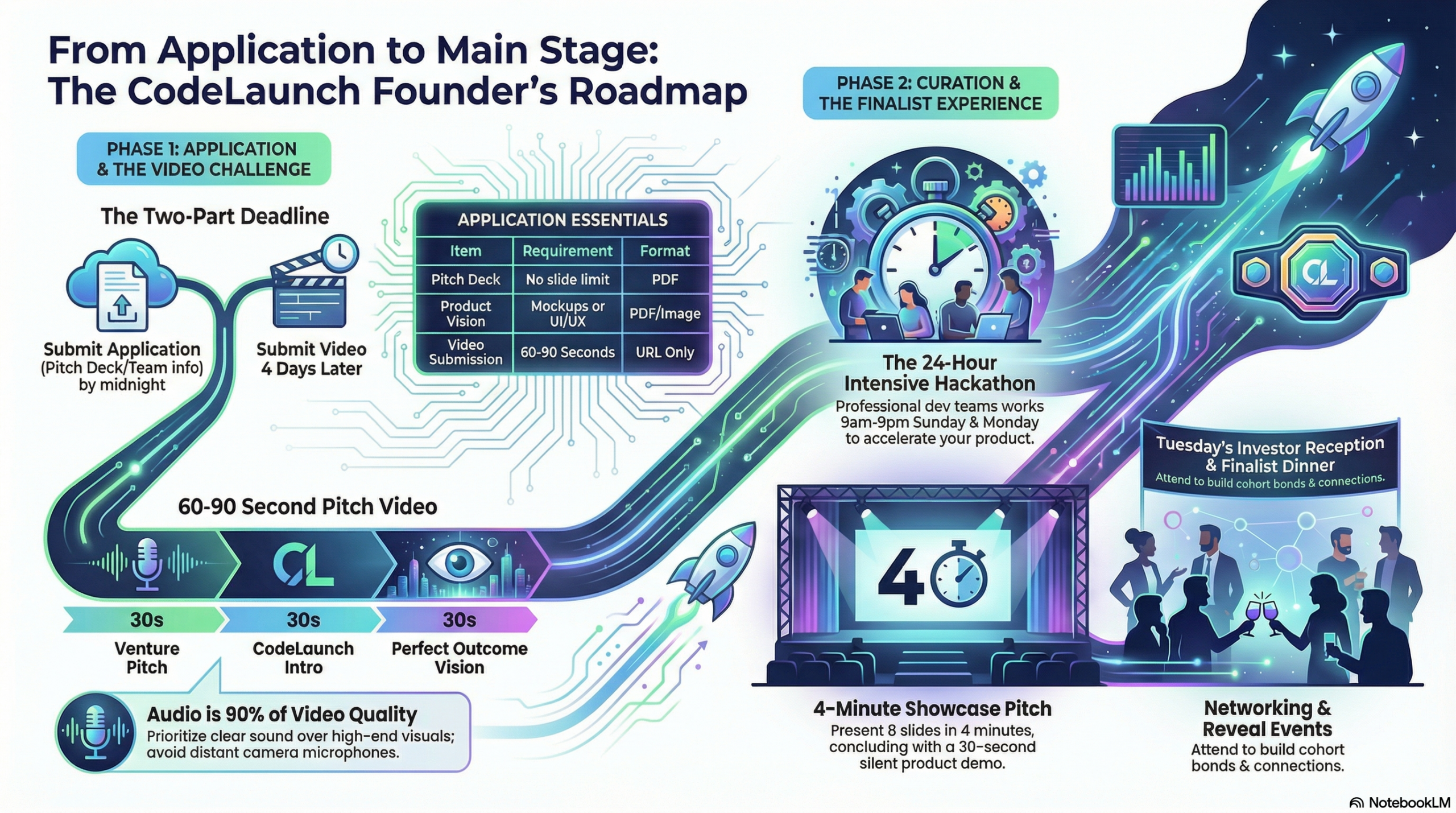
- Video Challenge Deadline: Submission of the Cohort Acceptance Appeal Video (4 days post-application).
- Acceptance Reveal: A synchronized live stream and local event.
- The Homework Phase: A 7-to-10-day intensive “document, execute, and level up” sprint.
- Semifinalist Pitch Meetings: Deep-dive vetting of the top 24–27 startups.
- The Draft: Selection of finalists from the “Draft Pool.” Note: The pool contains more startups than available teams, ensuring a competitive selection environment where only the most “code-ready” are chosen.
- The Finalist Showcase: The professional hackathon and stage presentation.
Success in this cycle begins with the meticulous assembly of the initial application assets, which serve as the primary filter for entry.
——————————————————————————–
2. Phase I: Mobilization and Asset Preparation
The initial application phase is the first strategic filter of the curation process. While the data entry requires only 30 minutes, the underlying assets determine the trajectory of the venture. These materials are not merely submissions; they are signals of professional readiness and the “passion and drive” required to scale.
Asset Requirement Architecture
Founders are required to provide a comprehensive data set to ensure “Apples to Apples” comparisons during curation:
- Organizational Data: Team composition, Venture details, Raise History, Product Maturity, and Business Metrics.
- The Pitch Deck: Must be submitted in PDF format. This should be the founder’s most current, high-fidelity deck.
- UI/UX Mockups (Code-Ready): Professional-grade wireframes are the gold standard. High-quality mockups indicate that the product is ready for a professional dev shop to begin execution immediately.
- The Embryonic Vision Document: For idea-stage startups lacking mockups, a one-page PDF must be submitted. This document must convincingly articulate the product’s disruptive vision to compensate for the lack of visual assets.
Competitive Differentiation Analysis
The quality of UI/UX mockups serves as the primary differentiator between “Accepted” and “Semifinalist” status. High-fidelity designs signal to curators that a founder has already invested significant effort into the product’s architecture. Once these static assets are secured, the founder must pivot immediately to the Digital Influence Challenge.
——————————————————————————–
3. Phase II: The Digital Influence Challenge (Video Submission)
The Stage 2 challenge involves the creation of the “Cohort Acceptance Appeal Video.” This is a tactical test of a founder’s digital marketing acumen and storytelling ability. It serves a dual purpose: vetting the founder’s “hustle” and growth-hacking CodeLaunch visibility through the founder’s network.
Operational Protocol: The 90-Second Blueprint
The script must be divided into three precise 30-second segments:
- The Venture Vision (0-30s): A high-impact elevator pitch defining the market disruption.
- The CodeLaunch Partnership (30-60s): An explanation of the value of free professional development, including the specific date and theater location of the event.
- The Strategic Ask (60-90s): A description of the “perfect outcome” (e.g., closing a specific seed round) and a call-to-action for the audience to subscribe to the CodeLaunch channel.
Production Quality: “Audio is King”
Founders must adhere to professional audio standards. Built-in camera or cell phone microphones are unacceptable due to room echo and low clarity.
- Command: Utilize a lavalier microphone or a dedicated wired headset.
- Command: Rigorously manage the environment to eliminate lawnmowers, sirens, or construction noise.
The “Proxy Influence Strategy” (Stealth Mode)
For founders in stealth mode, identity preservation is maintained through a Proxy Influence Strategy. A “trusted confidant” with an established following records the video on the founder’s behalf. The confidant explains the stealth nature of the venture and makes the “Strategic Ask” to their audience. This leverages the confidant’s reach to satisfy competition requirements without compromising the founder’s brand or employment.
——————————————————————————–
4. Phase III: Tactical Logistics and Resource Management
The transition from “Accepted” to “Semifinalist” marks the beginning of the “Homework Phase.” This is a 7-to-10-day sprint designed to force founders to document, execute, and level up their startups, ensuring they meet the maturity standards of the professional dev teams.
Resource Allocation Audit
| Resource Expenditure (Sweat Equity) | Monetary Requirements (Bootstrapping) |
| High-intensity “hustle” and 7-10 day homework sprint. | Airfare/travel to the host city. |
| Sunday/Monday hackathon sacrifice. | Hotel accommodations (via CodeLaunch partners). |
| Embedding a teammate with the dev shop. | All marginal bootstrapping expenses. |
Logistics of the Host City Transition
Finalists must be physically present for the acceleration event. Protocol dictates arrival in the host city no later than the Saturday night prior to the hackathon. This ensures the team is ready for a sharp 9:00 AM start on Sunday morning at the dev shop location (e.g., the Improving office).
——————————————————————————–
5. Phase IV: The 24-Hour Professional Hackathon
The CodeLaunch hackathon is a high-stakes professional acceleration event. Over a 24-hour cycle (split into two 12-hour days), professional developers deliver what is mathematically equivalent to three business days’ worth of work per person.
The “Mutual Sacrifice” Framework
The Sunday/Monday schedule is a symbolic and professional alignment of interests:
- The Developers: Sacrifice personal time (Sunday).
- The Company: Sacrifices professional billable hours and business goals (Monday). The founder must match this sacrifice by having a dedicated teammate embedded with the developers to provide instant product guidance and context.
On-Site Content Capture
Founders must remain “video ready” throughout the hackathon. The “Paper Light” production team will interrupt workflows for 20-minute segments to capture quotes and team dynamics. This content is high-stakes, as it may be utilized in the “World Championship” or global social media campaigns.
——————————————————————————–
6. Phase V: Showcase Execution and Long-Term Capitalization
The final 48 hours represent the “Showcase Phase,” where years of acceleration are condensed into minutes.
The “Silent Demo” and Pitch Protocol
Founders must master the following presentation constraints:
- The 4-Minute Pitch: Limited strictly to eight slides. Founders will use entertainment-grade clickers ($650 value) and must attend the rehearsal at 11:30 AM sharp on the day of the event to master stage lights and monitors.
- The 30-Second Silent Video: A demonstration of the “Secret Sauce.” Operational Command: Skip the login screens. The video must be silent, allowing the founder to narrate the disruptive core of the tech.
- The Mandatory Conclusion: The demo video must conclude with the founder explicitly thanking the hackathon team by their specific brand name.
Production Standards: Paper Light Requirements
Founders must coordinate with the Paper Light team regarding technical specifications for the demo video, including codec, orientation, and bit depth as specified on the event page. This ensures seamless playback on the showcase stage.
Maximizing Strategic Outcomes
- Investor Reception: Strategic founders utilize this “chill environment” for deep-dive business conversations, contrasting it with the “rockus party” of the main event.
- Post-Event Momentum: The Afterparty and Finalist Dinner are mechanisms for building a lifelong cohort bond. These relationships often lead to long-term growth and eventual exits.
Final Summary: The 6.5-week CodeLaunch cycle is a rigorous operational test. By adhering to these protocols—from the initial NDA to the 11:30 AM rehearsal call—a committed founder can transform an embryonic vision into a code-accelerated, investor-ready venture. Success requires the discipline to match professional development with personal sweat equity.