Study Guide: DeReticular and the Sovereign Rural Infrastructure Ecosystem
This study guide provides a comprehensive overview of the transition from centralized, linear infrastructure to decentralized, sovereign nodes in rural America. It covers the technological, philosophical, and financial frameworks established by DeReticular and Agra Dot Energy.
——————————————————————————–
Part I: Short-Answer Quiz
Instructions: Answer the following questions in 2–3 sentences based on the provided source materials.
- What is the core philosophy behind the concept of “The Death of the Line”?
- How does NIR Spectroscopy enhance the efficiency of Micro-GTL units?
- Define “Island Mode” and its importance to the Sovereign Node.
- What are the physical design requirements for Agrivoltaic “Vertical Fences” to remain compatible with standard farming?
- What is the “Spark Spread,” and how is it used in Revenue-Based Financing (RBF)?
- Explain the role of the “Field Foreman” agent within the RIOS ecosystem.
- How does “IRA Direct Pay” benefit rural non-profit cooperatives?
- What is the purpose of the “Locutus Ledger” in a rural community?
- Describe the technical specifications and benefits of vertical bifacial solar panels.
- What are the three primary high-margin output streams generated by the Agra Dot Energy stack?
——————————————————————————–
white paper
Part II: Answer Key
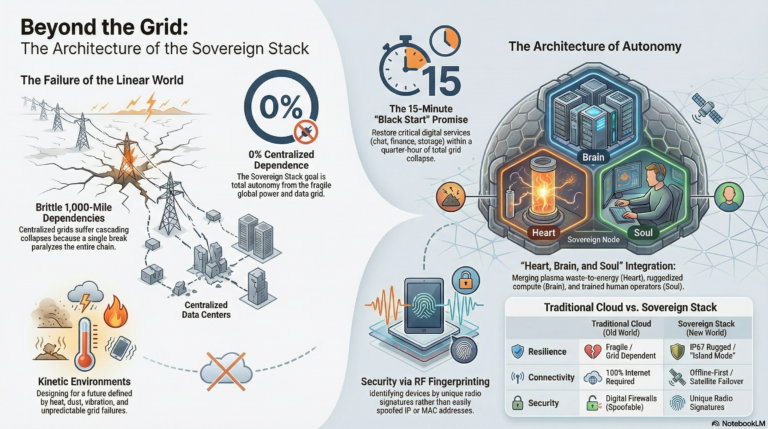
- The Death of the Line philosophy asserts that centralized, linear corridors of power, data, and logistics are structurally fragile and prone to failure. In response, DeReticular proposes “Spherical Resilience,” where self-contained Sovereign Nodes generate their own resources locally to ensure uninterrupted operational continuity.
- NIR Spectroscopy is used at the intake of Micro-GTL units to analyze variable feedstock, such as biomass or waste, in real-time. This allows the AI to predict methane yield and precisely calculate the optimal “blending recipe” for the microorganisms or chemical reactors, boosting gas output by up to 43%.
- Island Mode refers to the capability of a Sovereign Node to function as a self-contained industrial orb, generating its own power, fuel, and intelligence indefinitely. This state ensures that a community or farm remains resilient and operational even when disconnected from the centralized grid or global cloud networks.
- Vertical Agrivoltaic fences must be installed at intervals of at least 7 meters to accommodate the turning radius of standard agricultural machinery like tractors and combines. Additionally, they use geotechnical anchors, such as deep screw-piles, to handle high wind loads without requiring extensive concrete pours.
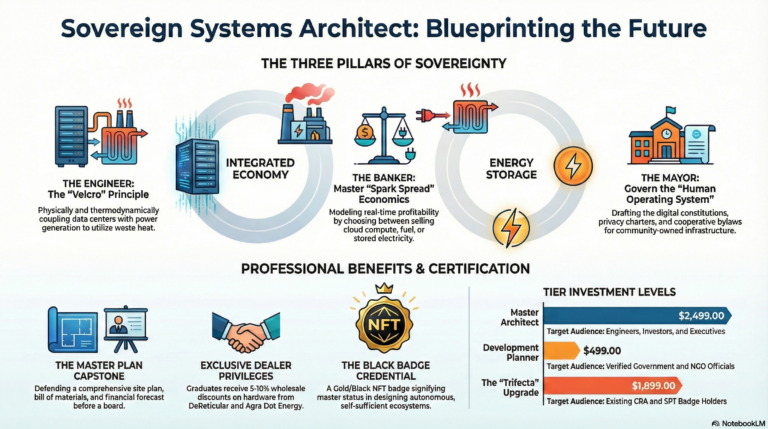
- The Spark Spread is the net delta or difference between the low cost of on-site energy production (e.g., $0.04/kWh) and the higher market utility rate (e.g., $0.12/kWh). In Revenue-Based Financing, this margin is used to pay down the initial hardware CAPEX, allowing entrepreneurs to lease equipment in exchange for a percentage of these earnings.
- The Field Foreman is an autonomous agent or robotic chassis responsible for the maintenance and diagnostics of physical hardware, such as chemical reactor pipes and heavy machinery. It is specifically designed to bypass proprietary software “repair locks” from original equipment manufacturers, ensuring the owner maintains “Right to Repair” sovereignty.
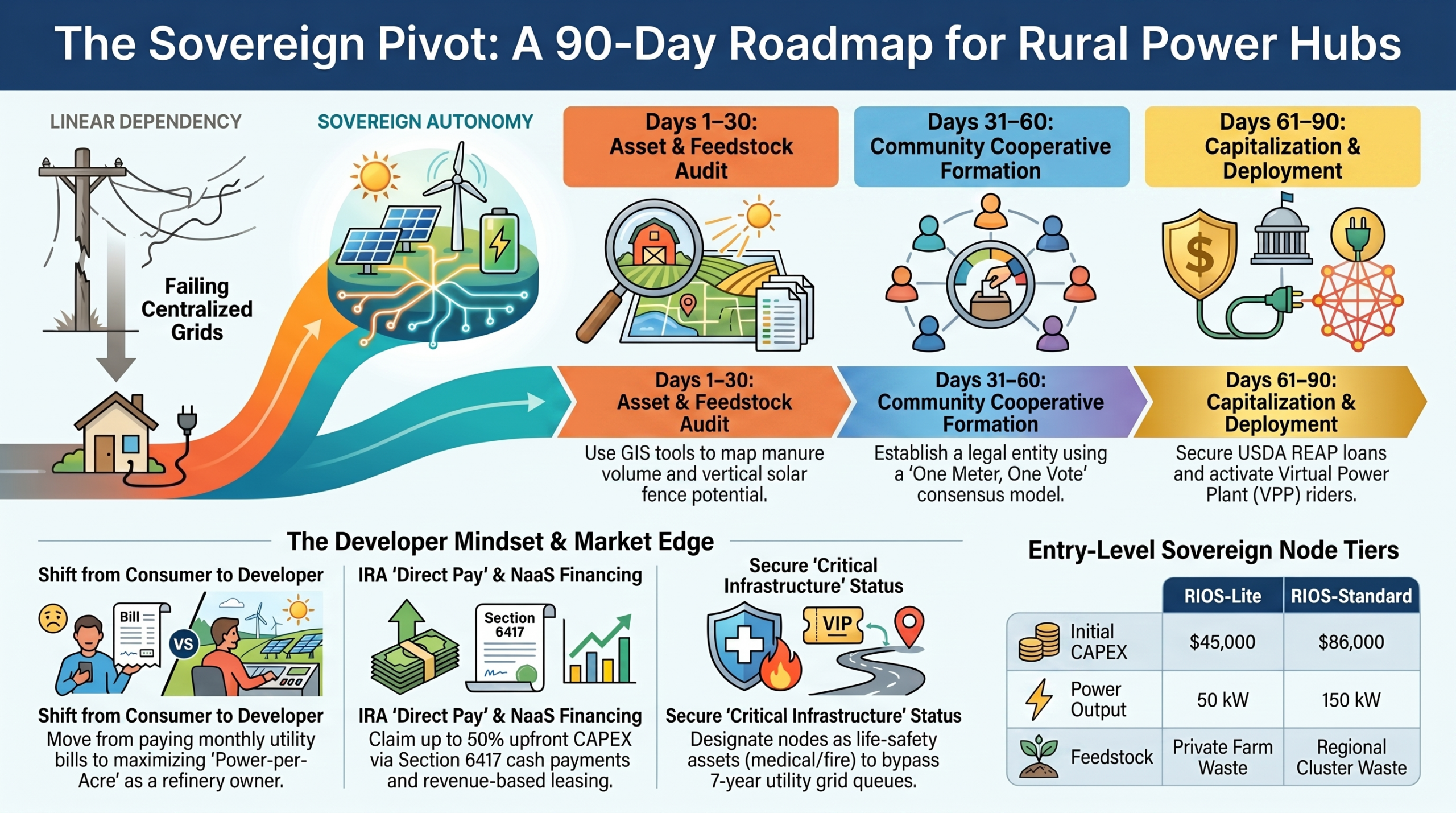
- IRA Direct Pay (under Section 6417) allows non-profit cooperatives and local municipalities to receive elective cash payments from the IRS equal to the value of energy tax credits. This mechanism can effectively fund 30–50% of the initial project CAPEX upfront, significantly reducing the debt load for rural power hubs.
- The Locutus Ledger serves as a peer-to-peer (P2P) settlement layer that enables the exchange of energy-backed tokens within a community. It allows neighbors to trade “work” (joules of energy or teraflops of compute) as a local currency, keeping capital within the town and facilitating low-friction monetary exchange.
- Vertical bifacial panels use N-type cells to capture ground-reflective light from both sides, performing approximately 15% better per surface area than fixed horizontal systems in winter. Their vertical orientation captures peak sun from the east and west while occupying less than 2% of the crop’s physical footprint.
- The three high-margin output streams are 24/7 baseload power (independent of grid instability), ASF™ (Agra Synthetic Fuel) such as diesel or jet fuel produced at the source, and Edge Compute hosting for industries requiring secure, local AI processing.
——————————————————————————–
podcast
Part III: Essay Format Questions
Instructions: Use the provided context to develop comprehensive responses to the following prompts. (Answers not provided).
- The Structural Inversion of the Grid: Analyze how rural America is transitioning from the “tail end” of the energy grid to its strategic “Above the Line” center. Contrast the operational “sclerosis” of traditional utilities with the “dynamic logic” of AI-enabled rural hubs.
- From Consumer to Developer: Discuss the psychological and economic shifts required for a rural entrepreneur to adopt a “Developer Mindset.” How does this transition mitigate the risks associated with the “Physical AI Supercycle”?
- The Role of Agentic Systems in Modern Agriculture: Evaluate how the 70/30 rule of agentic workflows (where AI handles 70% of preparatory tasks) changes the human capital requirements for a modern farm. Discuss the specific roles of the Vault Warden, Field Medic, and Field Foreman.
- Financing the Sovereign Transition: Compare and contrast traditional agricultural lending with innovative models like Node-as-a-Service (NaaS) and Energy-Backed Tokens. Explain why traditional models are insufficient for the “front-loaded” costs of Sovereign Energy kits.
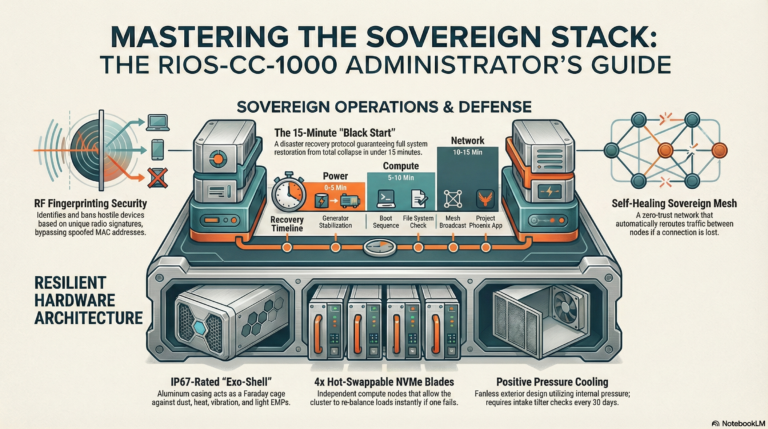
- Digital Sovereignty and the “Contextual Moat”: Explain how air-gapped logic and local server clusters like the RIOS-CC-1000 prevent “Capital Flight” and “Data Capital Flight” to hyperscale cloud providers. Why is “Industry-Deep Context” considered a superior strategic moat compared to generic AI?
——————————————————————————–
video
Part IV: Glossary of Key Terms
| Term | Definition |
| Above the Line | A strategic position where value is derived from proprietary context and physical hardware, insulating a business from the commoditization of generic AI. |
| Agrivoltaics | The simultaneous use of land for both solar energy generation and agriculture, often achieving Land Equivalent Ratios (LER) of 1.2 to 1.6. |
| ASF™ (Agra Synthetic Fuel) | High-grade synthetic diesel or jet fuel produced locally via Micro-GTL units using syngas derived from biomass. |
| Bifacial Panels | Solar panels capable of capturing light on both the front and back surfaces, often mounted vertically to capture reflective light and minimize land footprint. |
| CSTR (Continuous Stirred Tank Reactor) | Modular tanks used in anaerobic digestion to maintain a consistent environment for converting bio-waste into methane and electricity. |
| GTL (Gas-to-Liquids) | A refinery process that converts gaseous hydrocarbons (syngas) into liquid fuels like synthetic diesel. |
| Island Mode | The ability of a power or data hub to operate autonomously and indefinitely without any connection to external centralized grids or networks. |
| LER (Land Equivalent Ratio) | A metric used to measure the productivity of dual-use land; a ratio above 1.0 indicates that integrated farming/energy is more productive than separate operations. |
| Locutus Ledger | A proprietary P2P settlement protocol used to trade energy and compute tokens within a Sovereign Node mesh. |
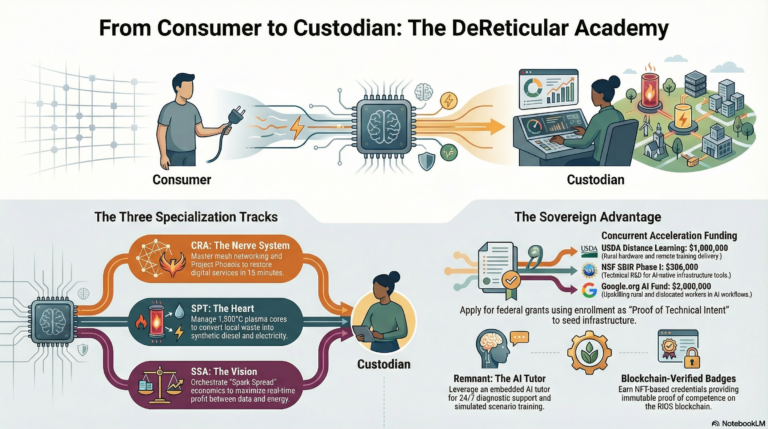
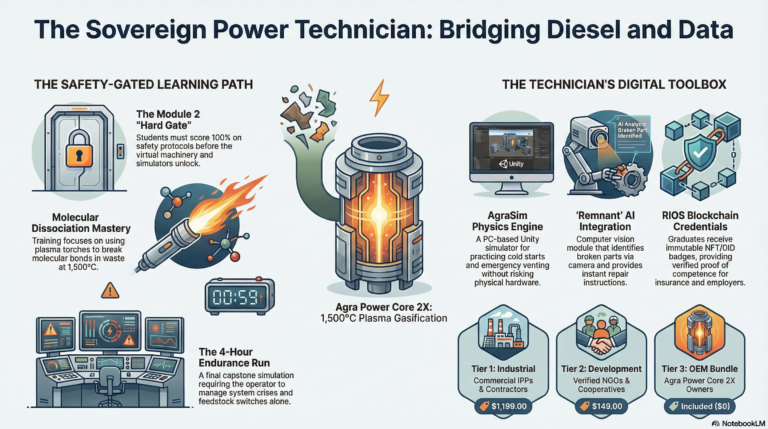
| Micro-GTL Unit | A transportable, modular reactor (roughly the size of a shipping container) that utilizes plasma gasification to convert waste into fuel and power. |
| NIR Spectroscopy | Near-Infrared technology used to scan feedstock at the molecular level to determine energy potential before processing. |
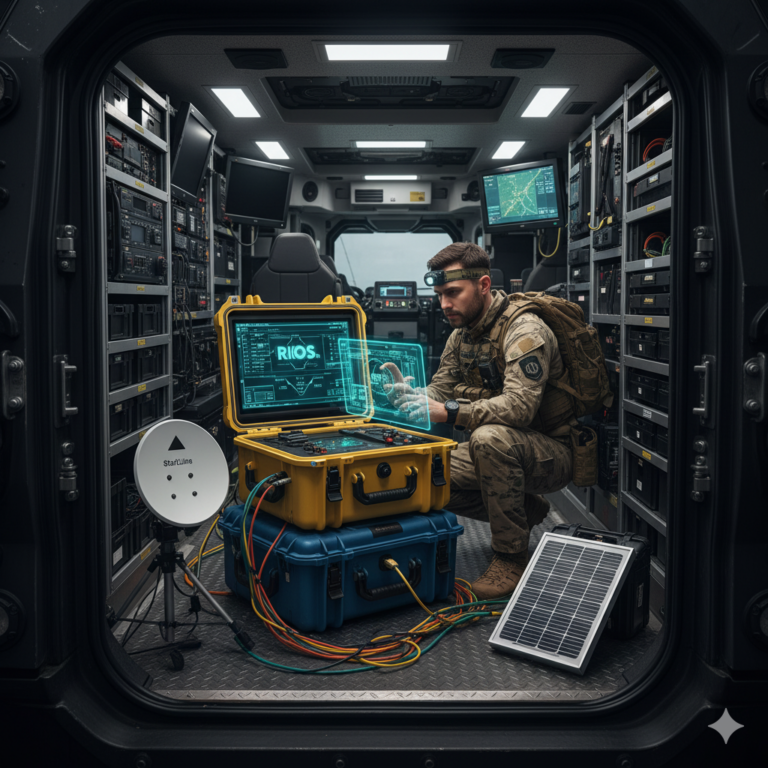
| Nomad Link | A private Wi-Fi 6E and LoRaWAN mesh canopy that provides miles-wide intranet connectivity independent of global internet providers. |
| Plasma Gasification | A process using temperatures exceeding 1,500°C to dissociate molecular bonds in biomass and waste to create syngas. |
| RIOS (Rural Infrastructure Operating System) | The air-gapped “central brain” or kernel that governs the logic, energy output, and agentic workflows of a Sovereign Node. |
| Sovereign Node | A self-contained, resilient industrial hub capable of localized production of energy, fuel, and data intelligence. |
| Spherical Resilience | A design philosophy prioritizing decentralized, multi-directional autonomy over vulnerable, linear dependencies. |
| Syngas | A fuel gas mixture consisting primarily of hydrogen and carbon monoxide produced by the gasification of organic feedstock. |