Comprehensive Study Guide: Node 4 and the Kaabong Smart Eco-Industrial Park (SEIP)
This study guide provides a detailed review of the industrial, technological, and financial frameworks governing Node 4 in Kaabong, Uganda. It explores the transition from a heavy industrial hemp-to-energy complex to a modular “Sovereign Oasis,” covering agronomic practices, autonomous systems, and decentralized finance.
Section 1: Short-Answer Quiz
Instructions: Answer the following questions in 2-3 sentences based on the provided source context.
- What is the Continuous Rolling Rotation Model, and how does it prevent industrial bottlenecks?
- Explain the “Oracle Problem” as it relates to remote infrastructure projects in East Africa.
- How does the plasma gasification system at Node 4 generate continuous power from agricultural waste?
- Identify the three primary partners in the Kaabong Agro-Energy Ltd. SPV and their specific operational responsibilities.
- What was the “Vanguard Pivot” of March 2026, and how did it change the mission of Node 4?
- Describe the mechanical risks associated with harvesting high-tensile industrial hemp fiber and the recommended solutions.
- What are “Controllable Electronic Records” (CERs) under UCC Article 12, and why are they significant for Node 4’s financing?
- How do Grain Weevil robots contribute to post-harvest grain management?
- Define “Spherical Resilience” within the context of the Sovereign Stack Consortium.
- What are the key fiscal incentives offered by the Government of Uganda for companies operating within a Green Special Economic Zone (SEZ)?
——————————————————————————–
Deck
https://academy.dereticular.com/wp-content/uploads/2026/06/The_Kaabong_Perpetual_Engine.pdf
Section 2: Quiz Answer Key
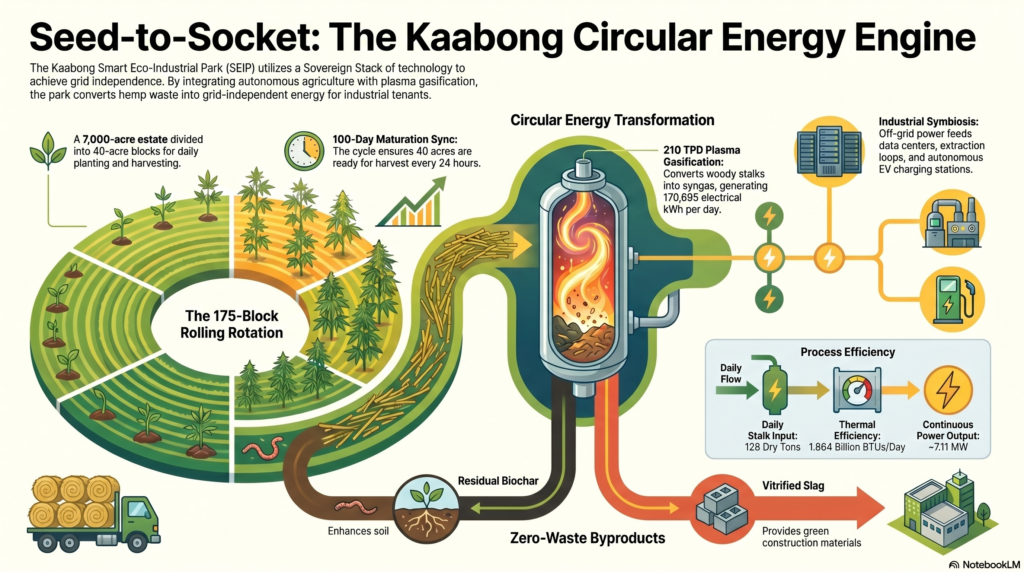
- Continuous Rolling Rotation Model: This model divides a 7,000-acre estate into 175 operational blocks of 40 acres each, where planting and harvesting occur simultaneously every day. This ensures a consistent daily intake of raw material (128 dry tons of stalks and 100 wet tons of foliage), maximizing equipment utilization and preventing seasonal bottlenecks at processing facilities.
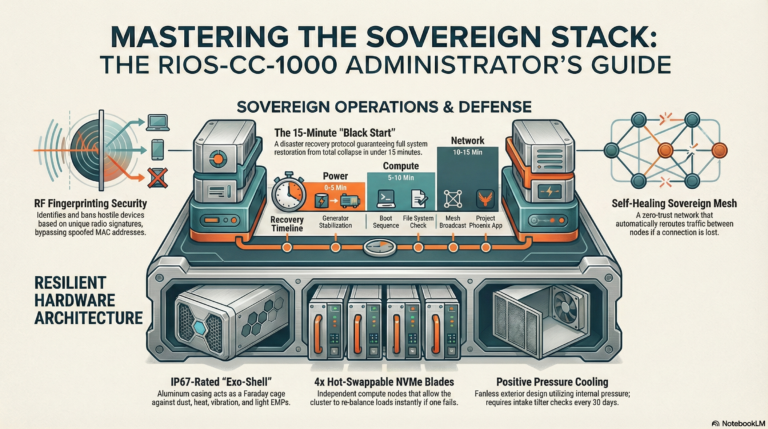
- The Oracle Problem: This refers to the spatial and temporal disconnect where global institutional lenders require empirical, verifiable proof of physical production before issuing credit. Node 4 solves this by using the RIOS Pilot Command Center to capture real-time telemetry and zero-knowledge proofs, creating a “Digital Twin” that serves as mathematically verified proof of yield.
- Plasma Gasification Energy: The system processes 128 dry tons of hemp stalks per day, which have a heating value of 6,500 BTU/lb, creating 1.664 billion BTUs of thermal energy. Using a combined-cycle gas turbine with 35% efficiency, this generates approximately 170,695 kWh of electrical power daily, resulting in a continuous output of roughly 7.11 MW.
- SPV Partners and Roles: Agra Energy Uganda (AEU) manages local land, labor, and agronomic operations; DeReticular provides the RIOS software, edge AI, and compute infrastructure; InVentures leads capital stacking, financial engineering, and hardware scale-up. Each partner holds a specific equity stake (AEU 35%, DeReticular 35%, InVentures 30%) to balance local execution with proprietary technology and capital.
- The Vanguard Pivot: Executed on March 24, 2026, this shift moved Node 1 (human logistics) to Chicago and redesignated Node 4 from an “Industrial Engine” to a “Sovereign Oasis.” The pivot was driven by logistical latencies and transport bottlenecks, refocusing Node 4 on off-grid hospitality, eco-tourism, and modular sovereign stack validation.
- Mechanical Risks and Solutions: Hemp’s high tensile strength causes fibers to wrap around spinning components of conventional disc mowers, leading to bearing seizures. To mitigate this, the fleet uses reciprocating sickle-bar mowers or modified draper headers that shear the stalks cleanly, and operators raise cutter bars to harvest only the seed heads.
- CERs and UCC Article 12: Article 12 defines tokenized assets, like RIOS Digital Twin NFTs, as Controllable Electronic Records (CERs). This classification allows lenders to “perfect” their security interest through cryptographic control rather than paper filings, enabling them to seize digital titles to physical assets in the event of a default.
- Grain Weevil Robots: These are compact, semi-autonomous robots deployed inside primary drying bins to maneuver across the grain surface using auger-based propulsion. They break up crust layers and level the seed pile to optimize airflow, which prevents pocket mold and spoilage while reducing manual labor requirements.
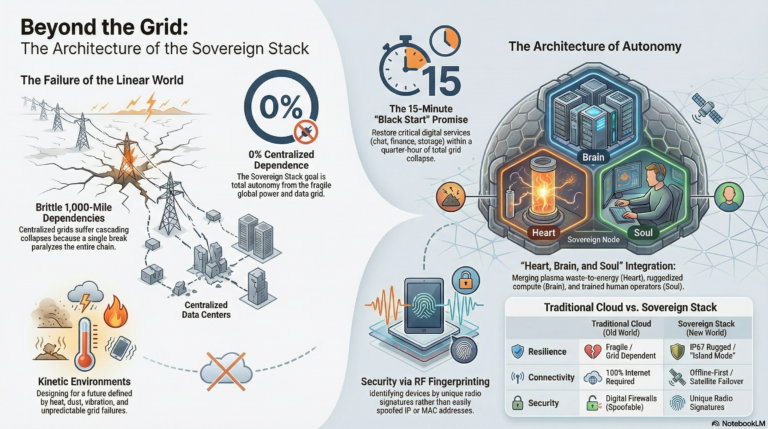
- Spherical Resilience: This concept, promoted by the Sovereign Stack Consortium, involves moving away from vulnerable, centralized infrastructure toward independent “islands” of automation. It is achieved by combining TriFi’s resilient hardware, DeReticular’s air-gapped RIOS software, and InVentures’ capital stacking to ensure utilities and data remain functional even if global networks fail.
- Green SEZ Fiscal Incentives: Qualifying companies can access a 10-year corporate income tax holiday (if exporting \ge 80% of output), 0% import duties on plant and machinery, and stamp duty exemptions on land leases. These incentives are managed by the Uganda Investment Authority (UIA) to drive investor ROI and shorten capital recovery cycles.
——————————————————————————–
Podcast
Section 3: Essay Questions
Instructions: Use the provided sources to develop comprehensive responses to the following prompts. (Answers not provided).
- The Circular Economy Model: Analyze how the Kaabong Smart Eco-Industrial Park integrates agricultural production, renewable energy, and digital infrastructure into a closed-loop system. Discuss the role of “industrial symbiosis” in maximizing profitability and resource efficiency.
- Technological Integration and Autonomy: Evaluate the impact of autonomous swarms, GPS-RTK guidance, and the RIOS “Sovereign Stack” on the operational viability of a 7,000-acre estate. How do these technologies address the specific challenges of the Karamoja sub-region?
- Financial Engineering in Developing Markets: Explain the “Capital Stacking” methodology used by InVentures. Discuss how private equity, multilateral grants, and RWA tokenization work together to de-risk high-CAPEX industrial projects in environments with limited traditional infrastructure.
- Agronomic and Industrial Specifications of Hemp: Compare the cultivation and harvesting requirements for high-density fiber stands versus low-density grain stands. Include a discussion on harvest timing, moisture management, and the retting process.
- Strategic Evolution of Operation Octagon: Discuss the transition of Node 4 from the “Industrial Engine” to the “Sovereign Oasis.” What does this shift suggest about the challenges of heavy industrialization in remote areas and the benefits of modular, off-grid resilience testing?
——————————————————————————–
Section 4: Glossary of Key Terms
| Term | Definition |
| BESS | Battery Energy Storage System; used at Node 4 for localized continuous power storage. |
| Bast Fiber | The strong, high-tensile outer bark of the hemp stalk used for textiles, automotive composites, and specialty paper. |
| Biochar | A carbon-rich byproduct of plasma gasification used as a soil amendment and for long-term carbon sequestration. |
| CER | Controllable Electronic Record; a legal classification under UCC Article 12 for digital assets like Dynamic NFTs. |
| Decortication | The mechanical process of separating the outer bast fiber from the inner woody hurd of a hemp stalk. |
| Digital Twin | A cryptographically verified digital proxy (often a Dynamic NFT) that carries the legal title and performance data of a physical asset. |
| eCBA | Extended Cost-Benefit Analysis; a mandated report in Uganda that tracks Natural Capital (carbon) and Social Capital (labor) in real time. |
| Hemp Hurd | The woody, silica-rich inner core of the hemp stalk; used for hempcrete, animal bedding, and bioplastics. |
| Island Mode | An operational state where a facility functions completely independently of national utility and telecommunication grids. |
| Locutus Ledger | A cryptographically signed, local, append-only database used by RIOS to protect logs and telemetry. |
| MaaS | Mobility-as-a-Service; the business model for the Kaabong Kars autonomous electric shuttle fleet. |
| Plasma Gasification | A high-temperature thermal process that converts organic matter (like hemp stalks) into synthesis gas (syngas) and vitrified slag. |
| Retting | The process (often dew-based) where moisture and fungi decompose the pectin bonds binding bast fibers to the woody hurd. |
| RIOS | Rural Infrastructure Operating System; the decentralized “brain” or operating system that manages off-grid hardware and AI agents. |
| vSIM | Virtual SIM; technology used by TriFi Wireless to provide automatic failover across multiple cellular carriers. |
| Zero-Knowledge Proof | A cryptographic method that allows one party to prove a statement is true without revealing the underlying data. |