
Evolution of Cellular IoT: From 5G RedCap to 6G Foundations

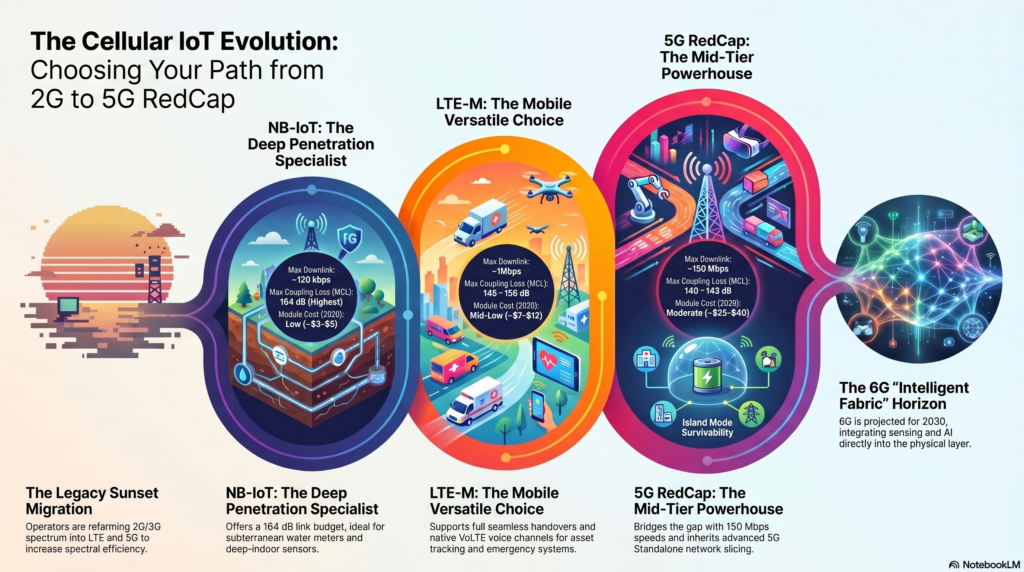
The global telecommunications ecosystem is undergoing a profound structural evolution, driven by the urgent need for resilient, scalable, and secure connectivity across the physical world. This transition is being catalyzed by the active global sunsetting of legacy 2G and 3G networks, as operators reclaim valuable spectrum and seek to eliminate fundamental security vulnerabilities, such as weak encryption and unidirectional authentication.
In response to this mass migration, a tiered hierarchy of cellular Internet of Things (IoT) technologies has emerged to dominate the modern landscape. At the foundation, NB-IoT and LTE-M have matured into the standard workhorses for massive, low-power IoT deployments, offering exceptional physical signal penetration and reliable mobility. Building upon this, 5G RedCap (Reduced Capability) and the upcoming eRedCap are actively bridging the critical gap between low-throughput systems and high-end 5G broadband. These mid-tier 5G technologies reduce hardware complexity and costs while introducing advanced 5G Standalone (5G SA) capabilities like network slicing, Time-Sensitive Networking (TSN), and enhanced security frameworks.
Furthermore, the industry is experiencing a strategic architectural shift toward the “Sovereign Stack.” This paradigm emphasizes deploying private, software-defined cellular networks at the edge to enable “Island Mode” survivability, ensuring that critical infrastructure—such as microgrids and autonomous logistics—can operate resiliently and independently of centralized cloud backhauls.
As these 4G and 5G IoT standards achieve widespread commercialization in 2026, the industry is simultaneously laying the groundwork for the next frontier. 6G mobile technology, currently in its study phase and targeted for commercial rollout by 2030, promises to transform wireless networks into an AI-native “intelligent fabric” that seamlessly integrates high-speed communications, edge computing, and real-time physical environmental sensing. Together, these advancements represent a continuous, unified roadmap from the retirement of legacy systems to the fully autonomous, intelligent networks of the next decade.