From “Stingrays” to Sovereign Edges: 5 Surprising Realities of the Modern Cellular Shift
1. Introduction: The Invisible Infrastructure Crisis
Across the globe, a massive and quiet disappearance is underway. As telecommunications carriers “sunset” legacy 2G and 3G networks to refarm spectrum for 5G, millions of devices—from elevators and alarm panels to water meters—are suddenly facing obsolescence. This transition exposes a fundamental “cloud-dependency” risk: critical systems that rely on a centralized server for coordination can fail the moment their link to the external world is severed.
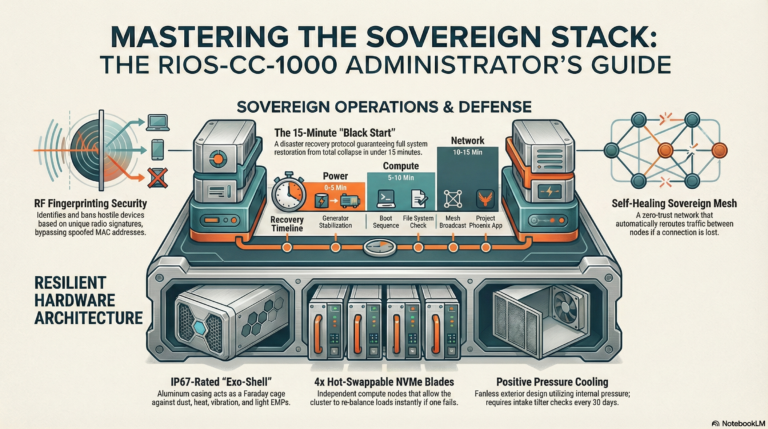
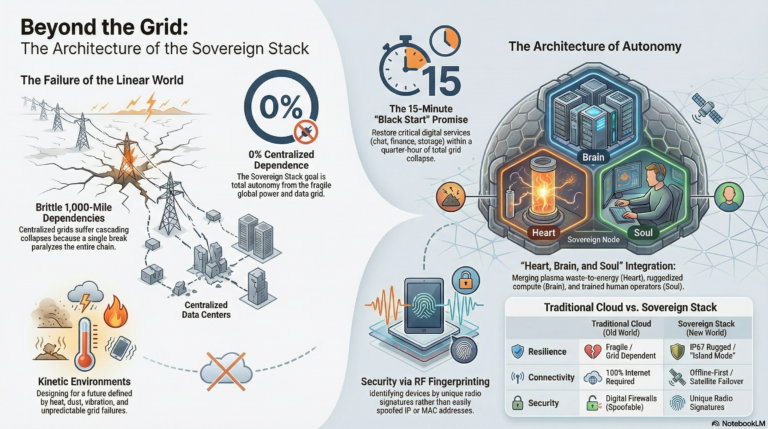
The future of infrastructure is not merely about reaching higher speeds; it is about “Island Mode” survivability. We are moving toward sovereign networks where localized compute and connectivity ensure that energy and water systems remain operational even when the cloud goes quiet. This shift represents a transition from being “tethered” to centralized providers to building resilient, autonomous infrastructure.
Link to the Technical White Paper https://dereticular.com/technical-white-paper-securing-the-kinetic-edge-a-sovereign-stack-evaluation-of-nb-iot-lte-m-and-5g-redcap/
2. The 2G Security Trap: Why Legacy Tech is an “IMSI Catcher” Magnet
One of the strongest drivers for the 2G sunset is a glaring structural flaw: Unidirectional Authentication. In 2G networks, the device authenticates to the network, but the network does not authenticate to the device. This makes 2G a playground for “Stingrays” (IMSI catchers)—low-cost Software-Defined Radios that mimic cellular towers to intercept traffic, spoof messages, and track locations.
Combined with compromised encryption algorithms like A5/1 and A5/2, which can be cracked in real-time by modern hardware, 2G represents a massive liability for critical infrastructure. Modern standards like LTE and 5G solve this through Mutual Authentication, where the device validates the network’s cryptographic credentials (using SUPI and SUCI encryption) before establishing a connection.
“This structural flaw allows hackers to deploy cheap Software-Defined Radios (SDRs) to mimic cellular towers (commonly known as IMSI Catchers or ‘Stingrays’) to intercept traffic, spoof SMS messages, and track user locations… The original GSM encryption standards (such as A5/1 and A5/2) have been thoroughly compromised.”
3. The Subterranean Superpower: How NB-IoT Punches Through Concrete
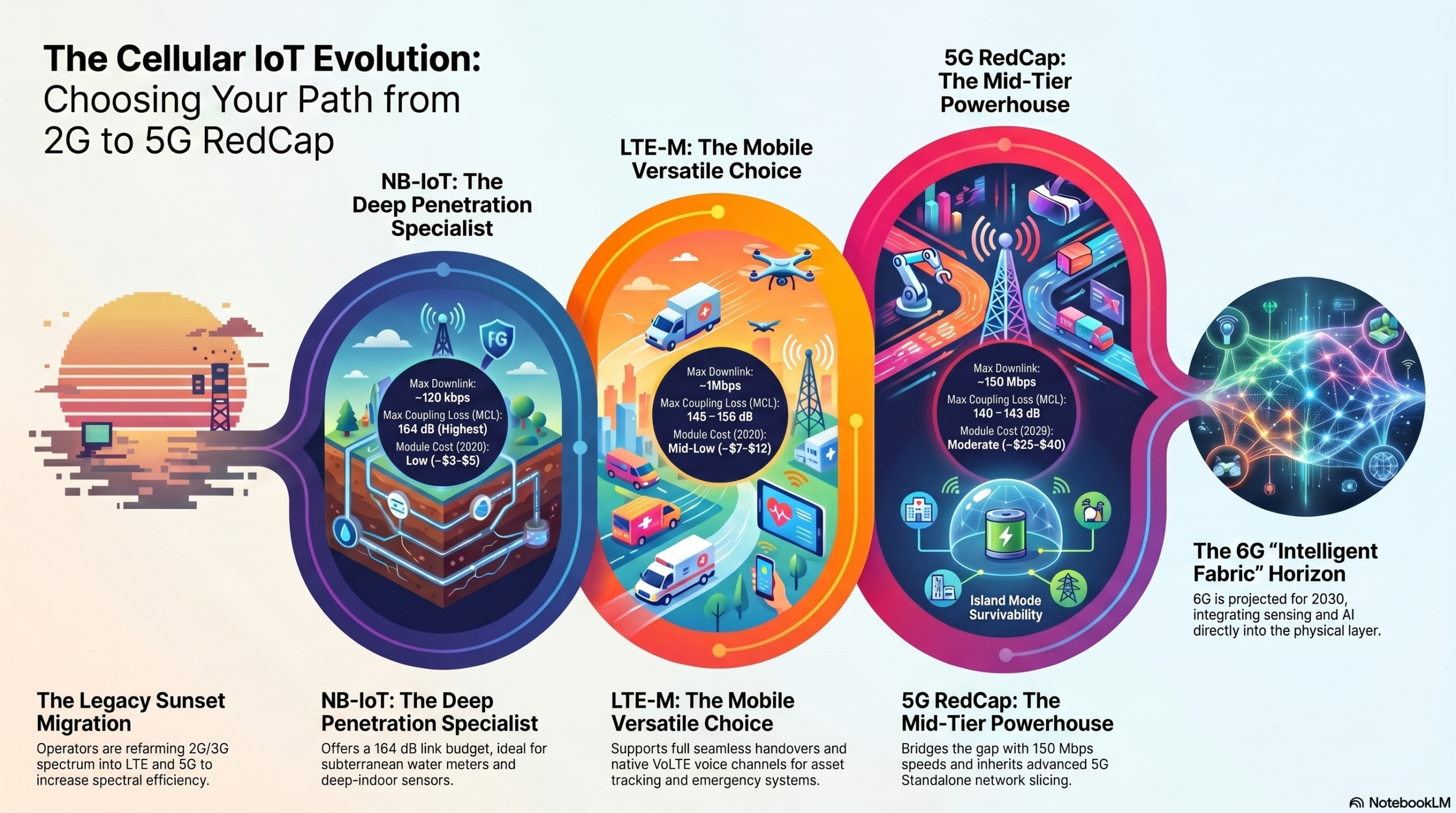
While much of the cellular world chases bandwidth, Narrowband IoT (NB-IoT) focuses on penetration. Its “subterranean superpower” comes from a simple formula for Power Spectral Density (PSD): PSD \propto \frac{P}{B}. By concentrating the device’s full transmit power into a tiny 180 kHz sliver of spectrum rather than diluting it across a wide band, NB-IoT achieves an incredible 164 dB Maximum Coupling Loss (MCL).
This 20 dB coverage enhancement over standard GSM allows signals to survive the extreme attenuation of reinforced concrete, packed soil, and steel access covers. Beyond penetration, NB-IoT offers a strategic “wow” factor for rural and maritime autonomy: a theoretical maximum cell radius of 120 km under Release 15. This “slow but deep” technology is the unglamorous hero of the smart city, reaching utility meters buried in vaults where standard LTE and 5G cannot follow.
4. “Island Mode”: The End of Cloud-Dependent Failure
The “Sovereign Stack” represents a shift from centralized backhaul to localized autonomy, or “Island Mode.” Modern IoT often falls into a “carrier-tethered trap” where a severed internet link renders a device useless. By utilizing private LTE-M or 5G Standalone (5G SA) cores, organizations can deploy their own gNodeB architectures that keep data and control localized.
True sovereignty, however, requires more than hardware; it demands Spectrum Sovereignty. Without control over the airwaves—via shared frameworks like CBRS (Citizens Broadband Radio Service) or local industrial licensing—the most advanced edge node remains at the mercy of external providers. When implemented correctly, these private networks allow for the coordination of physical machinery without requiring an external internet connection.
“Communications infrastructure is becoming part of sovereign compute infrastructure… The future edge stack increasingly merges: communications, AI inference, energy coordination, cryptographic identity, and autonomous control systems.”
Link to the Podcast https://academy.dereticular.com/podcast/evolution-of-cellular-iot-from-5g-redcap-to-6g-foundations/
5. 5G RedCap: The “Goldilocks” Solution for Industrial AI
5G RedCap (Reduced Capability) serves the “mid-tier” segment—applications like industrial video surveillance that need more speed than a sensor but less than a smartphone. To lower costs, RedCap introduces a “structural deficit,” reducing the required antennas from 4 to just 1 or 2, which creates a coverage penalty of 3 dB to 4 dB.
However, the transition faces an economic hurdle. In 2026, a standard LTE Cat-1bis module costs roughly 4–6, while a 5G RedCap module remains between 25–40. While RedCap is the designated future-proof path for “Kinetic AI,” LTE-M currently holds the maturity advantage for 2026 deployments. LTE-M offers a more operationally grounded choice today, providing 1 Mbps throughput, VoLTE support, and battery-saving features like PSM and eDRX at a fraction of the complexity.
6. The 6G Horizon: Sensing as a Service
Looking toward the 2029–2030 commercial target, 6G is being designed as an “intelligent fabric.” The most radical shift is Integrated Sensing and Communication (ISAC). In the 6G era, the network acts as a radar, perceiving the physical environment without the need for external sensors.
By utilizing the 6–8 GHz centimeter-wave spectrum, 6G will enable high-precision spatial positioning and obstacle detection. With potential throughput reaching 100 Gbps to 1 Tbps, 6G will turn the airwaves themselves into a sensing service, embedding machine learning directly into the physical layer to bridge the physical and digital domains seamlessly.
7. Conclusion: The Sovereign Builder’s Mandate
The transition from 2G to 6G is no longer just a series of generational upgrades; it is a strategic choice between being “tethered” to centralized providers or building “sovereign” connectivity. As we refarm the airwaves for a more secure and resilient future, the mandate for builders is clear: infrastructure must be designed for autonomy.
As we move toward a world of private cores and edge AI, one question remains: As we refarm the airwaves for a more secure future, is your infrastructure built to survive the day the cloud goes quiet?