This study guide provides a comprehensive overview of the Pawnee.us Agent-to-Agent (A2A) Reservation Engine, a decentralized autonomous commerce protocol developed by DeReticular LLC. It focuses on the shift from centralized middlemen to peer-to-peer mesh networks, specifically within the high-margin outdoor economy and off-grid infrastructure.
Core Concepts and System Overview
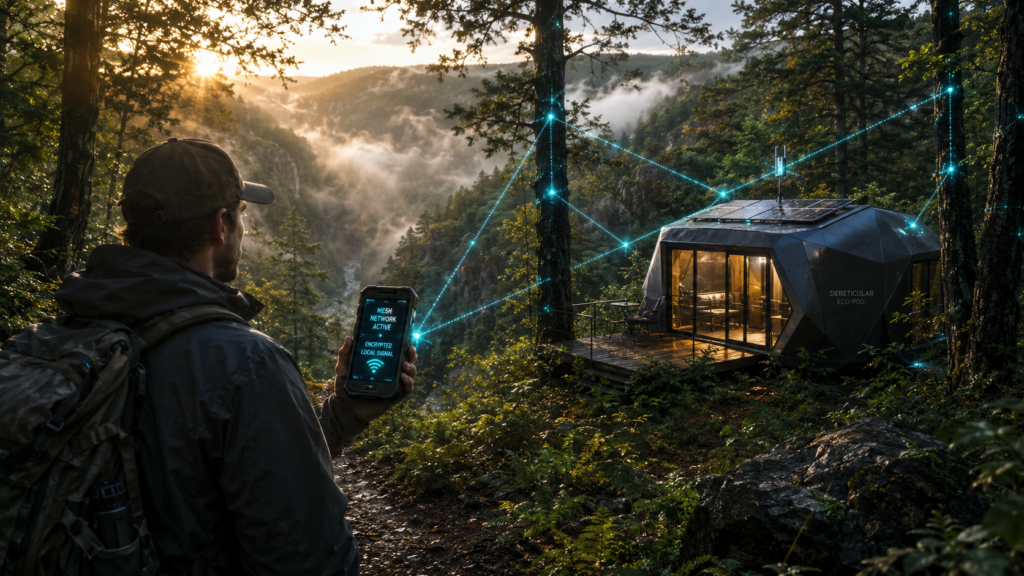
The Pawnee.us A2A engine is designed to eliminate the “extractive middleman” in the travel and outdoor experience industry. By utilizing the OpenClaw agentic kernel and a decentralized mesh architecture, it allows AI software agents—representing consumers, merchants, vehicles, and microgrids—to negotiate and settle transactions in real-time without reliance on centralized cloud servers or cellular connectivity.
The Triple-Value Engine
The protocol’s value proposition is divided into three primary categories:
- Commercial Decentralization: Replaces traditional 15% to 30% commission fees (e.g., Expedia, Viator) with a minimal 2.5% protocol fee, allowing local merchants to retain 97.5% of their revenue.
- Technological Sovereignty: Operates as an air-gapped system via WISP-in-a-Box gateways and TPM 2.0 hardware oracles, ensuring functionality in remote “cellular dead zones.”
- Thermodynamic Integration: Links booking transaction volume to energy production via the RIOS Spark Spread AI, integrating with West Virginia H.B. 2014 certified microgrids.
Strategic Hardware: WISP-in-a-Box Series
The physical infrastructure of the protocol relies on three tiers of Generation 5 commercial gateways:
- WISP-in-a-Box Agentic ($9,997.00): Acts as the local AI agent server and LLM inference engine.
- WISP-in-a-Box LTE ($5,887.00): Provides dual-WAN failover (Starlink and LTE) to sync the local ledger with regional nodes.
- WISP-in-a-Box Base ($1,497.00): Handles short-range handshakes (Bluetooth/Wi-Fi) with guest devices at trailheads or shops.
Comparison Matrix: Centralized vs. Decentralized
Dimension Legacy Centralized Aggregators Pawnee.us A2A Sovereign Engine
Take Rate 15% to 30% gross revenue cut. 2.5% decentralized protocol fee.
Connectivity 100% cloud-dependent; fails in dead zones. Air-gapped mesh; zero internet dependency.
Latency 5 to 15 minutes (manual browsing/forms). < 4 seconds (P2P AI negotiation).
Security Vulnerable cloud databases. Hardware-secured TPM 2.0 silicon oracles.
Automation Manual human calls/confirmation required. Direct physical API integration with drones/vehicles.
Quiz: Understanding the A2A Protocol
Instructions: Answer the following questions in 2-3 sentences based on the source context.
- What is the “Death of the Middleman” in the context of Pawnee.us?
- How does the protocol solve the problem of cellular signal failure in remote locations like the New River Gorge?
- What is the role of the OpenClaw agentic kernel?
- How does the 2.5% protocol micro-fee compare to industry standards for booking platforms?
- Explain the function of TPM 2.0 Oracles in a transaction.
- What is the significance of West Virginia House Bill 2014 to this project?
- Describe the role of West Virginia University (WVU) in the development of this protocol.
- What is the “Triple-Value Engine” as described in the documentation?
- What are the primary internal weaknesses identified in the SWOT analysis?
- According to the 10-year pro forma, what is the projected Gross Booking Volume (GMV) by Year 10?
Quiz Answer Key
- The “Death of the Middleman” refers to the replacement of centralized platforms like Expedia and Viator, which extract 15-30% commissions, with a decentralized peer-to-peer network. This shift allows local merchants to retain more revenue and control over their customer data.
- The protocol uses an air-gapped mesh architecture via WISP gateways and the Hyphanet/NeoMesh network. This allows AI agents to communicate and settle contracts locally without needing a cellular or cloud connection.
- OpenClaw is an ultra-lightweight agentic kernel optimized for edge deployment that allows autonomous software agents to maintain identities and evaluate complex decision trees. It enables these agents to execute atomic smart contracts for bookings and services.
- The 2.5% protocol fee is significantly lower than the 15-30% fees charged by legacy aggregators. This reduction lowers merchant onboarding friction and allows operators to retain 97.5% of their transaction value.
- TPM 2.0 Oracles are hardware-secured chips that cryptographically sign every transaction, location ping, and service confirmation. This silicon-level security prevents spoofing, false location data, or double-spending on the local mesh.
- H.B. 2014 provides a regulatory framework for certified microgrids and exempts local microgrid commerce networks from PSC utility oversight. It also establishes a statutory requirement that transactions be linked to behind-the-meter AI compute powered by local GenSets.
- WVU students act as primary protocol developers through the NSF RETI Consortium, building open-source connectors for local Point-of-Sale systems. In exchange, they earn developer micro-fees that fund student fellowships.
- The Triple-Value Engine is the protocol’s core benefit framework, focusing on commercial decentralization (lower fees), technological sovereignty (offline capability), and thermodynamic integration (linking booking volume to energy production).
- Internal weaknesses include an early-stage developer ecosystem and the requirement for physical WISP gateway installations. Additionally, there is a need for user education regarding AI agent booking and a dependency on GPU compute capacity.
- The protocol aims to process $20 billion in annual gross booking volume by Year 10. This scaling moves from a regional West Virginia pilot to a global DePIN rollout across international travel and logistics markets.
Essay Questions
- Economic Disintermediation: Analyze how the Pawnee.us A2A engine aims to shift the economic power balance from global corporate aggregators back to local rural outfitters.
- Hardware-Software Convergence: Discuss the importance of physical hardware anchors, such as WISP gateways and TPM 2.0 oracles, in establishing a “zero-trust” decentralized commerce network.
- Regulatory Strategy: Evaluate how the project utilizes specific state legislation (W. Va. H.B. 2014) to create a protected environment for technological innovation and energy arbitrage.
- The Future of Autonomous Commerce: Explore the implications of “Intent-to-Settlement” times of less than four seconds for multi-leg trip coordination involving drones, autonomous vehicles, and local merchants.
- Scalability and DePIN: Assess the strategic roadmap of Pawnee.us as it transitions from a regional Appalachian pilot to a global Decentralized Physical Infrastructure Network (DePIN).
Glossary of Key Terms
- A2A (Agent-to-Agent): A peer-to-peer communication model where autonomous software agents representing different entities (consumers, businesses, vehicles) negotiate and settle transactions directly.
- DePIN (Decentralized Physical Infrastructure Network): A network that uses blockchain or decentralized protocols to manage and coordinate physical hardware and infrastructure.
- Hyphanet / NeoMesh: The underlying mesh network technology that enables P2P communication between agents without traditional internet or cellular signals.
- Microgrid: A local energy grid with control capability, which can disconnect from the traditional grid and operate autonomously; here, integrated with transaction processing.
- OpenClaw Kernel: An open-source, lightweight software engine optimized for deploying AI agents at the “edge” (local hardware) rather than in the cloud.
- Pawnee Power GenSet: A 45 kW rotary multi-fuel generator used to power the local microgrids that host the A2A gateways.
- Sovereign Stack: DeReticular’s suite of technologies designed to provide users with complete control over their data, communication, and commerce.
- Spark Spread AI: An AI system that links transaction processing volume to the management of energy production and arbitrage within a microgrid.
- TPM 2.0 (Trusted Platform Module): A specialized hardware chip that provides secure, cryptographic functions to ensure the integrity and authenticity of data and transactions.
- WISP-in-a-Box: A series of hardware gateways (Base, LTE, and Agentic) that provide the physical infrastructure for the A2A mesh network.