Study Guide: DeReticular and the West Virginia Sovereign Infrastructure Initiative
Deck
podcast
video
This study guide provides a comprehensive overview of the strategic alignment between DeReticular’s AI-native infrastructure and West Virginia’s regulatory and academic landscape. It explores the technical, economic, and legal frameworks enabling the deployment of “Sovereign Stack” technology in the Appalachian region.
Part 1: Short-Answer Quiz
Instructions: Answer the following questions in two to three sentences, based on the provided source context.
- What is the “Permitting Wall,” and how does it impact the development of AI data centers?
- How does West Virginia House Bill 2014 (H.B. 2014) help developers bypass traditional utility constraints?
- Define the three primary modules of DeReticular’s “Sovereign Stack” categorized as the Mind, Muscle, and Motion.
- What is the “Captive Power Mandate,” and what specific mathematical requirement must a project meet to comply?
- How do the roles of the Morgantown Hub and the New River Gorge Hub differ in DeReticular’s operational blueprint?
- What is “Spark Spread” arbitrage, and how does RIOS execute it?
- What role does the $321 million NSF RETI Consortium play in West Virginia’s technology ecosystem?
- Explain the security benefits of using TPM 2.0 hardware oracles and Sysbox container isolation in the RIOS kernel.
- What are “Kurb Kars,” and what specific topographical challenges do they address in rural West Virginia?
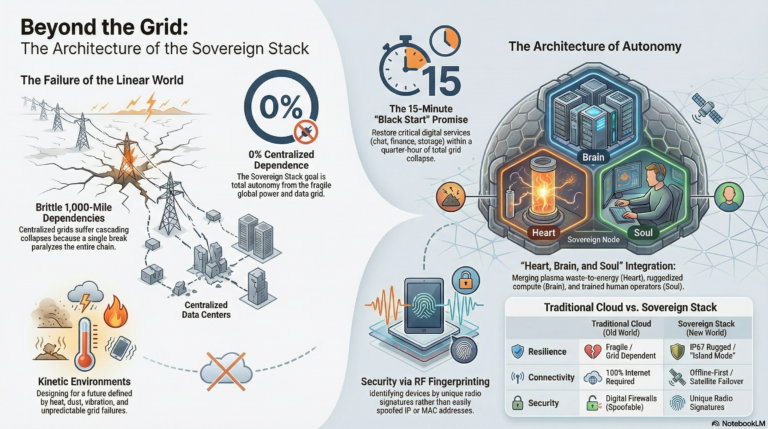
- Contrast the “Linear Infrastructure” model with DeReticular’s “Spherical Resilience” model.
Part 2: Quiz Answer Key
- What is the “Permitting Wall,” and how does it impact the development of AI data centers? The “Permitting Wall” refers to the multi-year interconnection delays (regularly 5–7 years) faced by developers attempting to connect large-scale compute loads to regional transmission grids like PJM. These delays are caused by choked interconnection queues, the need for massive transmission network upgrades, and regional capacity depletion.
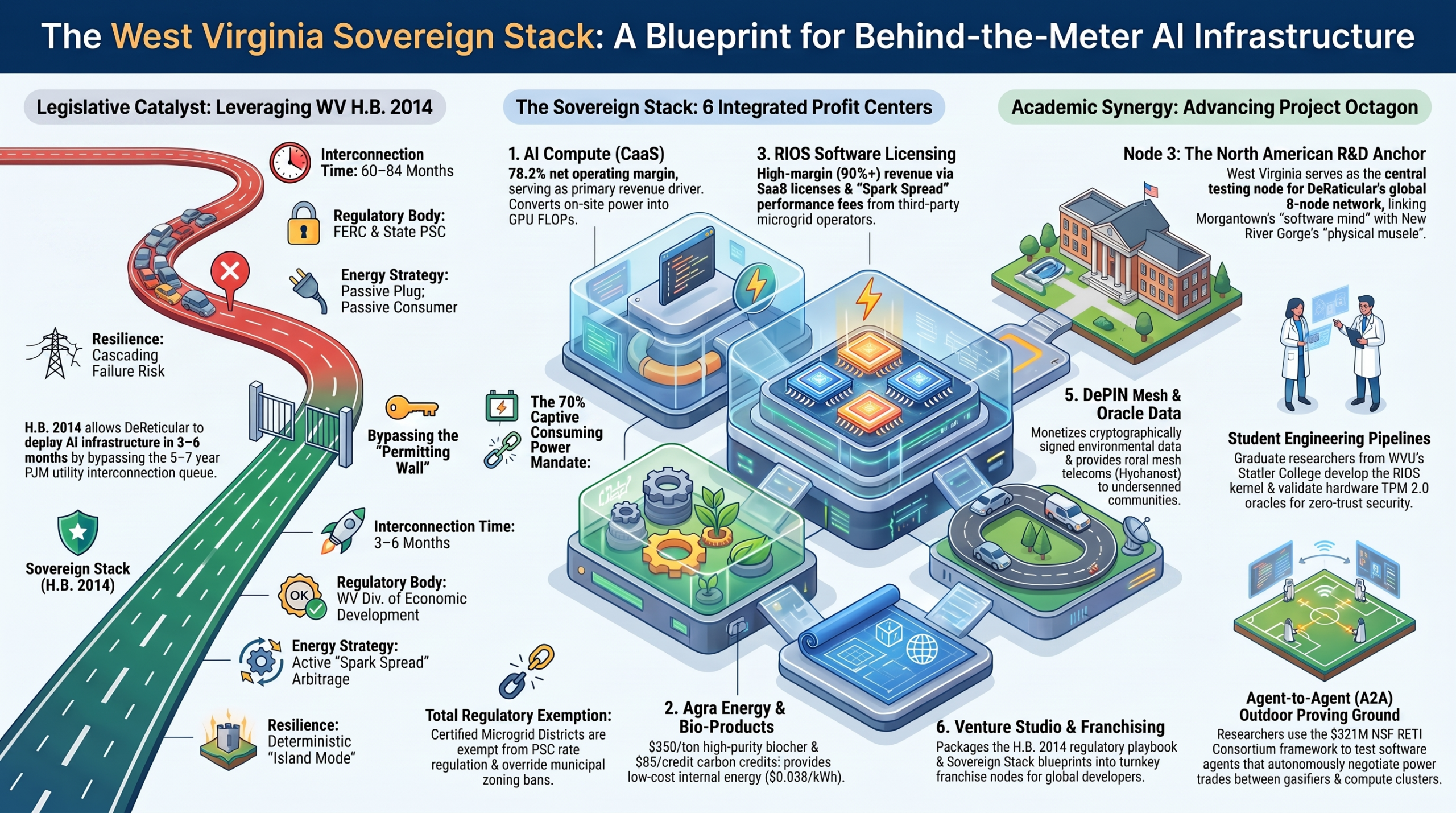
- How does West Virginia House Bill 2014 (H.B. 2014) help developers bypass traditional utility constraints? H.B. 2014 creates a Certified Microgrid Development Program that exempts qualified districts from Public Service Commission (PSC) jurisdiction regarding rates and siting. This allows developers to bypass the PJM interconnection queue by operating behind-the-meter, reducing deployment timelines from years to months.
- Define the three primary modules of DeReticular’s “Sovereign Stack” categorized as the Mind, Muscle, and Motion. The “Mind” is the Rural Infrastructure Operating System (RIOS), an AI-native software engine for microgrid orchestration. The “Muscle” consists of Agra Energy’s plasma gasification units and RIOS-CC-1000 compute modules, while the “Motion” refers to Kurb Kars, the autonomous DePIN logistics fleet.
- What is the “Captive Power Mandate,” and what specific mathematical requirement must a project meet to comply? The Captive Power Mandate requires that at least 70% of the electricity generated within a Certified Microgrid District be consumed locally by on-site industrial or compute assets. Furthermore, net exports to the commercial utility grid must be strictly capped at less than 10% on an annual aggregate basis.
- How do the roles of the Morgantown Hub and the New River Gorge Hub differ in DeReticular’s operational blueprint? Morgantown serves as the “Mind & Software Authority,” focusing on AI model training, R&D, and institutional partnerships with WVU. The New River Gorge serves as the “Muscle, Motion & Physical Testbed,” providing rugged terrain for testing autonomous vehicles, mesh communications, and off-grid “Island Mode” resilience.
- What is “Spark Spread” arbitrage, and how does RIOS execute it? Spark Spread arbitrage is the real-time conversion of energy into the most profitable output, typically either AI compute (FLOPs) or stored energy. The RIOS kernel executes this by monitoring economic signals and autonomously switching power routing between compute clusters, battery storage, or biochar production.
- What role does the $321 million NSF RETI Consortium play in West Virginia’s technology ecosystem? Led by West Virginia University, the RETI Consortium is a federal-private initiative focused on grid resilience, advanced energy storage, and hardware security. It provides DeReticular with a pipeline of engineering talent and a framework for co-developing open standards for rural microgrid stability.
- Explain the security benefits of using TPM 2.0 hardware oracles and Sysbox container isolation in the RIOS kernel. TPM 2.0 hardware oracles cryptographically sign telemetric data at the silicon level to prevent “Oracle Attacks” or spoofing. Sysbox provides rootless, virtual-machine-level isolation for containers, ensuring that compromised AI workloads cannot escape to access or interfere with physical microgrid control loops.
- What are “Kurb Kars,” and what specific topographical challenges do they address in rural West Virginia? Kurb Kars are off-grid, autonomous electric freight vehicles designed for heavy-duty logistics. They address challenges like unpaved logging roads, steep gradients, and dense timber cover by using localized sensors and mesh-relayed maps instead of relying on cloud-connected GPS.
- Contrast the “Linear Infrastructure” model with DeReticular’s “Spherical Resilience” model. Linear infrastructure relies on a cascading, single-point-of-failure topology where reliability depends on every preceding node in the chain. Spherical Resilience utilizes a decentralized, self-healing mesh topology that allows localized nodes to operate in “Island Mode,” completely independent of the central utility grid.
Part 3: Essay Format Questions
- The End of the Utility Monopoly: Analyze how West Virginia’s H.B. 2014 shifts the power dynamics between traditional utility companies and private infrastructure developers. In your answer, discuss the specific legal exemptions provided by the act and the economic implications for “High Impact Intelligence Centers.”
- Thermodynamics of AI: Discuss the technical and economic advantages of co-locating plasma gasification with high-density AI compute. How does this “behind-the-meter” strategy address the energy density requirements of modern GPU clusters while satisfying environmental and regulatory constraints?
- The Sovereign Node as an Economic Engine: Evaluate the six profit centers of the DeReticular ecosystem. How does this multi-revenue design protect the venture from market volatility in sectors like GPU pricing or energy costs?
- Academic-Industrial Synergy: Examine the strategic importance of the partnership between DeReticular and West Virginia University’s RETI Consortium. How does this collaboration accelerate the transition from laboratory research to field-deployable sovereign infrastructure?
- Autonomous Logistics in Hostile Environments: Explore the role of Kurb Kars and mesh telecommunications in establishing “Spherical Resilience.” How does the ability to operate without cloud connectivity or a centralized grid change the feasibility of industrial development in remote or topographically challenged regions?
Part 4: Glossary of Key Terms
- Agra Energy: A module of the Sovereign Stack that utilizes plasma gasification to convert regional biomass or waste into syngas for power generation.
- Behind-the-Meter (BtM): Power generation and consumption that occurs on-site, bypassing the need to interact with the broader utility transmission grid.
- Captive Power Ratio: The ratio of on-site energy consumption to total energy generation; H.B. 2014 requires this to be \ge 70\%.
- Certified Microgrid District: A statutory designation in West Virginia that grants specific legal and regulatory exemptions for localized power and industrial hubs.
- Compute-as-a-Service (CaaS): A business model where high-density GPU capacity is leased to external users for AI training and inference.
- DePIN (Decentralized Physical Infrastructure Network): A decentralized approach to building and managing physical hardware and networks, such as mesh telecoms or logistics fleets.
- H.B. 2014 (Power Generation and Consumption Act): West Virginia legislation that authorizes independent microgrids and streamlines the development of data centers.
- Hyphanet: A decentralized, hardware-secured mesh communication protocol used to bridge communication gaps in remote areas.
- Island Mode: An operational state where a microgrid functions in total isolation from the central utility grid.
- Kurb Kars: Autonomous, electric heavy-duty vehicles designed for off-grid rural logistics and biomass transport.
- Plasma Gasification: A high-temperature thermal process (> 3,000^\circ\text{C}) that converts organic matter into high-purity synthesis gas (syngas).
- Project Octagon: DeReticular’s global network of eight sovereign testbeds, of which West Virginia serves as “Node 3.”
- RETI Consortium: The Resilient Energy Technology and Infrastructure initiative led by WVU, funded by a $321 million NSF and industry match.
- RIOS (Rural Infrastructure Operating System): An AI-native software kernel designed to manage microgrids, compute loads, and autonomous logistics.
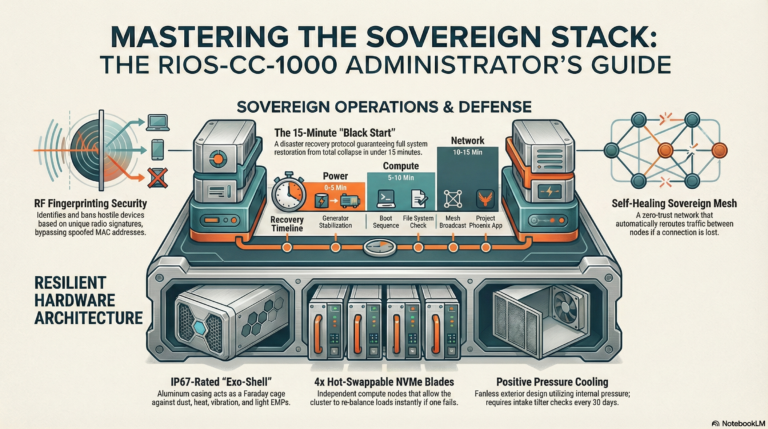
- RIOS-CC-1000: Ruggedized, liquid-cooled, containerized AI compute clusters deployed at the edge.
- Sovereign Stack: The integrated suite of hardware and software (RIOS, Agra Energy, Kurb Kars, RIOS-CC-1000) that enables autonomous infrastructure.
- Spark Spread: The economic margin or arbitrage opportunity created by converting a unit of energy (e.g., from biomass) into a unit of compute (e.g., AI FLOPs).
- Spherical Resilience: A design philosophy emphasizing decentralized, self-healing, and autonomous mesh topologies over linear, centralized systems.
- Sysbox: A specialized container runtime used by RIOS to provide virtual-machine-level isolation for rootless containers.
- TPM 2.0 (Trusted Platform Module): A hardware-based security chip used to cryptographically sign data packets, ensuring the integrity of microgrid telemetry.