Study Guide: DeReticular Generation 5 Operations and Quartzsite Infrastructure
This study guide provides a comprehensive overview of DeReticular’s Generation 5 (Gen 5) sovereign infrastructure deployment in Quartzsite, Arizona. It covers the company’s architectural philosophy, the seasonal demographic dynamics of the region, the technical specifications of the Gen 5 product suite, and the financial models driving the operation.
Part 1: Short-Answer Quiz
Instructions: Answer the following questions in 2–3 sentences based on the provided source materials.
- What is the strategic significance of the September 15 operational start date in Quartzsite?
- How does the “Death of the Line” philosophy differ from traditional infrastructure models?
- What are the three tiers of the WISP-in-a-Box Gateway, and how do their price points reflect their capabilities?
- Describe the demographic characteristics and technology needs of “Phase 3” (January–February) in the Quartzsite seasonal cycle.
- What is the Rural Infrastructure Operating System (RIOS), and what is its primary function?
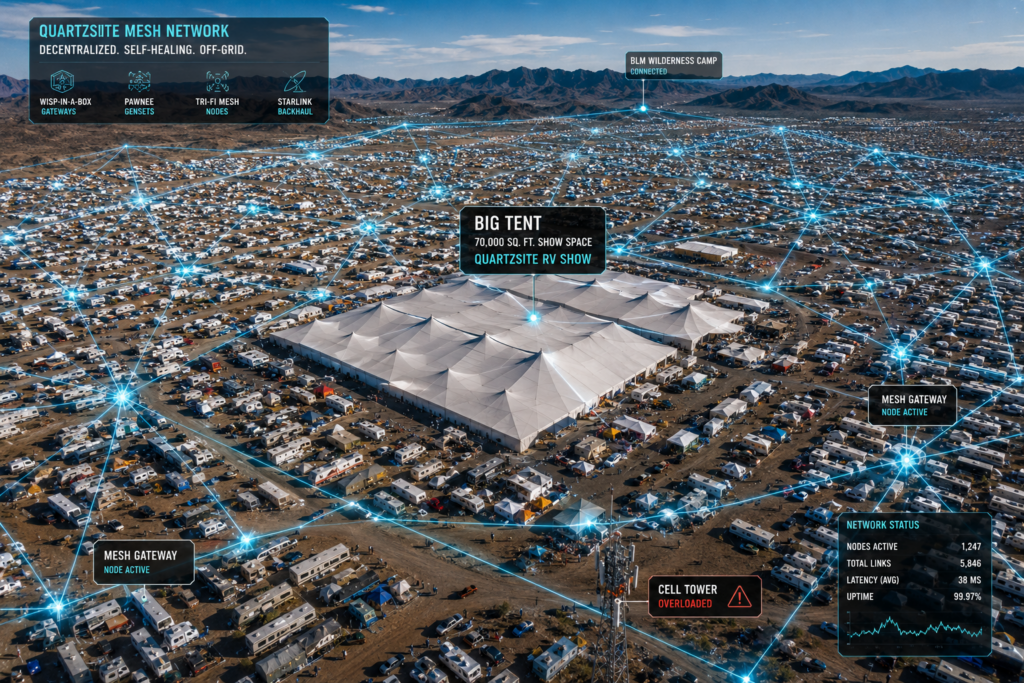
- How does DeReticular address the issue of “cellular saturation” during peak visitor surges?
- What are the specific capabilities and target audience for the Pawnee Flagship TAV (Tactical Autonomous Vehicle)?
- Define “Island Mode” in the context of DeReticular’s sovereign infrastructure.
- What are the four primary monetization streams identified for the Quartzsite 7-month operating season?
- What is the function of the Locutus/Ludis Ledger within the Gen 5 ecosystem?
Part 2: Quiz Answer Key
- September 15 Significance: This date marks the official opening of the Bureau of Land Management (BLM) Long-Term Visitor Area (LTVA) season, which runs through April 15. Starting then allows DeReticular to capture early-arriving “pioneers” and establish network topology before winter cellular congestion overwhelms local infrastructure.
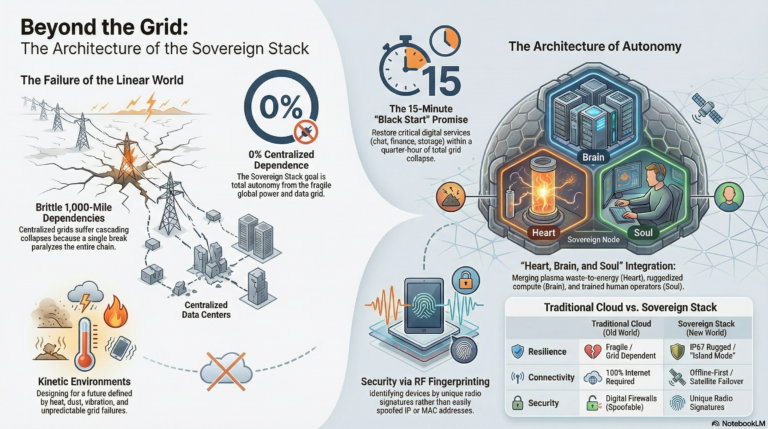
- Death of the Line: This philosophy argues that traditional centralized, linear topologies—like power grids and cloud data centers—are fragile single points of failure. DeReticular replaces “The Line” with “Spherical Resilience,” a framework where sovereign nodes operate independently of national utilities or external cloud backbones.
- WISP-in-a-Box Tiers: The Base Gateway (1,497) offers ruggedized 12V connectivity for budget nomads; the LTE Gateway (5,887) adds multi-carrier bonding for remote executives; and the Agentic AI Gateway ($9,997) includes an air-gapped local AI engine for high-security applications. These tiers scale in price as they move from basic connectivity to advanced, localized edge computing.
- Phase 3 Characteristics: Known as the “Peak Show Wave,” this phase sees population swells of 1 million to 1.5 million people, including RV show attendees and luxury overlanders. Core tech needs during this time include high-density power, edge compute, and cellular failover for point-of-sale (POS) systems to handle the massive commercial surge.
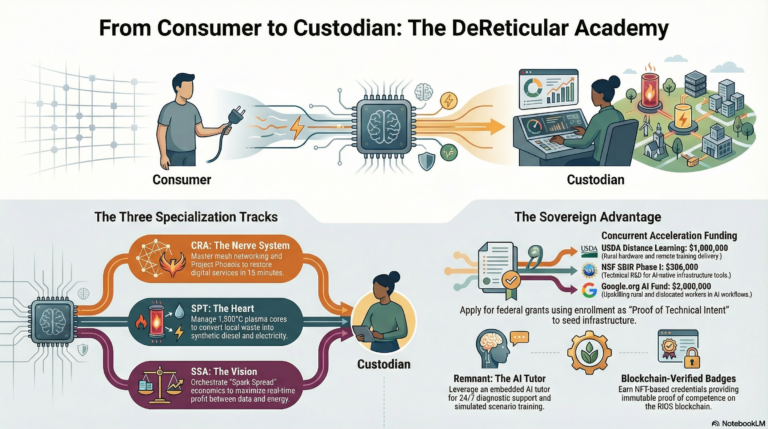
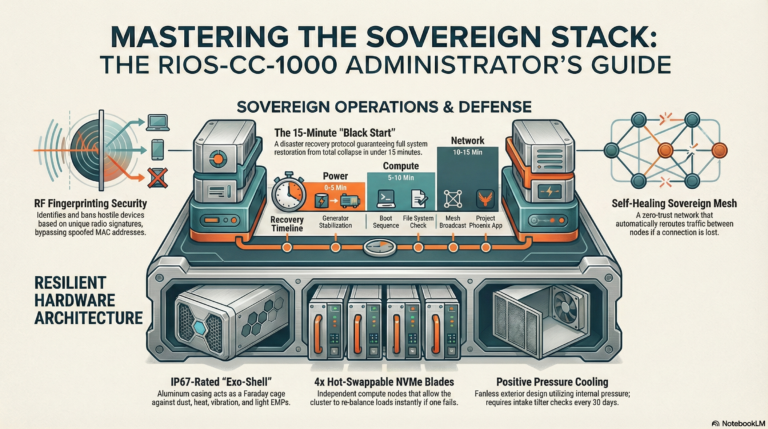
- RIOS: RIOS is an AI-native orchestration layer that serves as the “brain” for DeReticular’s ecosystem. it manages off-grid power generation, compute, communications, sensor networks, and autonomous mobility across distributed sovereign nodes.
- Addressing Cellular Saturation: DeReticular utilizes WISP-in-a-Box Gateways that employ multi-carrier bonding, combining Starlink, LTE, and 5G into a single “unbreakable” connection. This allows users to bypass local tower throttling by aggregating multiple signals and providing local mesh failovers.
- Pawnee Flagship TAV: The TAV is a $797,000 ultra-luxurious 6×6 tactical expedition vehicle designed as a mobile command-and-control platform. It targets Ultra-High-Net-Worth (UHNW) overlanders and executives who require total digital and physical sovereignty in an all-weather, off-road rig.
- Island Mode: Island Mode refers to the ability of sovereign nodes to operate in complete isolation from the national grid or external internet. In this state, devices maintain functionality through local power, air-gapped AI agents, and localized peer-to-peer data synchronization.
- Monetization Streams: The streams include Consumer/Nomad Hardware and Network Subscriptions (Stream 1), Commercial Vendor POS and Connectivity Packages (Stream 2), Heavy Kinetic Hardware and Microgrid Power Sales (Stream 3), and DePIN Local Compute/Edge Infrastructure Services (Stream 4).
- Locutus/Ludis Ledger: This is an offline-first, peer-to-peer database that enables transaction verification and telemetry synchronization without internet access. It allows machines and users within a Tri-Fi mesh to share data securely even when completely air-gapped from the cloud.
Part 3: Essay Format Questions
Instructions: Use the provided context to develop comprehensive responses to the following prompts.
- Infrastructure Resilience: Compare and contrast the “Spherical Resilience” model with traditional centralized infrastructure. How does the Quartzsite environment serve as a “living laboratory” to prove the necessity of decentralized systems?
- Economic Opportunity Analysis: Evaluate the three financial projection models (Conservative, Moderate, Aggressive) provided for the Quartzsite operation. Which revenue streams are most critical for reaching the “Moderate” target of $7.09M, and what are the primary risks to achieving these figures?
- Technological Integration: Discuss the relationship between RIOS, the Locutus Ledger, and the WISP-in-a-Box hardware. How do these components work together to provide a seamless “Civilization in a Box” experience for off-grid users?
- Demographic Needs and Solutions: Analyze the three primary customer segments (Remote Executives, Commercial Vendors, and Luxury Overlanders). Map their specific operational “frictions” in the desert to the Gen 5 products designed to solve them.
- Tactical Deployment Strategy: Outline the four-phase operational execution plan from September to April. Why is the chronological order of these phases essential for building a functional network backbone and maximizing seasonal revenue?
Part 4: Glossary of Key Terms
Term Definition
Agentic AI Gateway The highest tier of WISP-in-a-Box hardware, featuring an onboard air-gapped AI engine and Locutus Ledger synchronization.
Air-Gapped A security measure that ensures a computer or network is physically and digitally isolated from unsecured networks, such as the public internet.
BLM LTVA Bureau of Land Management Long-Term Visitor Area; millions of acres of public land near Quartzsite where nomads can camp off-grid for up to seven months.
DePIN Decentralized Physical Infrastructure Networks; a model for building and maintaining physical hardware through decentralized coordination.
Field Medic, The An automated, localized diagnostic platform designed for off-grid infrastructure maintenance, rapid equipment repairs, and medical triage.
Industrial Foreman, The An air-gapped AI agent platform used for operating heavy machinery, micro-grid balancing, and agricultural systems.
Island Mode A state in which a sovereign node or mesh network operates with total independence from external utilities or cloud computing.
Locutus/Ludis Ledger An offline-first, peer-to-peer database used for local data verification and telemetry synchronization without active internet.
Multi-Carrier Bonding The process of combining multiple internet signals (Starlink, LTE, 5G) into a single, high-bandwidth, redundant connection.
Pawnee Power GenSet A 45kW heavy-duty mobile kinetic generator designed to power microgrids and off-grid compute hubs quietly.
pfSense An open-source edge firewall and router software embedded into Gen 5 hardware to ensure data sovereignty.
RIOS Rural Infrastructure Operating System; the AI-native software layer that orchestrates power, compute, and comms for DeReticular nodes.
Sovereign Infrastructure Physical and digital systems owned and operated by the user, independent of centralized third-party providers or national grids.
Spherical Resilience An architectural framework where nodes are self-healing and autonomous, eliminating single points of failure found in linear networks.
Tri-Fi Mesh A localized, peer-to-peer mesh networking topology that allows devices to communicate and share data over miles of desert without cellular service.
WISP-in-a-Box DeReticular’s flagship line of connectivity gateways designed for rugged, off-grid mobile and field use.