
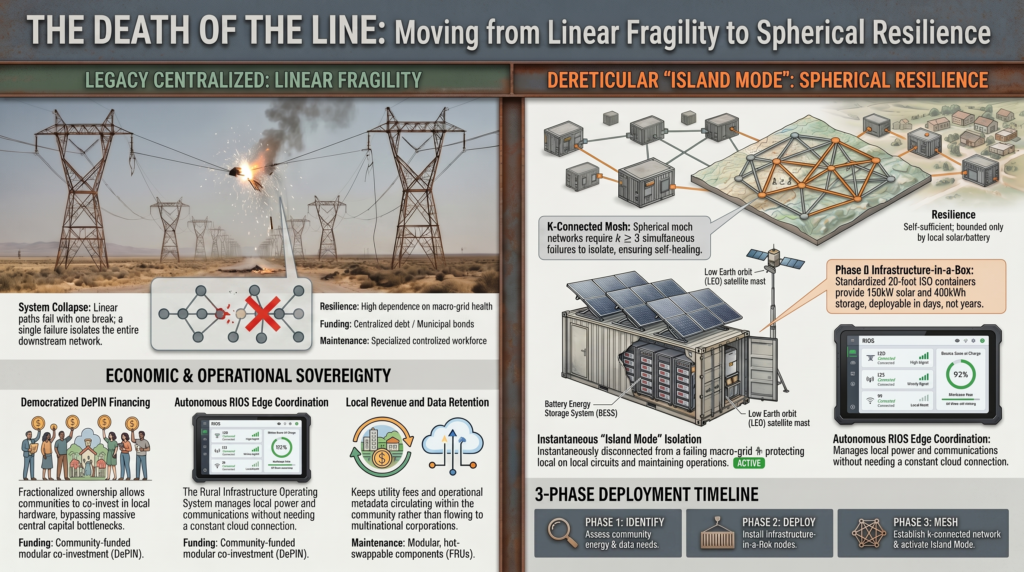
These sources detail the transition from fragile, centralized utility systems to sovereign autonomous infrastructure through a model known as spherical resilience. This architecture utilizes modular, “Infrastructure-in-a-Box” nodes that integrate solar energy, battery storage, and edge-native AI to ensure communities can function in “Island Mode” during regional outages. By shifting away from vulnerable linear grids, the framework employs decentralized networking and open-source software to provide reliable power and communications in rural or politically unstable areas. Economic viability is achieved through DePIN financing, which allows for fractionalized community ownership and keeps utility revenue local. The Rural Infrastructure Operating System (RIOS) serves as the technological backbone, managing complex tasks like signal fusion and autonomous load balancing without requiring constant cloud connectivity. Ultimately, these documents present a pragmatic roadmap for achieving technological and energy sovereignty by deploying resilient, self-healing networks today.