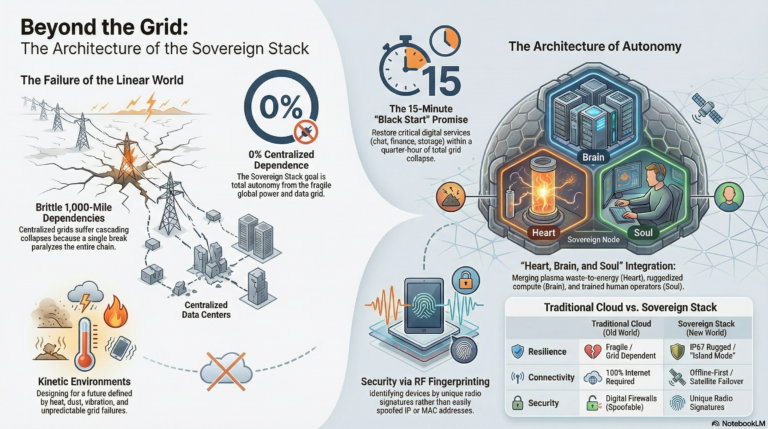
Technical White Paper Bridging the Sovereignty-Scale Divide: The “Digital Airlock” and Split-Ledger Architectures
Document Reference: WP-2026-DR-094
Date: May 21, 2026
Authors: Principal Cryptographic Engineer, Chief Information Security Officer
(CISO), & Data Privacy Architect, DeReticular
Classification: Public Release / Technical White Paper
Target Audience: Chief Information Officers (CIOs), Chief Information Security
Officers (CISOs), Compliance Officers, Security Engineers, and Applied
Cryptography Researchers.
PART 1: The Privacy Paradox and the Trusted Environment Fallacy
Modern enterprise IT and municipal administration architectures in 2026 face an
acute “Privacy Paradox.” Highly regulated entities—such as health networks,
financial institutions, and legal bodies—are increasingly pressured to leverage
the cognitive reasoning, natural language parsing, and predictive logic of
hyperscale cloud artificial intelligence models (such as Google’s Project Remy
or OpenAI’s API suites). However, these organizations are legally, ethically,
and contractually prohibited from exfiltrating proprietary intellectual property
(IP), protected health information (PHI), personally identifiable information
(PII), or granular financial metadata to third-party cloud infrastructure.
Historically, organizations have mitigated this tension by relying on “The
Trusted Environment Fallacy.” This is the assumption that soft, non-binding
corporate Terms of Service (ToS) agreements, business associate agreements
(BAAs), or zero-data-retention API endpoints provide sufficient protection
against data leakage.
From a threat-modeling perspective, this reliance represents an operational
vulnerability. It assumes that legal promises constitute physical and technical
barriers. In reality, modern centralized AI models utilize “data harvesting as
an architectural feature.” Their ingestion pipelines require massive corpuses of
real-world metadata, feedback loops, and temporal sequences to refine their
weights. When raw data is transmitted across a wide-area network (WAN) to a
centralized hypervisor, it is exposed to several distinct risk vectors:
- Subpoena and Jurisdictional Compulsion: Third-party cloud providers must
comply with regional legal directives (e.g., CLOUD Act warrants) that can
compel them to decrypt and hand over data without the data owner’s direct
knowledge. - Hypervisor and Enclave Compromise: Microarchitectural side-channel attacks,
rogue cloud administrators, or orchestration-layer exploits can compromise
even confidential computing instances (e.g., AMD SEV or Intel SGX enclaves)
running in tenant environments. - Inference-Phase Reconstruction Attacks: Adversaries can use carefully
crafted prompting sequences to reconstruct training or context-window data
from public model endpoints, exposing previously processed PII.
[ Centralized AI Cloud ] <=== (Unsanitized Context/PII Exposed) === [ Local Enterprise Net ]
^
| The Trusted Environment Fallacy:
+– Legally Non-Binding ToS / Soft API Keys (No Hardware Barrier)
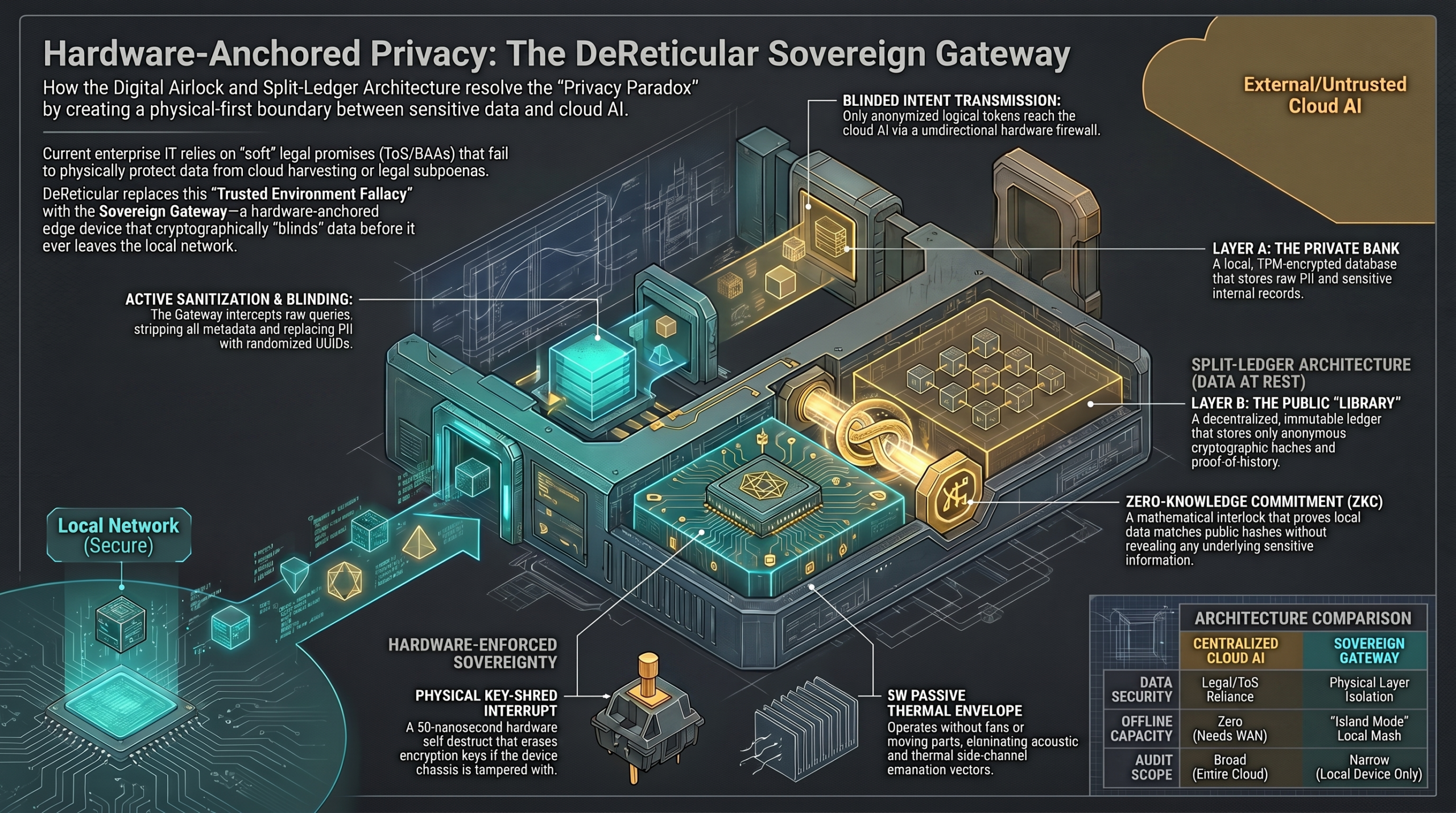
To resolve this paradox, DeReticular proposes a physical-first approach. Rather
than treating centralized cloud AI as an omniscient, orchestrating manager of
internal state, we define it strictly as an ephemeral, localized
utility—comparable to an untrusted arithmetic coprocessor. By establishing a
cryptographically blinding physical barrier at the network edge, we decouple the
heavy computational reasoning of hyperscale models from the sensitive identity
and state configurations of the local network.
PART 2: The Physical and Software Architecture of the Sovereign Gateway
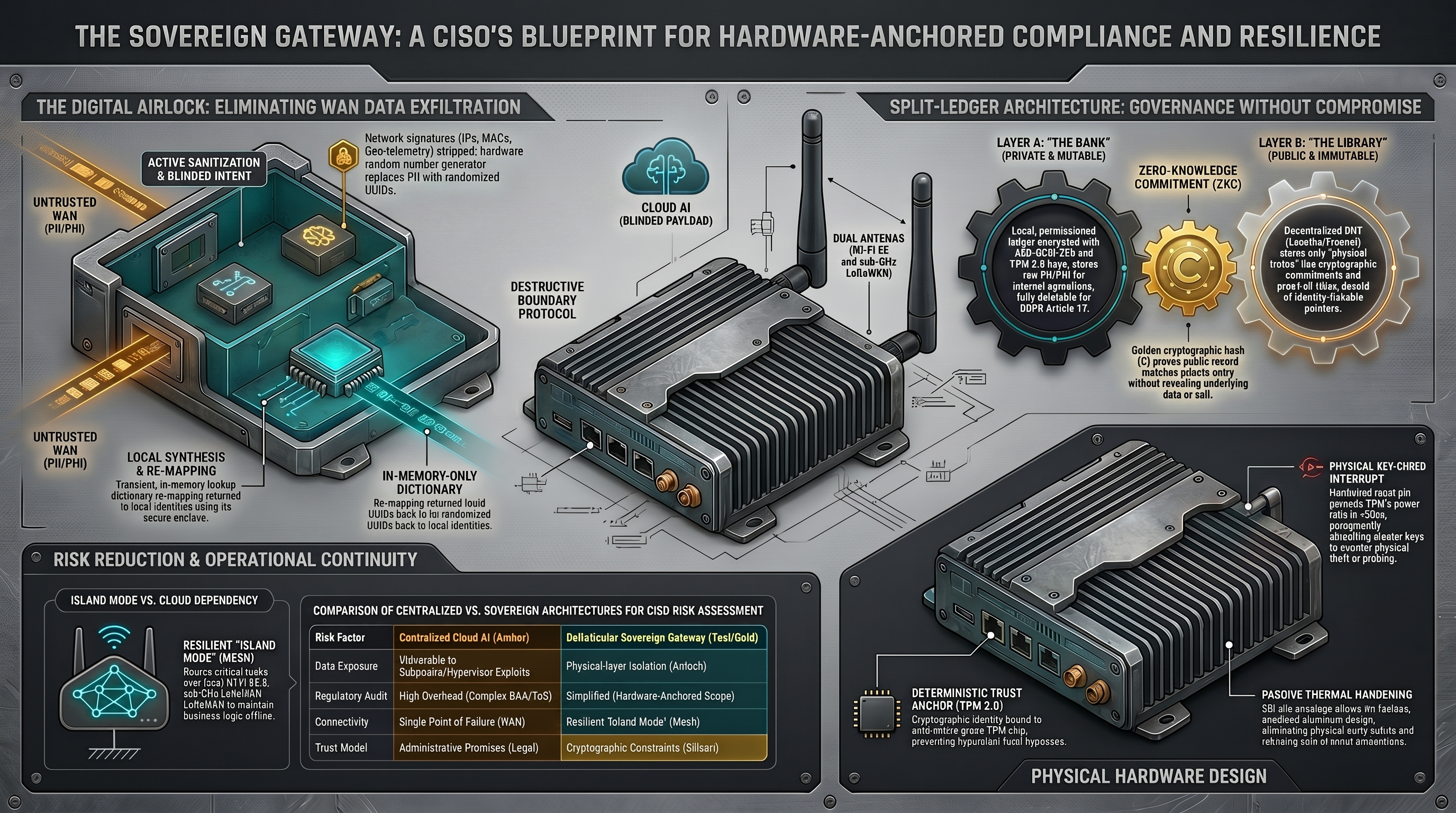
To enforce this boundary, DeReticular has designed the Sovereign Gateway Mesh
Router. This physical edge device acts as the local root of trust (RoT) and the
hardware-enforced translation boundary for all local-to-cloud communications.
   +-------------------------------------------------------------+
   |             SOVEREIGN GATEWAY MESH ROUTER                   |
   |                                                             |
   |  +-------------------------+   +-------------------------+  |
   |  | Wi-Fi 6E (Local Devs)   |   | LoRaWAN (sub-GHz Mesh)  |  |
   |  +------------+------------+   +------------+------------+  |
   |               |                             |               |
   |               +--------------+--------------+               |
   |                              |                              |
   |              +---------------v---------------+              |
   |              |  Silicon Sentry (Apple M4)   |              |
   |              |   - 16 GB Unified Memory      |              |
   |              |   - 5W Idle / Passive Cooling |              |
   |              +---------------+---------------+              |
   |                              |                              |
   |              +---------------v---------------+              |
   |              |     Discrete TPM 2.0 Chip     |              |
   |              +---------------+---------------+              |
   |                              |                              |
   |              +---------------v---------------+              |
   |              |  Physical Key-Shred Interrupt | <---+ [Physical
   |              +-------------------------------+     |  Intrusion/
   |                                                    |  Reset Pin]
   +----------------------------------------------------+--------+
Hardware and Thermal Envelope
The Sovereign Gateway is built on the Premium Silicon Sentry architecture. It
utilizes a modified Apple M4 system-on-chip (SoC) configured to run inside a
highly restricted 5W idle power envelope. This low power draw enables complete
dependency on passive thermal dissipation, eliminating active cooling fans. The
lack of moving parts reduces physical failure points, prevents dust and
environmental degradation in agricultural or industrial deployments, and hardens
the chassis against acoustic or thermal side-channel monitoring.
The SoC is paired with 16 GB of unified memory, providing a high-bandwidth,
low-latency bus between the CPU, GPU, and Neural Engine. This memory pool is
sufficient to run local, optimized, highly quantized small language models
(e.g., Llama-3-8B-Instruct-INT4) directly on-device for local validation, basic
classification, and offline fallback scenarios.
Dual Network Topology and “Island Mode”
The Gateway features a dual-radio physical layer to handle divergent local
communication requirements:
- Wi-Fi 6E (6 GHz band): Handles high-bandwidth, low-latency, localized data
transit for on-premise workstations, high-definition camera feeds, and
medical imaging devices. - Sub-GHz LoRaWAN (868/915 MHz): Operates on a long-range, low-power mesh
network to collect telemetry from distributed, low-density edge sensors,
agricultural nodes, or smart grid endpoints.
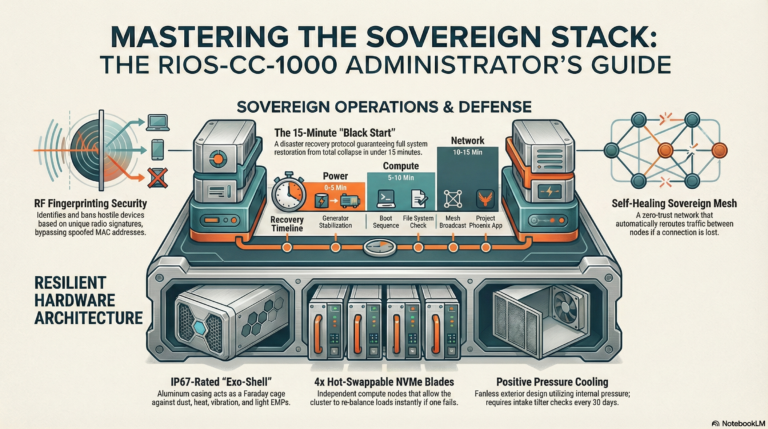
The physical layer is orchestrated by the Rural Infrastructure Operating System
(RIOS), a minimal, hardened Unix-based distribution. When WAN connectivity is
severed, RIOS automatically enters “Island Mode.” In Island Mode, the Sovereign
Gateway completely isolates the local network, routing Wi-Fi and LoRaWAN traffic
strictly within the local mesh. Critical municipal or enterprise functions—such
as localized water monitoring, power distribution, and peer-to-peer
messaging—continue to execute on the local mesh without external dependencies.
Local Trust and Initialization
The Sovereign Gateway operates with zero cloud-account dependency. It does not
call home to DeReticular servers, nor does it require third-party Identity
Providers (IdPs) for authentication.
Instead, the hardware root of trust is anchored to an on-board, discrete,
automotive-grade Trusted Platform Module (TPM 2.0) chip. Device initialization
occurs out-of-band:
- On first boot, the administrator performs a physical tap of a high-security
NFC setup card against the Gateway’s chassis. - This physical proximity action initiates an ephemeral, authenticated key
exchange. - The Gateway’s TPM 2.0 mints a localized cryptographic passkey (utilizing
elliptic-curve cryptography, Secp256r1) and securely provisions it directly
into the administrator’s hardware-backed mobile wallet (e.g., Apple Secure
Enclave or Android Keystore). - All subsequent administrative access requires a local biometric-backed
passkey challenge-response protocol over TLS 1.3, keeping management
credentials entirely within the user’s physical custody.
Ultimate Fail-Safe: Key-Shredding Interrupt
To counter physical theft or laboratory-level microprobing, the Gateway features
active chassis intrusion detection loops. A specialized, physical reset pin is
hardwired directly to the TPM 2.0’s physical master clear and write-enable
lines.
If the outer chassis is compromised, or if the physical reset pin is depressed,
a dedicated, low-latency hardware interrupt is triggered. This immediately pulls
the key-storage voltage rails of the TPM to ground, permanently shredding the
master seed keys and local decryption keys in less than 50 nanoseconds. Because
the local storage is fully encrypted with AES-XTS-256 bound to this TPM-derived
seed, the data volume immediately becomes cryptographically unrecoverable,
rendering cold-boot or memory-dump exploits useless.
PART 3: Deep Dive: The Mechanics of the Digital Airlock
The Digital Airlock Protocol is the core network-level and cryptographic
translation layer that mitigates the risk of data exfiltration during cloud
interaction. Rather than establishing a transparent tunnel between local clients
and the external cloud, the Airlock acts as a destructive boundary: it
intercepts local requests, deconstructs them, passes an anonymized mathematical
logical representation to the cloud, and re-synthesizes the return payload
within the secure local enclave.
Step-by-Step Data Flow
The following sequence details how a local user request (e.g., an automated
query to check patient record anomalies or legal contract compliance) interacts
with an external, untrusted hyperscale model such as Google’s Project Remy:
[Local Network Client]
|
| (1) Raw Query: “Check medical files of Patient Alice Smith (ID: 98122) for abnormalities in drug X.”
v
+—————————————————————————————————+
| SOVEREIGN GATEWAY ENCLAVE |
| |
| [Sovereign Executive Agent] |
| | |
| | (2) Intercept & Stage |
| v |
| [Active Sanitization Engine] |
| | |
| | – Strips: IPs, MACs, Geo-Telemetry, Client Signatures, Precise Identifiers |
| | – Maps: “Alice Smith (ID: 98122)” => {Subject_UUID_A} |
| | – Maps: “drug X” => {Substance_UUID_B} |
| v |
| [Blinded Intent Generator] |
| | |
| | (3) Formulates Blinded Intent Payload: |
| | “Evaluate interaction between {Subject_UUID_A} clinical history and {Substance_UUID_B}” |
| +—————————————————————————————–+
|
| (4) Physical-Level Airlock Firewall (WAN Outbound)
v
[ Decentralized Routing Layer (Tor/Relay Mesh) ]
|
v
[ Centralized Cloud AI (Google Project Remy) ]
|
| (5) Executes logic over blinded tokens; returns structural correlation vectors.
v
[ Decentralized Routing Layer (Tor/Relay Mesh) ]
|
| (6) Returns Blinded Response: “{Subject_UUID_A} exhibits 0.12 adverse risk to {Substance_UUID_B}”
v
+—————————————————————————————————+
| SOVEREIGN GATEWAY ENCLAVE |
| |
| [Digital Airlock Firewall] (WAN Inbound Intercept) |
| | |
| v |
| [State Translation Engine] |
| | |
| | (7) Re-maps variables using ephemeral local state lookup dictionary: |
| | – {Subject_UUID_A} => “Alice Smith (ID: 98122)” |
| | – {Substance_UUID_B} => “drug X” |
| v |
| [Local Synthesis Engine] |
| | |
| | (8) Generates local alert: “Patient Alice Smith exhibits a 12% adverse risk to drug X.”|
| v |
+—————————————————————————————————+
|
| (9) Rendered local alert (TLS 1.3 / local network)
v
[Local Network Client]
Step 1: Intercept & Stage
The user or internal system sends a transaction query. The Gateway’s Sovereign
Executive Agent intercepts this traffic at the network socket layer. The data is
held in an isolated, volatile staging memory region within the Apple M4 secure
hardware enclave. It does not hit the local solid-state disk (SSD).
Step 2: Active Sanitization
The Active Sanitization Engine runs a highly optimized parsing pass over the
staged request. It programmatically strips all headers, transport metadata,
network routing paths (IP addresses, MAC addresses), hardware fingerprint
characteristics, browser user-agents, localized system clocks, and geographical
coordinates.
Step 3: Blinded Intent Generation
The system extracts the core semantic structures and tokens from the text
payload. Any entity identified as PII, proprietary IP, or unique state is
replaced with cryptographically random UUIDs generated via the hardware random
number generator (TRNG).
A mapping translation matrix is written to a highly restricted, transient
in-memory lookup table that exists only for the lifetime of that specific
transaction loop:
\text{Mapping Matrix } M = { \text{Entity} \to \text{UUID} }
The output is a stripped, abstract, and “blinded” logical payload containing
only the relational operators, structural syntax, and generic tokens required to
perform reasoning.
Step 4: The Transmit
The blinded intent payload is serialized into a highly structured JSON or
Protobuf schema. It is passed through the physical-level Digital Airlock
Firewall—a dedicated microchip that enforces unidirectional or rate-limited
packet serialization to the WAN port. The traffic is routed through a
decentralized network layer (e.g., a multi-hop onion routing network or private
relays) to prevent the cloud provider from linking the request to the
enterprise’s public IP footprint.
Step 5: Compute & Return
The external cloud AI (e.g., Google’s Project Remy running on TPU v5e clusters)
processes the anonymized logical query. Because the cloud model only sees
abstracted variables (such as {Subject_UUID_A} and {Substance_UUID_B}), it
cannot determine what patient, what institution, what geographical location, or
what exact drug is being evaluated. It executes its massive transformer
reasoning matrix and returns a structural logical output.
Step 6: Local Execution & Synthesis
The return payload passes through the WAN port and is intercepted by the Digital
Airlock Firewall. The raw response is moved back into the M4’s volatile enclave
memory.
The State Translation Engine reads the local transient dictionary M and performs
a reverse-lookup to re-substitute the raw identifiers back into the structured
response:
\text{Result}{\text{Local}} = \text{Substitute}(\text{Response}{\text{Blinded}}, M^{-1})
The local client receives a coherent, fully resolved reasoning output (e.g.,
“Patient Alice Smith exhibits an adverse reaction potential to drug X”), while
the cloud provider’s logs record only the processing of an abstract,
un-linkable, mathematically blinded token graph.
PART 4: Resolving the Data Governance Paradox: Split-Ledger Architecture
For enterprises operating at scale, protecting PII is only half of the
challenge. Global supply chains, carbon tracking programs, agricultural export
validations, and international financial settlements require an open, immutable,
tamper-proof system to verify physical occurrences without a central trust
authority. However, storing this validation data on a public blockchain violates
fundamental tenant-level and regulatory requirements (such as the GDPR’s “Right
to be Forgotten” or HIPAA’s strict medical isolation rules).
DeReticular resolves this “Data Governance Paradox” by splitting the data path
into two cryptographically linked, physically distinct ledgers: Layer A (The
Bank) and Layer B (The Library).
              +----------------------------------------------+
              |            SPLIT-LEDGER ARCHITECTURE         |
              +----------------------------------------------+
                                     |
            +------------------------+------------------------+
            |                                                 |
            v                                                 v
+—————————+ +—————————+
| LAYER A: “THE BANK” | | LAYER B: “THE LIBRARY” |
| (Private Ledger) | | (Public Ledger) |
+—————————+ +—————————+
| * Permissioned / Closed | | * Decentralized / Public |
| * Stores: PII, PHI, IP | | * Locutus / Freenet DHT |
| * AES-GCM-256 Encrypted | | * Logs: Hashes, Metrics, |
| * Local TPM Keys | | Proof-of-Labor/Tokens |
+—————————+ +—————————+
| |
+————————+————————+
|
v
+——————————-+
| ZERO-KNOWLEDGE COMMITMENT |
| – Proves state in Layer A |
| matches hash in Layer B |
| – Zero data leak to public |
+——————————-+
Layer A (The Bank / Private Ledger)
Layer A is a permissioned, local, encrypted ledger that acts as the ultimate
authority for sensitive identity and financial state.
- Storage Mechanics: Implemented as an isolated, relational PostgreSQL engine
run inside an encrypted virtual partition on the local Gateway, or as a
private, high-speed Raft consensus network distributed across a small number
of authenticated peer Gateways. - Security Controls: Every record is encrypted at rest using AES-GCM-256 with
keys sourced dynamically from the hardware TPM 2.0. - Content: Contains raw customer files, real names, exact financial balances,
explicit trade routes, medical diagnoses, and historical PII. Access is
restricted exclusively to authenticated internal operators, authorized
financial institutions, and regulatory compliance auditors during an active
investigation.
Layer B (The Library / Locutus Ledger)
Layer B is an open, decentralized, peer-to-peer ledger hosted on the
Freenet/Locutus network.
- Storage Mechanics: Unlike traditional energy-intensive blockchains, the
Locutus Ledger utilizes a small-world decentralized hash table (DHT) where
data is stored as keys associated with WebAssembly (Wasm) contracts. - Security Controls: Completely anonymous and permissionless. It features zero
native tokenomics, preventing economic attack vectors, speculation, or
centralized gas fee manipulation. Nodes participate voluntarily by routing
and storing contracts based on geographic and topology-hiding proximity
algorithms. - Content: Contains only anonymized “physical truths.” This includes
cryptographic commitments, proof-of-labor validations, supply chain carbon
index ratings, sensor calibration signatures, and timestamp proofs. It is
completely devoid of raw PII or identity-linkable pointers.
The Cryptographic Interlock
To bridge these layers without compromising privacy, DeReticular employs a
Zero-Knowledge Commitment (ZKC) mechanism.
When a physical transaction occurs (such as a local agricultural cooperative
validating a grain moisture level and labor duration):
- The local Gateway records the raw identity of the laborer, location, and
precise weight on its local Layer A (The Bank). - The Gateway processes this raw data to generate an ephemeral cryptographic
hash representing the physical transaction, combined with a random salt
value (r):
\text{Commitment } C = \text{HMAC-SHA256}(\text{Transaction Data} \parallel \text{Salt } r)
- This commitment (C) is written to a specialized WebAssembly contract on
Layer B (The Locutus Ledger / Freenet). The contract enforces state
transitions: once written, C is immutable, globally accessible, and
verifiable. - When a global distributor wishes to verify the validity of this shipment at
a port of entry, they query the public Locutus Wasm contract. - The local Gateway presents a cryptographic proof (a localized zero-knowledge
proof or a designated-verifier signature). This proves that the commitment C
stored in the public Library corresponds to a valid, un-revoked, and
authorized record in the private Bank, without revealing the salt r, the
identity of the laborer, or the specific internal enterprise keys.
This structural split satisfies compliance frameworks by allowing complete
erasure of Layer A records (satisfying GDPR “Right to be Forgotten” mandates)
while leaving the cryptographic proof of history on Layer B structurally intact
and verifiable but mathematically impossible to link to any physical entity.
PART 5: Strategic Risk Register and Implementation Blueprint
Moving from standard centralized infrastructure to a hardware-anchored edge
model introduces distinct technical trade-offs. The following Risk Register
outlines potential attack vectors, architectural limitations, and their
mitigations:
Risk Register
| Risk ID | Risk Vector / Vulnerability | Likelihood | Impact | Technical Mitigation Strategy |
|---|---|---|---|---|
| R-API-01 | Upstream Blocking: Centralized AI providers block or rate-limit blinded intent queries due to lack of diagnostic telemetry or payload structured formatting. | Medium | High | Dynamic Schema Alignment: Implement automated schema synthesis that formats blinded queries to resemble typical developer workloads. If blocked, default to Local Inference Fallback Mode, executing localized processing on the Gateway’s internal M4 Neural Engine. |
| R-KEY-02 | Physical Seed Loss: Degradation or destruction of the physical NFC setup card and TPM key block due to environmental damage or accident. | Low | Critical | M-of-N Cryptographic Sharding: Implement a local threshold secret sharing scheme (Shamir’s Secret Sharing). Master backup keys are split into $N$ physical key fragments, requiring $M$ fragments (distributed among different trustees) to reconstruct the root authorization keys. |
| R-NET-03 | RF Jamming / Mesh Isolation: Active signal jamming targeting the Wi-Fi 6E or sub-GHz LoRaWAN spectrum, isolating the Gateway from its mesh nodes. | Low | Medium | Asymmetric Dual-Radio Fallback: When high-frequency interference is detected, RIOS automatically reduces transmission rates and switches to ultra-narrowband, frequency-hopping sub-GHz LoRaWAN mesh topologies to maintain low-rate telemetry routing. |
| R-PHY-04 | Side-Channel Analysis: Physically proximate adversaries conducting electromagnetic (EM) or power-differential profiling of the M4 SoC during cryptographic blinding operations. | Very Low | High | Constant-Time Blinding Protocols: Implement constant-time cryptographic primitives at the software layer to normalize energy consumption profiles. Use electromagnetic shielding inside the anodized aluminum chassis of the Gateway. |
Compliance Posture Analysis
Deploying the Sovereign Gateway and Split-Ledger architecture simplifies
compliance auditing by converting policy-based rules into physical,
cryptographic constraints:
- HIPAA (Health Insurance Portability and Accountability Act): Because patient
names, specific diagnostic codes, and localized identifiers are fully
sanitized and replaced with transient, cryptographically generated UUIDs
before leaving the physical boundaries of the Gateway, the external cloud
network (and its host provider) are entirely excluded from the PHI data flow
path. This boundaries-first separation dramatically narrows the scope of
HIPAA-regulated networks, eliminating the requirement to sign multi-party
BAAs with external model operators. - GDPR (General Data Protection Regulation): Under Article 17, EU citizens
maintain the “Right to be Forgotten.” On a standard blockchain, this
requirement is nearly impossible to meet due to ledger immutability. The
Split-Ledger Architecture resolves this: because all PII is stored
exclusively on the private Layer A, an operator can delete the local
identity mapping. Once the private keys or mapping tables are deleted, the
immutable hash stored on the public Layer B (Locutus Ledger) becomes
cryptographically disconnected from any real-world identity, rendering it
anonymous data under GDPR recitals. - SOC 2 (Trust Services Criteria – Security, Confidentiality, Privacy):
Traditional SOC 2 compliance heavily relies on administrative controls
(e.g., policy documents, employee training, soft access reviews). By using
TPM 2.0 hardware-enforced boot chains, automated active sanitization, and a
physical self-destruct mechanism, the Sovereign Gateway provides auditors
with verifiable technical evidence of security boundary enforcement. Access
is limited by hardware bounds, not administrative promises.
Architectural Trade-offs and Conclusion
Transitioning to this architecture involves clear engineering trade-offs.
Organizations must weigh the increased complexity of managing local physical
hardware, organizing offline cryptographic multi-signature cards, and supporting
decentralized mesh networks against the alternative of a single centralized
point of failure.
| Centralized Cloud AI Architecture | DeReticular Sovereign Gateway Architecture |
|---|---|
| Zero upfront hardware costs; instant scalability. | Upfront physical hardware capital expenditure; physical deployment logistics. |
| Complete data exposure to hypervisor exploits, legal subpoenas, and provider data exploitation. | Physical-layer data isolation; cryptographically blinded external network exposure. |
| High dependency on continuous WAN connectivity; single network failure disables operational logic. | Resilient “Island Mode” routing; local core municipal and business logic executes offline. |
| Complex regulatory audit overhead (TOS changes, data processing addendums, liability negotiations). | Simplified audit scope via hardware-anchored zero-knowledge compliance boundaries. |
Ultimately, physical digital sovereignty requires accepting the responsibility
of local key management. By shifting the security boundary from fragile legal
frameworks to physical silicon and cryptographic blinding protocols, the
Sovereign Gateway and Split-Ledger Architecture provide enterprises and
municipal bodies with a mathematically bounded path to utilize hyperscale AI
computation without surrendering intellectual, operational, or civic autonomy.