Study Guide: Democratizing Carbon Finance and the Sovereign Stack
This study guide provides a comprehensive overview of the global carbon credit industry as of 2026, focusing on the structural shift from unverified avoidance offsets to hardware-secured physical removals. It examines DeReticular’s “Trash Banker” ecosystem and the “Sovereign Stack” architecture designed to resolve systemic trust, liquidity, and verification gaps in the market.
video
Part I: Short-Answer Review Quiz
Instructions: Answer the following questions in 2–3 sentences based on the provided research reports.
- What are the two primary systemic barriers that historically exclude smallholder farmers and local communities from the carbon credit market?
- How does the “Sovereign Sentry Pro” hardware facilitate localized machine learning for carbon verification?
- Explain the “Island Mode” protocol within DeReticular’s TriFi Mesh infrastructure.
- What is the difference between “Legacy Avoidance Credits” and “High-Integrity Removal Credits” in the 2026 voluntary carbon market?
- How does the “Trash Banker” model transform agricultural waste into “liquid” assets for farmers?
- What role does “Direct ADC Sampling” play in securing decentralized mesh networks?
- Why is “Feedstock Verification” considered a critical bottleneck for high-durable carbon removals like Biochar (BCR)?
- Describe the function of the “Carbon Oracle” and zkVerify within the RIOS stack.
- What is a “Corresponding Adjustment” (CA), and why has it caused a supply bottleneck for the CORSIA aviation scheme?
- Contrast the federal legislative trend in the United States with the state-level policies of California regarding carbon disclosures.
podcast
Part II: Quiz Answer Key
- The barriers include the “Collateral Barrier,” where decomposing agricultural waste is viewed as “dead capital” with zero financial liquidity, and “Extractive Auditing Costs,” where the price of hiring Western firms to verify biomass often exceeds the value of the credits generated. DeReticular resolves these by using edge AI to instantly value waste and automated cryptographic proofs to eliminate manual audit overhead.
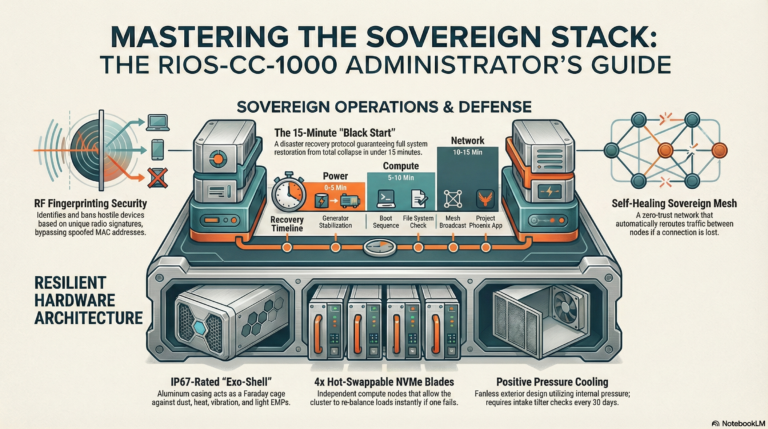
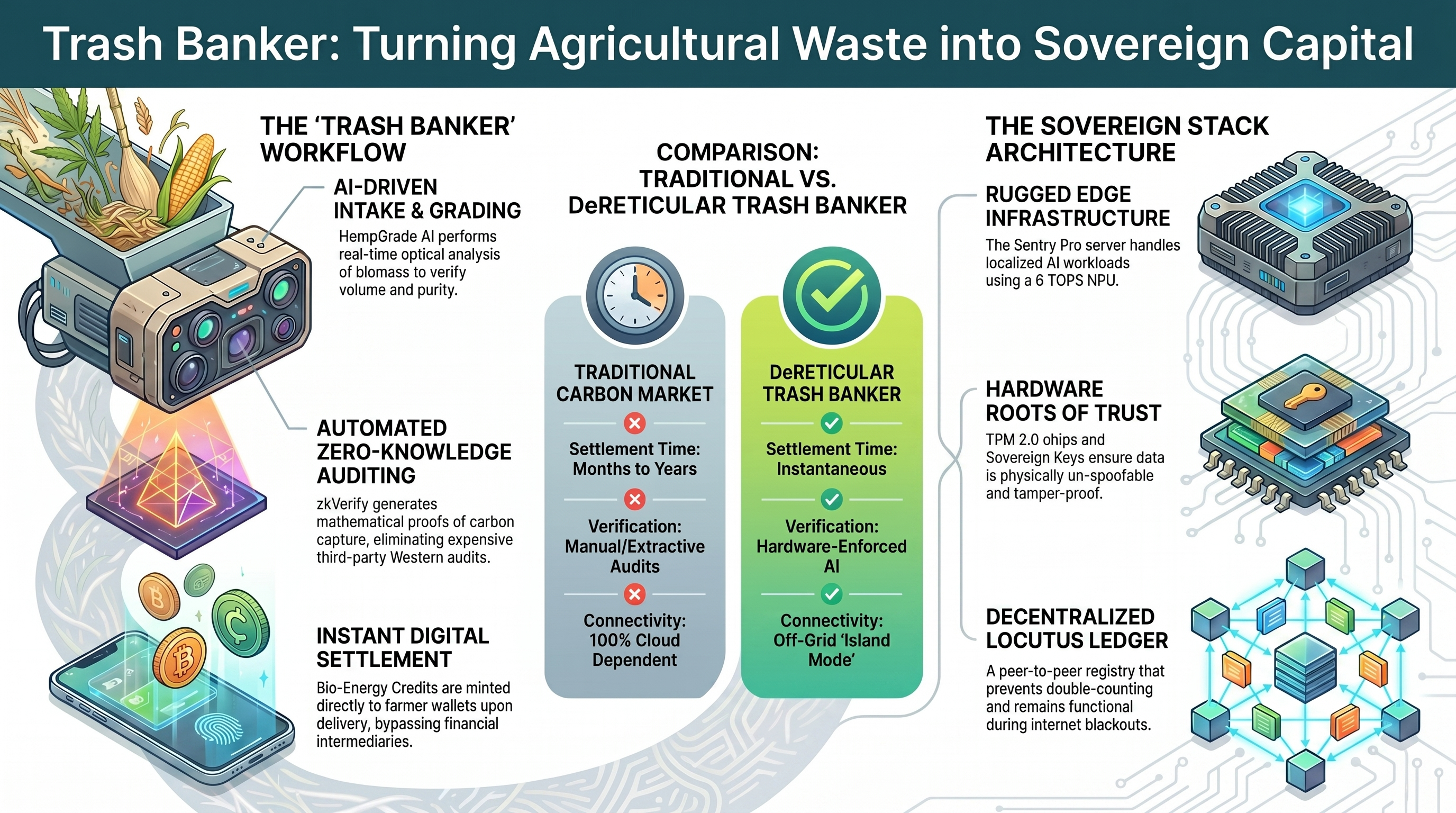
- The Sentry Pro features an integrated 6 TOPS Neural Processing Unit (NPU) and a minimum of 32GB of RAM, which is the exact footprint required to hold a quantized 8-billion parameter model in local memory. This allows it to perform high-throughput computer vision and sensor inference on-site without relying on the cloud.
- “Island Mode” allows a localized network to maintain full operational capacity even when disconnected from the global internet or suffering from macro-network disruptions. During these events, the network uses performance-aware Isotonic Regression routing to sync data locally, which is then merged back into the global ledger once connectivity is restored.
- Legacy avoidance credits (like REDD+) are based on counterfactual projections and often trade below $5/tonne due to “greenwashing” concerns and low integrity. In contrast, high-integrity removal credits (like ARR or Blue Carbon) trade between $22 and $60+/tonne because they represent the physical extraction of CO2 from the atmosphere.
- The model uses HempGrade AI and the Industrial Foreman AI to scan, grade, and value agricultural residues (like hemp hurd) at the point of delivery. Once verified, the system instantly mints “Bio-Energy Credits” directly to the farmer’s digital wallet, bypassing traditional banks that refuse to accept biomass as collateral.
- Direct ADC (Analog-to-Digital Converter) Sampling captures the unique sub-microsecond electromagnetic transients produced by a device’s radio transceiver. Because the physical variations in silicon chips cannot be cloned, this creates an un-spoofable hardware fingerprint that prevents Sybil attacks or virtual node spoofing.
- Premium buyers require proof that feedstocks are sustainable organic waste rather than illegally logged timber or contaminated materials. If a developer processes non-compliant materials, the carbon-neutral baseline is violated, exposing buyers to legal risks and compromising the ecological integrity of the credit.
- The Carbon Oracle uses zkVerify to compile physical parameters (biomass mass, gasifier temperature, and energy output) into a Zero-Knowledge Proof (ZKP). This ZKP mathematically proves carbon sequestration has occurred without exposing proprietary engineering data, allowing for continuous, automated auditing on the Locutus Ledger.
- A Corresponding Adjustment is a formal guarantee by a host country that a carbon reduction will not be double-counted toward its own national targets while being sold internationally. A lack of host-nation administrative infrastructure to issue these adjustments has restricted the supply of CORSIA-eligible credits, driving significant price premiums.
- At the federal level, the U.S. has moved toward deregulation, including withdrawing from the Paris Agreement and rescinding the EPA’s authority to regulate GHGs. Conversely, California has tightened rules through AB 1305, which mandates strict public disclosure for voluntary carbon claims to prevent greenwashing.
Part III: Essay Format Questions
The following questions are designed for in-depth analysis. No answers are provided.
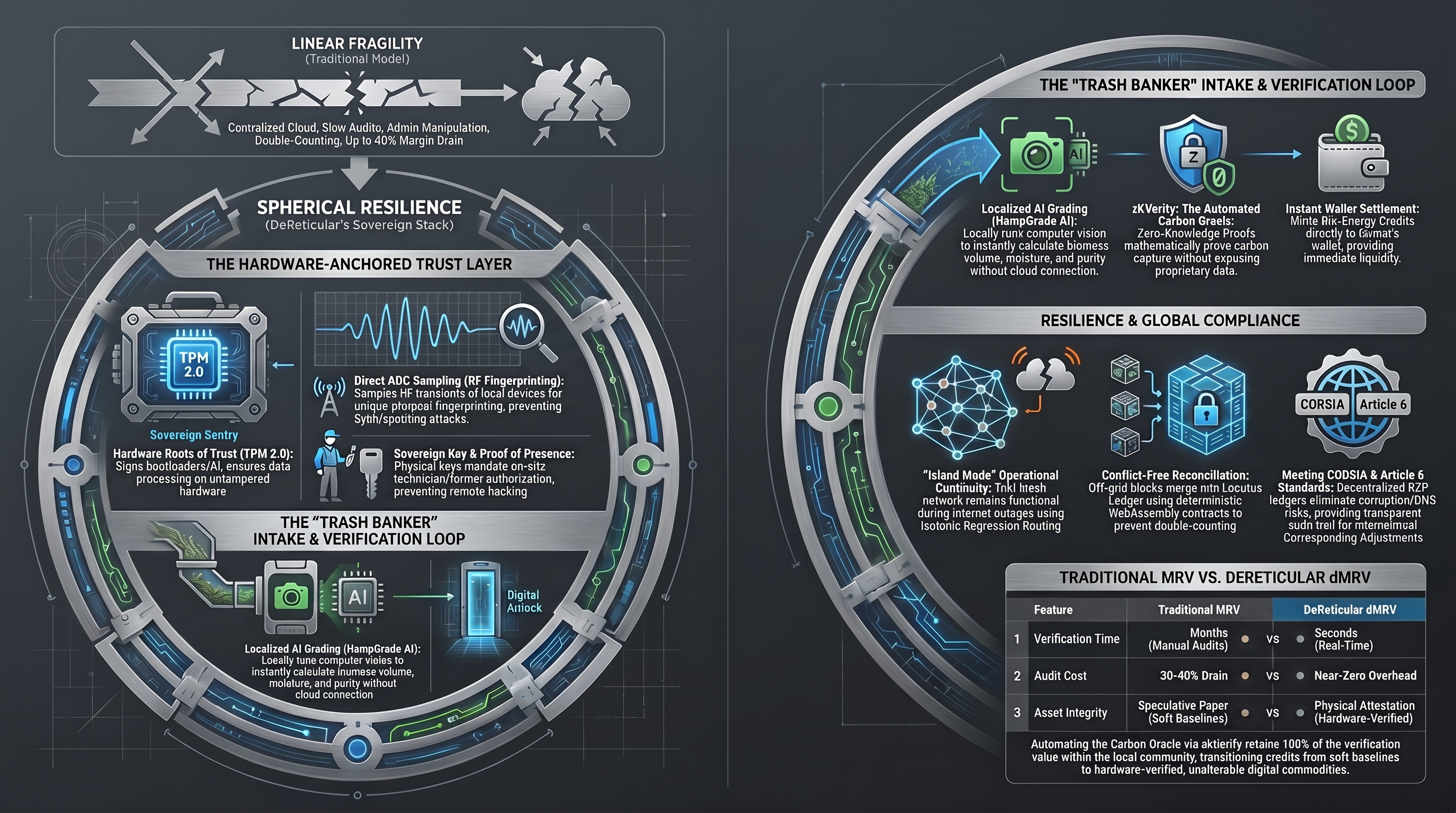
- The Evolution of Ecological Integrity: Evaluate the shift from “paper-based” carbon accounting to “Hard Physical Attestation.” How do technologies like TPM 2.0 and hardware roots of trust mitigate the “trust deficit” currently plaguing the Voluntary Carbon Market?
- Sovereign Infrastructure vs. Linear Fragility: Analyze DeReticular’s critique of centralized cloud dependencies. Discuss how a “Spherical Resilience” architecture, utilizing P2P ledgers and mesh networking, provides a more stable foundation for international carbon registries under Article 6 of the Paris Agreement.
- The Macroeconomics of the “Trash Banker”: Discuss the “Trash Banker” as a solution for “dead capital” in rural economies. How does the integration of plasma gasification, autonomous logistics (Kurb Kars), and digital wallets create a circular economy that benefits Indigenous Peoples and Local Communities (IPLCs)?
- Technological Gatekeeping in Industrial CDR: Examine the role of the Sovereign Sentry Pro as a “Digital Airlock” for Biochar Carbon Removal (BCR). Why is real-time, edge-based computer vision necessary to secure the premium price point of engineered carbon removals?
- Navigating Regulatory Polarization: The 2026 U.S. regulatory landscape is deeply divided. Assess how the use of Zero-Knowledge Proofs (ZKPs) and politically neutral mathematical attestation might allow multinational corporations to remain compliant across both deregulated federal environments and strict subnational transparency frameworks.
Part IV: Comprehensive Glossary of Key Terms
| Term | Definition |
| A6.4ER | Article 6.4 Emission Reductions; the first UN-regulated carbon units issued under the Paris Agreement Crediting Mechanism. |
| ARR | Afforestation, Reforestation, and Revegetation; a nature-based removal methodology involving planting trees on degraded or non-forested land. |
| Biochar (BCR) | A stable, solid carbon form produced via pyrolysis of biomass; used to lock carbon in soil for centuries. |
| Blue Carbon | Carbon captured by coastal and marine ecosystems (mangroves, seagrasses, salt marshes) which can store carbon at rates 10x higher than rainforests. |
| CBAM | Carbon Border Adjustment Mechanism; an EU policy that applies carbon costs to imports, forcing trade partners to adopt domestic carbon pricing. |
| CORSIA | Carbon Offsetting and Reduction Scheme for International Aviation; an ICAO-administered framework requiring airlines to offset emissions exceeding 85% of their 2019 baseline. |
| Corresponding Adjustment (CA) | A legal mechanism under the Paris Agreement to prevent double-counting of carbon credits between host nations and international buyers. |
| dMRV | Digital Monitoring, Reporting, and Verification; the use of automated technology (sensors, AI, blockchain) to replace manual carbon auditing. |
| HempGrade AI | A localized computer vision model used to grade agricultural hemp biomass on-site for volume, quality, and carbon density. |
| Industrial Foreman | An AI agent built on the OpenClaw framework that manages physical machinery and feedstock verification at the edge. |
| Isotonic Regression Routing | A performance-aware routing algorithm used in TriFi Mesh networks to optimize data flow across low-bandwidth, high-latency connections. |
| Locutus Ledger | A decentralized, peer-to-peer state machine built on the Freenet/Hyphanet protocol that uses WebAssembly (Wasm) contracts to secure registry data. |
| OBBBA (2025) | The “One Big Beautiful Bill” Act; a U.S. federal law that rolled back clean energy tax credits and restructured carbon sequestration incentives. |
| OpenClaw | An open-source, multi-agent AI execution engine used by DeReticular to run localized software agents at the edge. |
| RIOS | Rural Infrastructure Operating System; an AI-native, decentralized operating system designed to run off-grid hardware and workflows. |
| Sovereign Deck | A ruggedized, IP65-rated tactical tablet used as a field terminal for dMRV and agricultural grading. |
| Sovereign Sentry Pro | An industrial-grade edge server with an integrated NPU and TPM 2.0, acting as a gateway for ledger validation and machinery control. |
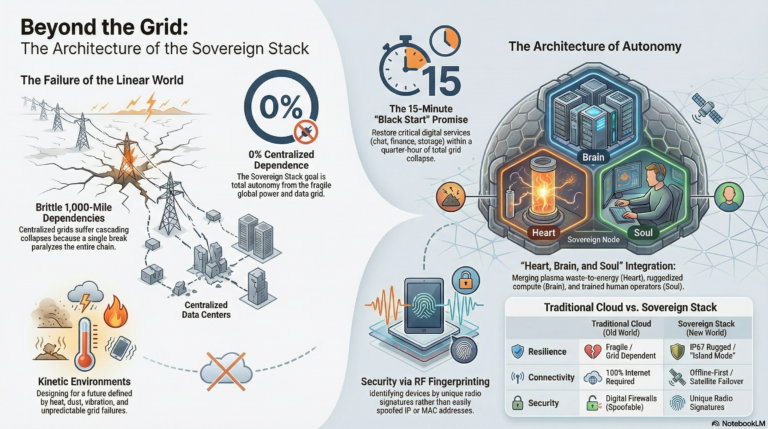
| Sovereign Stack | DeReticular’s integrated ecosystem of edge hardware, local networking, and decentralized ledgers designed for “Island Mode” resilience. |
| TPM 2.0 | Trusted Platform Module; a hardware security chip that provides cryptographic attestation to ensure a system’s software and kernel have not been tampered with. |
| Trash Banker | A decentralized framework that converts physical agricultural waste into digital Bio-Energy Credits for local farmers. |
| zkVerify | A technology integrated into the RIOS stack that generates Zero-Knowledge Proofs to provide mathematically certain evidence of carbon sequestration. |