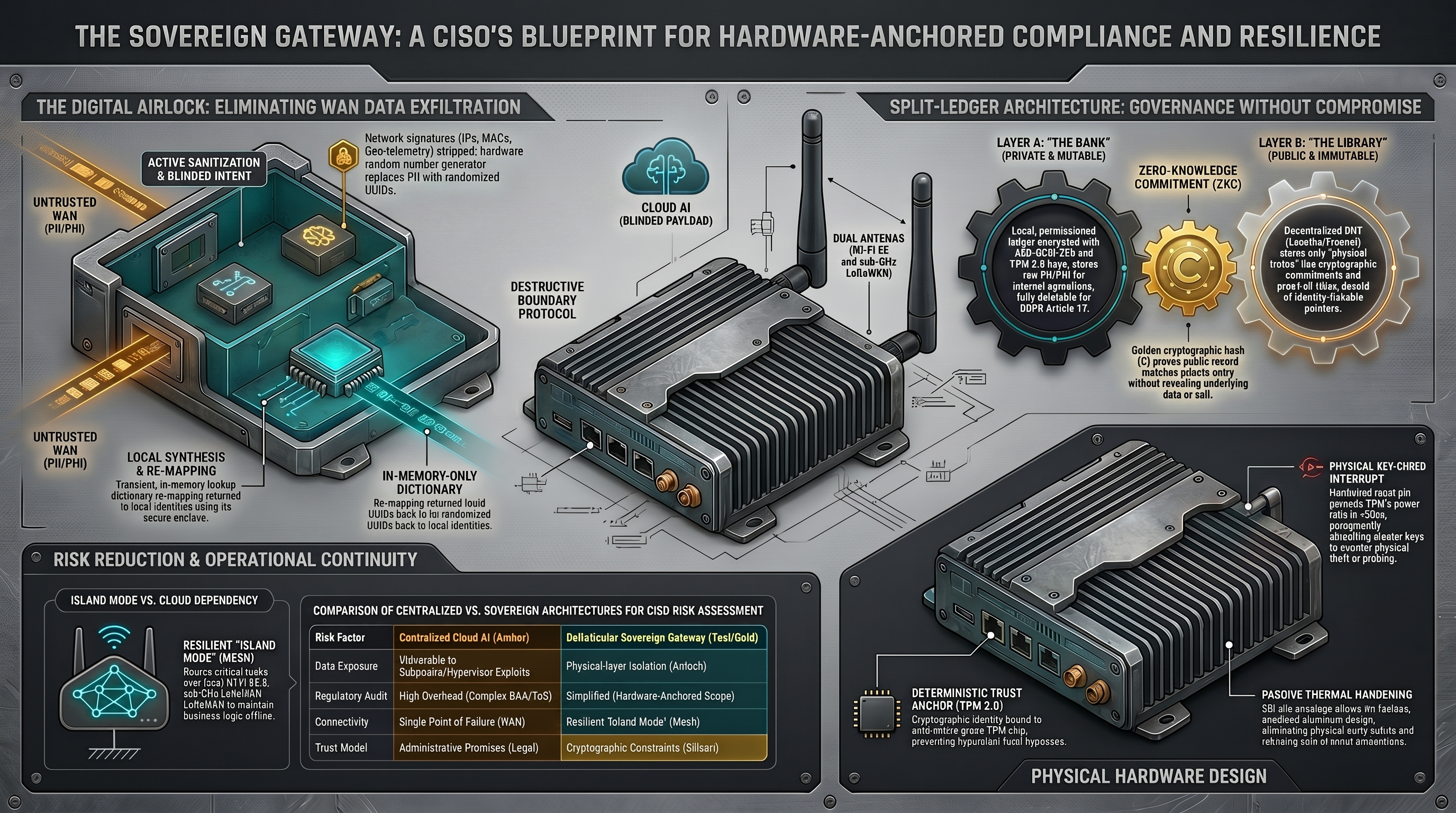
This study guide provides a comprehensive overview of the DeReticular Sovereign Gateway, the Digital Airlock protocol, and the Split-Ledger Architecture. It focuses on the technical mechanisms, strategic advantages, and operational challenges associated with hardware-anchored digital sovereignty.
Comprehensive Review Quiz
1. What is the “Trusted Environment Fallacy” as defined in the DeReticular white paper? The Trusted Environment Fallacy is the assumption that legal agreements, such as Terms of Service or Business Associate Agreements, provide a physical or technical barrier against data leakage. In reality, modern centralized AI models are designed for data harvesting, meaning raw data transmitted to a cloud provider is exposed to risks like jurisdictional compulsion and hypervisor compromise.
2. How does the Sovereign Gateway’s physical design contribute to its security profile? The Gateway uses a 5W idle power envelope and passive thermal dissipation, eliminating the need for fans and preventing physical entry points for environmental contaminants. This fanless, low-power design also hardens the device against side-channel attacks by reducing acoustic and thermal emanation vectors that adversaries could monitor.
3. Describe the initialization process for the Sovereign Gateway. The device initialization occurs out-of-band and does not rely on cloud accounts or third-party identity providers. An administrator performs a physical tap of a high-security NFC setup card against the chassis, which triggers an ephemeral key exchange to provision a localized cryptographic passkey into the administrator’s hardware-backed mobile wallet.
4. What occurs during the “Key-Shredding Interrupt” event? When the chassis intrusion detection loops are broken or the physical reset pin is depressed, a hardware interrupt pulls the TPM’s key-storage voltage rails to ground. This permanently shreds the master encryption keys in less than 50 nanoseconds, rendering the local AES-XTS-256 encrypted storage volume unrecoverable.
5. How does the Active Sanitization Engine prepare data for the cloud? The engine programmatically strips all metadata from a request, including IP addresses, MAC addresses, hardware fingerprints, and geographical coordinates. It essentially deconstructs the local request to ensure that no network signatures or identifiable transport characteristics reach the wide-area network.
6. What is “Blinded Intent Generation” within the Digital Airlock protocol? Blinded Intent Generation identifies sensitive entities like PII or proprietary IP and replaces them with cryptographically random UUIDs generated by a hardware random number generator. The resulting payload contains only the relational operators and abstract tokens necessary for the cloud AI to perform reasoning without knowing the actual content.
7. Explain the functional difference between Layer A and Layer B in the Split-Ledger Architecture. Layer A, “The Bank,” is a private, encrypted, and mutable ledger that stores sensitive data like PII and raw records locally. Layer B, “The Library,” is a public, decentralized, and immutable ledger on the Locutus DHT network that stores only anonymized hashes and cryptographic commitments.
8. How does the system handle the GDPR “Right to be Forgotten”? Under the Split-Ledger Architecture, PII is stored exclusively on the mutable Layer A. When an operator deletes the local identity mapping or keys, the immutable hash remaining on the public Layer B becomes cryptographically disconnected from any real-world identity, fulfilling the legal requirement for data erasure.
9. What is “Island Mode” and when is it activated? Island Mode is a state triggered by the Rural Infrastructure Operating System (RIOS) when WAN connectivity is severed. In this mode, the Gateway isolates the local network and routes traffic via Wi-Fi 6E and sub-GHz LoRaWAN mesh, allowing critical functions like power distribution or messaging to continue executing locally.
10. What are the primary technical trade-offs of deploying a hardware-anchored edge model? The model requires higher upfront capital expenditure for physical hardware and introduces maintenance overhead, such as firmware patching and hardware lifecycle management. Additionally, the process of staging and sanitizing data introduces measurable transaction latency, which may be unsuitable for ultra-low-latency applications like high-frequency trading.
Quiz Answer Key
- The Trusted Environment Fallacy: The belief that soft legal promises (ToS/BAAs) constitute technical barriers, ignoring the architectural reality of data harvesting in centralized AI.
- Physical Design: Passive cooling eliminates fans (physical entry points) and reduces side-channel emanation (acoustic/thermal), while the anodized aluminum chassis provides shielding.
- Initialization: Out-of-band NFC tap initiates a localized passkey exchange between the TPM 2.0 and an administrator’s hardware wallet, requiring no cloud account.
- Key-Shredding Interrupt: A physical trigger that grounds TPM voltage rails, destroying master keys in <50ns to prevent data recovery from stolen or tampered devices.
- Active Sanitization: The removal of transport metadata, hardware signatures, and network identifiers at the socket layer before data is serialized for transit.
- Blinded Intent: Mapping PII to random UUIDs using a hardware TRNG, creating an abstract logical payload that maintains the structure of a query but hides the identities.
- Layer A vs. Layer B: Layer A is private/mutable for identity storage; Layer B is public/immutable for verifiable proof of history without identity.
- GDPR Compliance: By deleting identity links in the private Layer A, the public Layer B record becomes truly anonymous and un-linkable, satisfying Article 17.
- Island Mode: An automated local-only routing state used during network outages to maintain municipal or enterprise services over a localized mesh network.
- Technical Trade-offs: Increased CAPEX, operational/maintenance overhead for physical devices, and transaction latency caused by the sanitization and blinding process.
Essay Questions
- The Shift from Legal to Physical Sovereignty: Evaluate the argument that legal frameworks like ToS and BAAs are insufficient for modern data protection. Contrast this with DeReticular’s approach of using “physical silicon” as the ultimate boundary for digital sovereignty.
- The Mechanics of Cryptographic Blinding: Deeply analyze the step-by-step data flow of the Digital Airlock. How does the use of a transient lookup dictionary and localized variable mapping solve the paradox of using untrusted cloud resources for sensitive computations?
- Resilience and Edge Computing: Discuss the implications of the “Island Mode” and the use of the M4 SoC for local inference. What are the limitations of edge hardware compared to hyperscale cloud models, and how does the RIOS hierarchical model architecture attempt to mitigate these gaps?
- Regulatory Scope Reduction: Analyze how the Sovereign Gateway architecture changes the landscape for HIPAA and GDPR audits. Specifically, explain how “mathematically ensuring” that PII never leaves the gateway reduces the administrative and legal costs associated with external cloud hosts.
- Threat Modeling and Side-Channel Attacks: Considering the SWOT analysis and Risk Register, discuss the potential vulnerabilities of the Sovereign Gateway, such as upstream API telemetry enforcement and microarchitectural profiling. How do the proposed mitigations (e.g., constant-time protocols and M-of-N sharding) address these risks?
Glossary of Key Terms
| Term | Definition |
| Active Sanitization | The programmatic removal of network signatures, IPs, and device fingerprints at the network socket layer. |
| Blinded Intent | A logical payload where sensitive entities are replaced with randomized UUIDs, allowing cloud AI to process reasoning without seeing PII. |
| Digital Airlock | The network-level and cryptographic translation layer that enforces a destructive boundary between local and cloud networks. |
| Island Mode | A restricted operational state where the Gateway routes all traffic strictly within a local mesh network during a WAN outage. |
| Key-Shredding Interrupt | A hardware-enforced self-destruct mechanism that clears TPM encryption keys in response to physical tampering. |
| Layer A (“The Bank”) | A private, encrypted, permissioned ledger used for storing sensitive identity and state information. |
| Layer B (“The Library”) | A public, decentralized, immutable ledger (Locutus DHT) used for recording cryptographic hashes and proofs. |
| Locutus DHT | A small-world decentralized hash table network used by Layer B to host WebAssembly contracts and anonymized “physical truths.” |
| M-of-N Sharding | A threshold secret-sharing scheme (e.g., Shamir’s) that splits master keys into multiple fragments to prevent a single point of failure. |
| RIOS | The Rural Infrastructure Operating System; a hardened Unix-based distribution that orchestrates the Gateway’s hardware and mesh networking. |
| Sovereign Gateway | The physical edge device that acts as the hardware root of trust and translation boundary for all local-to-cloud communications. |
| TPM 2.0 | A discrete Trusted Platform Module chip used to anchor the hardware root of trust and store cryptographic seed keys. |
| Zero-Knowledge Commitment (ZKC) | A mechanism that proves a public hash on Layer B corresponds to a private record on Layer A without exposing the underlying data. |