The Digital Airlock: A Student’s Primer on Private AI Integration
To understand the future of privacy, we must first address a fundamental conflict in modern technology. Organizations like hospitals, municipal grids, and banks require the cognitive “reasoning” power of hyperscale Cloud AI models. However, they are legally and ethically forbidden from surrendering proprietary data, medical records, or sensitive identities to third-party infrastructure.
This document explores a hardware-anchored solution: the Digital Airlock. By moving the security boundary from legal promises to physical silicon, we can leverage the world’s most powerful AI models without ever surrendering our digital sovereignty.
1. The “Privacy Paradox”: Why Cloud AI is a Double-Edged Sword
Most modern enterprises rely on the Trusted Environment Fallacy. This is the assumption that soft, non-binding legal frameworks—such as Terms of Service (ToS) or Business Associate Agreements (BAAs)—provide a physical barrier against data leakage. In reality, centralized AI is designed to harvest data; its ingestion pipelines require massive corpuses of real-world metadata to refine their weights.
To solve this, we must shift our mental model. We must stop treating the cloud as a trusted partner and instead treat it as an untrusted coprocessor—a powerful but “blind” calculator used only for its mathematical reasoning, never for its storage of our secrets.
| Feature | The Trusted Environment Fallacy (Soft/Legal) | Physical Sovereignty (Hard/Technical) |
| Primary Defense | Legal contracts, ToS, and non-binding promises. | Hardware-anchored trust and cryptographic anchors. |
| Risk Vector | Subpoenas, cloud admin exploits, and data harvesting. | Data is physically prevented from crossing the WAN. |
| Vulnerability | Bypassed via jurisdictional compulsion or software bugs. | Bypassed only through physical device destruction. |
| Trust Model | Reliance on the cloud provider’s employees and code. | Reliance on local silicon in your physical possession. |
2. Meet the Guardian: The Sovereign Gateway Hardware
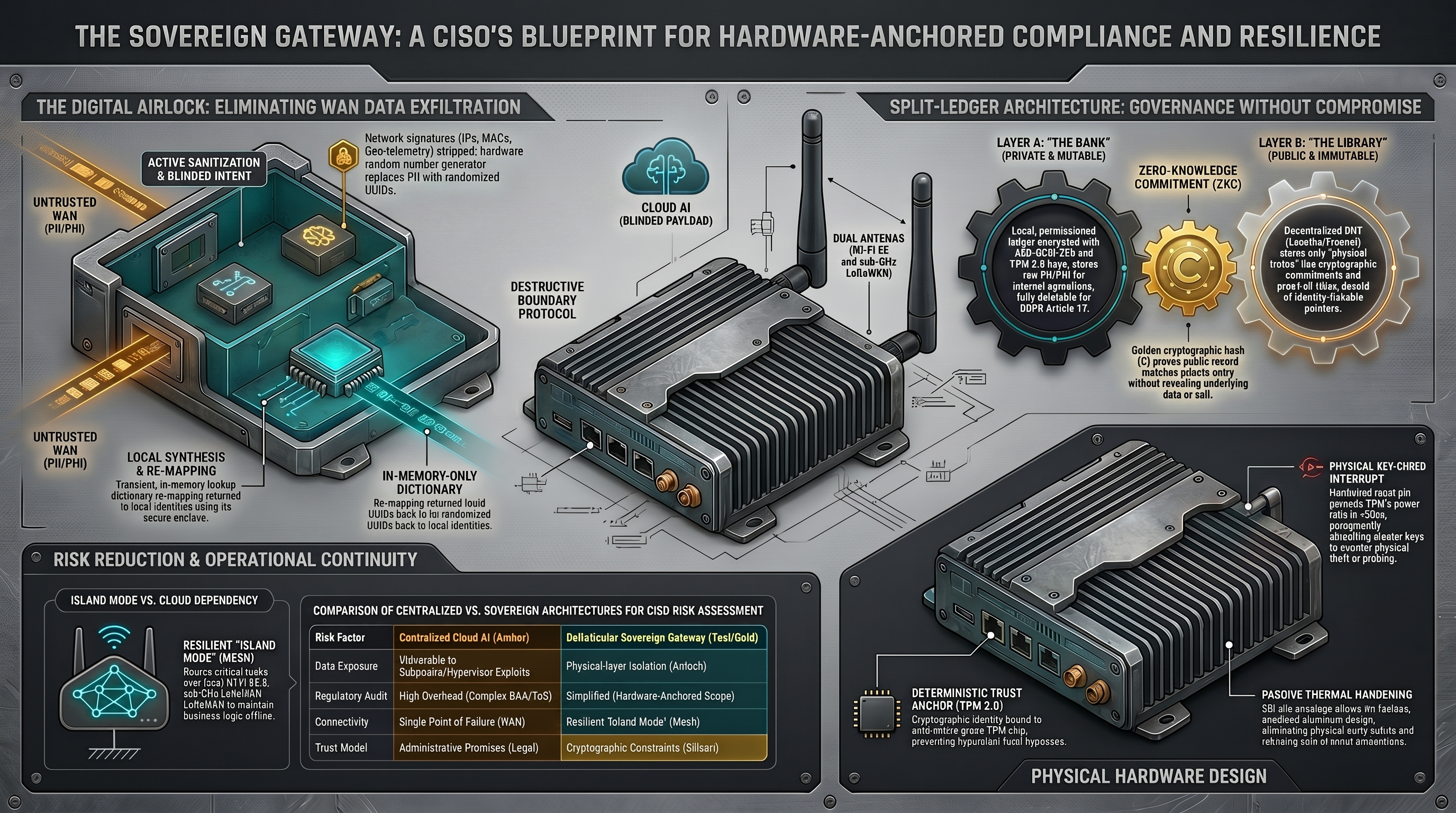
The Digital Airlock is enforced by the Sovereign Gateway, a “Silicon Sentry” designed as a local Root of Trust. Unlike standard routers, this device requires no cloud account to function; it is initialized via a physical NFC tap of a setup card against the chassis, keeping management credentials entirely in your physical custody.
- The Apple M4 Silicon Sentry: The heart of the device is an M4 chip restricted to a 5W power envelope.
- Benefit: This low power draw enables 100% passive cooling. By eliminating fans and vents, we close “acoustic leak” and thermal side-channel emanation vectors that sophisticated adversaries use to profile processor activity.
- Discrete TPM 2.0 Chip: A dedicated, automotive-grade Trusted Platform Module.
- Benefit: It acts as a high-security vault that holds localized cryptographic passkeys, ensuring the device only runs authorized software and never “calls home” to a central server.
- 16 GB Unified Memory Bus: High-bandwidth memory shared between the CPU and Neural Engine.
- Benefit: This allows the device to perform “Deterministic Data Minimization” in real-time. The massive bandwidth ensures that data sanitization occurs in under 12 milliseconds per kilotoken, maintaining high speed without sacrificing security.
3. The Three Pillars of the Airlock: Intercept, Sanitize, and Blind
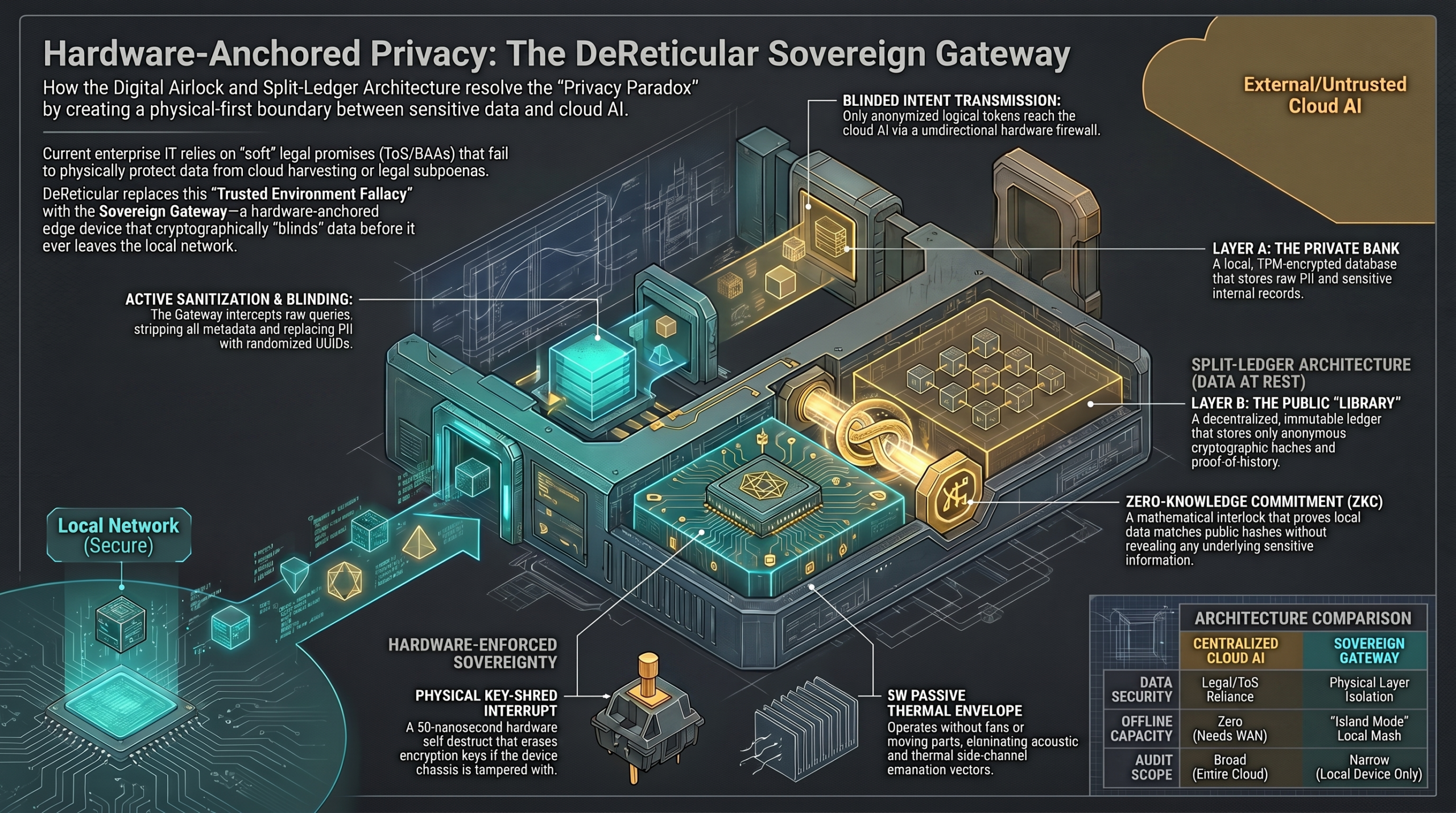
The Digital Airlock protocol acts as a destructive boundary. Like a physical airlock, it ensures that the “inside” (Local Net) and “outside” (Cloud) environments never have a direct, open path.
- Intercept: The Sovereign Executive Agent catches data at the network socket layer. This data is staged exclusively in “volatile” memory within the M4’s secure enclave; it is never written to a hard drive and vanishes instantly if power is lost.
- Sanitize: The Active Sanitization Engine performs Deterministic Data Minimization. It programmatically strips all “digital fingerprints,” including MAC addresses, browser user-agents, hardware fingerprint characteristics, and GPS coordinates.
- Blind: The Blinded Intent Generator replaces sensitive identifiers with cryptographically random UUIDs. The gateway then routes this “blinded” payload through a decentralized network layer (Tor/Relay Mesh) to ensure the cloud provider cannot link the query to your enterprise’s IP address.
Example: A “Blinded” Request The gateway creates a temporary Mapping Matrix (M) to remember which UUID belongs to which local identity.
// BEFORE (Sensitive Data in Local Staging)
{
  "request": "Check medical files of Alice Smith (ID: 98122) for abnormalities in drug X."
}

// AFTER (Blinded Intent sent to Cloud)
{
  "intent": "Evaluate interaction between {Subject_UUID_A} clinical history and {Substance_UUID_B}."
}
4. Deep Dive: Understanding “Blinded Intent”
The core innovation of this architecture is Blinded Intent. Instead of sending raw data, the Gateway sends only “relational operators and structural syntax.” The Cloud AI receives a logic puzzle rather than a story. It performs its reasoning on these abstract variables and returns a structural answer.
The State Translation Engine then uses the Mapping Matrix (M)—which is volatile and exists only for the lifetime of that specific transaction—to map the cloud’s answer back to local identities. While this process introduces a slight processing delay (roughly 12ms per kilotoken), it ensures the cloud never learns who it is helping.
Blinded Intent Definition: A privacy-preserving protocol where sensitive identifiers are replaced by cryptographically random tokens, allowing remote AI to process logical structures and return reasoning results without ever accessing the underlying raw identity or proprietary data.
5. The Ultimate Fail-Safes: “Island Mode” and Key-Shredding
A sovereign system must remain resilient even during network failures or physical theft.
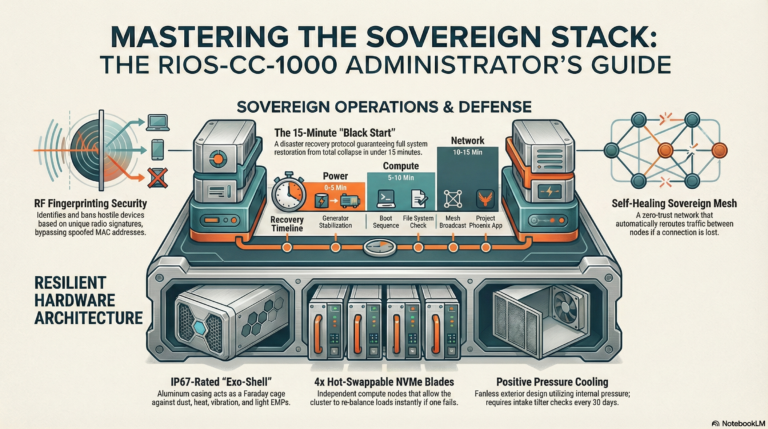
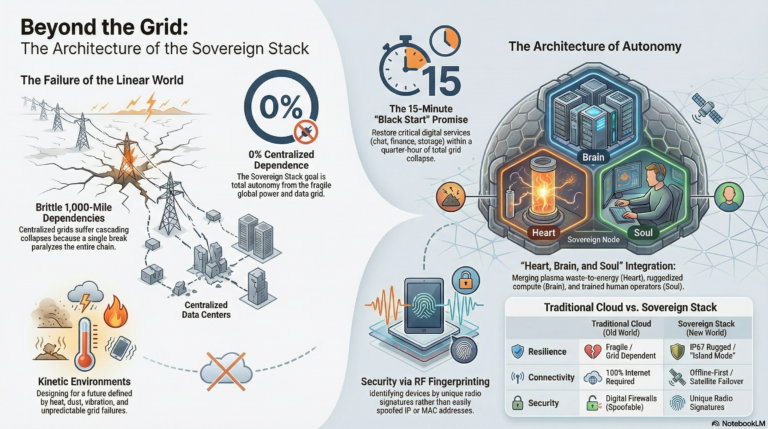
Island Mode (RIOS) If the wide-area network (WAN) is severed, the Rural Infrastructure Operating System (RIOS) enters “Island Mode.” It automatically routes critical local transactions over a Wi-Fi 6E and sub-GHz LoRaWAN mesh network.
- So what? Your hospital or utility grid remains smart and functional even if the global internet goes dark.
Physical Key-Shred The Gateway features active chassis intrusion detection. If the box is pried open or the physical reset pin is triggered, a hardware interrupt occurs. In less than 50 nanoseconds, the device grounds the voltage rails to the TPM chip.
- So what? This permanently shreds the master encryption keys. Even with laboratory-level equipment, a thief cannot recover your data from the stolen hardware.
6. The Student’s Cheat Sheet: Split-Ledger Compliance
To solve the “Data Governance Paradox,” the Gateway utilizes a Split-Ledger Architecture. This allows organizations to meet modern compliance standards by mathematically separating identity from proof.
- Layer A (The Bank): A private, mutable, TPM-encrypted ledger that holds the actual names and PII.
- Layer B (The Library): A public, immutable, decentralized ledger (Locutus DHT) that holds only anonymized cryptographic hashes or “physical truths.”
By decoupling these layers, an organization can satisfy the GDPR “Right to be Forgotten” by simply deleting the identity link in Layer A; the hash on Layer B remains but becomes mathematically impossible to link to a human being.
| Category | Standard Cloud AI | Digital Airlock Architecture |
| Cost & Logistics | Zero upfront hardware; low friction. | Upfront capital expenditure; physical setup. |
| Privacy & Security | Data exposed to cloud admins and subpoenas. | Physical isolation; deterministic minimization. |
| Reliability | Total failure during WAN outages. | “Island Mode” resilience via local mesh. |
| Compliance | Complex legal audits (HIPAA/GDPR). | “Scope Reduction” via hardware boundaries. |
In the age of AI, physical silicon—not legal paperwork—is the new boundary for human privacy. By using a Digital Airlock, we maintain the sovereignty of our local data while harnessing the scale of the cloud.