Sovereign Autonomous Infrastructure and Spherical Resilience Study Guide
This study guide serves as a comprehensive resource for understanding the transition from traditional centralized infrastructure to sovereign autonomous models. It synthesizes technical, economic, and strategic data regarding decentralized mesh networks, “Island Mode” operations, and the deployment of modular infrastructure.
Part I: Short-Answer Quiz
Instructions: Answer the following questions in 2–3 sentences based on the provided source context.
- Define “Island Mode” and explain its primary purpose.
- What is “Phase 0” deployment in the DeReticular framework?
- Explain the difference between “Linear Fragility” and “Spherical Resilience.”
- How does the “leapfrog” dynamic apply to developing regions and infrastructure?
- What are the four foundational pillars enabling the immediate deployment of sovereign autonomous infrastructure?
- Describe the function of RIOS (Rural Infrastructure Operating System).
- What is a Decentralized Physical Infrastructure Network (DePIN) and how does it change infrastructure financing?
- How do “Behind-The-Meter” (BTM) configurations help bypass regulatory hurdles?
- According to graph theory, why is a “k-connected” mesh (where k \ge 3) superior to a tree topology?
- What is “Signal Fusion” within the context of the DeReticular stack?
podcast
Part II: Answer Key
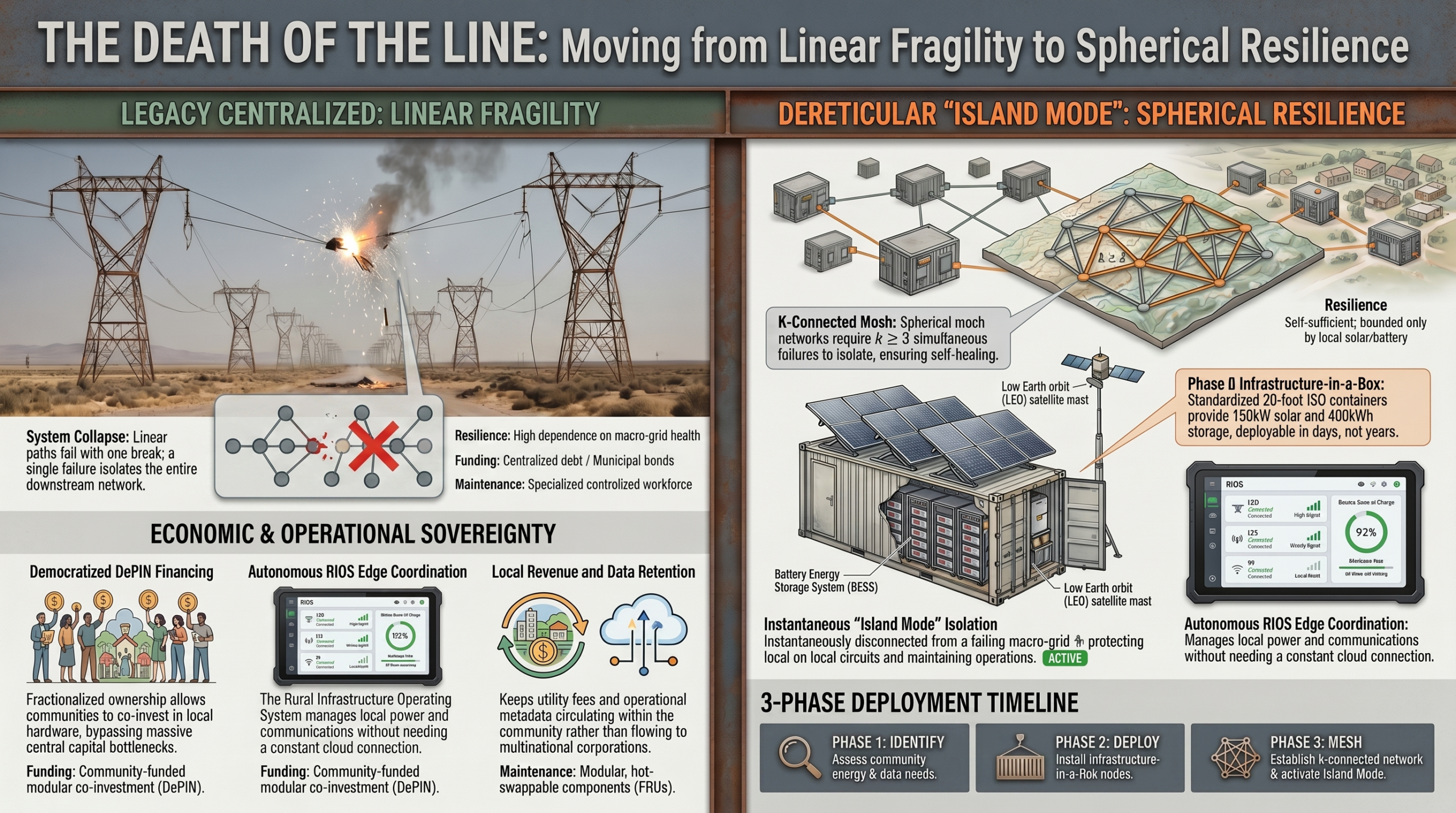
- Island Mode refers to a state of edge-autonomous operation where a local node activates its internal control loop to function independently of the macro-grid. Its purpose is to physically and digitally bound failures to a localized zone, ensuring critical services like water pumping and communications continue even during regional collapses.
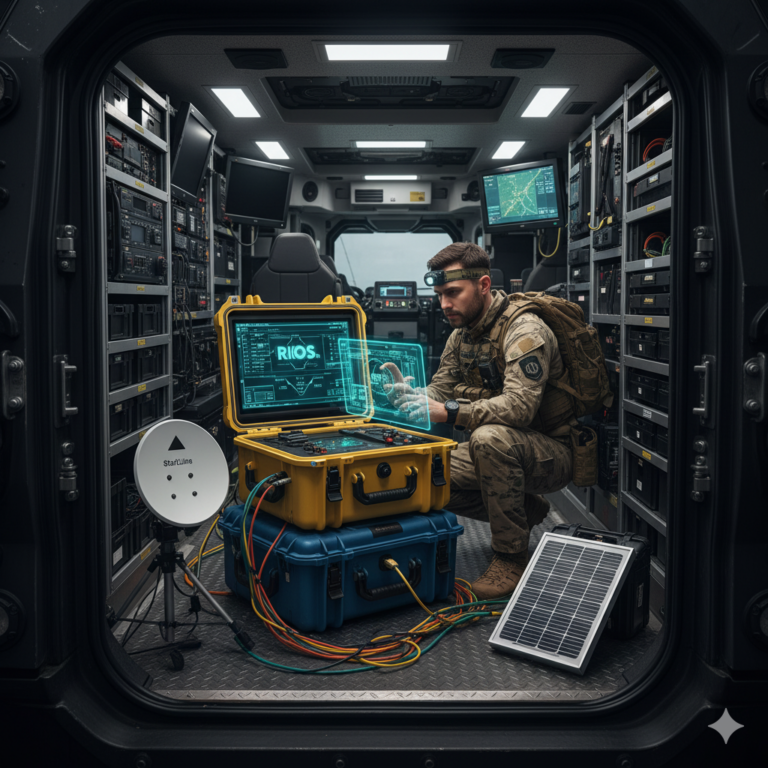
- Phase 0 deployment involves the use of “Infrastructure-in-a-Box,” a standardized 20-foot ISO shipping container equipped with 150 kW solar arrays and 400 kWh battery storage. It is designed for rapid transit and commissioning, allowing municipalities to establish immediate localized energy and telecommunications security.
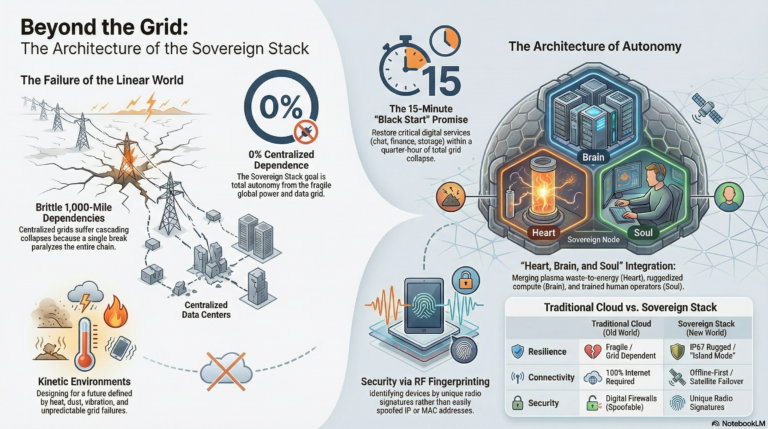
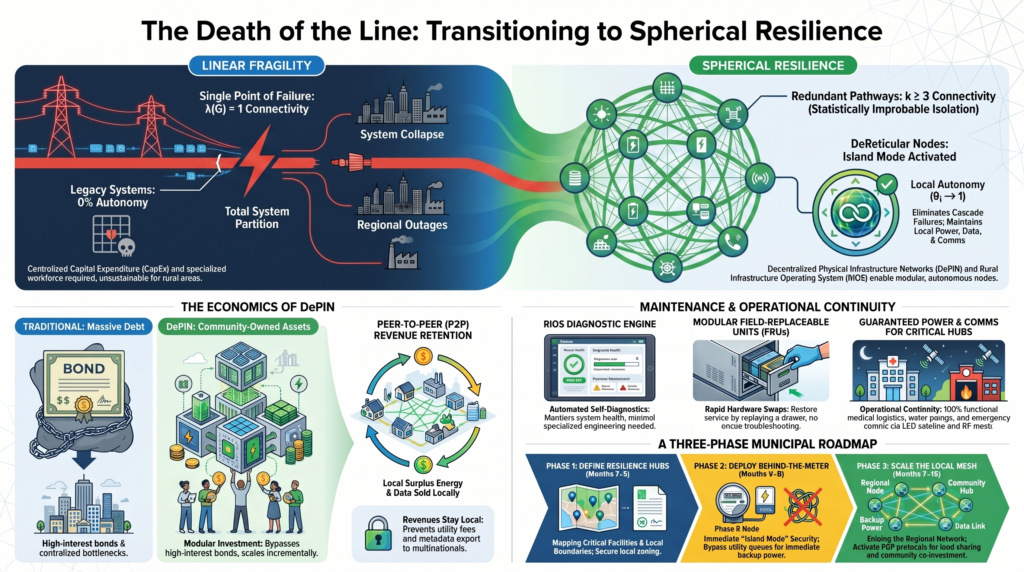
- Linear Fragility describes systems reliant on centralized corridors (like high-voltage lines) where a single severance causes downstream collapse. Spherical Resilience replaces this with a dense, multi-directional mesh where nodes remain self-sustaining and can route around disruptions.
- The leapfrog dynamic suggests that developing regions, which often lack entrenched legacy infrastructure, can skip the centralized cloud and telecom stage entirely. Just as these regions moved directly to mobile phones without landlines, they may move directly into sovereign autonomous infrastructure.
- The four foundational pillars are open-source software (e.g., Linux, Kubernetes), commodity hardware (e.g., mini PCs, ARM systems), decentralized networking (e.g., mesh networks, P2P systems), and edge AI/localized operations that allow for offline functionality.
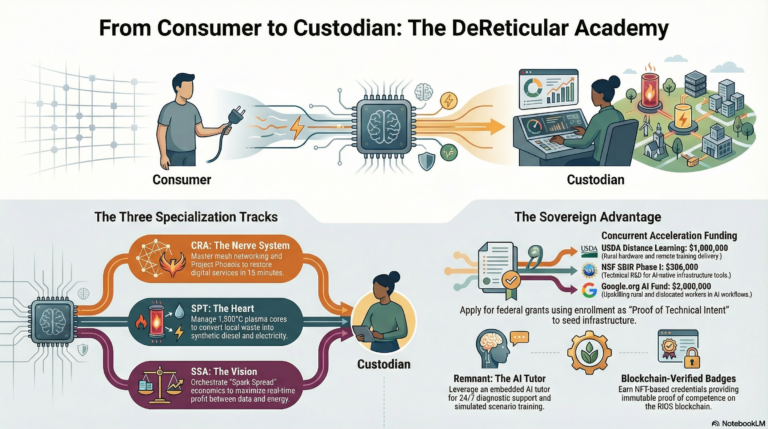
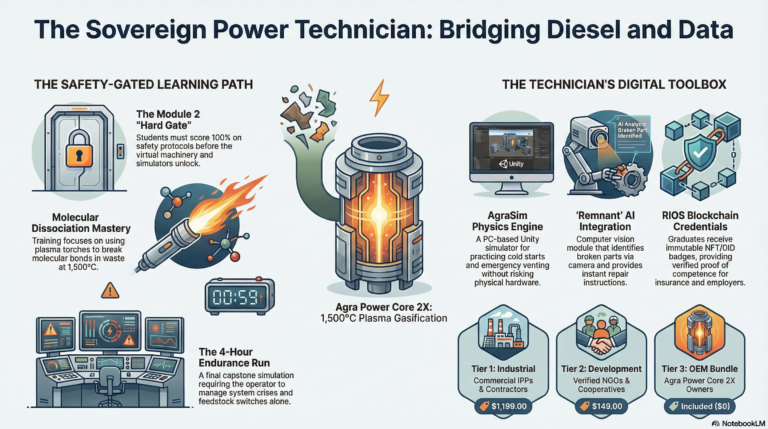
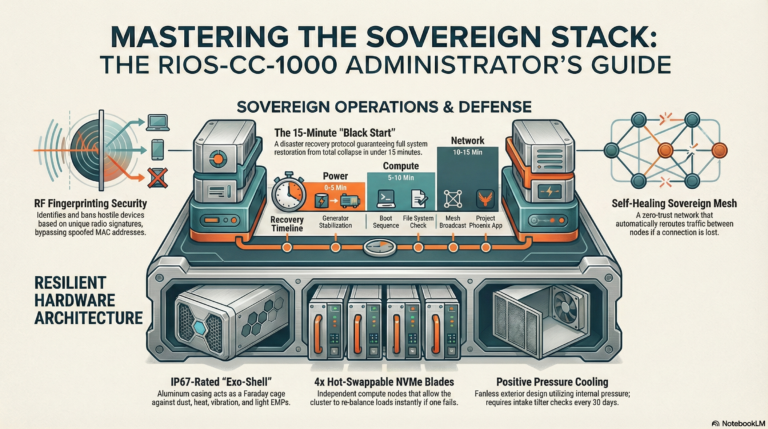
- RIOS is an edge-native microkernel operating system designed to manage local resources under air-gapped or degraded conditions. It handles signal fusion for communications, load balancing through its Autonomous Machine Coordination (AMC) engine, and maintains local consensus without a cloud connection.
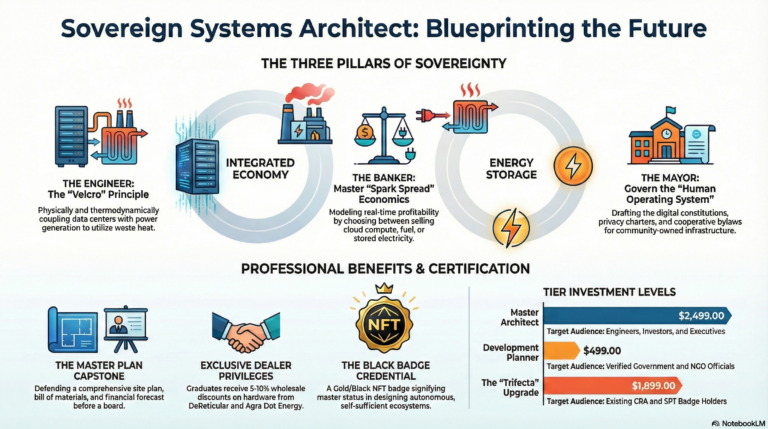
- DePIN is an economic framework that democratizes the funding of physical assets by fractionalizing ownership on a transparent ledger. It shifts infrastructure from a capital-intensive central planning model to a modular, community-financed model where local investors and cooperatives share in revenues.
- BTM configurations allow nodes to be installed directly at municipal facility service points to offset local loads without exporting power to the macro-grid. This strategy avoids the multi-year utility connection study queues and “electrical corporation” classifications that often delay grid-tied projects.
- In a tree topology, the connectivity is 1, meaning a single link failure partitions the network. A k-connected mesh (k \ge 3) ensures that at least three independent pathways must fail simultaneously to isolate a node, mathematically reducing the probability of system failure.
- Signal Fusion is an engine within RIOS that monitors all communication interfaces, including LEO satellite, LTE, and RF mesh. It evaluates packet loss and jitter to dynamically fragment and route data over the optimal interface on a millisecond-by-millisecond basis.
video
Part III: Essay Format Questions
Instructions: These questions are designed for deeper analysis and do not include provided answers.
- The Economic Shift from Scale to Distribution: Analyze how sovereign autonomous models challenge the traditional economic advantage of “centralized scale.” Consider the roles of commodity hardware, reduced operational overhead through AI, and DePIN.
- Geopolitical and Sovereign Implications: Discuss how decentralized infrastructure impacts “digital sovereignty.” How might the transition to sovereign AI blocs and fragmented digital sovereignties affect international relations and regional stability?
- Technological Maturity vs. Operational Gaps: The text argues that the foundational technologies for SAIM are already deployable. However, it identifies remaining gaps in “agentic coordination” and “machine identity.” Evaluate the significance of these gaps in achieving full autonomy.
- Infrastructure Leapfrogging in Rural Environments: Compare the suitability of traditional hyperscale cloud models versus sovereign autonomous models for rural or disaster-recovery zones. Focus on logistics, grid stability, and capital requirements.
- Regulatory and Monopolistic Challenges: Explore the “Threats” identified in the SWOT analysis, specifically utility monopoly litigation. How can decentralized infrastructure providers navigate the conflict with established Investor-Owned Utilities (IOUs)?
Part IV: Glossary of Key Terms
| Term | Definition |
| AMC (Autonomous Machine Coordination) | A RIOS engine that implements machine-learning models to balance local power generation against critical loads (e.g., water pumps) during Island Mode. |
| BESS (Battery Energy Storage System) | The internal energy storage component of a node, specifically utilizing Lithium Iron Phosphate (LiFePO4) chemistry for thermal stability and longevity. |
| BTM (Behind-The-Meter) | A deployment configuration where infrastructure is installed on the customer’s side of the utility meter, primarily serving local loads. |
| Commodity Hardware | Standard, widely available hardware (like mini PCs or consumer GPUs) used to build infrastructure, reducing the need for proprietary enterprise systems. |
| DePIN | Decentralized Physical Infrastructure Network; a model leveraging blockchain and community co-investment to fund and operate physical hardware. |
| FRU (Field-Replaceable Unit) | Modular hardware components (like battery strings or inverters) designed to be easily swapped out by local operators without specialized engineering expertise. |
| Infrastructure-in-a-Box | A standardized, ruggedized ISO 20-foot shipping container containing solar, battery, compute, and comms hardware for rapid deployment. |
| Island Mode | The ability of a microgrid or node to disconnect from the main grid and operate autonomously using local generation and storage. |
| K-connectedness | A measure of network redundancy in graph theory; a k-connected graph requires the failure of k paths to isolate any single node. |
| LFP (LiFePO4) | Lithium Iron Phosphate; the battery chemistry favored in sovereign nodes for its safety, low toxicity, and high cycle life. |
| RIOS | Rural Infrastructure Operating System; the hardware-agnostic, edge-native OS that manages the DeReticular autonomous stack. |
| SCADA | Supervisory Control and Data Acquisition; legacy industrial control systems that decentralized nodes must often interface with or replace. |
| Signal Fusion | The process of evaluating and aggregating multiple communication links (Satellite, LTE, RF) to ensure resilient data backhaul. |
| Spherical Resilience | An engineering framework where networks are organized as dense multi-directional meshes to prevent cascading failures. |