Study Guide: DeReticular, TriFi Wireless, and the Sovereign Stack Ecosystem
This study guide provides a comprehensive overview of the technical, strategic, and financial frameworks governing the development of resilient, off-grid infrastructure. It synthesizes information regarding the Sovereign Stack, the RIOS ecosystem, federal funding pathways like NSF VINES, and the collaborative consortium between DeReticular, TriFi Wireless, and InVentures.
——————————————————————————–
Part I: Short-Answer Quiz
Instructions: Answer the following ten questions based on the provided research and intelligence reports. Each answer should be approximately 2–3 sentences in length.
- What is the core concept of “Spherical Resilience” as defined by DeReticular?
- Explain the technical significance of “Island Mode” for municipal and industrial operations.
- What are the three mandatory competencies (A, B, and C) required for a compliant NSF VINES Track 2 proposal?
- Describe the “Structural Deficit” associated with 5G RedCap and how 3GPP Release 17/18 addresses it.
- How does TriFi Wireless utilize virtual SIM (vSIM) technology and SignalScan™ to ensure connectivity?
- What specific vulnerabilities in legacy 2G/3G networks have necessitated the transition to the Sovereign Stack?
- Identify the components and purpose of the “Sovereign Harvest” agriculture bundle.
- Define “Non-Dilutive Capital Stacking” and its role in the InVentures investment model.
- What is the “Fiber Gap,” and why did the Rural Digital Opportunity Fund (RDOF) fail to bridge it for nearly 1.9 million locations?
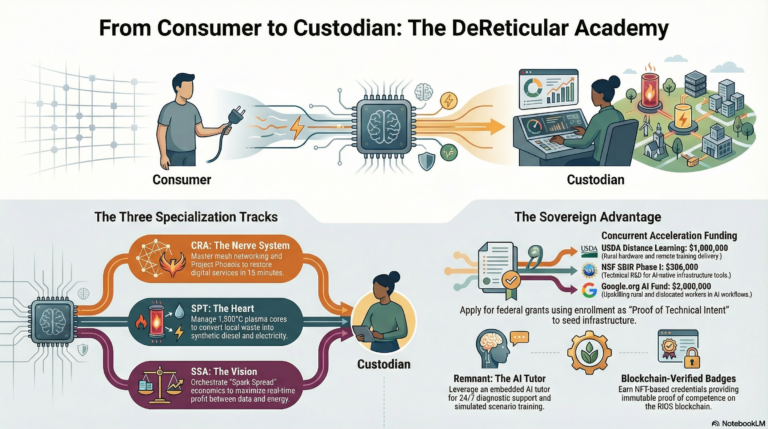
- Explain the role of the Locutus Ledger and Sovereign Badges within the RIOS security architecture.
——————————————————————————–
Part II: Quiz Answer Key
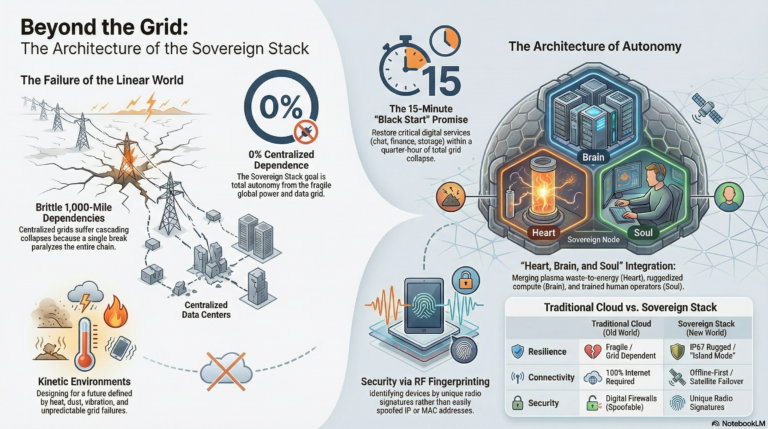
- Spherical Resilience: This concept refers to the transformation of fragile, centralized “linear” infrastructure into resilient, autonomous, and self-funding systems. It moves away from dependence on external cloud backhauls and centralized utilities, favoring localized control and survivability.
- Island Mode: Island Mode is a state of survivability where municipalities, industrial operations, or agricultural networks can maintain critical services—such as healthcare, local governance, and water management—entirely offline. This is achieved through localized edge computing, private mesh networks, and decentralized energy sources that function independently of the public internet or power grid.
- NSF VINES Competencies: Competency A requires deep expertise in primary wireless networking technology (RAN, core, or routing); Competency B requires expertise in a specific vertical domain (such as smart grids or precision agriculture); and Competency C requires the engineering capability to integrate A and B into an active, end-to-end system.
- 5G RedCap Structural Deficit: To reduce costs, 5G RedCap scales down from 4 receive (RX) antennas to 1 or 2, resulting in a 3 dB to 4 dB structural coverage penalty. To compensate for this loss in signal stability and prevent dropped connections, protocols like slot aggregation, inter-slot frequency hopping, and transport block scaling are implemented.
- vSIM and SignalScan™: TriFi uses domestic US-based SIM banks and vSIM technology to allow devices to switch between AT&T, T-Mobile, and US Cellular interchangeably. The SignalScan™ (TowerSync) algorithm periodically pings towers and performs a sub-minute failover to the strongest available network to maintain a continuous connection.
- Legacy Vulnerabilities: Legacy 2G/3G networks suffer from unidirectional authentication (the device authenticates the network, but not vice versa), allowing for IMSI Catcher attacks. Furthermore, they utilize weak encryption ciphers (A5/1 and A5/2) that are easily decrypted and lack integrity protection for telemetry data.
- Sovereign Harvest: This agriculture bundle includes 50 Nomad Mesh-Points for a miles-wide Wi-Fi 6E canopy, 5 LoRaWAN towers, and 10 Nomad Fleet Kits. These kits interface with the CAN Bus and ISOBUS ports of heavy machinery, allowing operators to bypass proprietary manufacturer locks and manage telemetry locally.
- Non-Dilutive Capital Stacking: This strategy involves pairing private venture capital equity with federal and state grants (such as NSF or DoD contracts) to fund development. This approach maximizes capital efficiency for investors while preserving founder equity and extending the financial runway for capital-intensive “hard tech” projects.
- Fiber Gap and RDOF Failure: The “Fiber Gap” refers to the economic unfeasibility of laying physical fiber in low-density areas, where costs reach $50,000 per mile. The RDOF failed due to a reverse auction model that incentivized speculative, low-cost bidding by companies lacking operational capacity, leading to a 30% default rate and leaving millions of locations “stranded” and ineligible for other funding.
- Locutus Ledger and Sovereign Badges: The Locutus Ledger is a decentralized cryptographic ledger that logs all automated actions and physical labor transactions to create an immutable history of activity. Sovereign Badges are non-transferable, soulbound NFTs used as cryptographic credentials to authorize and verify certified human operators within the network.
——————————————————————————–
Part III: Essay Format Questions
- The Evolution of Sovereign Infrastructure: Discuss the transition from centralized cloud-dependent paradigms to the Sovereign Stack. Analyze how RIOS Campus and RIOS Mobile modules create a “Sovereign Translation Layer” that bridges academic research with industrial application.
- Federal Funding as a Catalyst for Deep Tech: Evaluate the strategic importance of the NSF VINES and SBIR/STTR programs for early-stage hard-tech companies. Compare the eligibility and implementation requirements of VINES Track 2 with the SBIR Strategic Breakthrough Pilot.
- The Impact of Wireless Sensing on Industrial Automation: Examine the technical mechanics of using Channel State Information (CSI) for spatial awareness. How does repurposing standard OFDM signals (Wi-Fi/LTE/5G) for gesture recognition and 3D mapping enhance the capabilities of the “Industrial Foreman” and “Field Medic” AI agents?
- Domestic Manufacturing and Economic Sovereignty: Analyze the role of the Build America, Buy America (BABA) Act in the telecommunications sector. How does TriFi Wireless’s Oklahoma manufacturing facility serve as a strategic asset for the Sovereign Stack Consortium when pursuing NTIA and NSF funding?
- A New Model for Venture Capital: Critique the InVentures “Dual-Core Model” of a Venture Studio and High-Conviction Fund. Discuss how the integration of fractional co-founders and technical experts—such as materials science engineers and health informatics specialists—addresses the unique risks of hard-tech commercialization.
——————————————————————————–
Part IV: Glossary of Key Terms
| Term | Definition |
| 5G RedCap | “Reduced Capability” 5G (Release 17), designed for mid-tier IoT use cases, balancing cost and performance by reducing antenna complexity and bandwidth. |
| AI-RAN | Artificial Intelligence-native Radio Access Network; a software-defined architecture that embeds ML into the physical layer and core routing to optimize spectrum and power. |
| BABA | Build America, Buy America Act; federal legislation requiring that a significant portion of manufactured products for infrastructure projects be sourced domestically. |
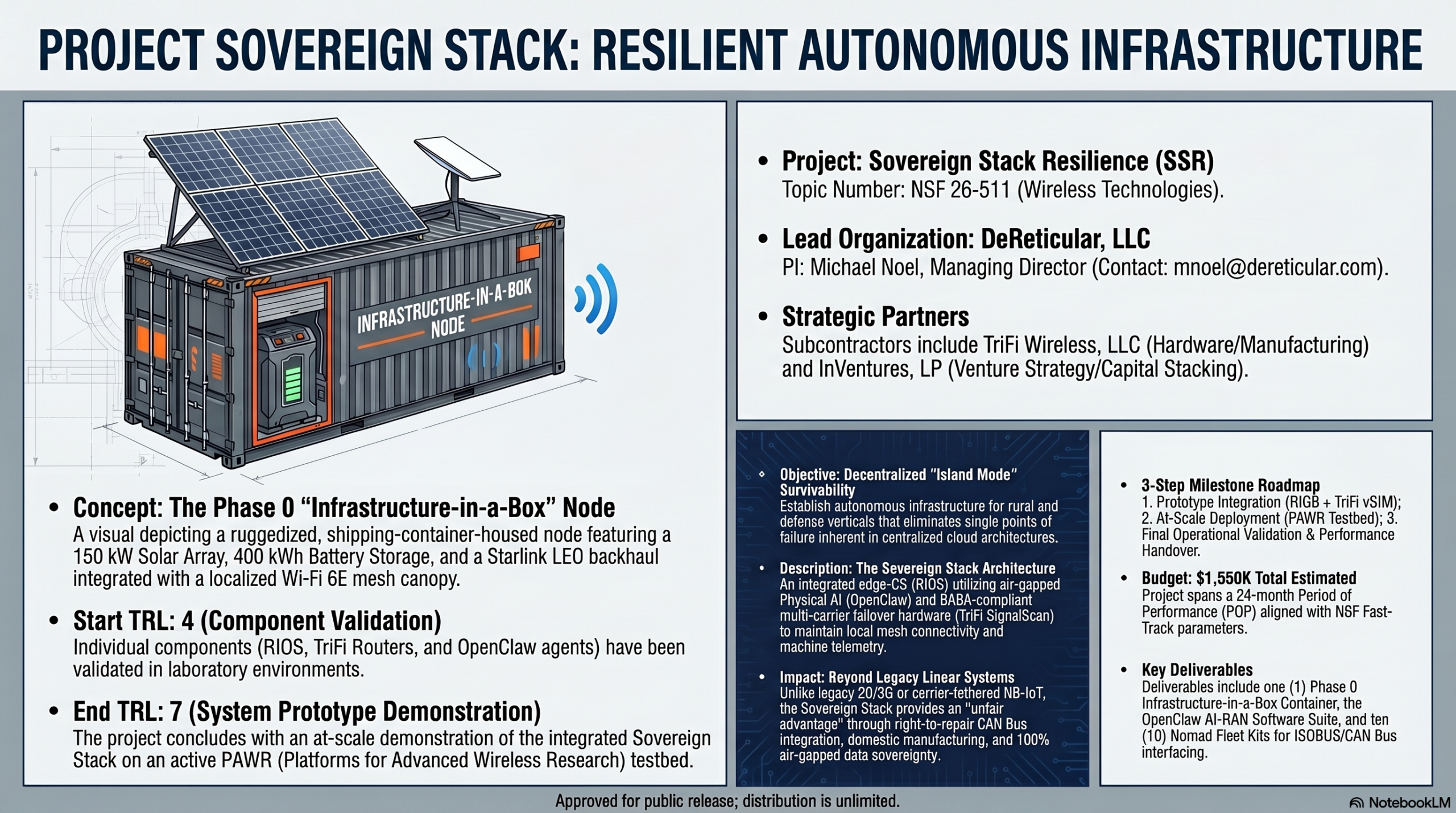
| BESS | Battery Energy Storage System; the RIOS Campus uses a 400 kWh BESS to store power generated from its 150 kW solar array. |
| CAN Bus / ISOBUS | Standard communication protocols used in heavy machinery and agricultural equipment; the Nomad Fleet Kits interface with these to provide “Right-to-Repair” capabilities. |
| CSI (Channel State Information) | Complex data extracted from OFDM signals (amplitude and phase) used to map physical environments and detect motion without cameras or LiDAR. |
| IMSI Catcher | A device (often called a “Stingray”) that mimics a cell tower to intercept mobile traffic; legacy 2G networks are highly vulnerable to these due to a lack of mutual authentication. |
| ISAC / JCAS | Integrated Sensing and Communication (or Joint Communication and Sensing); a 6G paradigm where the network infrastructure functions simultaneously as a radar-like sensor. |
| Locutus Ledger | A decentralized cryptographic ledger within the RIOS ecosystem used to log automated maintenance, labor transactions, and machine actions. |
| MCL (Maximum Coupling Loss) | A metric representing the maximum signal loss a wireless link can tolerate while maintaining a connection; NB-IoT has a high MCL of 164 dB for deep penetration. |
| Nomad Series | DeReticular’s line of mobile mesh-points and fleet kits designed for edge connectivity and “Tractor-as-a-Relay” functionality. |
| OpenClaw | The open-source framework used by DeReticular to deploy localized, air-gapped agentic AI for industrial and agricultural automation. |
| PAWR | Platforms for Advanced Wireless Research; an NSF-funded program providing at-scale testbeds for evaluating next-generation networking technologies. |
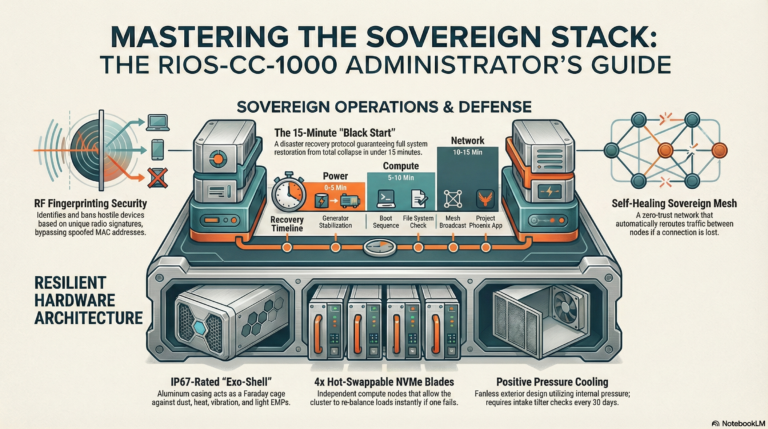
| RIOS | Rural Infrastructure Operating System; DeReticular’s proprietary decentralized operating system for managing energy, compute, and networking. |
| Sovereign Stack | A unified architecture integrating TriFi hardware, DeReticular software, and InVentures capital to provide off-grid, autonomous infrastructure. |
| SPIN | Service Provider Identification Number; a credential required for companies like TriFi to participate in federal and municipal telecommunications contract programs. |
| TPM 2.0 | Trusted Platform Module; a secure microcontroller used to cryptographically verify the physical provenance of hardware nodes and ensure system integrity. |
| vSIM | Virtual Subscriber Identity Module; technology that allows hardware to host multiple carrier profiles and switch between them without physical SIM changes. |