Study Guide: Agent-to-Agent (A2A) “Deep” Hospitality and the Sovereign Nodal Destination Network
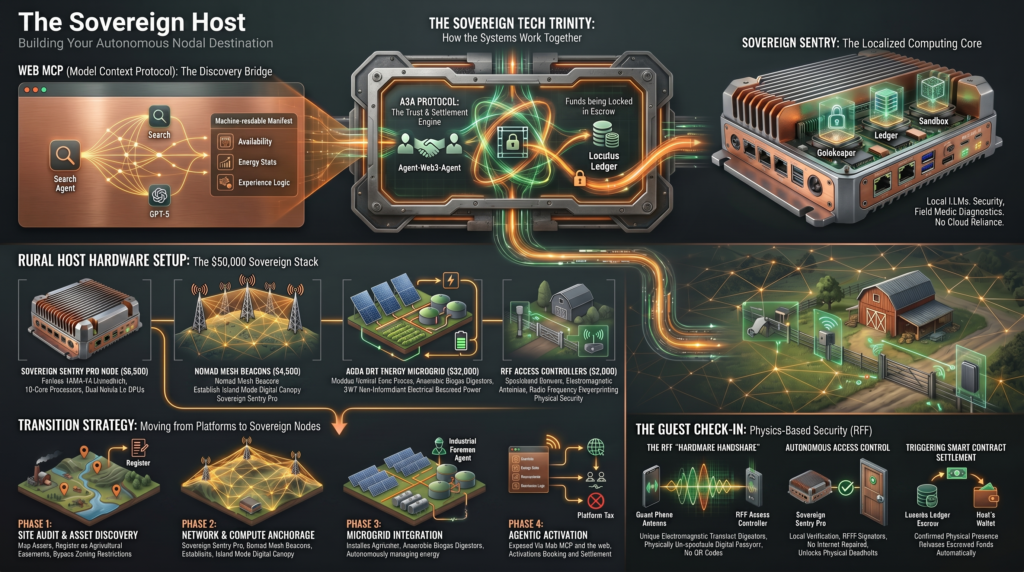
This study guide provides a comprehensive review of the structural shift in the hospitality industry from platform-mediated models to decentralized, agent-orchestrated ecosystems. It explores the technical, financial, and operational frameworks required to establish Sovereign Nodal Destination Networks.
——————————————————————————–
Part I: Short-Answer Quiz
Instructions: Answer the following questions in 2–3 sentences based on the provided source materials.
- What is the “Platform Tax” and how does the A2A model eliminate it?
- Define “Island Mode” within the context of Sovereign Networks.
- What is the role of the Model Context Protocol (MCP) in the agentic travel ecosystem?
- How does “Experience Logic” differ from traditional hospitality marketing?
- What is Radio Frequency Fingerprinting (RFF) and why is it used by DAOSRUS?
- Describe the three specialized agents within the OpenClaw automation framework.
- What components make up the Agra Dot Energy System?
- Explain the “Agent-Web3-Agent” (A3A) settlement process.
- What are the primary financial hurdles identified in the Gap Analysis for rural landowners?
- How does the use of “Agricultural Easements” and Land Equivalent Ratios (LER) serve as a regulatory defense?
——————————————————————————–
Part II: Quiz Answer Key
- The “Platform Tax” refers to the 15–30% commission fees extracted by giant aggregators like Airbnb and Booking.com for acting as gatekeepers of discovery and trust. The A2A model eliminates these fees by allowing consumer-side AI agents to communicate and negotiate directly with property-side agents using open protocols.
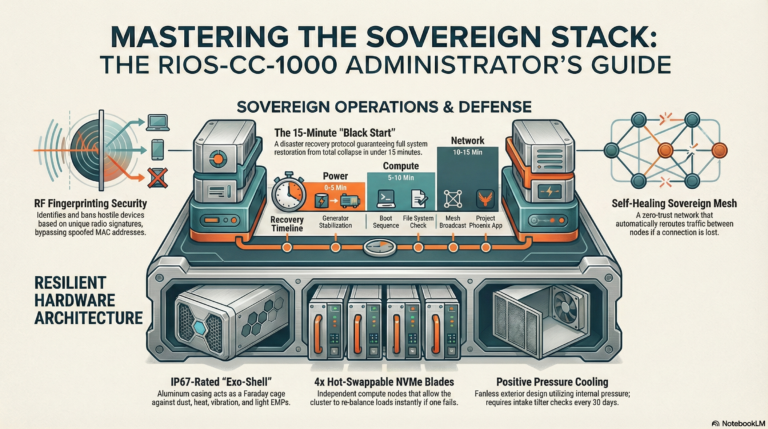
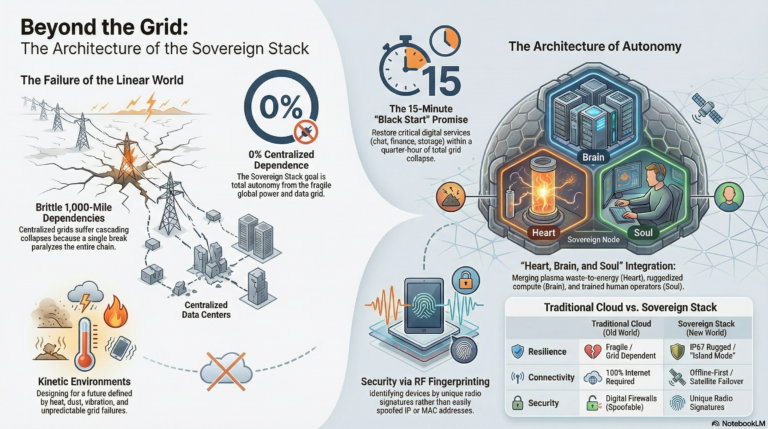
- “Island Mode” refers to the ability of a Sovereign Node to function as a self-contained, off-grid entity that remains operational during utility blackouts or centralized cloud failures. It achieves this by integrating local energy production (Agra Dot), localized computing resources (Sovereign Sentry), and a private network canopy (Nomad Mesh).
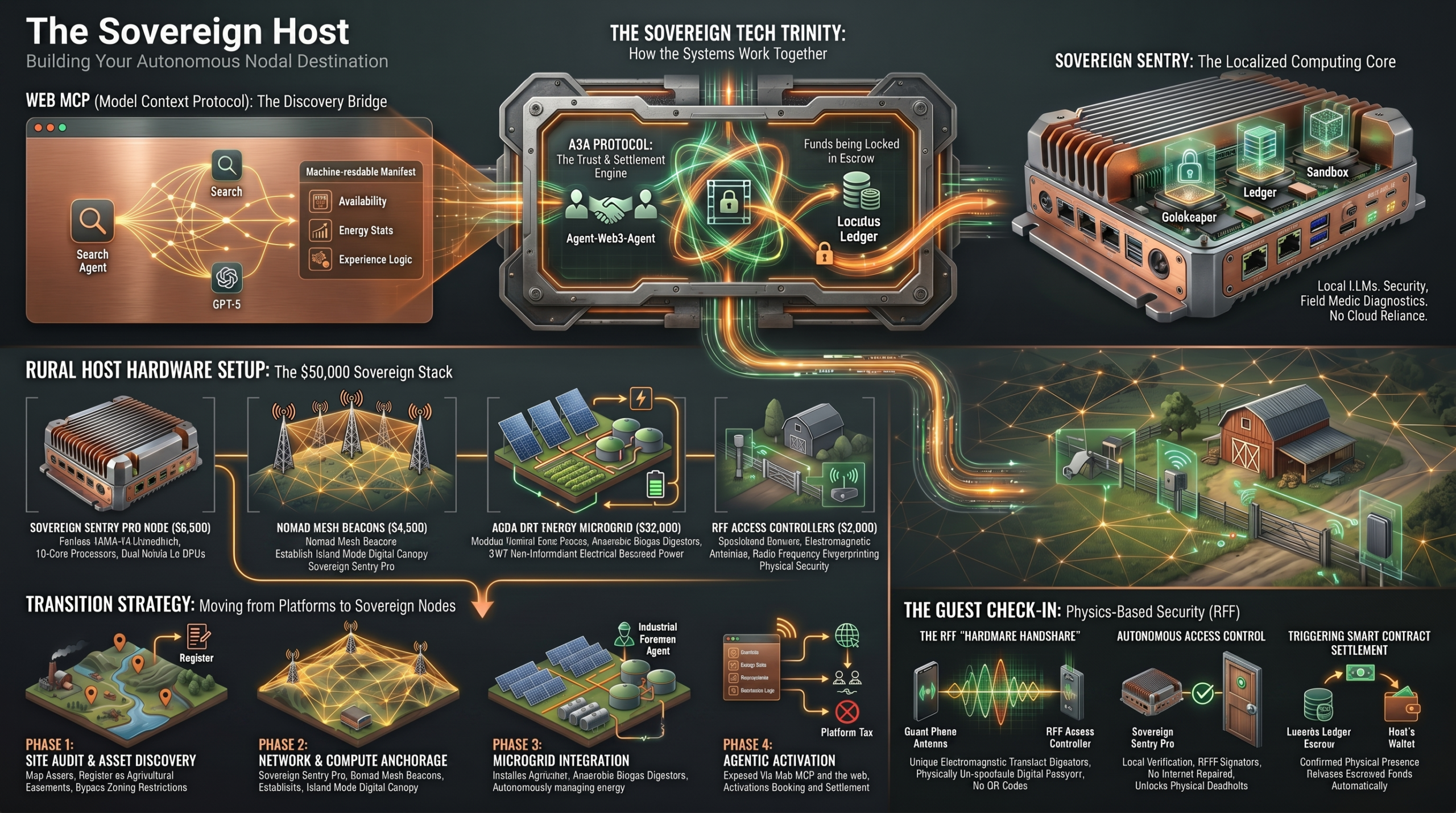
- The MCP acts as a standardized connector that allows AI applications to safely expose and query real-time data from external databases, APIs, or files. In the travel industry, it enables agents to access live inventories, such as hotel reservation databases, without needing a human-friendly website interface.
- Traditional marketing focuses on photography and SEO to drive brand recognition, whereas Experience Logic is a digital blueprint of a stay that an agent can verify through specific parameters. It includes verifiable data such as contextual assets, autonomous interaction capabilities, and real-time acoustic “quiet scores” from on-site sensors.
- RFF is a physical-layer security mechanism that identifies a mobile device based on the unique electromagnetic transients of its radio antenna. DAOSRUS uses it as an un-spoofable “Digital Passport” to grant physical access to cabins and gear without requiring external internet connectivity or transmitting personal metadata.
- The OpenClaw framework includes the DevOps Sovereign for local system administration and self-healing, the Field Medic for predictive hardware diagnostics and repair instructions, and the Industrial Foreman for automating machinery and utility loops. These agents run locally and air-gapped on the Sentry Pro hardware.
- The Agra Dot system combines vertical agrivoltaic bifacial solar arrays with modular anaerobic biogas digesters. This configuration provides non-intermittent baseload electricity and thermal heat by utilizing both solar energy and the thermophilic digestion of local agricultural waste.
- A3A embeds a decentralized trust and settlement layer into inter-agent protocols using smart contracts on the Locutus Ledger. A traveler’s agent negotiates terms, locks funds in escrow, and automatically releases payment to the host only after physical check-in is verified by the node’s RFF system.
- The primary hurdle is the high upfront capital expenditure (CAPEX) of approximately $50,000 per node. Additionally, traditional agricultural lenders currently lack underwriting models for dual-use assets like agrivoltaic/edge-computing hardware, creating a significant credit gap.
- By maintaining a Land Equivalent Ratio (LER) above 1.2 through active farming, properties retain their status under Agricultural Easement protections. This makes them immune to municipal zoning bans or licensing fees intended for commercial hospitality, as the land remains primarily dedicated to agriculture.
——————————————————————————–
Part III: Essay Questions
Instructions: Use the source materials to develop comprehensive responses to the following prompts. (Answers not provided).
- The Transition of Value: Analyze the shift from “Platform-Mediated” to “Agent-Orchestrated” hospitality. Discuss how this transition reclaims capital for rural entrepreneurs and shifts the competitive advantage from marketing budgets to “Experience Logic.”
- Resilience as Luxury: Evaluate the strategic argument that “authenticity” and “low-cognitive-load” environments constitute the new “Above the Line” luxury. How do Sovereign Nodes leverage physical silence and data privacy to attract high-net-worth travelers?
- The DePIN Economic Flywheel: Explain how a single Sovereign Node generates revenue through four distinct channels. Discuss how the Locutus Ledger and DAO governance ensure that this capital is retained within the local rural community rather than being extracted by centralized tech monopolies.
- Technical Architecture of Autonomy: Describe the synergy between the Sovereign Sentry hardware, the Nomad Mesh network, and the OpenClaw AI agents. How does this integrated stack allow for continued operation during a “Network Partition” or global internet outage?
- Strategic Risk and Remediation: Identify the major threats to the Sovereign Nodal Destination Network from legacy utility and platform monopolies. Propose a mitigation strategy based on the “Node-as-a-Service” (NaaS) model and federal grant programs like USDA REAP.
——————————————————————————–
Part IV: Glossary of Key Terms
| Term | Definition |
| A2A (Agent-to-Agent) | A protocol enabling independent AI systems to communicate, negotiate, and collaborate directly without human-led manual searching. |
| A3A (Agent-Web3-Agent) | An extension of A2A that embeds decentralized trust and Web3 settlement layers (smart contracts) directly into inter-agent transactions. |
| Above the Line | High-value, non-reproducible contextual assets (e.g., historical sites, off-grid autonomy) that cannot be easily commoditized by centralized search algorithms. |
| Agrivoltaics | The dual use of land for both solar energy generation and agriculture, often utilizing vertical solar panels to allow machinery and crop growth between rows. |
| DePIN | Decentralized Physical Infrastructure Network; a model where physical infrastructure is built and managed in a decentralized manner, often utilizing tokenized incentives. |
| HCI (Hyperconverged Infrastructure) | A software-defined system that integrates compute, storage, and networking into a single hardware chassis, such as the Sovereign Sentry. |
| Island Mode | A state of operational resilience where a node functions independently of the national electrical grid and the macro-internet. |
| LER (Land Equivalent Ratio) | A metric used to evaluate the efficiency of dual-use land (agrivoltaics); a ratio above 1.0 indicates that the land is more productive than if used for a single purpose. |
| Locutus Ledger | A decentralized, peer-to-peer storage and ledger network used for managing encrypted data shards, smart contracts, and localized system states. |
| MCP (Model Context Protocol) | An open standard that connects AI models to external tools and data sources, allowing agents to “understand” property manifests and inventories. |
| RFF (Radio Frequency Fingerprinting) | A physical-layer security method that identifies a device by its unique antenna signature, used for un-spoofable access control. |
| Sovereign Node | A self-contained destination unit containing its own energy production, compute resources, and private network, governed locally via a DAO. |
| Spherical Resilience | An architectural philosophy that replaces linear, fragile systems with decentralized, self-healing networks where every node is a self-sufficient entity. |
| Web MCP | The application of the Model Context Protocol to the open web, allowing small host websites to publish machine-readable capabilities for AI discovery. |