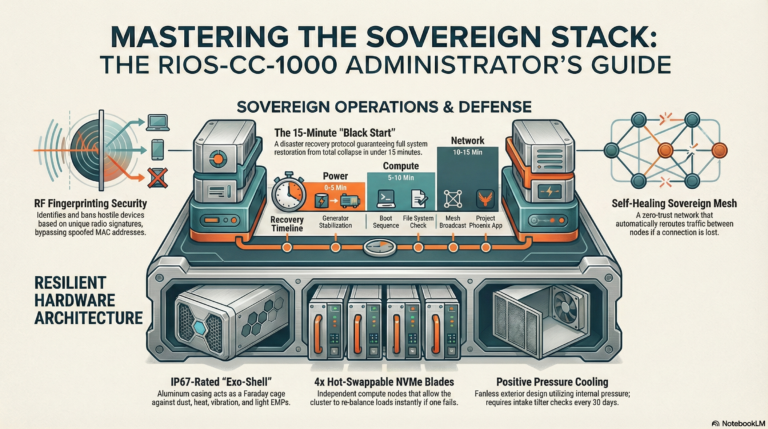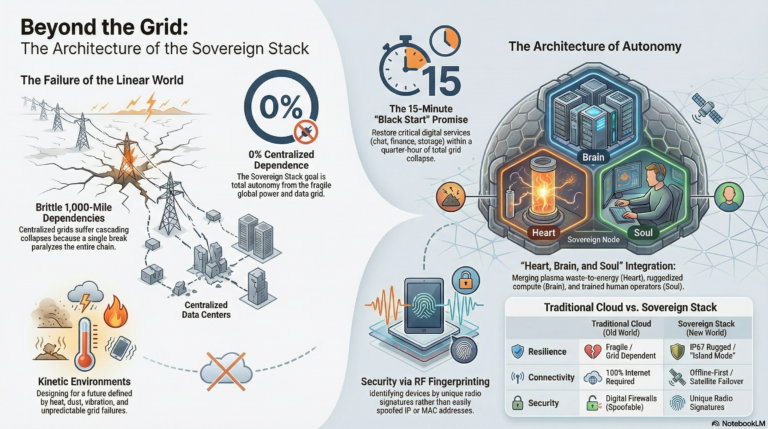
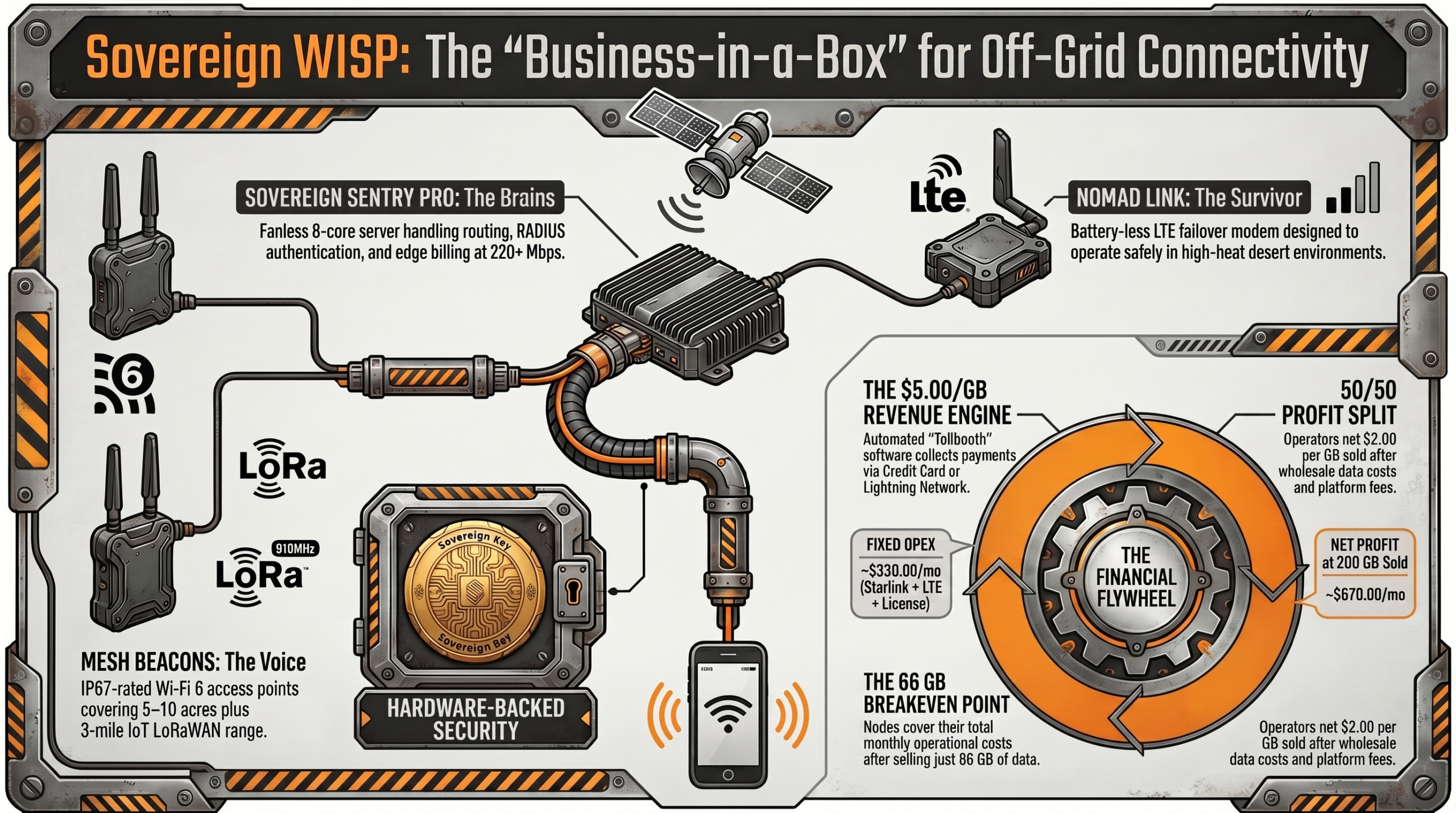
Study Guide: DeReticular Sovereign WISP Ecosystem and Generation 4 Infrastructure
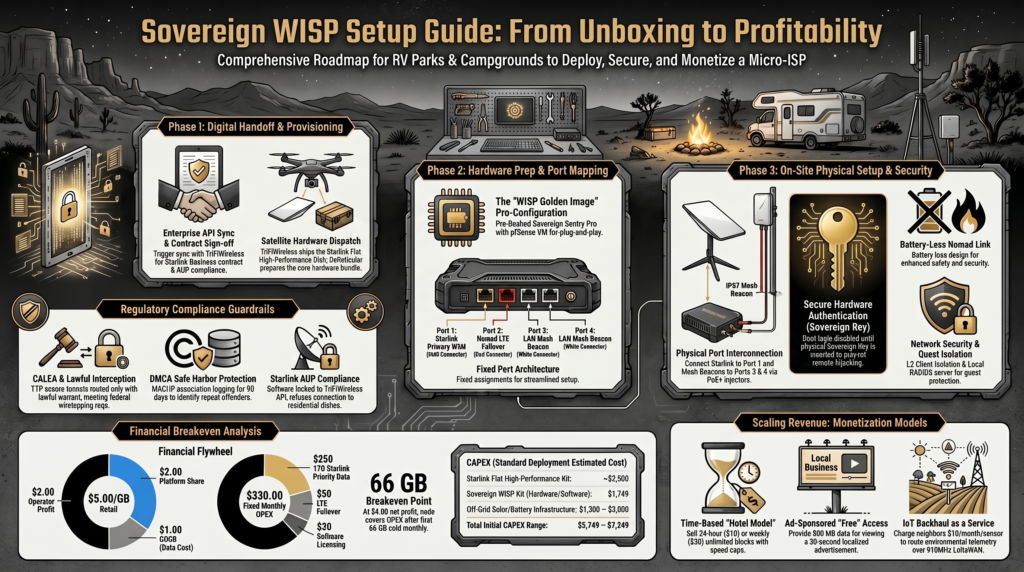
This study guide provides a comprehensive overview of the DeReticular hardware ecosystem, the Sovereign Wireless Internet Service Provider (WISP) Kit, and the projected evolution into Generation 4 communications infrastructure. It is designed to synthesize technical specifications, financial models, and operational workflows into a clear resource for understanding decentralized, off-grid networking.
Part 1: Short-Answer Quiz
Instructions: Answer the following questions in 2–3 sentences based on the provided source materials.
- What is the primary function of the “Sovereign Key” (RIOS-OP-KEY) within the Sentry Pro environment?
- Explain the “Battery Elimination Circuit” (BEC) found in the Nomad Link and why it is a critical safety feature.
- How does the $5.00/GB data resale strategy distribute profit between the Node Operator and the DeReticular platform?
- Describe the specific role of the “OpenClaw Tollbooth Agent” in managing network access.
- What are the three distinct phases of the Sovereign WISP Kit fulfillment workflow?
- In the standard “WISP Golden Image” port configuration, what hardware is connected to Port 1 and Port 2 of the Sentry Pro?
- What is the monthly data sales threshold required for a Node Operator to reach a financial breakeven point?
- How does the Sovereign Deck (RIOS-OP-DECK) assist technicians in field operations?
- Identify two major technological shifts projected for Generation 4 (Gen 4) infrastructure compared to the Gen 3 baseline.
- How does DeReticular ensure compliance with Starlink’s Acceptable Use Policies (AUP) regarding bandwidth resale?
video
Part 2: Answer Key
- Sovereign Key Function: The Sovereign Key is a gold-plated NFC/USB-C hardware token (FIDO2/PIV compliant) required for physical second-factor authentication. It is used to securely unlock the Sentry Pro’s deep-administration backend, ensuring that root login is disabled unless the key is physically inserted, thereby protecting billing ledgers from remote exploitation.
- BEC Technology: The Battery Elimination Circuit replaces traditional lithium-ion batteries with a DC-to-DC system that pulls power directly from a vehicle’s 12V block or a solar battery bank. This eliminates the fire hazards associated with swelling or degrading batteries in high-heat environments like vehicle dashboards or desert solar boxes.
- Revenue Distribution: Out of the $5.00/GB retail price, approximately $1.00 is allocated to the Cost of Goods Sold (COGS) for wholesale data and fees. The remaining $4.00 in net profit is split 50/50, providing $2.00/GB to the Node Operator and $2.00/GB to the DeReticular platform.
- OpenClaw Tollbooth Agent: This software container manages the localized Captive Portal, handles payment processing (Credit Card or Crypto), and registers client MAC addresses with the RADIUS server. It also enforces strict Quality of Service (QoS) rules, such as a 15 Mbps download and 2 Mbps upload limit per user.
- Fulfillment Phases: The workflow begins with Phase 1 (Digital Partner Handoff), where TriFiWireless handles contracts and ships the Starlink dish. It continues through Phase 2 (Physical Workshop Preparation) for hardware configuration at DeReticular’s Node 3, and concludes with Phase 3 (Customer Activation), involving on-site deployment and system initialization.
- Port Mapping: Port 1 is designated as WAN1 (Primary Uplink) and connects to the Starlink Flat High-Performance Dish. Port 2 is designated as WAN2 (Secondary Failover) and connects to the Nomad Link LTE Bridge to act as a hot standby if the satellite signal experiences packet loss.
- Breakeven Point: A Node Operator incurs approximately $330.00 in fixed monthly operational expenditures (OPEX) for data plans and licensing. At the retail rate of $5.00/GB, the operator must sell at least 66 GB of data per month to cover these fixed costs.
- Sovereign Deck Role: The Sovereign Deck is a ruggedized tablet running Kali Linux with an integrated RTL-SDR (Software Defined Radio). It allows field technicians to audit the 2.4GHz and 915MHz RF spectrums to identify interference, locate “rogue” nodes, or perform network security stress tests.
- Gen 4 Shifts: Generation 4 infrastructure shifts from single-orbit LEO satellite backhaul to multi-orbit dynamic SD-WAN and upgrades local wireless standards from Wi-Fi 6 to Wi-Fi 7 with Multi-Link Operation (MLO). It also incorporates Edge AI through dedicated Neural Processing Units (NPUs) for autonomous telemetry filtering.
- AUP Compliance: DeReticular locks the system to the TriFiWireless Enterprise API, which is authorized for bandwidth resale. The “Tollbooth” software is designed to refuse to boot if the Sentry Pro is connected to a standard, non-authorized residential Starlink terminal.
podcast
Part 3: Essay Format Questions
The following questions are designed to test deep synthesis and critical analysis of the source material. No answers are provided.
- The Evolution of Resilience: Analyze the shift from Generation 3 to Generation 4 communications infrastructure. How do the projected advancements in multi-orbit SD-WAN and 3GPP Release 19 5G NTN address the “single-provider failure” risks identified in the current Gen 3 SWOT analysis?
- Sovereignty through Hardware: Discuss the “Sovereign” philosophy as it relates to DeReticular’s physical hardware design. Specifically, how do components like the Sovereign Key, the fanless Sentry Pro, and the battery-less Nomad Link manifest the goal of moving away from “centralized and fragile” corporate monopolies?
- The Micro-ISP Economic Model: Evaluate the financial viability of the “WISP-in-a-Box” for a rural entrepreneur. Consider the upfront CAPEX, the recurring OPEX, and the data resale profit-share model. What factors could influence the speed of the Return on Investment (ROI)?
- Mitigating Regulatory and Technical Risks: The documentation identifies several risks for Node Operators, including CALEA compliance, DMCA violations, and MAC address spoofing. Critically assess how the RIOS ecosystem and the proposed transition to WPA3-Enterprise tokens aim to shield operators from these liabilities.
- Target Market Utility: Compare the use cases for the Sovereign WISP Kit across the “Remote Industrial” and “Emergency Management” segments. How do the same core hardware components (Sentry, Mesh Beacon, Nomad Link) provide different strategic values to a wheat farmer versus a wildland fire coordination team?
Part 4: Glossary of Key Terms
| Term | Definition |
| 3GPP Release 19 | A standard-aligned 5G Non-Terrestrial Network (NTN) protocol used in Gen 4 for satellite-to-device fallback. |
| BEC (Battery Elimination Circuit) | A DC-to-DC power system that allows hardware to run directly from external power sources without internal lithium batteries. |
| CALEA | US federal law requiring telecommunication providers to support authorized wiretapping; handled by DeReticular via Trusted Third Party tunneling. |
| Captive Portal | A web page that users are redirected to for authentication and payment before gaining access to the public Wi-Fi network. |
| Edge AI (NPU) | Integrated Neural Processing Units in Gen 4 hardware used for autonomous local telemetry filtering and ML-driven RF scanning. |
| FIDO2/PIV | Cryptographic standards for hardware-based authentication supported by the Sovereign Key. |
| IP67 | A rating indicating that hardware is dust-tight and can withstand immersion in water, a standard for DeReticular Mesh Beacons. |
| LoRaWAN (915MHz) | A low-power, long-range wireless protocol used by Mesh Beacons to collect data from IoT sensors up to 3 miles away. |
| Mesh Beacon (RIOS-EXT-01) | A dual-radio outdoor access point that projects Wi-Fi 6 for human users and LoRaWAN for machine telemetry. |
| Nomad Link (RIOS-NL-01) | A battery-less, ruggedized LTE bridge used for mobile edge connectivity or stationary failover. |
| OpenClaw Tollbooth | The specific software agent responsible for the gateway interface, billing, and RADIUS mapping on a Sovereign Node. |
| pfSense | A virtualized firewall and routing software hosted on the Sentry Pro to manage network traffic and SD-WAN bonding. |
| Proxmox VE | The hypervisor environment running on Sentry nodes that hosts various virtual machines for routing and auditing. |
| RIOS (Rural Infrastructure OS) | The centralized software “brain” and operating system that manages the DeReticular hardware and telemetry dashboards. |
| SDR (Software Defined Radio) | Technology integrated into the Sovereign Deck and Gen 4 Sentry nodes for visual spectrum analysis and RF optimization. |
| Sovereign Sentry Pro | The primary 8-core, fanless edge server that acts as the core compute hub and router for the WISP Kit. |
| Starlink Business | A high-bandwidth LEO satellite service provisioned via TriFiWireless, serving as the primary backhaul for Sovereign Nodes. |
| TriFiWireless | DeReticular’s partner for Starlink Business contracting, API integration, and wholesale data provisioning. |
| WISP-in-a-Box | The colloquial name for the Sovereign WISP Kit (SKU: RIOS-KIT-WISP), a turnkey bundle for starting a micro-ISP. |
| ZTNA (Zero-Trust Network Access) | A Gen 4 security model replacing open captive portals with cryptographic tokens to prevent MAC address spoofing. |