Sovereign Systems and Rural Infrastructure: A Comprehensive Study Guide
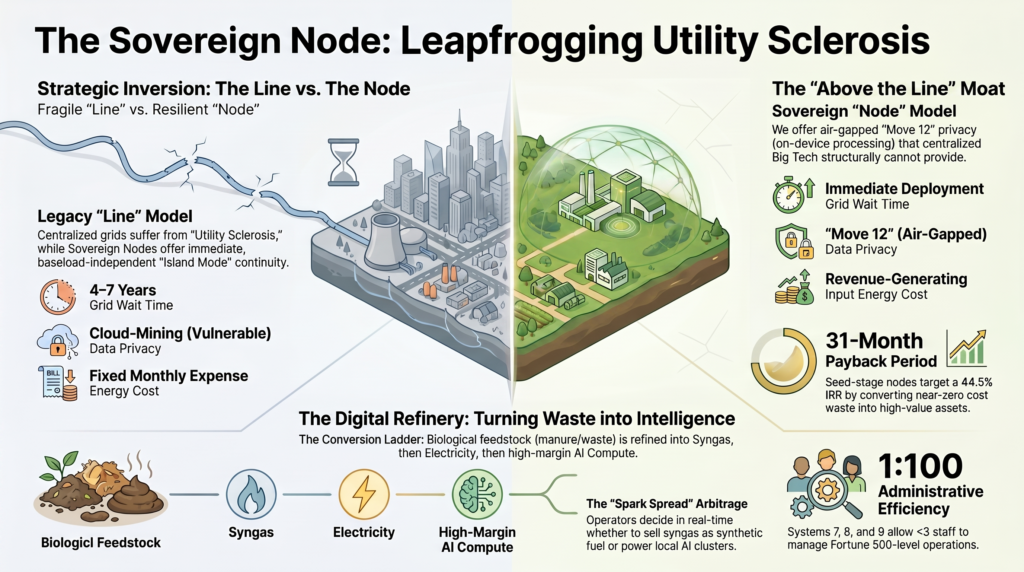
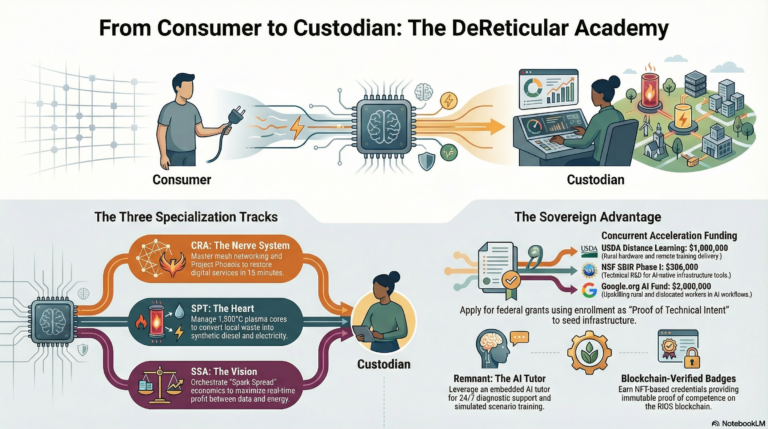
This study guide provides a detailed review of the DeReticular ecosystem, the BizBuilder Mike strategic mentorship, and the RIOS (Rural Infrastructure Operating System) framework. It explores the transition from centralized “Line” models to decentralized “Sovereign Nodes,” focusing on energy independence, localized AI compute, and the “Editor” paradigm of administrative efficiency.
——————————————————————————–
Part 1: Short-Answer Quiz
Instructions: Answer each of the following questions in two to three sentences based on the provided materials.
- What is “Utility Sclerosis,” and how does a Sovereign Node leverage this condition for market entry?
- Explain the “Refinery Arbitrage” process as it relates to biological feedstock.
- How does the “Move 12” strategy provide a competitive advantage over centralized Big Tech cloud providers?
- Describe the function of “System 7” within the “Editor Paradigm.”
- What is the “Spark Spread,” and how does an operator use it to make daily decisions?
- Define “Island Mode” and explain its significance to civilizational continuity.
- What role does the “Sovereign Ledger” play in Community Energy Co-ops (A2A Trading)?
- How does “System 9” (Voice-to-Structure) eliminate the “Administrative Drag” of documentation?
- Describe the “Move 1” (Prompt to Product) workflow in the context of modular manufacturing.
- What is the “Regulatory Hedge” mentioned in the Sovereign Node business plan?
——————————————————————————–
Part 2: Quiz Answer Key
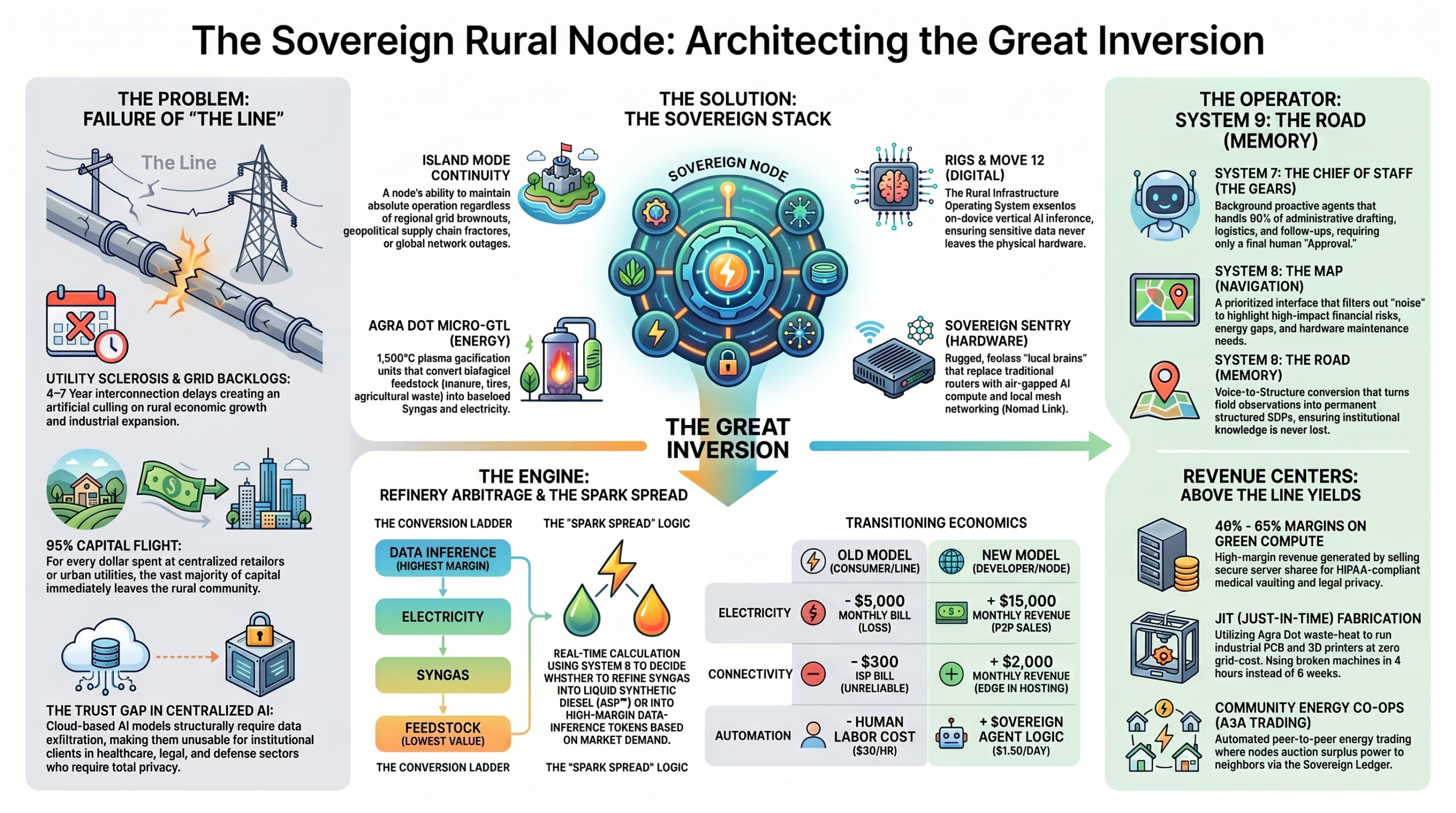
- Utility Sclerosis refers to the systemic fragility and 4–7 year wait times for grid-tie expansion in centralized utility models. Sovereign Nodes leverage this by deploying baseload-independent hardware immediately, bypassing the grid entirely to fulfill high-density compute and energy demands.
- Refinery Arbitrage is the process of capturing value across multiple conversion states, starting with low-value waste (manure, tires, agricultural scrub). This feedstock is transformed into syngas, then electricity, and finally into high-margin “Above the Line” services like data inference.
- The Move 12 strategy involves executing AI inference vertically on-device at the node, ensuring that sensitive data never leaves the physical facility. This offers air-gapped security that centralized competitors cannot provide without undermining their own data-aggregation business models.
- System 7 (The Chief of Staff) functions as the “gears” of the operation, acting as a proactive background agent that triages emails, drafts proposals, and prepares briefings to 90% completion. It allows the entrepreneur to shift from a “Doer” who types responses to an “Editor” who provides final authorization.
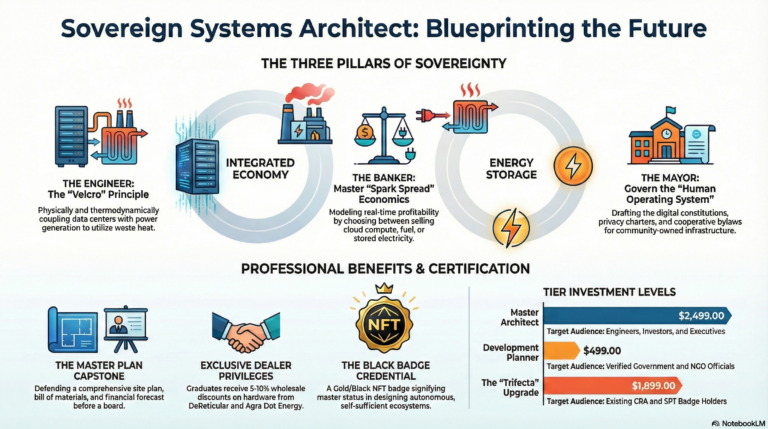
- The Spark Spread is the calculated margin between the cost of local energy production and the market value of various outputs. Operators use System 8 to decide whether it is more profitable to convert syngas into liquid synthetic fuel (ASF™) for logistics or into electricity to power AI compute clusters.
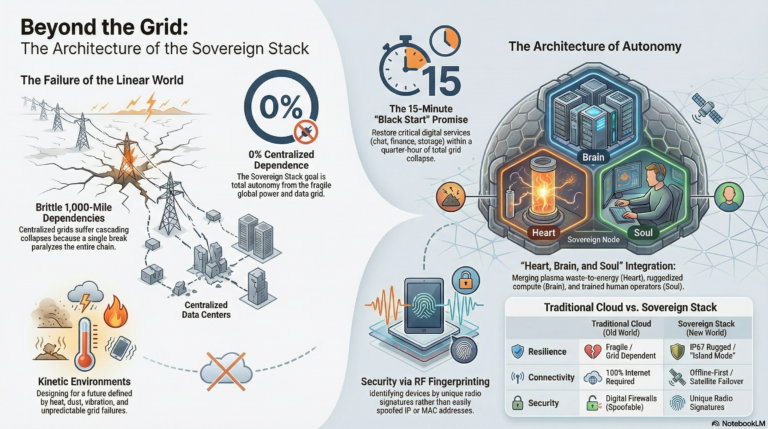
- Island Mode is the ability of a Sovereign Node to maintain total operational continuity regardless of regional grid failures, geopolitical supply chain fractures, or global network outages. It ensures the node remains a reliable provider of “Civilization-as-a-Service” even when centralized infrastructure is severed.
- The Sovereign Ledger serves as a local, immutable accounting system that records every kilowatt exchanged within a mesh network. It enables instant, peer-to-peer (P2P) token transactions between neighbor nodes without the need for a central bank or a middleman utility.
- System 9 utilizes “Voice-to-Structure” technology to capture raw audio observations from the field and automatically format them into structured Standard Operating Procedures (SOPs). This creates “Infrastructure as Memory,” ensuring every problem is solved once and hardcoded into the business logic.
- Move 1 (Prompt to Product) is the transition from an unstructured AI description of a need to a structured physical fabrication file. This allows nodes to produce specialty industrial parts on-site using CNC mills or PCB printers in as little as four hours.
- The Regulatory Hedge involves designating Sovereign Nodes as “Critical Emergency Resilience Infrastructure.” This framing helps secure municipal “Right to Exist” protections and allows the nodes to bypass certain utility monopoly laws and trade barriers.
——————————————————————————–
Part 3: Essay Format Questions
Instructions: These questions are designed for deeper analysis and should be answered in long-form essay format. (Note: Answers are not provided for this section.)
- The Great Inversion: Analyze the transition from the “Line Model” to the “Node Model.” Discuss how shifting rural areas from “tail-end consumers” to “refinery producers” changes the economic balance between urban and rural centers.
- The Cognitive Shift: Discuss the “Editor Paradigm” as a solution to administrative exhaustion and the “Brain Drain” in rural communities. How do Systems 7, 8, and 9 enable a high-tech business to run with a fraction of the traditional headcount?
- Above the Line Security: Evaluate the “Trust Barrier” created by air-gapped hardware and Move 12 privacy. Why is the “hardware root of trust” a more durable moat than software-only solutions in industries like healthcare and law?
- Sustainable Arbitrage: Examine the “Energy-to-Information Inversion.” How does the use of Agra Dot Micro-GTL units to convert biological waste into digital intelligence solve both waste management and energy reliability issues?
- Community Sovereignty: Explore the implications of Peer-to-Peer (P2P) energy trading and localized manufacturing for community resilience. How does this model protect small towns from global supply chain failures and utility-led price fluctuations?
——————————————————————————–
Part 4: Glossary of Key Terms
| Term | Definition |
| A2A (Agent-to-Agent) | Automated negotiation protocols where AI systems interact directly to handle commerce, such as energy trading, without human intervention. |
| Above the Line | High-margin, un-commoditizable industrial moats, such as local energy, Move 12 privacy, and secure medical data. |
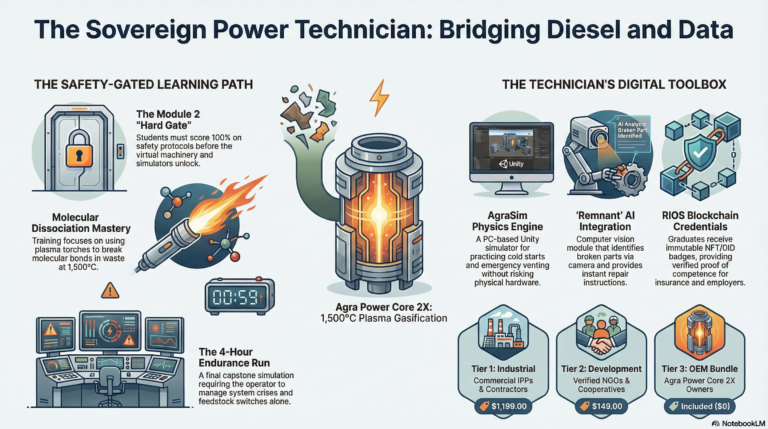
| Agra Dot Energy | The division specializing in 24/7 baseload power through Micro-GTL systems and 1,500°C plasma gasification. |
| Agentic Sovereignty | The legal and technical ability of a local node to authorize machine functions and operations without needing external approval from a central headquarters. |
| ASF™ (Automated Synthetic Fuel) | High-value synthetic diesel produced from syngas through the Agra Dot Micro-GTL process. |
| Below the Line | Vulnerable, low-margin commodities such as utility power, centralized cloud storage, and generic AI “chatbots.” |
| Editor Paradigm | A management philosophy where the entrepreneur acts as quality control (the Editor) while AI agents (the Doers) handle 90% of task production. |
| Field Medic Agent | A specialized, air-gapped AI agent designed for on-site diagnostic pattern recognition and HIPAA-compliant healthcare logic. |
| Industrial Foreman | An AI agent (OpenClaw) that manages physical machine diagnostics and repair logic locally, bypassing OEM software locks. |
| Island Mode | A state of operation where a node remains fully functional and self-powered despite the loss of external grid or internet connectivity. |
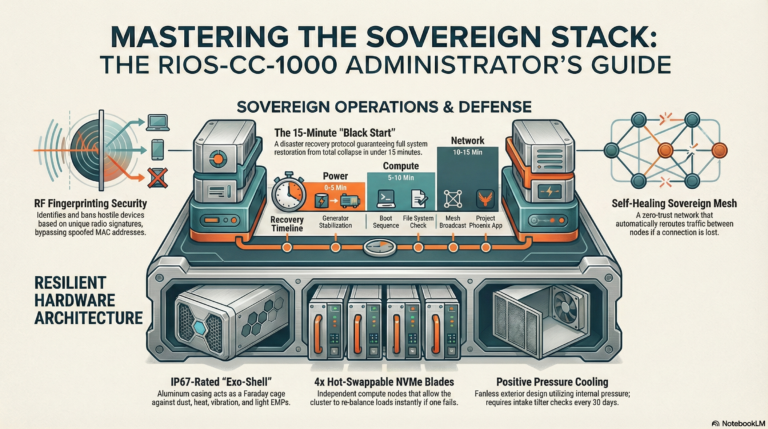
| Mesh Canopy | A private, miles-wide localized data network provided by Sovereign Sentry and Nomad Link units. |
| Micro-GTL | Gas-to-Liquids units that use plasma gasification to convert biomass and waste into syngas and synthetic fuels. |
| Move 1 (Prompt to Product) | The rapid transition from a voice or text description of an industrial part to a finished physical component. |
| Move 12 (On-device Vertical) | The deployment of AI inference directly on local hardware to ensure total data isolation and privacy. |
| Nomad Link | A decentralized, mobile mesh-networking tool used to create connectivity in areas without standard grid service. |
| Permission Gap | A structural vulnerability where local assets require a signal from a remote, centralized server to function. |
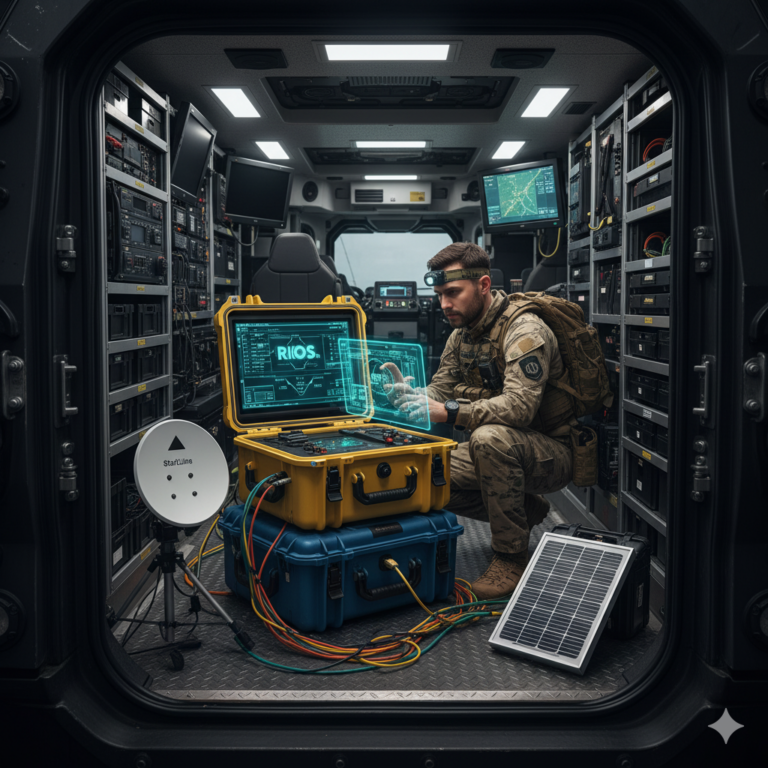
| RIOS (Rural Infrastructure OS) | The baseline kernel for industrial intelligence that manages the power, compute, and economic logic of a Sovereign Node. |
| Sovereign Deck | A rugged, sunlight-readable field terminal used for machine authentication and SDR visualization. |
| Sovereign Sentry | The IP67-rated, air-gapped “local brain” of a node that provides AI compute and network security. |
| Spark Spread | The calculated margin between local energy production costs and the market value of energy-intensive outputs (Compute vs. Fuel). |
| System 7 | The “Gears”; a Chief of Staff agent that handles proactive administrative triage and drafting. |
| System 8 | The “Map”; a navigational interface that prioritizes high-impact decisions and monitors system health. |
| System 9 | The “Road”; a Voice-to-Structure framework that converts field observations into permanent, structured SOPs. |
| The Line | Centralized, fragile infrastructure models (grids, fiber lines) that create dependency and vulnerability for those at the “tail end.” |