Why the Future of AI is Growing on the Farm: 5 Surprising Takeaways from the Sovereign Infrastructure Movement
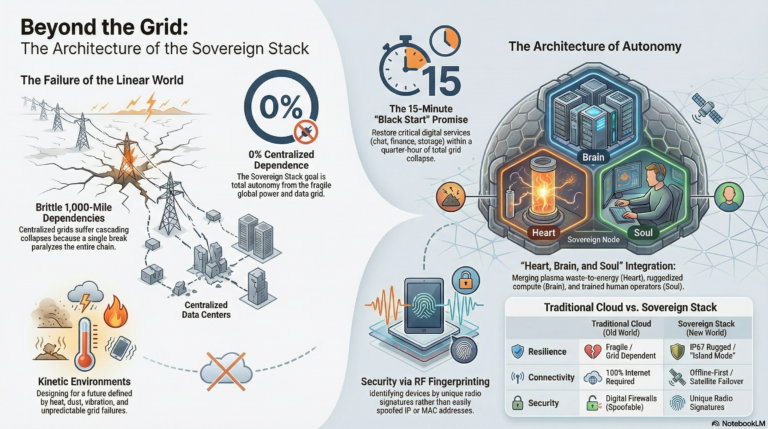
We are currently witnessing a relatable but dangerous paradox in high-technology infrastructure. On one hand, the global demand for AI compute and raw electrical power is accelerating at an unprecedented rate. On the other, the physical systems required to support this demand are trapped in a systemic “gridlock.” According to recent data from the Lawrence Berkeley National Laboratory (LBNL), the median wait time for utility grid interconnection now exceeds four years, with regional transmission queues for energy projects often stretching between three to seven years.
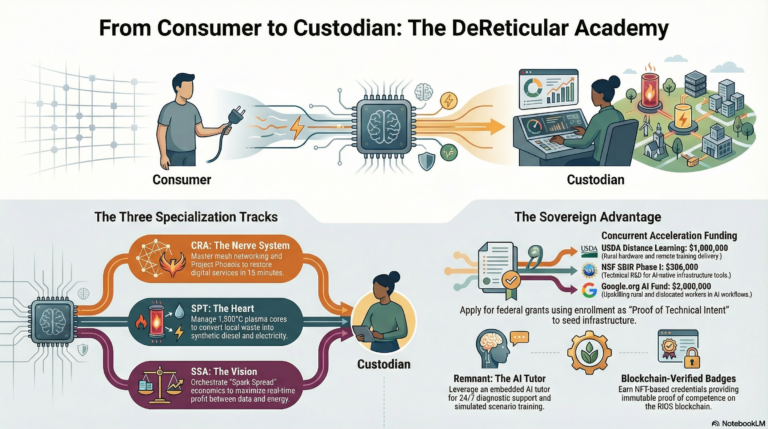
While centralized systems struggle with these backlogs and inherent vulnerabilities, a movement led by Michael Noel and the DeReticular ecosystem is gaining traction. Built on a doctrine of “Local Autonomy,” this approach shifts the strategic focus from a fragile, centralized grid to sovereign, “Island Mode” infrastructure. By transforming agricultural centers into high-tech powerhouses, the Agra Dot Energy framework provides a blueprint to circumvent the bottleneck.
Here are five surprising, counter-intuitive takeaways from the front lines of the sovereign infrastructure movement.
- Bypassing the 4-Year Grid Queue via the “Potential Certified Microgrid Pathway”
As any strategic analyst will tell you, the primary bottleneck for modern technology is no longer the availability of hardware—it is the availability of power and the regulatory permission to use it. To solve this, Agra Dot Energy utilizes a strategic regulatory pathway modeled after West Virginia’s H.B. 2014 (W. Va. Code §5B-2-21).
By establishing “Certified Microgrid Districts,” operators can co-locate power generation with a “captive” industrial consumer, such as high-density GPU racks. When the on-site load consumes a significant portion of the generated power (targeting an average of 84.8% in current models), the installation may qualify for an exemption from Public Service Commission (PSC) utility rate regulations and retail supplier constraints.
It is important to note that this is not an “automatic” bypass; as a strategic architect, we must recognize that this requires a formal application to the Department of Economic Development and specific statutory findings. However, once certified, the project avoids the multi-year regional transmission operator queues.
“The core commercial problem DeReticular addresses is that power availability, interconnection backlogs, and cloud vulnerability—not hardware availability—represent the primary bottleneck for edge operations.”
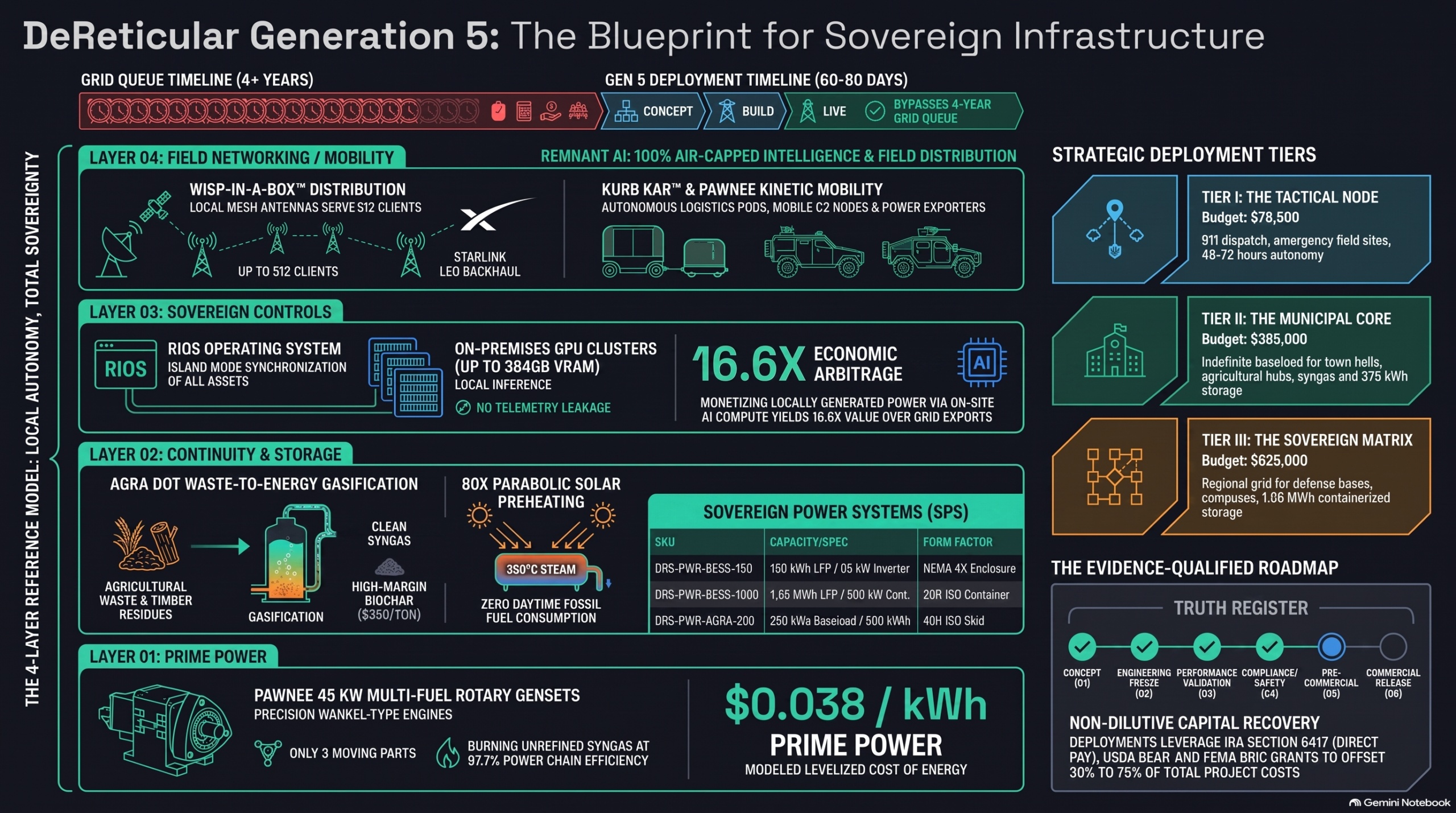
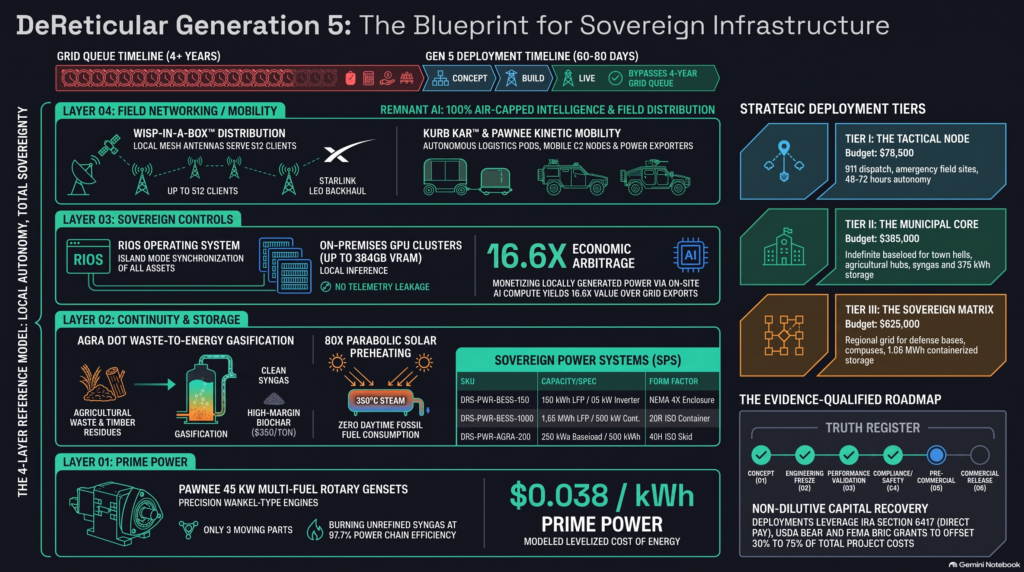
Why this matters: This strategy targets a modeled timeline of 60 to 90 days from project launch to operation, allowing data center developers to leapfrog the multi-year utility wait times that currently paralyze the industry.
- The 16.6x Arbitrage — Turning Manure into “Intelligence”
The sovereign infrastructure movement is built on the doctrine that “Agriculture Can Both Produce and Consume Energy.” Instead of treating agricultural waste—such as dairy manure and forestry residues—as a liability, Agra Dot Energy treats it as a feedstock for “Intelligence.”
The economics rely on a modeled target levelized prime power cost of 0.038 / kWh**. If a farm sells that power back to the grid, it receives a low wholesale tariff. However, by using that power on-site to run RIOS-CC-1000 liquid-cooled GPU racks, the operator achieves a 16.6x arbitrage multiple. Furthermore, the gasification process produces high-purity biochar, a high-margin byproduct valued at **350 / Ton for soil remediation and carbon sequestration.
Why this matters: This economic engine transforms a farm from a commodity producer into a high-tech data center, utilizing the GPU racks as a “captive baseload” that makes the regulatory microgrid status financially viable.
- The Mechanical Simplicity of the Rotary Revolution
Standard piston-driven diesel generators are heavy, high-vibration, and prone to mechanical failure. The Pawnee Power architecture replaces these with precision Wankel-type rotary engines, such as the Pawnee 530cc Rotapower core. These engines are deceptively simple, operating with only three primary moving parts: the rotor, the eccentric shaft, and the gearing.
This “Rotary Revolution” offers several “Island Mode” advantages:
- Multi-Fuel Versatility: These cores can seamlessly combust unrefined agricultural syngas, raw biogas, propane, or liquid biofuels produced on-site.
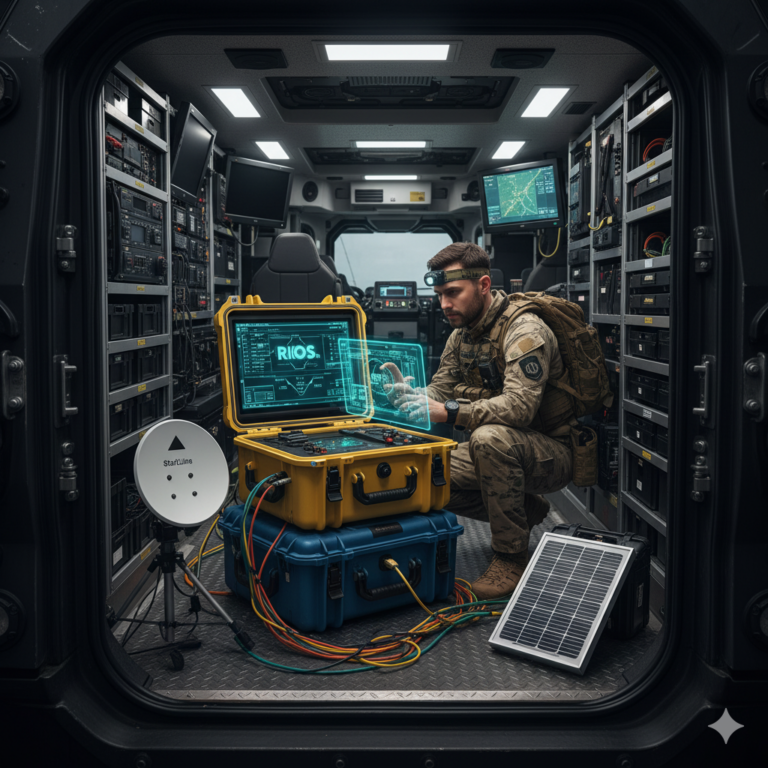
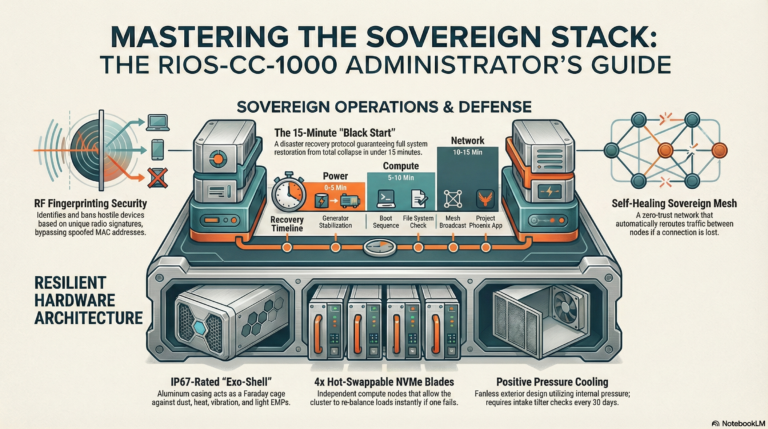
- Signature Suppression: The balanced rotary motion and liquid cooling create a low-vibration, low-acoustic signature, which is critical for physical security in isolated or tactical environments.
- Direct-to-DC Efficiency: The architecture targets a 97.7% power chain efficiency (at the converter stage) by rectifying power directly to a 700V DC busbar.
Why this matters: By utilizing a 700V DC busbar, the system eliminates the standard AC-to-DC conversion losses that typically plague data center efficiency, while reducing the mechanical failure points that threaten long-term autonomy.
- 80x Solar Concentration — Gasification Without the Fuel
One of the most impactful layers of the Agra Dot Energy stack is the DOE Parabolic Solar Thermal Array. This system uses linear parabolic curved mirror troughs to achieve 80x optical concentration, focusing ambient solar radiation onto pressurized receiver tubes.
This concentration delivers 350°C industrial process steam, which is used to preheat the biomass gasification vessels. By providing the necessary thermal lift via solar energy rather than burning the feedstock itself, the system can achieve a state of “gasification without the fuel” during daylight hours.
Why this matters: This allows the DR5-PWR-AGRA-250 gasifiers to operate with zero daytime fossil fuel consumption, maximizing the volume of syngas available for power generation and the volume of biochar available for resale.
- Navigating the “Free” Infrastructure Stack (Federal Grant Stacking)
Transitioning to sovereign power requires significant capital, but the DeReticular “Venture Studio” approach aims for a capital offset of 30% to 75%+ through the strategic stacking of non-dilutive federal funding.
However, as we move from concept to “Engineering Freeze,” we must replace fixed MSRPs with Engineered Budgetary Ranges. For instance, while a Tier I Tactical Node has a listed MSRP of $78,500, a full Bill of Materials (BOM) analysis reveals an actual floor closer to $142,349. Federal stacking bridges this gap:
- IRA Section 6417: Provides “Elective Pay” (direct cash refunds) for tax-exempt entities and municipalities qualifying for clean energy credits.
- USDA REAP: Targets biomass gasifiers and BESS storage (Note: While new grant applications were paused in early 2026, the guaranteed loan pathways remain a vital pillar).
- FEMA BRIC: Applies to critical “lifeline” hazard mitigation, covering hardened items like the DR5-PWR-STS-1200A sub-cycle transfer switch and DR5-ENC-QZ-TACTICAL ballistic-rated enclosures.
Why this matters: By mapping specific hardware SKUs to federal programs, project owners can de-risk the transition to sovereign power, making “Island Mode” a viable financial reality for municipal and agricultural co-ops.
Conclusion: The Rise of the Sovereign Island
The DeReticular model is a four-layer architecture—Power, Continuity, Controls, and Field Networking—that represents a fundamental shift in infrastructure philosophy. As the centralized grid becomes increasingly congested and vulnerable, we must ask: Does the future of national security depend on our ability to maintain “Island Mode” resilience?
By integrating localized power, air-gapped AI via the RIOS-TC-01 core, and hardened communication mesh, the sovereign infrastructure movement is proving that true stability is no longer found on the grid—it is grown on the farm.
Local Autonomy. National Security. Total Sovereignty.
Download The Deck
The Energy Autonomy Blueprint Engineered Infrastructure Sovereignty via the DeReticular Generation 5 Architecture. https://academy.dereticular.com/wp-content/uploads/2026/09/Sovereign_Infrastructure_Blueprint.pdf
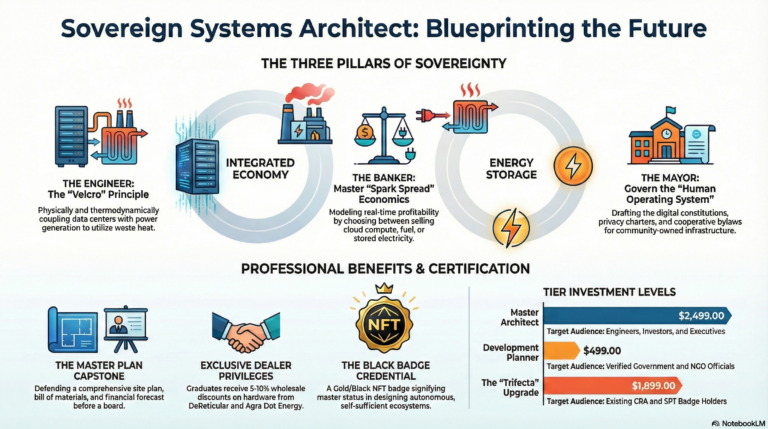
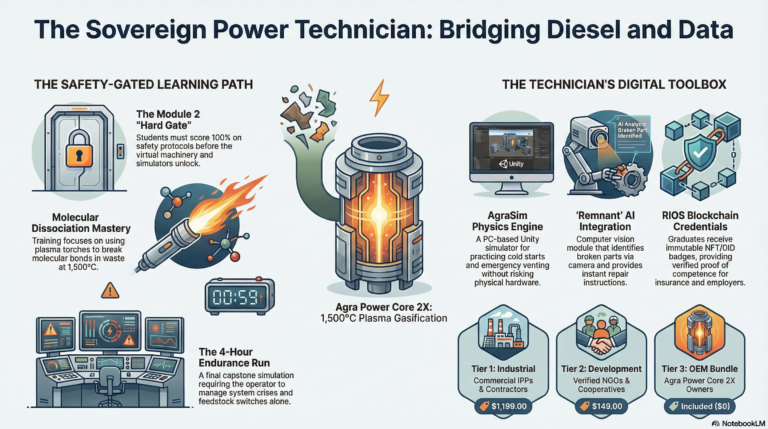
The provided documents detail the DeReticular ecosystem, a vertically integrated infrastructure consortium led by Michael Noel that focuses on achieving local autonomy and sovereign power. At its core, the technology stack utilizes Agra Dot Energy’s plasma gasification and solar thermal systems to convert agricultural waste into low-cost electricity and fuels. This energy powers Pawnee Power’s multi-fuel rotary engines and supports on-site AI compute racks, a strategy designed to bypass traditional utility grid delays and generate high-value economic arbitrage. The ecosystem further integrates WISP-in-a-Box telecommunications and Kurb Kars kinetic mobility to maintain secure, air-gapped operations in isolated “island mode.” Comprehensive standard operating procedures and regulatory analyses ensure the consortium’s digital and physical assets remain resilient against external dependencies. Ultimately, the sources describe a modular, Generation 5 architecture that merges energy production, hardened networking, and decentralized governance into a unified framework for national security and rural independence.