Comprehensive Study Guide: DeReticular Systems Architecture, RELA, and the Veridical Ambulance
Part 1: Comprehensive Architectural Overview
This study guide synthesizes the core epistemological, thermodynamic, mathematical, biophysical, and regulatory frameworks established across the DeReticular Systems Institute corpus, including the Resilient Epistemic & Thermodynamic Ledger Architecture (RELA), the Asymptotic Synthetic Framework, and the Veridical Ambulance (DERETICULAR-MED-2026-V1).
- Epistemology & Formal Mathematical Systems
A. The Structural Epistemic Paradox & Perspectival Realism
Cognitive agents (both biological humans and synthetic AI swarms) operate within localized, low-dimensional, noise-corrupted observation manifolds:
\mathcal{S} \subset \mathbb{R}^d \quad (d \ll \infty)
Conversely, the objective, mind-independent physical cosmos (\mathcal{M}) is high-dimensional (\dim(\mathcal{M}) = D \to \infty), thermodynamically unyielding, and non-teleological. When agents coordinate solely through ungrounded symbolic representations (such as natural language LLM tokens or unbacked fiat currency), they succumb to the Epicycle Trap—introducing auxiliary parameters and narrative rationalizations to defend flawed internal models against empirical refutation.
The framework resolves this through Fallibilistic Perspectival Realism, rejecting both:
- Dogmatic Absolutism (Naïve Realism): Presumes direct, unmediated cognitive access to the ontic manifold \mathcal{M}, mistaking subjective projections for ground truth.
- Radical Relativism (Constructivism): Claims truth is merely a negotiated social power construct, collapsing under performative self-contradiction when physical systems fail upon violating unyielding natural laws.
Under Perspectival Realism, an epistemic perspective is modeled as a smooth, dimension-reducing projection operator:
\hat{\Pi}\theta: \mathcal{M} \to \mathcal{P}\theta, \quad \dim(\mathcal{P}_\theta) = d \ll D
- Rule of Veridicality: A low-dimensional projection is veridical within its plane if and only if the induced metric on \mathcal{P}_\theta preserves the causal topological separation of the true invariant dynamical attractor \Omega^* \subset \mathcal{M} up to a controlled distortion bound \varepsilon(\theta):
\forall x, y \in \Omega^*, \quad \bigl| d_{\mathcal{P}\theta}(\hat{\Pi}\theta(x), \hat{\Pi}\theta(y)) – d{\mathcal{M}}(x, y) \bigr| \le \varepsilon(\theta)
- Peircean Asymptotic Recovery: Absolute truth is defined as the invariant dynamical core recovered across the intersection of all mutually orthogonal, verified perspectival projections over indefinite self-correcting inquiry:
\Omega^* = \lim_{t \to \infty} \bigcap_{\theta \in \Theta_t} \hat{\Pi}\theta^{-1}\left(\mathcal{P}\theta^{\text{validated}}\right)
B. Topological Parameter Foreclosure (Via Negativa)
Knowledge advances strictly through the systematic, irreversible elimination of falsified parameter space (d\mu(\Theta)/dt \le 0), rather than the unpenalized accumulation of positive assertions.
Let (\Theta, \mathcal{B}, \mu) be a compact probability space. At epoch t, reality interacts through empirical telemetry events E_t \in \mathcal{Y}. A hypothesis \theta is evaluated via a pre-registered discrepancy loss statistic S(E_t, \theta) \in \mathbb{R}{\ge 0}. Falsification occurs when discrepancy exceeds an empirical rejection threshold sequence {\tau_t}{t=1}^\infty:
\Omega_{\text{falsified}}^{(t)} = \left{ \theta \in \Theta_t : S(E_t, \theta) > \tau_t \right}
The active hypothesis space shrinks monotonically: \Theta_{t+1} = \Theta_t \setminus \Omega_{\text{falsified}}^{(t)}. Under the first Borel-Cantelli Lemma, three regularity conditions (Identifiability, Uniform Convergence, and Conservative Falsification Thresholds) guarantee that the true parameter projection \theta^* \in \bigcap_{t=0}^\infty \Theta_t with probability 1, contracting the diameter of the parameter space to the physical measurement resolution limit \epsilon \ge 0:
\lim_{t \to \infty} \operatorname{diam}(\Theta_t) \le \epsilon
- The DeReticular 5-Layer Sovereign Stack
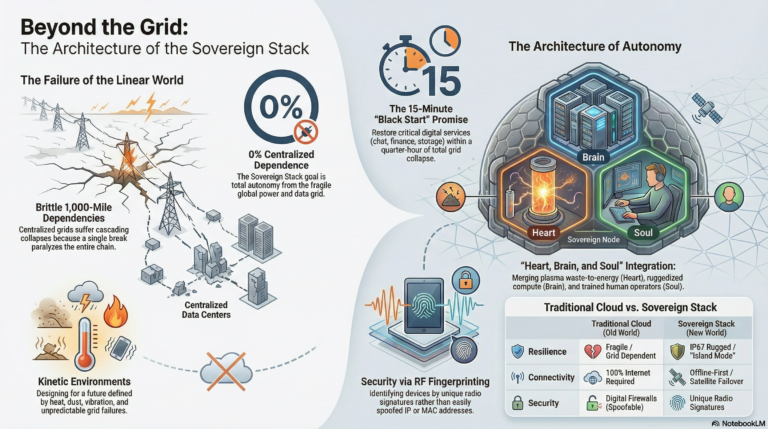
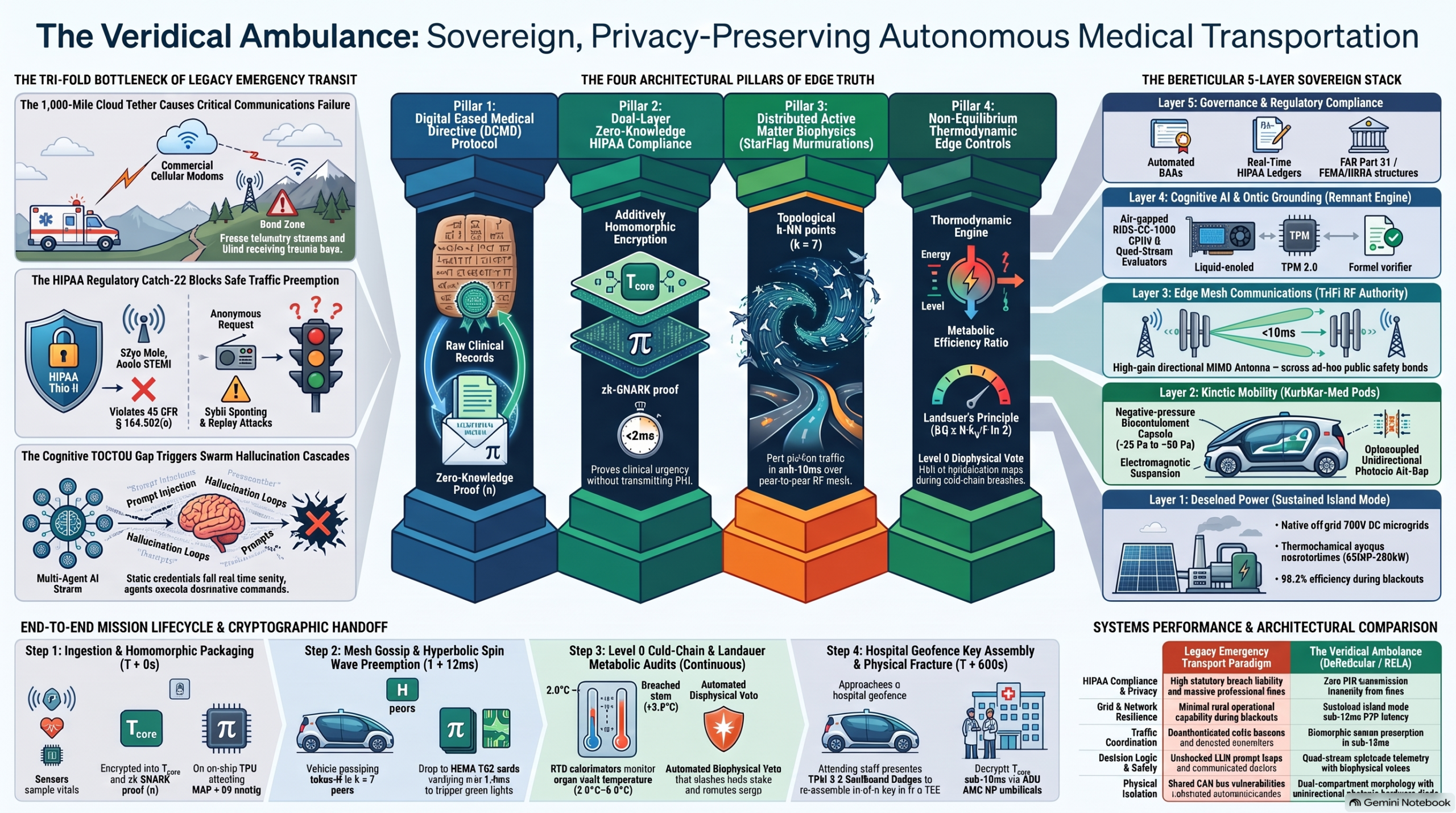
To guarantee operational autonomy and eliminate single-point cloud dependencies, synthetic swarms and autonomous mobility platforms embed within a vertically integrated five-layer physical and computational stack:
Layer Domain Key Architectural Subsystems & Invariants
Layer 5 Governance & P3 Compliance Automated Business Associate Agreements (BAA), real-time HIPAA ledgers, FAR Part 31 / DCAA SF 1408 accounting isolation, FEMA BRIC / USDA Section 6417 grant integration.
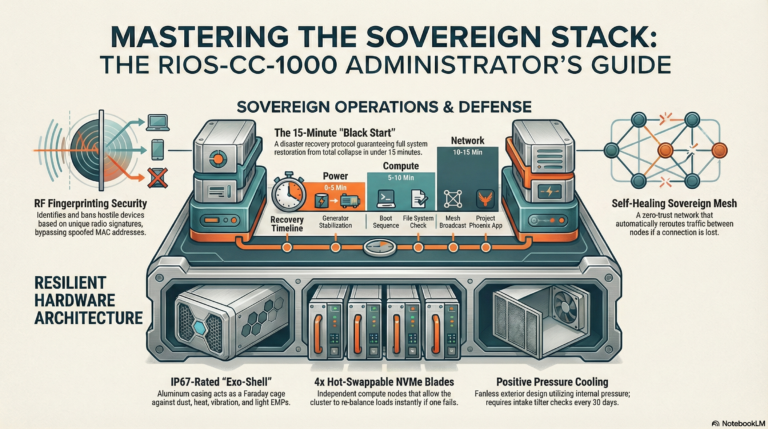
Layer 4 Cognitive AI & Epistemic Telemetry Air-gapped liquid-cooled RIOS-CC-1000 GPU skids running the Remnant Core Engine, TPM 2.0 silicon root of trust, Lean 4 Abstract Syntax Tree (AST) deductive type-checkers, Quad-Stream Runtime Telemetry.
Layer 3 Edge Mesh Communications TriFi directional MIMO arrays, peer-to-peer (P2P) sub-16ms packet authority, collision-resistant state trees, zero-cloud topological handoffs.
Layer 2 Kinetic Mobility & Biocontainment KurbKar-Med autonomous drive-by-wire electric vehicle, negative-pressure clinical care capsule, active electromagnetic suspension, optocoupled unidirectional photonic air-gap.
Layer 1 Baseload Power & Energy Escrow Off-grid native 700V DC microgrids, Agra.Energy thermochemical biomass/syngas microturbines (65kW–250kW), Pawnee rotary engines operating in Sustained Island Mode.
- Replacing Perimeter SSO with Continuous Quad-Stream Telemetry
Static perimeter Single Sign-On (OAuth2, OIDC, JWT, mTLS) introduces the Cognitive TOCTOU Gap (Time-of-Check to Time-of-Use) and the Confused Deputy Problem: an agent authenticated at time t_0 can ingest adversarial prompt injection, suffer semantic drift, or enter a Chain-of-Thought hallucination loop before dispatching an action at t_1. While legacy security gateways check valid static key signatures, they cannot evaluate reasoning sanity or physical viability.
RELA replaces static credentials with dynamic identity grading across four continuous runtime telemetry streams:
┌─────────────────────────────────────────────────────────────────────────┐
│ CONTINUOUS EXECUTION TELEMETRY FRAME │
├───────────────────┬───────────────────┬─────────────────────────────────┤
│ STREAM 1: │ STREAM 2: │ STREAM 3: │
│ EPISTEMIC │ SYNTACTIC │ THERMODYNAMIC │
│ • Brier Score BS │ • Lean 4 AST │ • Landauer Heat (ΔQ) │
│ • Free Energy F │ • Proof Kernel │ • Free Energy Gain (ΔF) │
│ • Gradient dF/dt │ • S_syn ∈ {0, 1} │ • M_ratio = ΔF / (λ · ΔQ) │
├───────────────────┴───────────────────┴─────────────────────────────────┤
│ STREAM 4: ONTIC PHYSICAL TELEMETRY │
│ • Level 0 Sensor Discrepancy: S(E_t, θ) = ||y_sensor – y_pred|| │
│ • Rejection Threshold: τ_t │
└───────────────────────────────────┬─────────────────────────────────────┘
│
▼
[CONTINUOUS IDENTITY STATE EVALUATOR]
Calculates Composite Health Index: Ψ_i(t) ∈ [0, 1]
Effective Weight: W_eff(t) = W_staked · Ψ_i(t)
- Stream 1 (Epistemic Calibration): Evaluates rolling Brier reliability scores BS \in [0, 2] and Variational Free Energy F. If the temporal derivative \dot{F} = dF/dt > 0 across three consecutive cycles (Delirium Detection), execution authority is suspended.
- Stream 2 (Syntactic Deductive Soundness): Enforces that directives compile into formal Lean 4 Abstract Syntax Trees (ASTs). If compilation fails (S_{\text{syn}} = 0.0), the execution branch is excised, and 10% of staked collateral is slashed.
- Stream 3 (Thermodynamic & Landauer Accounting): Tracks bit-erasure in VRAM (\Delta Q = N_{\text{bits}} k_B T \ln 2) and evaluates the Metabolic Efficiency Ratio:
\mathcal{M}{\text{ratio}} = \frac{\Delta F}{\lambda \cdot \Delta Q} = \frac{D{\mathrm{KL}}(q_{\text{new}} \parallel q_{\text{old}})}{\lambda \cdot (N_{\text{bits}} k_B T \ln 2)}
If \mathcal{M}_{\text{ratio}} < 1.0, the agent is burning exergy without reducing uncertainty. A hardware interrupt (FORCE_ACTION_HALT) terminates the reflection loop and truncates the context window. 4. Stream 4 (Ontic Physical Resistance): Audits physical sensor telemetry E_t \in \mathcal{Y}. If discrepancy S(E_t, \theta) > \tau_t, the node fails physical reality: 50% of its stake is burned, its identity is quarantined, and the parameter space is foreclosed.
Composite Health Index (\Psi) and Operational Tiers
\Psi_i(t) = w_1 e^{-\gamma_1 \text{BS}i} + w_2 S{\mathrm{syn}} + w_3 \min(1.0, \mathcal{M}{\mathrm{ratio}}) + w_4 e^{-\gamma_2 S{\mathrm{ontic}}}
- Tier 1 (0.85 \le \Psi \le 1.00): Veridical Core. Full consensus voting and proposal sponsorship; authorized for Level 1/0 execution.
- Tier 2 (0.65 \le \Psi < 0.85): Sub-Calibrated. Compute throttled by 30%; context capped; proposals require co-signing.
- Tier 3 (0.40 \le \Psi < 0.65): Epistemic Warning. Excluded from voting; mandatory external AST type-checking.
- Tier 4 (0.00 \le \Psi < 0.40): Byzantine Fault. Immediate halt; 50% stake burned; TPM keys revoked.
Hierarchical Transitive Slashing & Snap-Back Reversion
When capabilities are delegated transitively (A \to B \to C), liability is conserved:
- Primary Slash: Executing node (C) loses 50% stake.
- Curation Slash: Intermediary node (B) loses 25% curation stake.
- Sponsorship Slash: Originator (A) loses 10% risk deduction.
- Instant Snap-Back: The delegation tree dissolves instantly; unslashed balances revert to Originator A; failing nodes incur a +0.50 penalty on their Brier scores.
- The Oracle Separation Protocol & Source-of-Truth Hierarchy
To prevent intersubjective consensus from overruling physical reality, RELA establishes an absolute divide between cryptographic ledger integrity and ontic truth:
- Level 2 Authority (Cryptographic Ledger Integrity): Guarantees immutability, state provenance, and append-only recordkeeping via BFT consensus, Merkle trees, and zk-SNARKs. Guarantee: “The record was recorded as cast.” It cannot guarantee truth.
- Level 0 Authority (Ontic Correspondence / Truth): Physical sensors, calorimeters, SCADA meters, and material failure resistance. Guarantee: “The directive corresponds to physical reality.”
LEVEL 0 (SUPREME): ONTIC PHYSICAL RESISTANCE
Calorimeters, SCADA sensors, material fracture, bus voltage. Overrides all votes/models.
▲
│
LEVEL 1: MACHINE-CHECKED DEDUCTIVE PROOF
Formally verified Lean 4 Abstract Syntax Trees (ASTs). Γ ⊢ ψ ⟹ Γ ⊨ ψ.
▲
│
LEVEL 2: APPEND-ONLY CRYPTOGRAPHIC LEDGER
Partially synchronous BFT consensus, Merkle state trees, zk-SNARKs.
▲
│
LEVEL 3: SYMMETRIC INTERSUBJECTIVE CONSENSUS
Democratic balloting, Quadratic Values Voting, Futarchy prediction markets.
▲
│
LEVEL 4 (ZERO WEIGHT): SOVEREIGN DECLARATIVE FIAT
Unverified political decrees or prompted LLM natural language text. Assigned 0 weight.
- Biomorphic Systems Engineering: Starling Murmurations
To overcome the scaling limits and broadcast storms of artificial swarms, the architecture adapts the empirical physics of European starling murmurations (Sturnus vulgaris):
- Topological (k \approx 7), Not Metric Interaction: Starlings interact with a fixed number (k \approx 7) of nearest topological neighbors (S_i = {j : \operatorname{rank}(d_{ij}) \le 7}), rather than within a fixed metric radius (r \le 300\text{ m}). This makes interaction invariant to flock density, preventing flock fragmentation during high-G maneuvers or density expansion.
- Scale-Free Behavioral Correlation (\xi \propto L): Velocity correlation length \xi scales linearly with the physical diameter of the entire flock L. Poised at a second-order phase transition, susceptibility \chi \to \infty, allowing local perturbations to propagate instantly without damping.
- Inertial Spin Waves (Hyperbolic Wave Propagation): Trajectory changes propagate not as slow diffusive processes (\mathcal{O}(N^2)), but as undamped, linear dispersion waves (x = c \cdot t) at speeds c \approx 20\text{–}40\text{ m/s}, far exceeding forward airspeed and neuromuscular reactances:
\frac{d\mathbf{v}_i}{dt} = \frac{1}{\chi_0} \mathbf{s}_i \times \mathbf{v}i, \qquad \frac{d\mathbf{s}i}{dt} = \sum{j \in S_i} J{ij} (\mathbf{v}_i \times \mathbf{v}_j) – \frac{\eta_0}{\chi_0} \mathbf{s}_i
Synthetic swarms map this biophysics directly: k \approx 7 topological interaction eliminates LLM context bloat; conserved spin waves replace multi-turn \mathcal{O}(N^2) conversational debates with \mathcal{O}(N) wave sweeps; and anisotropic vision maps to quorums spanning \ge 3 orthogonal model families (Transformers, State-Space Models, Symbolic AST Kernels) to eliminate the Condorcet Inversion.
- Domain Implementation: The Veridical Ambulance (DERETICULAR-MED-2026-V1)
A. The Regulatory Catch-22
Emergency medical transit faces a structural deadlock under federal law:
- 45 CFR § 164.502(b) (Minimum Necessary Standard): Disclosing clinical facts (“58yo male, STEMI”) across open V2X radio waves to roadside units, traffic signals, or civilian cars violates federal privacy law because these nodes are not healthcare providers.
- 45 CFR § 164.312(e) (Transmission Security): Broadcasting identifiable telemetry over open-air RF creates an actionable statutory breach under § 164.402.
- The Anti-Sybil Threat: Stripping all telemetry and sending an anonymous “Emergency Request” beacon allows bad actors with software-defined radios (SDRs) to replay packets or spin up Sybil identities, hijacking traffic signals and paralyzing municipal grids.
THE DIGITAL CASED MEDICAL DIRECTIVE (DCMD)
[ RAW CLINICAL TELEMETRY ] (SpO2, 1 kHz EKG, MAP, GCS, SSN)
│
▼
┌─────────────────────────────────────────────────────────────────────────┐
│ STEP 1: THE INVARIANT INNER CORE (T_core) │
│ • Paillier / Exponential ElGamal Additive Homomorphism │
│ • Encrypted directly under Destination Trauma Key K_pub │
│ • C = Enc(M, r) = (g^r mod n^2, h^r · g^M mod n^2) │
│ • Statutorily inert ciphertext; satisfies 45 CFR § 164.312(e)(1) │
└────────────────────────────────────┬────────────────────────────────────┘
│
▼
┌─────────────────────────────────────────────────────────────────────────┐
│ STEP 2: THE OUTER CLAY ENVELOPE (T_env) │
│ • zk-SNARK Arithmetic Circuit C_triage (Groth16 / PLONK) │
│ • Private Witnesses (w_priv): Vitals, Waveforms, Patient Name, SSN │
│ • Public Inputs (x_pub): │
│ 1. (MAP < 65 mmHg ∨ GCS ≤ 8) == TRUE (Shock Instability) │
│ 2. (t_current – t_onset) ≤ 180 min (Thrombolytic Tissue Window) │
│ 3. VerifySign_TPM(Sensor_Payload) == VALID │
│ • Proof Size: ~256 bytes | Verification: < 2 ms │
│ • Satisfies 45 CFR § 164.502(b) Minimum Necessary Standard │
└────────────────────────────────────┬────────────────────────────────────┘
│
▼
┌─────────────────────────────────────────────────────────────────────────┐
│ STEP 3: TOPOLOGICAL MESH GOSSIP (TriFi RF Authority) │
│ • Broadcast Cased Token: H = SHA256(C || π) to k ≈ 7 nearest peers │
│ • Intersections cycle green; civilian platoons clear lanes in sub-12ms │
└────────────────────────────────────┬────────────────────────────────────┘
│
▼
┌─────────────────────────────────────────────────────────────────────────┐
│ STEP 4: TRAUMA BAY ARRIVAL & THRESHOLD FRACTURE │
│ • Destination surgical team combines m-of-n private key shares │
│ • Inner Core decrypted in sub-10ms inside hospital EHR │
└─────────────────────────────────────────────────────────────────────────┘
B. Physical Morphology of KurbKar-Med
- Kinetic Drive Bay: Operates on an off-grid native 700V DC bus, SiC fast-switching inverters, dual BLDC motors, active linear electromagnetic suspension (<0.05g vibration floor), and directional TriFi MIMO arrays. Ingests preemption tokens only.
- Clinical Care Capsule: Negative-pressure biocontainment (-25 Pa to -50 Pa), dual-stage H14 HEPA/UV-C air scrubbing, active Free-Piston Stirling cooling (2.0°C–8.0°C), and liquid-cooled RIOS-CC-1000 GPU skids running on an isolated CAN-FD bus anchored by a TPM 2.0 cryptoprocessor.
- Optocoupled Unidirectional Photonic Air-Gap: Data passes from Capsule to Drive Bay strictly via a GaAs infrared laser emitter facing a silicon PIN photodiode across a fiber-optic substrate. The silicon PIN receiver has zero photon-emitting capability; there are no copper traces or ground return wires. It is physically impossible for cyberattacks targeting the chassis radio to traverse into the clinical capsule.
- Automated Biophysical Veto: In cold-chain biologics transport, if temperature discrepancy S(E_t, \theta) = |T_{\text{measured}} – T_{\text{nominal}}| > 2.0^\circ\text{C}, the firmware trips a Level 0 hardware veto: 50% of the vehicle’s stake is slashed, the organ is flagged unviable on the BFT ledger, and surgical teams are notified before an unviable graft is implanted.
Part 2: Short-Answer Quiz
- What is the “Structural Epistemic Paradox” described in the systems architecture corpus?
- Explain the “HIPAA Regulatory Catch-22” as it applies to autonomous emergency medical transit.
- How does the Digital Cased Medical Directive (DCMD) protocol adapt the ancient Babylonian cased tablet method?
- What is the fundamental difference between topological k-NN interaction and metric radius interaction in swarm dynamics?
- Describe Landauer’s Principle and explain how the Metabolic Efficiency Ratio (\mathcal{M}_{\text{ratio}}) prevents computational delirium in edge AI models.
- What are the two structural compartments of the KurbKar-Med physical morphology, and how are they isolated?
- Explain the function and execution triggers of the “Automated Biophysical Veto” in cold-chain biologics transport.
- Under the Oracle Separation Protocol, how does RELA differentiate between Cryptographic Ledger Integrity (Level 2) and Ontic Correspondence / Truth (Level 0)?
- What structural conditions cause the “Condorcet Inversion” in homogeneous AI swarms, and how does the architecture mitigate it?
- Define the four streams that constitute the Quad-Stream Runtime Telemetry Engine designed to replace perimeter Single Sign-On (SSO).
Part 3: Quiz Answer Key
- What is the “Structural Epistemic Paradox” described in the systems architecture corpus? Answer: The Structural Epistemic Paradox arises because cognitive agents operate within localized, low-dimensional, noise-corrupted observation manifolds (\mathcal{S} \subset \mathbb{R}^d), whereas the mind-independent universe (\mathcal{M}) is high-dimensional (\dim(\mathcal{M}) \to \infty) and thermodynamically unyielding. When agents coordinate exclusively through ungrounded symbolic representations, they enter the “Epicycle Trap,” multiplying auxiliary parameters to defend flawed internal models. The framework resolves this by enforcing Fallibilistic Perspectival Realism and monotonic parameter foreclosure (Via Negativa).
- Explain the “HIPAA Regulatory Catch-22” as it applies to autonomous emergency medical transit. Answer: Disclosing raw clinical telemetry (“58yo male, STEMI”) over open vehicular airwaves to clear right-of-way breaches the Minimum Necessary Standard (45 CFR § 164.502(b)) and Transmission Security (§ 164.312(e)) because roadside units and civilian cars are not healthcare providers. Conversely, transmitting an anonymous, unauthenticated preemption request strips all clinical context, exposing municipal traffic grids to Sybil spoofing and replay attacks by bad actors. The Catch-22 forces a choice between federal privacy violations and severe physical traffic security vulnerabilities.
- How does the Digital Cased Medical Directive (DCMD) protocol adapt the ancient Babylonian cased tablet method? Answer: The DCMD protocol splits medical data into a dual-layer container mirroring Babylonian clay-cased tablets. The inner core (T_{\text{core}}) contains raw patient vitals encrypted under the destination hospital’s public key using additively homomorphic encryption (Paillier/ElGamal), remaining statutorily inert to intermediate nodes. The outer envelope (T_{\text{env}}) encapsulates a compact zk-SNARK proof (\pi) proving physiological urgency and authentic silicon signatures without disclosing protected health information (PHI).
- What is the fundamental difference between topological k-NN interaction and metric radius interaction in swarm dynamics? Answer: Metric radius interaction binds agent communication to a fixed spatial distance (r \le 300\text{ m}), which causes broadcast storms in dense networks and disconnects agents when the flock expands. Topological interaction (derived from StarFlag starling physics) maintains communication strictly with a fixed number of nearest topological neighbors (k \approx 7), regardless of spatial density. This density invariance preserves flock cohesion and prevents network fragmentation during high-speed evasive maneuvers.
- Describe Landauer’s Principle and explain how the Metabolic Efficiency Ratio (\mathcal{M}{\text{ratio}}) prevents computational delirium in edge AI models. Answer: Landauer’s Principle establishes a physical thermodynamic lower bound for computational state reset, dissipating \Delta Q \ge N{\text{bits}} k_B T \ln 2 joules per erased bit. The Metabolic Efficiency Ratio (\mathcal{M}{\text{ratio}} = \Delta F / (\lambda \cdot \Delta Q)) measures the gain in Variational Free Energy relative to thermodynamic work expended during recursive inference. If \mathcal{M}{\text{ratio}} < 1.0, the agent is burning exergy without yielding actionable clarity, triggering an automated FORCE_ACTION_HALT interrupt.
- What are the two structural compartments of the KurbKar-Med physical morphology, and how are they isolated? Answer: The KurbKar-Med is divided into a Kinetic Drive Bay (housing locomotion, 700V DC power, and road-mesh radios) and a Clinical Care Capsule (a negative-pressure medical cleanroom). The two chambers are isolated by a physical firewall bulkhead and an optocoupled unidirectional photonic air-gap consisting of an infrared GaAs laser emitter facing a silicon PIN photodiode over optical fiber. Because the PIN receiver cannot emit photons and lacks copper traces, cyberattacks targeting the chassis radio cannot physically cross into the clinical capsule.
- Explain the function and execution triggers of the “Automated Biophysical Veto” in cold-chain biologics transport. Answer: The Automated Biophysical Veto is a Level 0 hardware safety circuit that halts operations when symbolic dashboard claims diverge from physical ground truth. In biologics transport, if calorimetric sensors measure a temperature discrepancy S(E_t, \theta) = |T_{\text{measured}} – T_{\text{nominal}}| > 2.0^\circ\text{C} (violating the 2.0^\circ\text{C}\text{–}8.0^\circ\text{C} window), the veto trips instantly. The vehicle’s proof-of-stake bond is slashed by 50%, the organ is marked unviable on the ledger, and surgical teams are notified to abort implantation before graft failure occurs.
- Under the Oracle Separation Protocol, how does RELA differentiate between Cryptographic Ledger Integrity (Level 2) and Ontic Correspondence / Truth (Level 0)? Answer: Cryptographic Ledger Integrity (Level 2) uses zk-SNARKs and BFT consensus to guarantee syntactic correctness, immutability, and state provenance, certifying strictly that “a transaction was recorded as cast.” Ontic Correspondence / Truth (Level 0) relies on direct physical sensors, calorimeters, and SCADA meters to verify that a claim corresponds to physical universe state transitions. Under the five-tier hierarchy, Level 0 physical resistance overrides Level 2 ledger consensus and Level 3 voting.
- What structural conditions cause the “Condorcet Inversion” in homogeneous AI swarms, and how does the architecture mitigate it? Answer: The Condorcet Inversion occurs when expanding a voting collective guarantees convergence on 100% error (\lim_{N \to \infty} P_N = 0) because agents share correlated errors (\operatorname{Cov}(v_i, v_j) > 0) from identical pre-training weights, shared prompt templates, or sycophantic context windows, driving individual competence below chance (p < 0.5). The architecture mitigates this by mandating architectural heterogeneity across quorums (combining Transformers, State-Space Models, and Lean 4 Symbolic AST Kernels) and continuously weighting voting authority by rolling Brier calibration scores.
- Define the four streams that constitute the Quad-Stream Runtime Telemetry Engine designed to replace perimeter Single Sign-On (SSO). Answer: The Quad-Stream Engine evaluates agency across four orthogonal streams: Stream 1 (Epistemic Calibration via rolling Brier scores and Active Inference free energy dF/dt), Stream 2 (Syntactic Deductive Soundness via Lean 4 AST type-checking), Stream 3 (Thermodynamic Accounting via Landauer heat bounds and Metabolic Efficiency Ratio \mathcal{M}_{\text{ratio}}), and Stream 4 (Ontic Physical Resistance via Level 0 sensor discrepancy statistics S(E_t, \theta) \le \tau_t).
Part 4: Essay Format Questions
Note: Answers are intentionally omitted for study and discussion.
- Epistemological Formalisms & Systemic Epicycles: Analyze the transition from early conceptual drafts to the formal mathematical framework of RELA-TR-2026-V1. In your response, contrast the “Epicycle Trap” of hyper-parameterized LLM multi-agent swarms with the measure-theoretic formulation of Via Negativa parameter foreclosure, evaluating how the first Borel-Cantelli Lemma guarantees asymptotic contraction to the true ontic attractor \Omega^*.
- Thermodynamic Economics & Macro-Systemic Failure: Examine the structural isomorphism between ungrounded LLM context saturation and neoclassical macroeconomic debt expansion as presented in the corpus. Discuss how the decoupling of monetary debt claims (D(t) = D_0 e^{rt}) from real physical carrying capacity (EROEI and Carnot limits) parallels the failure of symbolic AI, and detail how RELA Axiom 3 enforces biophysical-monetary equivalence.
- Biomorphic Active Matter & Information Physics: Discuss how the physical principles of European starling murmurations (Sturnus vulgaris)—specifically topological k-NN interaction, scale-free correlation (\xi \propto L), and undamped hyperbolic spin waves (\omega = ck)—resolve the computational limits of multi-agent artificial intelligence. How do these dynamics eliminate context window bloat, reduce O(N^2) conversational latency, and mitigate the Condorcet Inversion?
- Cryptographic Jurisprudence & Regulatory Resolution: Evaluate the Digital Cased Medical Directive (DCMD) protocol as a solution to the tension between statutory privacy mandates (HIPAA Title II § 164.502(b) and § 164.312(e)) and physical traffic preemption. Detail the mathematical interaction between the homomorphic inner core (T_{\text{core}}), the outer zero-knowledge envelope (T_{\text{env}}), and roadside hardware units, proving how zero PHI disclosure is achieved alongside absolute immunity from Sybil attacks.
- Cyber-Physical Isolation & Engineering Failure Analysis: Assess the physical vehicle morphology of the KurbKar-Med platform in de-risking edge autonomous transit. Focus your analysis on the optocoupled unidirectional photonic air-gap, the Landauer Halting Gate, stationary base-docking umbilicals, and Lean 4 AST compilation gates, evaluating how the architecture prevents cyber-physical kinetic hijacking while maintaining continuous software safety verification.
Part 5: Comprehensive Glossary of Key Terms
- Active Inference: A theoretical framework (originating from Karl Friston) modeling cognitive agents as variational free energy minimization engines that balance internal computational complexity against external empirical accuracy.
- Automated Biophysical Veto: An unbypassable Level 0 hardware circuit breaker that trips when real-world physical sensor telemetry violates allowable safety bounds (e.g., organ cold-chain temperature exceeding 8.0^\circ\text{C}), immediately slashing node collateral and triggering rerouting protocols.
- Brier Score (BS): A strictly proper score rule measuring the calibration of probabilistic predictions against empirical outcomes: \text{BS} = \frac{1}{N} \sum_{t=1}^N (f_t – o_t)^2 \in [0, 2] Lower scores indicate superior epistemic calibration.
- Cognitive TOCTOU Gap: Time-of-Check to Time-of-Use Gap. A structural security vulnerability in probabilistic AI systems where an agent authenticated at time t_0 via static perimeter credentials (JWT/mTLS) suffers semantic drift, prompt injection, or cognitive collapse before executing a directive at t_1.
- Condorcet Inversion: The failure mode of collective decision-making where expanding the number of voting nodes mathematically guarantees convergence on 100% collective error (\lim_{N \to \infty} P_N = 0), caused by shared common-mode bias, correlated errors (\operatorname{Cov}(v_i, v_j) > 0), or competence dropping below chance (p < 0.5).
- Digital Cased Medical Directive (DCMD): A cryptographic protocol adapting Old Babylonian clay-cased tablets, encapsulating an additively homomorphic inner core (T_{\text{core}}) within an outer zero-knowledge proof envelope (T_{\text{env}}) to satisfy HIPAA privacy rules while enabling real-time edge traffic coordination.
- Epicycle Trap: The computational and conceptual pathology wherein an ungrounded model responds to empirical refutation by introducing unpenalized auxiliary parameters (inflating Kolmogorov complexity) to preserve internal coherence at the expense of out-of-sample predictive power.
- Fallibilistic Perspectival Realism: An epistemological stance synthesizing perspectival realism and Popperian falsificationism, holding that while cognitive access to reality is filtered through low-dimensional projection operators (\hat{\Pi}_\theta), true mind-independent attractors (\Omega^*) are asymptotically recoverable through rigorous parameter elimination (Via Negativa).
- Free Energy (F): In Active Inference, Variational Free Energy quantifies the upper bound on sensory surprise, balancing model accuracy against the computational complexity of internal representations relative to external observations.
- Landauer’s Principle: A fundamental physical law of computation establishing that the irreversible erasure or overwrite of N bits of information dissipates a minimum thermodynamic heat energy of \Delta Q \ge N \cdot k_B T \ln 2 joules.
- Lean 4 AST Gate: A machine-checked deductive proof compiler gate that evaluates Abstract Syntax Trees (ASTs) written in the Lean 4 formal logic language, enforcing that incoming code or directives satisfy axiomatic safety bounds (\Gamma \vdash \psi \implies \Gamma \models \psi) before execution.
- Metabolic Efficiency Ratio (\mathcal{M}{\text{ratio}}): The ratio measuring the gain in Variational Free Energy relative to the thermodynamic Landauer work expended during computation: \mathcal{M}{\text{ratio}} = \frac{\Delta F}{\lambda \cdot \Delta Q} Values below 1.0 indicate thermodynamic waste and trigger a FORCE_ACTION_HALT.
- Minimum Description Length (MDL): A formalization of Occam’s Razor prioritizing models that minimize the total sum of model description length and data encoding length given the model: \mathcal{S}{\text{MDL}} = \arg\min{\mathcal{M}} [ L(\mathcal{M}) + L(\D \mid \mathcal{M}) ]
- Optocoupled Unidirectional Photonic Air-Gap: A physical hardware diode constructed of a GaAs infrared laser transmitter facing a silicon PIN photodiode across a fiber-optic substrate, allowing data to flow strictly from the Clinical Care Capsule to the Kinetic Drive Bay while physically preventing reverse packet transmission.
- Oracle Separation Protocol: An architectural boundary separating Level 2 Cryptographic Ledger Integrity (syntactic correctness and provenance) from Level 0 Ontic Correspondence (empirical truth verified by physical sensors).
- Perspectival Manifold (\mathcal{P}\theta): A low-dimensional projection space (\dim(\mathcal{P}\theta) = d \ll D) produced by an observation operator \hat{\Pi}_\theta acting on the high-dimensional physical state manifold \mathcal{M}.
- Quad-Stream Runtime Telemetry: A continuous authentication and identity evaluation framework monitoring Epistemic Calibration (Stream 1), Syntactic Soundness (Stream 2), Thermodynamic Efficiency (Stream 3), and Ontic Sensor Resistance (Stream 4).
- Quadratic Voting (QV): A collective decision-making mechanism where the cost of casting n votes scales quadratically (C(n) = n^2), allowing voters to express preference intensity while preventing majority domination and Sybil influence.
- Scale-Free Behavioral Correlation (\xi \propto L): A physical property of critical systems (such as starling flocks) where the correlation length of behavioral changes \xi scales linearly with the physical diameter of the entire system L, enabling instant, un-damped information transmission.
- Soulbound Tokens (SBT): Non-transferable cryptographic identity tokens bound to specific physical hardware TPM 2.0 cryptoprocessors, used to prove node diversity and prevent Quadratic Sybil attacks.
- StarFlag Murmuration Dynamics: Swarm physics formulations derived from empirical European starling tracking, utilizing topological k-NN interaction (k \approx 7), scale-free criticality, and hyperbolic inertial spin waves to achieve decentralized collective coordination.
- Structural Epistemic Paradox: The fundamental tension between cognitive agents operating inside low-dimensional, noise-corrupted sensory frames (\mathcal{S} \subset \mathbb{R}^d) and the high-dimensional, unyielding physical universe (\mathcal{M} \subset \mathbb{R}^D).
- Topological k-NN Interaction: A communication topology where each agent interacts strictly with its k \approx 7 nearest topological neighbors based on ordinal rank distance rather than metric spatial distance, rendering swarm communication invariant to density fluctuations.
- Topological Parameter Foreclosure (Via Negativa): The process of advancing knowledge and systemic stability by monotonically and irreversibly pruning falsified parameter spaces (\Theta_{t+1} = \Theta_t \setminus \Omega_{\text{falsified}}^{(t)}) whenever discrepancy exceeds empirical rejection bounds (S(E_t, \theta) > \tau_t).
- TriFi RF Authority: A high-gain directional MIMO mesh communications framework operating on licensed public-safety and ad-hoc spectrum, enabling sub-16ms peer-to-peer vehicle coordination without commercial cellular or cloud infrastructure.
- Veridical Ambulance (DERETICULAR-MED-2026-V1): An autonomous, off-grid medical mobility system integrating native 700V DC microgrids, the DCMD protocol, starling flocking biophysics, and Landauer-bounded edge AI to deliver verified emergency healthcare transit under HIPAA.
- Variational Free Energy (F): An information-theoretic measure quantifying the mismatch between an agent’s internal model expectations and external sensory inputs, calculated as Kullback-Leibler divergence plus surprise.
- zk-SNARK: Zero-Knowledge Succinct Non-Interactive Argument of Knowledge. A cryptographic proof construction allowing a prover to demonstrate to a verifier that a mathematical statement is true (e.g., physiological urgency constraints) without revealing any underlying private data (such as protected health information).