Comprehensive Study Guide: Wireless Sensor Networks and Edge IoT Systems
Source Context Review & Core Concepts Synthesis
This section synthesizes the fundamental engineering principles, physics constraints, network architectures, and domain implementations of modern Wireless Sensor Networks (WSNs) and Edge Internet-of-Things (IoT) systems as presented in the source context.
- Universal Four-Tier Architectural Stack
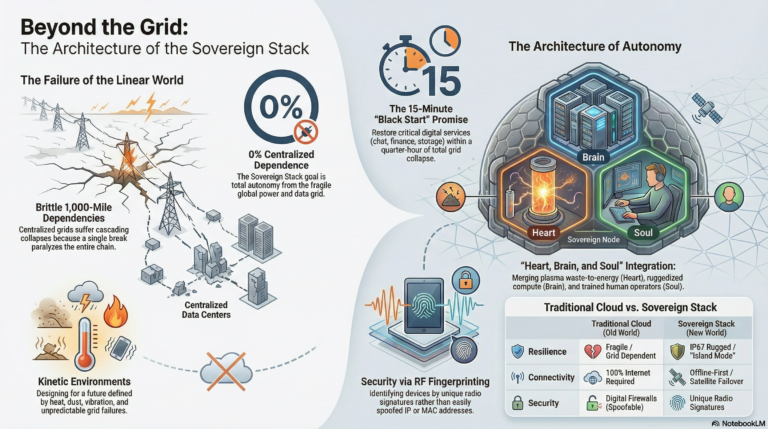
Modern WSNs and Edge IoT deployments operate across a four-tier functional framework that converts continuous physical phenomena into digital intelligence:
+———————————————————————————–+
| APPLICATION LAYER |
| SCADA Systems, Industrial Enterprise Historians, Digital Twins, Closed-Loop Control|
+———————————————————————————–+
▲
│ RESTful APIs, gRPC, OPC-UA, MQTT
+———————————————————————————–+
| MIDDLEWARE, FOG & CLOUD LAYER |
| Stream Ingestion (Apache Kafka), State Storage, Over-the-Air (OTA) Management |
+———————————————————————————–+
▲
│ IP Backbone, 5G NR, LEO Satellite, Fiber
+———————————————————————————–+
| NETWORK & ROUTING LAYER |
| Topologies (TSCH, RPL, 6LoWPAN, LoRaWAN, Wi-SUN), MAC Scheduling, DTN, DBR |
+———————————————————————————–+
▲
│ Sub-GHz, 2.4 GHz, Acoustic, VLF Induction
+———————————————————————————–+
| PERCEPTION & PHYSICAL COMPUTING LAYER (WSN NODE) |
| Transducers, AFE (Instrumentation Amps, Filters), SAR/Delta-Sigma ADCs, MCU, PMIC|
+———————————————————————————–+
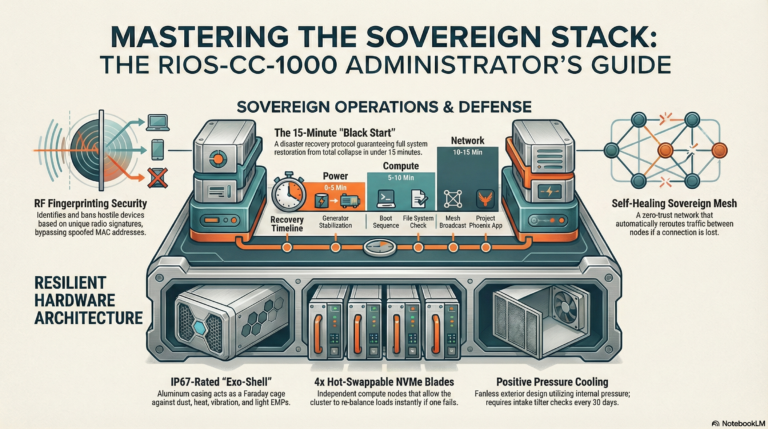
Node Anatomy & Signal Processing
- Analog Front-End (AFE): Uses high Common-Mode Rejection Ratio (\text{CMRR} > 100\text{ dB}) instrumentation amplifiers and active anti-aliasing low-pass filters (e.g., 4th-order Butterworth/Bessel) to condition low-amplitude physical signals.
- Digitization: Successive Approximation Register (SAR) ADCs offer fast, zero-cycle conversion latencies for duty-cycled applications (12\text{–}16\text{ bits}). Delta-Sigma (\Delta\Sigma) ADCs use oversampling and noise-shaping for high-resolution (24\text{ bits}) acquisition in biopotential, seismic, and structural monitoring.
- Microcontrollers & Security: Powered by low-power cores (ARM Cortex-M33, RISC-V RV32IMAC) integrating silicon Root of Trust, Physical Unclonable Functions (PUFs), and hardware cryptographic accelerators (AES-256).
- MAC Layer & Routing Landscapes
MAC Protocol Determinism Energy Overhead Performance Under Heavy Load
CSMA/CA (IEEE 802.15.4) Non-deterministic (Best-effort) High (Collisions & continuous idle listening) Throughput collapses exponentially as node density increases (\tau \to 1).
TDMA (Static Slots) Deterministic (Bounded delay) Low (Scheduled duty-cycling) Poor adaptability to dynamic topology shifts.
TSCH (IEEE 802.15.4e) Deterministic (Synchronized mesh) Ultra-Low (Microsecond slot alignment) High reliability (>99.999%) via channel hopping across 16 ISM bands.
- Specialized Domain Engineering Summaries
+————————————————————————————————–+
| DOMAIN ENGINEERING MATRIX & CONSTRAINTS |
+————————————————————————————————–+
| Domain | Primary Medium & Carrier | Primary Engineering Constraints / Failures |
+————————+————————–+———————————————-+
| Civil Infrastructure | Short-Range RF Mesh, | Clock drift corrupting mode shape calculations|
| (SHM) | LTE-M / 5G / Fiber | ($<10\ \mu\text{s}$ PTP/TDMA time sync required)|
+————————+————————–+———————————————-+
| Electric Power | Sub-GHz FHSS (Wi-SUN), | Extreme EMI, high $dV/dt$ transients, |
| Utilities | 2.4 GHz, Optical | core saturation during short-circuit faults |
+————————+————————–+———————————————-+
| Subsurface Underground | VLF/ELF Magnetic | RF signal absorption in conductive rock; |
| Mining | Induction (300 Hz–3 kHz) | Explosive atmospheres ($\text{CH}_4$/dust) |
+————————+————————–+———————————————-+
| Wilderness Disaster | Direct-to-Satellite | Deep canopy shadow, extreme temperatures, |
| Mitigation | (LR-FHSS, 3GPP NTN) | $\text{Li-SOCl}_2$ battery passivation layer |
+————————+————————–+———————————————-+
| Marine Systems | Acoustic Pressure Waves | Slow sound speed ($1,500\text{ m/s}$), multipath,|
| (UWSNs) | ($10\text{–}50\text{ kHz}$) | biofouling, hydrostatic pressure ($10\text{ MPa/km}$)|
+————————+————————–+———————————————-+
Civil Infrastructure & Structural Health Monitoring (SHM)
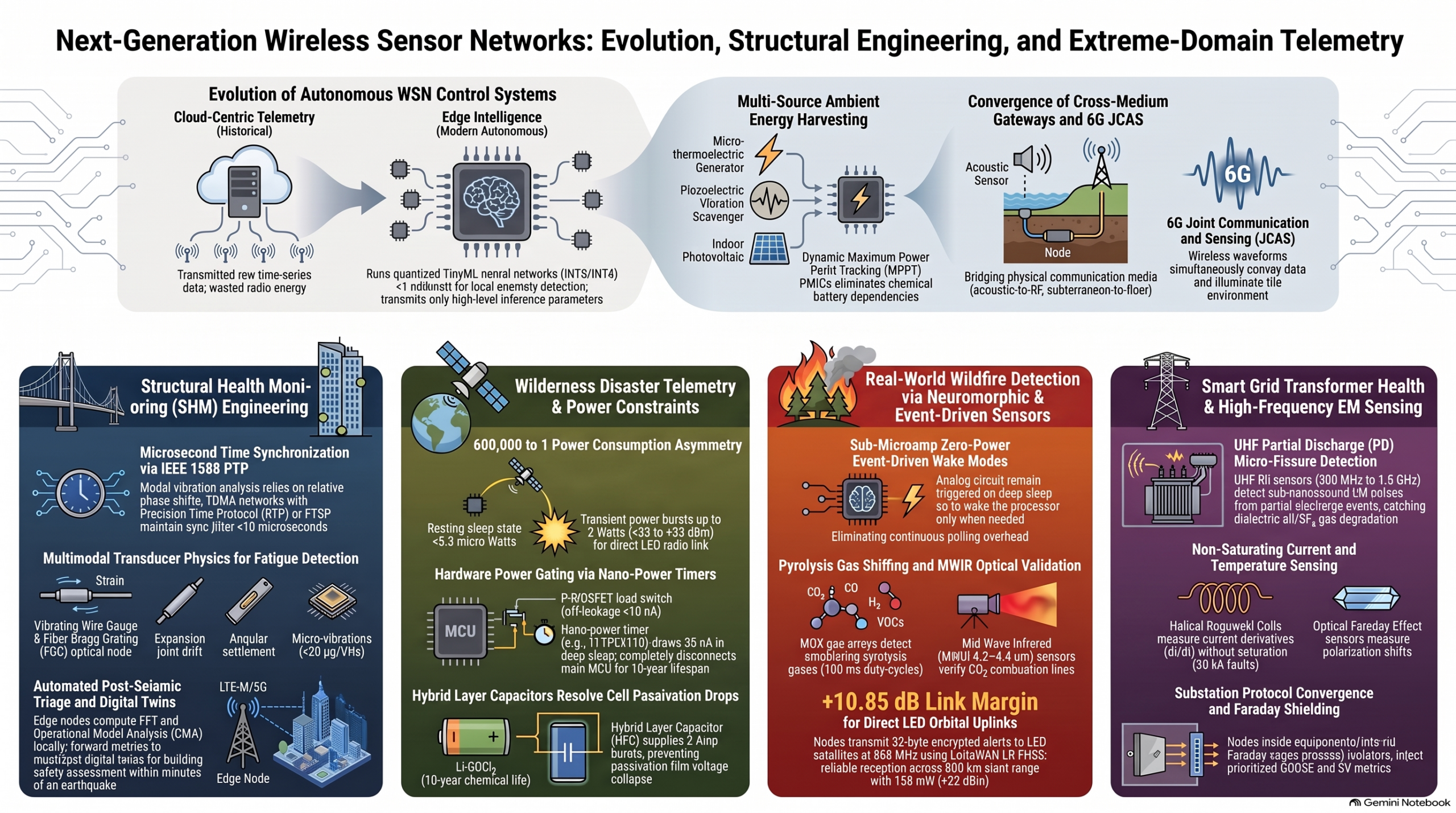
- Modal Analysis: Requires microsecond-level clock synchronization (\text{jitter} < 10\ \mu\text{s}) via Precision Time Protocol (IEEE 1588) or Flooding Time Synchronization Protocol (FTSP) over TDMA mesh networks to compute accurate mode shapes, damping ratios, and natural frequencies.
- Transducer Physics: Vibrating wire strain gauges evaluate structural stress via frequency shifts (\Delta \epsilon \propto \Delta f^2). Fiber Bragg Grating (FBG) optical sensors track shifts in Bragg wavelength (\lambda_B) without spark risks. Low-noise accelerometers capture micro-vibrations with noise densities below 20\ \mu\text{g}/\sqrt{\text{Hz}}.
Electric Power Utilities & Smart Grids
- Hardening & Shielding: Line-mounted nodes operate on the “bird-on-a-wire” equipotential principle inside Faraday cages with rounded edges (R_{\text{edge}} > 15\text{ mm}) to suppress corona discharge. Galvanic isolators mandate Common-Mode Transient Immunity (\text{CMTI}) exceeding 150\text{ kV}/\mu\text{s}.
- Parasitic Energy Harvesting: Split-core nanocrystalline Current Transformers (CTs) extract magnetic energy from phase lines. Active depletion-mode MOSFET shunts and solid-state Triac crowbars short the CT secondary during fault currents (>20\text{ kA}) to prevent core saturation and thermal destruction. Electric-Field Energy Harvesting (EFEH) extracts capacitive displacement currents (I_{\text{harvest}} = \omega C_{\text{ground}} V_{\text{line}}) from unenergized/unloaded lines.
Subsurface Mining & Geotechnical Engineering
- Through-The-Earth (TTE) Transmission: High-frequency RF attenuates rapidly in conductive rock (\sigma = 10^{-3}\text{–}10^{-1}\text{ S/m}). TTE systems use low frequencies (300\text{ Hz}\text{–}3\text{ kHz}) where the attenuation constant (\alpha = \sqrt{\pi f \mu \sigma}) allows signals to penetrate hundreds of meters of solid overburden.
- Intrinsic Safety (“Ex ia” Group I): Regulates electronics in explosive methane (5%\text{–}15%) and coal dust atmospheres. Circuits must restrict stored electrical spark energy below 150\ \mu\text{J} (E = \frac{1}{2}CV^2 \le 150\ \mu\text{J}, E = \frac{1}{2}LI^2 \le 150\ \mu\text{J}). High-power TTE transmitters use series-resonant LC tuning (\omega_0 = 1/\sqrt{LC}) to cancel inductive reactance at f_0, allowing high AC currents at safe DC voltages (\le 5\text{ V}).
Environmental Monitoring & Disaster Mitigation
- Deep-Sleep Architectures: Hard power gating using P-MOSFET load switches (I_{\text{leak}} < 10\text{ nA}) and dedicated nano-timers (e.g., TPL5110 drawing 35\text{ nA}) drops system resting current below 1\ \mu\text{A}.
- Battery Passivation: Primary \text{Li-SOCl}_2 cells form a protective Lithium Chloride (\text{LiCl}) passivation layer that prevents self-discharge (<1%/\text{year}) but increases internal resistance. Pairing the cell with a Hybrid Layer Capacitor (HLC) provides the low Equivalent Series Resistance (\text{ESR} < 100\text{ m}\Omega) necessary to deliver multi-ampere pulses for satellite transmitters without brownouts.
- Direct-to-Satellite IoT: Employs LEO satellite links using LR-FHSS or 3GPP Rel-17 IoT-NTN. LR-FHSS splits payloads into sub-fragments that hop pseudorandomly across narrow sub-channels (488\text{ Hz} wide), providing Doppler immunity and high collision resistance.
Marine Systems & Underwater Acoustic Sensor Networks (UWSNs)
- Acoustic Wave Imperative: High salinity (\sigma \approx 4\text{ S/m}) absorbs RF signals within centimeters. Sound waves (c \approx 1,500\text{ m/s}) act as the primary medium. Attenuation follows Thorp’s equation, which incorporates chemical relaxation of boric acid and magnesium sulfate.
- Spatio-Temporal Uncertainty: Low propagation speed introduces a delay of \approx 0.67\text{ s/km}, causing severe latency, wideband Doppler scaling (\Delta = v/c), and rendering terrestrial CSMA/CA handshakes useless (“hidden terminals in time”).
- Routing & Mechanics: Depth-Based Routing (DBR) uses internal hydrostatic pressure sensors to forward telemetry toward surface buoys without global routing tables. Enclosures are machined from Grade 5 Titanium or PEEK to withstand abyssal pressure (10\text{ MPa/km}). Biofouling is mitigated using copper-nickel alloys, mechanical wipers, and localized UV-C LEDs (265\text{–}280\text{ nm}).
Short-Answer Quiz
- Why do Structural Health Monitoring (SHM) systems require sub-millisecond clock synchronization, and what protocols are used to achieve it?
- How do Rogowski coils overcome the operational limitations of traditional Iron-Core Current Transformers (CTs) under high-voltage fault conditions?
- What is the “bird-on-a-wire” equipotential principle, and why is Common-Mode Transient Immunity (CMTI) critical for line-mounted utility sensors?
- Why do conventional high-frequency radio signals fail to communicate through subterranean rock, and how does Through-The-Earth (TTE) technology overcome this?
- How do TTE transmitters resolve the engineering contradiction between needing high magnetic dipole moments and adhering to Intrinsic Safety (Ex\ ia) energy limits?
- What causes the passivation layer to form in Lithium Thionyl Chloride (\text{Li-SOCl}_2) batteries, and how does a Hybrid Layer Capacitor (HLC) prevent voltage brownouts during radio transmissions?
- What features make Long Range Frequency Hopping Spread Spectrum (LR-FHSS) modulation suitable for Direct-to-Satellite IoT links?
- Why does Carrier Sense Multiple Access with Collision Avoidance (CSMA/CA) fail in Underwater Acoustic Sensor Networks (UWSNs)?
- How does Depth-Based Routing (DBR) forward data through an underwater acoustic network without maintaining global routing tables?
- What physical mechanism allows Time-Domain Reflectometry (TDR) sensors to measure volumetric soil moisture content?
Quiz Answer Key
- Why do Structural Health Monitoring (SHM) systems require sub-millisecond clock synchronization, and what protocols are used to achieve it?
Answer: Modal vibration analysis relies on calculating precise relative phase shifts between spatially separated sensor nodes to extract natural frequencies, mode shapes, and damping ratios. If clock drift occurs between nodes, relative phase shift calculations fail, resulting in corrupted mode-shape estimations. To prevent this, SHM networks reject standard CSMA/CA protocols in favor of Time-Division Multiple Access (TDMA) combined with the Precision Time Protocol (PTP / IEEE 1588) or Flooding Time Synchronization Protocol (FTSP), maintaining time synchronization jitter below 10\ \mu\text{s}. - How do Rogowski coils overcome the operational limitations of traditional Iron-Core Current Transformers (CTs) under high-voltage fault conditions?
Answer: Traditional Iron-Core Current Transformers rely on heavy ferromagnetic cores that suffer from magnetic saturation under high short-circuit currents, leading to severe signal distortion and potential explosive thermal failure. Rogowski coils utilize an air-core helical design placed around conductors that outputs an analog voltage directly proportional to the derivative of the current (\frac{di}{dt}). Because they lack an iron core, Rogowski coils cannot saturate, allowing them to measure massive fault surges safely and linearly. - What is the “bird-on-a-wire” equipotential principle, and why is Common-Mode Transient Immunity (CMTI) critical for line-mounted utility sensors?
Answer: The “bird-on-a-wire” principle dictates that a line-mounted sensor node operates inside a conductive Faraday enclosure clamped directly to an energized phase line, maintaining the entire chassis at phase potential to eliminate steady-state voltage differentials. However, steep transient events (such as switching surges or lightning strikes) produce extreme rates of voltage change (\frac{dV}{dt} > 100\text{ kV}/\mu\text{s}) across transmission lines. Galvanic isolators must possess a high Common-Mode Transient Immunity (\text{CMTI} \ge 150\text{ kV}/\mu\text{s}) to prevent high displacement currents from crossing internal isolation barriers and corrupting low-voltage microelectronics. - Why do conventional high-frequency radio signals fail to communicate through subterranean rock, and how does Through-The-Earth (TTE) technology overcome this?
Answer: High-frequency RF signals (e.g., 915\text{ MHz} or 2.4\text{ GHz}) induce severe electrical conduction currents in lossy geological rock strata, causing continuous ohmic dissipation that attenuates electromagnetic waves by hundreds of decibels per meter. TTE communications bypass this limitation by operating in the Very Low Frequency (VLF: 300\text{ Hz}\text{–}3\text{ kHz}) or Extremely Low Frequency (ELF: 3\text{ Hz}\text{–}300\text{ Hz}) bands using loop or ferrite-core antennas. These low-frequency carriers generate quasi-magnetostatic fields whose attenuation constant (\alpha = \sqrt{\pi f \mu \sigma}) remains low enough to penetrate hundreds of meters of solid rock overburden. - How do TTE transmitters resolve the engineering contradiction between needing high magnetic dipole moments and adhering to Intrinsic Safety (Ex\ ia) energy limits?
Answer: High TTE magnetic moments (m = N \cdot I \cdot A) require driving high currents through inductive coils, which violates Intrinsic Safety (Ex\ ia) rules that strictly restrict stored inductive energy (E = \frac{1}{2}LI^2 \le 150\ \mu\text{J}) to prevent ignition of explosive methane atmospheres. To resolve this, TTE nodes connect a precision capacitor in series with the antenna coil, tuning the LC circuit to exact resonance (\omega_0 = 1/\sqrt{LC}) at the carrier frequency. Resonance cancels the antenna’s reactive impedance, enabling high oscillating currents to flow at safe, low DC supply voltages (\le 5\text{ V}), backed by redundant active MOSFET shunts and fast diode arrays that clamp inductive discharge spikes if an antenna breaks. - What causes the passivation layer to form in Lithium Thionyl Chloride (\text{Li-SOCl}_2) batteries, and how does a Hybrid Layer Capacitor (HLC) prevent voltage brownouts during radio transmissions?
Answer: The passivation layer forms when the metallic lithium anode reacts with the liquid thionyl chloride electrolyte, creating a thin protective crystalline film of Lithium Chloride (\text{LiCl}) that arrests internal chemical self-discharge and extends battery shelf life beyond ten years. However, this film introduces high internal resistance; when a radio requests a high-current pulse, the terminal voltage momentarily drops below the microcontroller’s brownout limit. Connecting a Hybrid Layer Capacitor (HLC) in parallel resolves this because the primary cell trickle-charges the HLC during sleep, and the low Equivalent Series Resistance (\text{ESR} < 100\text{ m}\Omega) of the HLC supplies the entire high-current surge during radio transmissions. - What features make Long Range Frequency Hopping Spread Spectrum (LR-FHSS) modulation suitable for Direct-to-Satellite IoT links?
Answer: LR-FHSS splits an uplink data packet into small sub-second fragments and hops pseudorandomly across hundreds of narrow frequency sub-channels (488\text{ Hz} wide) spanning a wider operating bandwidth (137\text{ kHz}\text{–}1.5\text{ MHz}). The narrow sub-channels provide high immunity against wideband Doppler frequency shifts induced by fast-moving Low-Earth Orbit (LEO) satellites. Furthermore, because transmissions hop over time and frequency, thousands of ground sensors can transmit simultaneously with minimal packet collisions, allowing a single satellite receiver to process millions of daily messages. - Why does Carrier Sense Multiple Access with Collision Avoidance (CSMA/CA) fail in Underwater Acoustic Sensor Networks (UWSNs)?
Answer: CSMA/CA relies on instantaneous channel feedback, assuming that listening to the medium indicates whether a channel is clear. In seawater, sound travels at roughly 1,500\text{ m/s}—five orders of magnitude slower than light—introducing a massive propagation delay of \approx 0.67\text{ s/km}. Consequently, a node sensing a quiet local channel cannot detect an acoustic wave already in transit from a distant node, leading to severe packet collisions at the receiver (“hidden terminals in time”) and rendering contention-based handshaking (RTS/CTS) prohibitively latency-intensive and energy-wasteful. - How does Depth-Based Routing (DBR) forward data through an underwater acoustic network without maintaining global routing tables?
Answer: DBR equips each underwater node with an internal piezoresistive hydrostatic pressure sensor to continuously calculate its current depth below the sea surface. When a node transmits data, it embeds its depth value into the packet header; neighboring nodes receiving the transmission compare their own pressure depth against the packet’s value. If a neighbor is deeper, it drops the packet; if it is shallower, it calculates a local holding delay inversely proportional to its depth difference (\Delta z) before rebroadcasting, ensuring the shallowest candidate node transmits first and natural multi-hop paths direct telemetry upward to surface buoys. - What physical mechanism allows Time-Domain Reflectometry (TDR) sensors to measure volumetric soil moisture content?
Answer: TDR sensors inject a high-frequency electromagnetic pulse along a metallic waveguide inserted into the soil matrix and calculate its propagation velocity (v = \frac{c}{\sqrt{\varepsilon_r’}}), which depends on the soil’s apparent real dielectric permittivity (\varepsilon_r’). Because liquid water has an exceptionally high relative dielectric constant (\varepsilon_r’ \approx 80 at 20^\circ\text{C}) compared to dry soil minerals (\varepsilon_r’ \approx 3\text{–}5) and air (\varepsilon_r’ \approx 1), any increase in soil moisture significantly reduces pulse velocity. The measured permittivity shift is then converted directly into volumetric water content (\theta_v) using Topp’s empirical equation.
Essay Practice Questions
Note to Students: These essay topics are designed to test deep synthesis, multi-physics integration, and system design criteria across the source context. Answers are not provided.
- Physical Channel Limits and Subsea Protocol Design:
Compare the physical communication limits of seawater against atmospheric air. Analyze why electromagnetic, optical, and acoustic modalities behave differently underwater, and detail how the physical properties of acoustic propagation (velocity, attenuation, refraction, and Doppler scaling) dictate the architecture of underwater physical-layer modulation (e.g., ZP-OFDM) and spatio-temporal MAC protocols. - Power Architecture Trade-Offs Across Harsh Environments:
Contrast the power supply architectures of high-voltage transmission line sensors with those of remote wilderness disaster early-warning nodes. Discuss how parasitic energy harvesting (magnetic CTs and capacitive displacement) and primary chemical energy storage (\text{Li-SOCl}_2 paired with HLCs) solve their respective physics constraints, detailing how each architecture manages fault conditions, passivation, and extreme thermal cycling. - Subsurface Sensing and Hazardous Environment Compliance:
Examine the physical barriers to wireless signal propagation in deep underground mining operations. Explain how Through-The-Earth (TTE) magnetic induction operates, and provide a detailed analysis of how circuit architects resolve the fundamental tension between maximizing magnetic dipole moments (m = N \cdot I \cdot A) and satisfying Intrinsic Safety (Ex\ ia Group I) limits regarding inductive energy, capacitive spark discharge, component surface temperatures, and physical creepage/clearance. - Domain Comparison of Industrial WSN Architectures:
Construct an architectural comparison across four mainstream industrial domains: Precision Agriculture, Transportation & Logistics, Healthcare (WBAN), and Industrial Automation (IWSN). For each domain, evaluate the dominant physical constraints, target latency and reliability metrics, typical RF spectrums, and MAC-layer protocol selections (e.g., CSMA/CA vs. TSCH vs. IEEE 802.15.6). - The Convergence of Edge Compute, TinyML, and Zero-Trust Silicon Security:
Discuss the technical shift from traditional centralized cloud-bound IoT telemetry to autonomous edge-computing WSN fabrics. Detail how on-node TinyML micro-inference and hardware-enforced silicon security (Roots of Trust, PUFs, crypto engines) change node energy budgets, network bandwidth consumption, fault isolation, and overall resilience against physical and cyber attack surfaces in critical infrastructure.
Comprehensive Glossary of Key Terms
- Absolute Slot Number (ASN): A total count of time slots elapsed since an IEEE 802.15.4e TSCH network was initiated, used by nodes to calculate precise slot timing and frequency hopping channels via the formula f = F[(\text{ASN} + \text{ChannelOffset}) \pmod{N_{\text{channels}}}].
- Acoustic Shadow Zone: A subsea volume created when steep vertical temperature gradients in the upper ocean layer bend acoustic rays downward away from the surface, preventing acoustic detection of targets located within the shadowed region.
- Analog Front-End (AFE): The primary physical hardware circuit layer consisting of instrumentation amplifiers, programmable gain stages, and anti-aliasing low-pass filters that cleans, conditions, and amplifies weak analog transducer signals prior to ADC conversion.
- Bird-on-a-Wire Topology: A line-mounted equipment deployment methodology where an autonomous sensor node and its Faraday enclosure are clamped directly onto an energized high-voltage conductor, maintaining the chassis at phase potential and eliminating line-to-ground voltage stress.
- Common-Mode Transient Immunity (CMTI): The maximum tolerable rate of common-mode voltage rise or fall across an isolation barrier (expressed in \text{kV}/\mu\text{s}) that a digital isolator can withstand without causing output bit errors or physical dielectric breakdown.
- Depth-Based Routing (DBR): A stateless, geographic underwater acoustic routing protocol that uses hydrostatic pressure measurements to dynamically steer telemetry packets toward surface buoys by prioritizing forwarding nodes at shallower depths.
- Direct-to-Satellite IoT: A communication model where ground-based sensor nodes transmit telemetry payloads directly to orbiters in Low-Earth Orbit (LEO) or Geostationary Orbit (GEO) using specialized sub-GHz or L-band waveforms (e.g., LR-FHSS, 3GPP Rel-17 NTN) without terrestrial gateways.
- Effective Number of Bits (ENOB): An accurate metric evaluating the real-world dynamic signal-to-noise performance of an Analog-to-Digital Converter, defined as \text{ENOB} = (\text{SINAD} – 1.76) / 6.02.
- Ex ia Group I: The highest level of Intrinsic Safety protection for electrical equipment deployed in underground coal mines subject to methane gas and coal dust hazards, requiring equipment to remain non-igniting under normal operation plus two independent countable faults.
- Faraday Effect: An electro-optic phenomenon exploited by Optical Current Transducer (OCT) sensors where the polarization plane of a light beam passing through a magneto-optic glass crystal rotates in direct proportion to the surrounding magnetic field.
- Hybrid Layer Capacitor (HLC): A high-pulse-density lithium capacitor placed in parallel with a primary bobbin-type \text{Li-SOCl}_2 battery to supply multi-ampere pulse currents required during radio transmissions without triggering severe passivation voltage drops.
- Intrinsic Safety (“Ex i”): A design technique for electrical equipment operating in hazardous explosive atmospheres that limits electrical spark discharge energy (E \le 150\ \mu\text{J}) and surface temperatures below the minimum ignition threshold of surrounding flammable gases or dusts.
- Long Range Frequency Hopping Spread Spectrum (LR-FHSS): A robust wireless physical-layer protocol that splits an uplink payload into small sub-fragments and hops pseudorandomly across wide sub-GHz frequency allocations, delivering Doppler resilience and high capacity for direct-to-satellite IoT.
- Mackenzie Equation: An empirical formula used to calculate sound speed (c) in seawater as a function of temperature (T), salinity (S), and depth/hydrostatic pressure (z).
- Modal Vibration Analysis: An analytical method in Civil Structural Health Monitoring that processes synchronized acceleration time-series data from spatially distributed nodes to deduce structural dynamic parameters, including natural frequencies, mode shapes, and damping ratios.
- Passivation Layer: A thin, non-conductive crystalline film of Lithium Chloride (\text{LiCl}) that forms spontaneously on the metallic lithium anode of a \text{Li-SOCl}_2 cell, preventing self-discharge over decade-long deployments while increasing initial internal cell resistance.
- Precision Time Protocol (PTP / IEEE 1588): A network clock synchronization protocol capable of aligning clocks across distributed Ethernet or TDMA wireless nodes to sub-microsecond precision, essential for spatial phase calculations in modal vibration analysis.
- Rogowski Coil: An air-core helical inductive coil wrapped around a conductor that outputs an analog voltage directly proportional to the derivative of current (\frac{di}{dt}), offering immunity to magnetic saturation and explosive failure during short-circuit faults.
- SOFAR (Sound Fixing and Ranging) Channel: An oceanic depth layer (typically between 800\text{ m} and 1,200\text{ m}) where temperature and pressure combine to form a minimum sound speed axis, acting as an acoustic waveguide that traps sound waves and routes them over thousands of kilometers.
- Through-The-Earth (TTE) Communication: A specialized subsurface wireless transmission system utilizing Very Low Frequency (VLF: 300\text{ Hz}\text{–}3\text{ kHz}) quasi-magnetostatic induction to send telemetry directly through hundreds of meters of solid geological rock overburden.
- Time-Domain Reflectometry (TDR): A sensing technique that measures the propagation speed of a high-frequency electromagnetic pulse along a submerged metal waveguide to calculate the real dielectric permittivity of soil, which maps directly to volumetric water content (\theta_v).
- Time-Slotted Channel Hopping (TSCH): An advanced MAC layer mechanism (IEEE 802.15.4e) combining precise TDMA slotframes with dynamic frequency hopping across multiple channels to achieve deterministic, interference-resistant industrial wireless mesh communication.
- TinyML: The deployment of ultra-compact, quantized machine learning models (such as 8-bit deep neural networks) directly onto resource-constrained microcontrollers operating below 1\text{ mW} to execute real-time edge inference without raw data streaming.
- Tonpilz Transducer: A heavy-duty acoustic projector comprising a central prestressed piezoceramic ring stack clamped between a dense metal tail mass and a light flared head mass, engineered to project high-power longitudinal acoustic waves into seawater.
- Waveguide-Below-Cutoff (WBC): An enclosure shielding design technique that utilizes metallic tube openings with an aspect ratio of \ell/d \ge 3 to attenuate lower-frequency electromagnetic waves exponentially as they pass through the tube aperture.
- Zero-Padded OFDM (ZP-OFDM): An acoustic multi-carrier digital modulation scheme that inserts zero-amplitude guard intervals between OFDM blocks, allowing long subsea multipath delay spreads to decay silently without inducing inter-symbol interference.