
Comprehensive Study Guide: TriFi Wireless & Sovereign Mesh Technology
This study guide provides a structured review of the hardware specifications, architectural frameworks, procurement standards, and industry applications surrounding the TriFi Wireless product collection and DeReticular’s Sovereign Mesh “WISP-in-a-Box” telecommunications ecosystem.
Key Concepts & System Summary
The 5-Layer Unified Sovereign Architecture
The Sovereign Infrastructure Consortium (SIC) governs its decentralized infrastructure through a 5-layer functional stack designed under Noel’s Law of Structural Vulnerability:
- Layer 1: Power (Agra Dot Energy): Baseload off-grid generation, 700V DC native busbars, and thermochemical biomass gasification that bypasses traditional public utility interconnection queues.
- Layer 2: Mobility & Proving (Kurb Kars / DAOSRUS): Autonomous commercial utility EVs, mobile battery skids, and tactical nomadic nodes operating under offline machine-to-machine protocols (DAOS_A2A_M2M_v3).
- Layer 3: Mesh Communications (DeReticular Core / TriFi Wireless) [Active Scope]: Carrier-grade RF mesh networks, sub-16ms channel handoffs, multi-carrier auto-failover, hardware TPM 2.0 cryptoprocessors, and WISP carrier distribution.
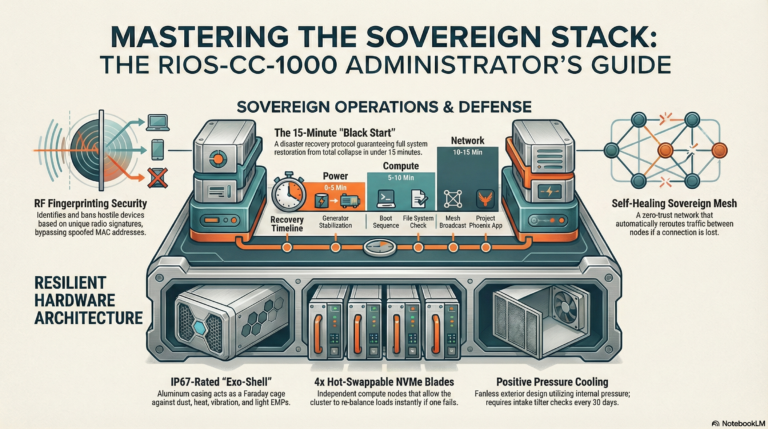
- Layer 4: SCADA & Cognitive Intelligence (DeReticular Energy): Air-gapped on-premise compute, liquid-dielectric immersion-cooled GPU racks (RIOS-CC-1000), and supervisory control telemetry.
- Layer 5: Governance & Advisory (Biz Builder Mike / SIEA Academy): Public-Private Partnership (P3) capital stacking (USDA REAP, FEMA BRIC, IRA §6417 Direct Pay) and municipal islanding audits.
Governing Theoretical Principles
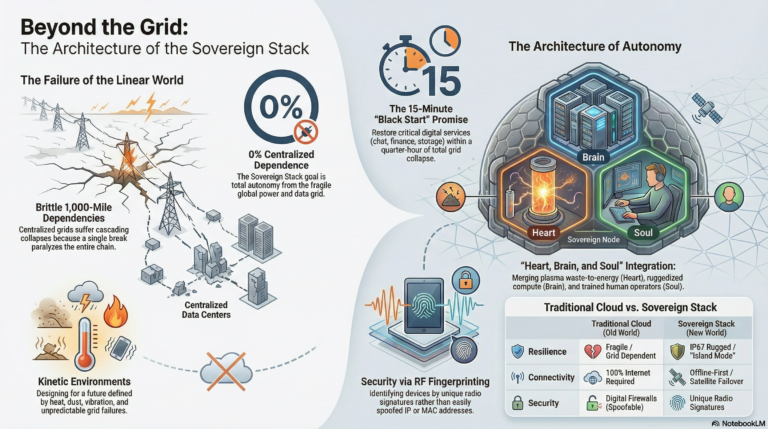
- Noel’s Law of Structural Vulnerability: “The survivability of any operational node is inversely proportional to the length and central coordination of its critical supply chains and communication backhauls.”
- The 1,000-Mile Failure Model: The vulnerability where local facilities collapse due to remote supply chain disruptions, centralized hyperscaler cloud outages, or public electric grid failures.
- Island Mode: The operational state in which local district hardware functions completely autonomously and air-gapped without needing external cloud uplinks or central grid power.
Hardware Portfolio & Cost Matrix
Every turnkey unit in the TriFi ecosystem adheres to a unified initial acquisition cost formula: \text{Initial Turnkey Charge} = \text{Base Hardware Cost} + $45.00 \text{ (Staging/Provisioning Fee)} + $120.00 \text{ (Month 1 APN Data Service)}
All devices require an ongoing subscription billed at $120.00 per month for uncapped, non-throttled multi-carrier cellular/APN backhaul.
Product Name & Master SKU Form Factor & Role Base HW Price Staging Fee Initial Turnkey Charge Ongoing Monthly 1-Year Total Cost of Ownership (TCO) Key Specifications
TriFi Rover
TRIFI-ROVER-SLG06 Tactical Handheld / Portable Hotspot $80.00 $45.00 $245.00 $120.00 $1,565.00 Rubberized chassis, 4,000 mAh LiFePO4 battery (up to 140°F), color LCD with Wi-Fi pairing QR code, USB-C PD pass-through.
TriFi Far X
TRIFI-FARX-1271 Kinetic Fleet AP / Long-Range Desktop Router $250.00 $45.00 $415.00 $120.00 $1,735.00 Upright matte-gray body, 4 vertical 9dBi directional paddles, dual-band Wi-Fi 6 bubble, native 12V DC & 120V AC input, sub-16ms sync.
TriFi Signal Pro
TRIFI-SIGPRO-8355 Fixed Wireless Terminal / Campus CPE $650.00 $45.00 $815.00 $120.00 $2,135.00 Matte-white circular dome, IP67 cast aluminum, 4×4 MU-MIMO directional array, 48V Passive Gigabit PoE, sub-16ms RF sync.
TriFi WISP-in-a-Box Lite
TRIFI-WISP-BASE-100 Carrier Base Station Prime (District Hub) $899.00 $45.00 $1,064.00 $120.00 $2,384.00 High-gain mast/tower mount, 15-mile NLOS envelope, hardware TPM 2.0, RIOS agent, gas-discharge surge arrestor.
Logistics, Audits, and Capital Stacking
- Fulfillment SLA: Managed via Anchor Distributing in Minneapolis, MN, under cost code 5200-LOGISTICS. Ground dispatch requires orders to clear by 2:00 PM CST for same-day routing.
- $45 Staging Scope: Covers unboxing, hardware TPM 2.0 root key enrollment, RIOS firmware flashing, IMEI/ICCID SIM marrying, and radio bench testing (RF loopback and sub-16ms failover verification).
- Accounting Standards: Procurement adheres to FAR Part 31 (Federal Acquisition Regulation: Cost Principles) and DCAA SF 1408 job-costed ledger criteria.
- Forensic Engineering Audits:
- Single Critical Facility Audit ($25,000): For isolated assets such as water SCADA facilities, standalone hospitals, or fire stations.
- Municipal Island Triad Audit ($75,000): Comprehensive assessment covering the local infrastructure triad: City Hall/Administration, Water/Wastewater SCADA, and 911 Emergency Dispatch.
- Grant Eligibility: Qualified for funding via FEMA BRIC, Homeland Security Grant Program (HSGP), USDA REAP & ReConnect, IRA §6417 (Direct Pay), and NTIA Tribal Broadband Connectivity Program (TBCP) / BEAD.
Short-Answer Review Quiz
Questions
- What is “Noel’s Law of Structural Vulnerability,” and how does it explain the necessity of “Island Mode” operation?
- What is the universal financial formula used to calculate the initial acquisition charge across all TriFi hardware models?
- How do the physical form factors and antenna configurations of the TriFi Far X (Model X1271) and TriFi Signal Pro (Model 8355) differ?
- What hardware and software security components give the TriFi WISP-in-a-Box Lite its carrier-grade protection and management capabilities?
- What is the operational significance and timing threshold of the ecosystem’s dynamic failover mechanism?
- What are the two types of Municipal Islanding Audits provided by DeReticular, what are their costs, and what specific facilities do they cover?
- How does WISP-in-a-Box technology overcome signal loss challenges in intermodal port environments containing heavy corrugated steel container stacks?
- What are the thermal operating limits, battery chemistry, and primary interface features of the TriFi Rover (Model SLG-06)?
- Which federal accounting standards and grant programs govern the procurement and capital stacking for DeReticular deployments?
- Which distributor handles fulfillment for TriFi products, where is it located, and what is its daily dispatch cutoff time?
Answer Key
- Noel’s Law of Structural Vulnerability states that a node’s survivability is inversely proportional to the length and central coordination of its critical supply chains and communication backhauls. “Island Mode” operation is necessary because it enables local nodes to operate completely air-gapped and self-sustained, protecting them from remote system collapses described in the 1,000-Mile Failure Model.
- The initial acquisition charge is calculated by adding the base hardware price, a 45.00** staging/provisioning fee, and **120.00 for the first month’s APN data service. After this initial charge, subscribers pay a recurring flat rate of $120.00 per month for unlimited cellular data.
- The TriFi Far X (Model X1271) is an upright, matte-gray desktop/fleet router equipped with four prominent vertical 9dBi directional paddle antennas for dual-band Wi-Fi 6. In contrast, the TriFi Signal Pro (Model 8355) is a low-profile, matte-white circular dome built from weather-sealed IP67 cast aluminum and powered via 48V Passive Gigabit PoE.
- The WISP-in-a-Box Lite features an integrated TPM 2.0 hardware cryptoprocessor to guarantee boot integrity, cryptographic root-of-trust identity, and defense against over-the-air tampering. It is factory pre-flashed with the proprietary RIOS telemetry agent for remote management and built with gas-discharge lightning surge suppression for extreme weather durability.
- The dynamic failover mechanism continuously monitors radio telemetry and executes channel or carrier handoffs within a sub-16ms window. This ultra-low latency guarantees that critical UDP streams, SCADA polling loops, and tele-operated machinery experience zero dropped connections during link degradation.
- DeReticular offers the Single Critical Facility Audit (25,000)** for isolated assets like water lift stations or hospitals, and the **Municipal Island Triad Audit (75,000). The Triad Audit evaluates the three primary local government assets: City Hall/Administration, Water/Wastewater SCADA, and 911 Emergency Dispatch.
- In port environments, WISP-in-a-Box utilizes high link-budget penetration and high-gain directional arrays mounted on gantry cranes to overcome signal scattering caused by “container canyons.” Its sub-16ms carrier handoff ensures moving automated guided vehicles (AGVs) and yard hostlers maintain persistent connectivity without dropping sessions.
- The TriFi Rover uses a heat-resistant 4,000 mAh LiFePO4 battery capable of operating in extreme temperatures up to 140°F (60°C) within a drop-tested rubberized chassis. Its interface includes a full-color active LCD screen displaying live signal metrics, battery percentage, data consumption, and a dynamic Wi-Fi pairing QR code.
- Hardware sales and service contracts comply with federal cost-accounting standards under FAR Part 31 and DCAA SF 1408 job-costed ledgers. Deployment projects qualify for non-dilutive capital stacking via FEMA BRIC, USDA REAP, IRA §6417 (Direct Pay), and NTIA TBCP/BEAD grants.
- Fulfillment is handled by Anchor Distributing, located in Minneapolis, MN (mapped internally to ledger code 5200-LOGISTICS). Orders process under a same-day ground freight dispatch cutoff time of 2:00 PM CST.
Essay Practice Questions
Note: Answers are intentionally omitted for self-directed study and synthesis.
- Architectural Analysis: Evaluate the Sovereign Infrastructure Consortium’s 5-Layer Stack. Analyze how Layer 3 (Edge Mesh Comms) serves as the authority link connecting Layer 1 power generation and Layer 2 mobility nodes with Layer 4 SCADA telemetry and Layer 5 capital funding.
- Comparative Technology Assessment: Contrast WISP-in-a-Box technology with commercial cellular macro-towers and LEO satellite arrays (e.g., Starlink) across parameters including line-of-sight dependency, hardware security, islanding capability, and long-term operating expense.
- Financial & Grant Mechanics: Explain how municipal or commercial entities can leverage Public-Private Partnerships (P3) and non-dilutive federal grants—such as IRA §6417 Direct Pay and FEMA BRIC—to offset upfront hardware costs and forensic audit expenditures.
- Sector Deployment Strategies: Detail how WISP-in-a-Box and its associated client terminals (Signal Pro, Far X, Rover) can be deployed across either Precision Agriculture or Municipal Water/SCADA infrastructure to solve industry-specific vulnerabilities.
- Security & Supply Chain Engineering: Discuss the technical role of TPM 2.0 hardware cryptoprocessors, pre-dispatch staging procedures ($45 scope), and FAR/DCAA accounting compliance in establishing zero-trust network integrity for air-gapped critical infrastructure.
Comprehensive Glossary of Key Terms
- APN (Access Point Name): The configurable gateway identifier that connects a cellular device network to a private or carrier-managed IP data backbone.
- ATS (Automatic Transfer Switch): An electrical switchgear mechanism that automatically transfers a power load between a primary grid source and a localized off-grid generator or microgrid within sub-second thresholds.
- CPE (Customer Premises Equipment): Terminal hardware installed at a client facility or endpoint location to receive wireless backhaul signals (e.g., TriFi Signal Pro 8355).
- DCAA (Defense Contract Audit Agency): The federal agency responsible for auditing financial and accounting procedures of government contractors; represented here by the SF 1408 job-costing standard.
- FAR (Federal Acquisition Regulation): The principal set of rules governing the process by which the U.S. federal government purchases goods and services; Part 31 specifically regulates contract cost principles.
- ICCID (Integrated Circuit Card Identifier): The unique 18- to 20-digit serial number used to identify an individual SIM card hardware chip.
- IMEI (International Mobile Equipment Identity): A unique 15-digit code used to identify specific physical cellular modems and radio devices.
- Island Mode: The capability of a local power, SCADA, or communications network to operate continuously and autonomously in an air-gapped state, independent of central grids, satellite links, or cloud servers.
- 1,000-Mile Failure Model: The systemic failure condition where local critical infrastructure collapses due to reliance on distant supply chains, centralized cloud providers, or long-distance power grids.
- NLOS (Non-Line-of-Sight): Radio frequency propagation capabilities that penetrate structural obstacles, dense tree foliage, smoke, and terrain without requiring a direct visual path between antennas.
- Noel’s Law of Structural Vulnerability: An architectural axiom stating that an operational node’s survivability decreases as the length and central control of its supply chains and backhauls increase.
- P3 (Public-Private Partnership): A contractual arrangement between public sector agencies and private sector entities to fund, construct, and operate infrastructure projects.
- PoE (Power over Ethernet): A network standard (such as 48V Passive Gigabit PoE) that passes electric power along with data over standard twisted-pair Ethernet cabling.
- RIOS (Resilient Infrastructure Operating System): The proprietary operating system and telemetry agent pre-flashed onto TriFi hardware for automated orchestration, monitoring, and mesh communications.
- SCADA (Supervisory Control and Data Acquisition): A system architecture of software and hardware elements used by industrial organizations to control processes locally or remotely and monitor real-time equipment data.
- SIC (Sovereign Infrastructure Consortium): The governing body coordinating the 5-layer sovereign architecture across power, mobility, communications, AI, and capital advisory.
- SSOT (Single Source of Truth): A standardized foundational document defining authorized technical, operational, and financial baselines across an enterprise.
- TPM 2.0 (Trusted Platform Module 2.0): An international standard for a dedicated secure cryptoprocessor microchip designed to carry out cryptographic operations and secure hardware boot integrity.
- VPP (Virtual Power Plant): An aggregated network of decentralized power generation units (like solar, wind, and BESS) coordinated via real-time telemetry to supply grid or microgrid power.
- WISP (Wireless Internet Service Provider): An entity or network architecture that provides internet access and data routing to subscribers via wireless transmission technology.