Study Guide: The DeReticular Sovereign Ecosystem
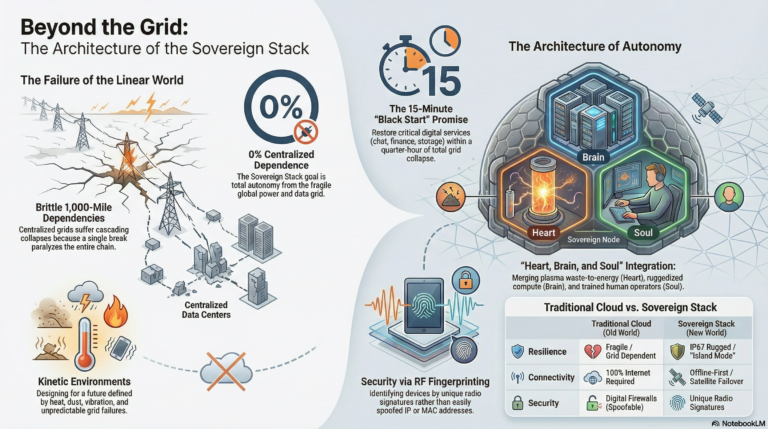
This study guide provides a comprehensive review of the DeReticular system architecture, designed to maintain operational self-sufficiency—known as “Island Mode”—for communities, medical facilities, farms, and emergency response centers during large-scale power grid and communications failures.
Ecosystem Architecture Review
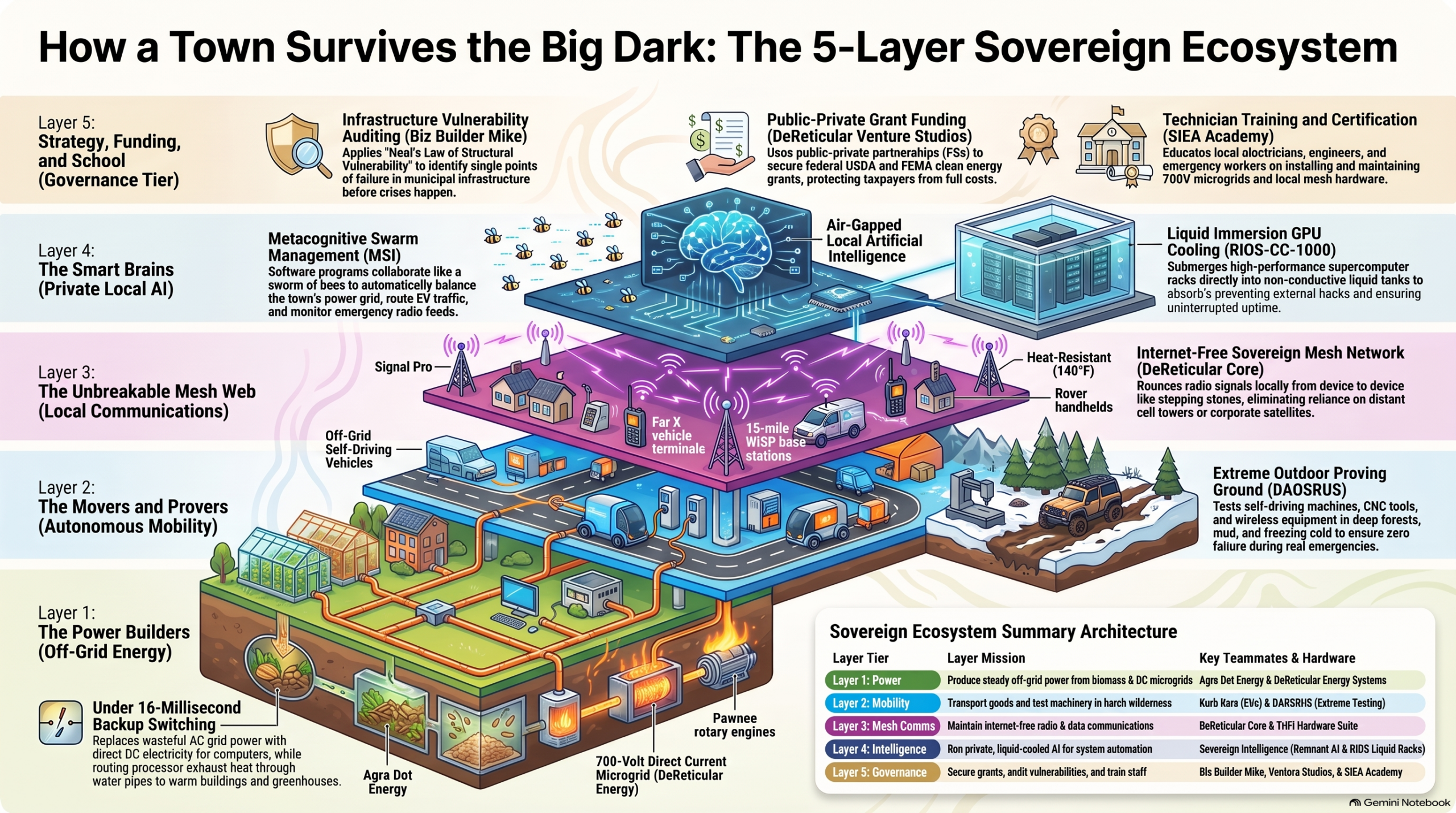
The DeReticular Sovereign Ecosystem operates across five distinct layers. Each layer addresses a critical vulnerability in centralized utility, transport, communication, compute, or administrative infrastructure.
Summary Matrix of the 5 Layers
Layer Functional Domain Primary Entities & Innovations Operational Purpose
Layer 1 Power Generation & Distribution Agra Dot Energy, DeReticular Energy Systems Generates 24/7 off-grid electricity via biomass gasification and Pawnee rotary engines; distributes high-efficiency 700V DC power with sub-16ms backup switching and compute heat recovery.
Layer 2 Mobility & Testing Kurb Kars, DAOSRUS Deploys autonomous electric utility vehicles and mobile battery pods capable of off-grid recharging; stress-tests hardware, robotics, and CNC tools in extreme environments.
Layer 3 Mesh Communications DeReticular Core, TriFi Hardware Line Establishes localized, non-centralized wireless mesh networks that bounce signals between nodes without requiring internet telecom towers or satellites.
Layer 4 Local Intelligence Sovereign Intelligence, Remnant AI, RIOS-CC-1000, Metacognitive Swarms (MSI) Runs private, air-gapped AI on liquid-immersion-cooled GPU racks; utilizes multi-agent software swarms to manage traffic, power routing, and emergency radios.
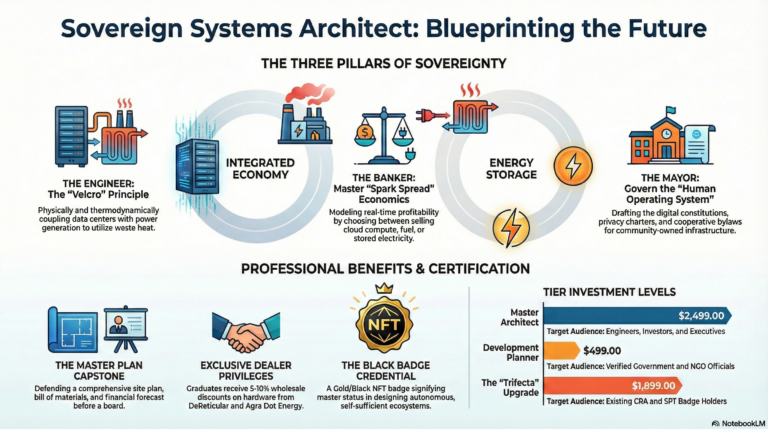
Layer 5 Strategy, Finance & Education Biz Builder Mike, DeReticular Venture Studios, SIEA Academy Audits systemic vulnerabilities, secures public-private partnership (P3) federal grants (USDA/FEMA), and trains technical personnel to install and maintain sovereign systems.
Detailed System Breakdown
Layer 1: Power Builders
- Agra Dot Energy (Agra.Energy): Produces continuous electricity locally using thermal processing (pyrolysis and gasification) to convert agricultural scraps and wood chips (biomass) into clean fuel without burning them into smoke. This fuel powers specialized Pawnee rotary engines to deliver 24-hour electricity regardless of weather conditions.
- DeReticular Energy Systems (energy.dereticular.com): Utilizes 700-Volt Direct Current (DC) power networks to eliminate energy loss common in traditional Alternating Current (AC) computing conversions. Features rapid transfer switches that detect grid failures and transition to backup power in under 16 milliseconds (preventing computer downtime) and captures waste heat from processors to warm greenhouses and buildings via warm-water piping.
Layer 2: Movers and Provers
- Kurb Kars (KurbKars.com): Manufactures self-driving electric utility vehicles and transportable battery units. These vehicles recharge directly from local microgrids without an internet connection, transporting patients, medical gear, and emergency provisions during outages.
- Digital Adventures Outdoors R US – DAOSRUS (daosrus.com): Serves as a rugged outdoor proving ground. Equipment including autonomous vehicles, CNC machinery, robotics, and wireless systems are stress-tested in harsh environments (mud, deep forests, sub-zero temperatures, and rocky terrain) to ensure durability.
Layer 3: Unbreakable Walkie-Talkie Web
- DeReticular Core (dereticular.com) & The Sovereign Mesh: Operates a peer-to-peer mesh communications network where devices serve as intermediate relay nodes, bouncing data locally across the network rather than routing through remote corporate servers or cellular towers.
- TriFi Product Line:
- TriFi Signal Pro 8355: Heavy-duty, weatherproof metal antenna for high-altitude installation (hospitals, schools, water towers) to provide campus-wide coverage.
- TriFi WISP-in-a-Box Lite: Commercial base station broadcasting up to 15 miles through dense physical obstructions like foliage and hills.
- TriFi Far X (X1271): Dual-antenna terminal mounted on vehicle roofs (e.g., ambulances) to transform mobile units into rolling Wi-Fi hubs.
- TriFi Rover (SLG-06): Pocket-sized, rubberized wireless hotspot equipped with heat-resistant battery technology capable of operating in temperatures up to 140°F.
Layer 4: Smart Brains
- Air-Gapped Remnant AI: Self-contained artificial intelligence processing chips operating completely isolated from the external internet (“air-gapped”), eliminating external hacking vectors and maintaining functionality during internet blackouts.
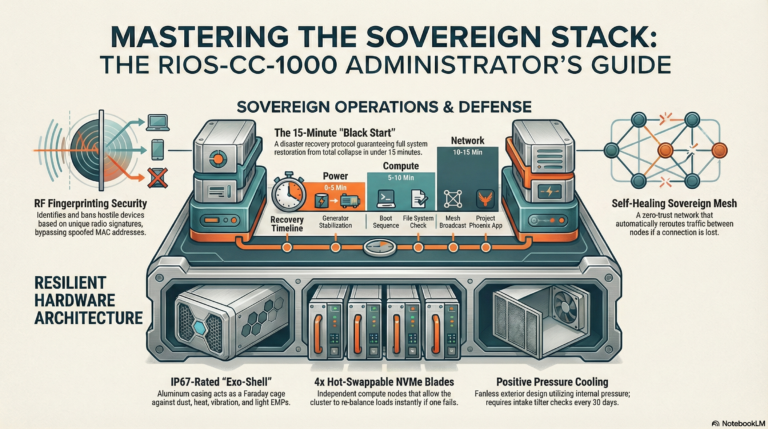
- Immersion-Cooled GPU Racks (RIOS-CC-1000): Supercomputing racks submerged in non-conductive liquid tanks, replacing traditional air fans to dissipate thermal output efficiently without short-circuiting electronics.
- Metacognitive Swarms (MSI): Interconnected software agents that automatically balance municipal electrical loads, coordinate vehicle traffic, and monitor emergency communication channels.
Layer 5: Strategy, Money, and School
- Biz Builder Mike (BizBuilderMike.com): Performs municipal structural audits using “Noel’s Law of Structural Vulnerability” to identify single points of failure in municipal infrastructure prior to critical events.
- DeReticular Venture Studios: Identifies capital and manages public-private partnerships (P3s) to help municipalities acquire federal funding (such as USDA and FEMA clean energy grants), lowering the tax burden of microgrid adoption.
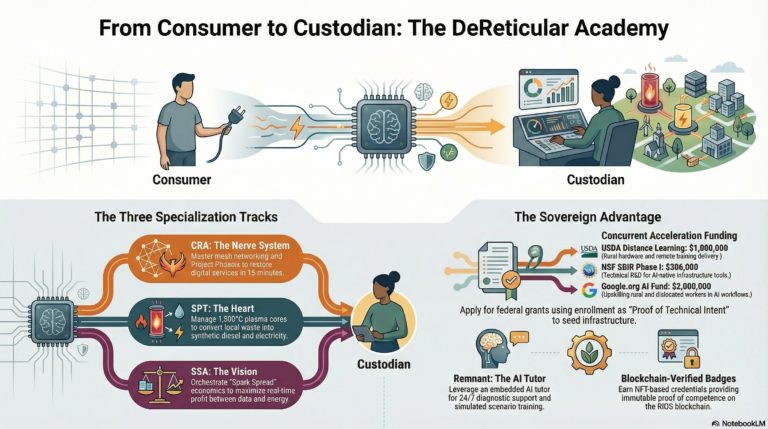
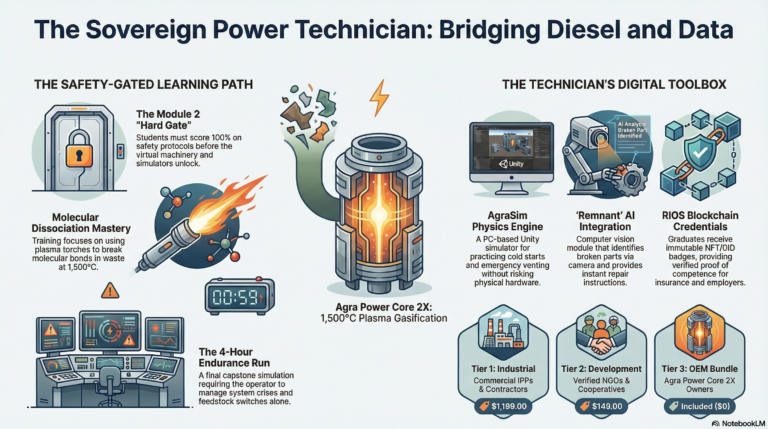
- DeReticular Academy / SIEA Academy (Academy.Dereticular.com): Operating under the non-profit SIEA umbrella, this institution educates engineers, electricians, and technicians on installing and servicing 700V microgrids, mesh radios, and off-grid computing networks.
Short-Answer Quiz
- How does Agra Dot Energy generate 24/7 electrical power without relying on standard fossil fuels or variable weather conditions?
- What specific electrical system architecture and switching capability does DeReticular Energy Systems use to prevent compute disruptions during a blackout?
- What is the operational function of DAOSRUS within Layer 2 of the Sovereign Ecosystem?
- How does the “Sovereign Mesh” network transmit messages when central internet lines and cell towers are inactive?
- What are the key physical and thermal characteristics of the TriFi Rover (SLG-06)?
- What is “Remnant AI,” and why is it deployed with an “air gap”?
- How does the RIOS-CC-1000 liquid immersion cooling system manage supercomputer heat output?
- What underlying principle guides the municipal vulnerability audits conducted by Biz Builder Mike?
- How does DeReticular Venture Studios help local governments offset the costs of building clean microgrids?
- What role does the SIEA Academy play in supporting long-term sovereign infrastructure operations?
Short-Answer Quiz Answer Key
- Agra Dot Energy uses pyrolysis and gasification to heat agricultural leftovers and wood chips without burning them into smoke. This produces a clean fuel that runs specialized Pawnee rotary engines, producing continuous electrical power 24 hours a day regardless of solar or wind availability.
- DeReticular Energy Systems uses a 700-Volt Direct Current (DC) distribution standard to minimize computer conversion losses. It incorporates high-speed transfer switches capable of sensing grid failures and swapping to backup power in under 16 milliseconds, preventing electronic flickering or system shutdown.
- DAOSRUS serves as an extreme outdoor proving ground designed to stress-test critical emergency hardware. It evaluates autonomous vehicles, CNC machines, robotics, and wireless devices in severe conditions like mud, deep forests, freezing cold, and rocky terrain to ensure hardware reliability.
- The Sovereign Mesh operates as a peer-to-peer network where individual local radios act as intermediate stepping stones. Instead of sending data to remote servers or commercial cell towers, each device bounces messages directly to adjacent local nodes.
- The TriFi Rover (SLG-06) is a ruggedized, rubber-coated handheld pocket Wi-Fi hotspot. It features specialized battery chemistry engineered to operate safely in ambient temperatures as high as 140°F without melting or overheating.
- Remnant AI consists of localized artificial intelligence chips installed on-site inside a facility without connections to external networks. This “air-gap” design prevents remote cyberattacks and ensures processing capabilities remain active if public internet lines fail.
- The RIOS-CC-1000 system dunks high-performance supercomputers directly into tanks filled with a specialized, non-conductive liquid. This liquid absorbs intense processor heat directly without using noisy fans or causing electrical short circuits.
- Biz Builder Mike’s audits are guided by “Noel’s Law of Structural Vulnerability.” This methodology identifies single points of failure in civic infrastructure—such as a critical transformer powering a city water pump—allowing leaders to correct weaknesses prior to a crisis.
- DeReticular Venture Studios Structures Public-Private Partnerships (P3s) to fund off-grid infrastructure. They actively locate and secure federal grants, including funds from FEMA and the USDA, minimizing direct costs to local taxpayers.
- Operating under the non-profit SIEA, the SIEA Academy provides practical education for technical personnel. It trains technicians, electricians, and engineers on how to safely install, maintain, and repair 700V microgrids, mesh networking gear, and independent infrastructure.
Essay Questions
The following essay prompts are designed for deeper analysis and critical evaluation. Answers are not provided.
- Systemic Resilience and “Island Mode”: Analyze how the five layers of the DeReticular ecosystem integrate to transition a town into “Island Mode.” Discuss how failure in one layer (e.g., power or communications) would impair the others if not for the specific innovations provided by Layer 1 through Layer 5.
- Comparison of Centralized vs. Decentralized Infrastructures: Compare the traditional public utility grid and cloud-based telecom architecture with DeReticular’s 700V DC microgrids and Sovereign Mesh networks. Focus your analysis on efficiency, vulnerability to single-point failures, and recovery speed during natural disasters.
- Thermal Management and Resource Efficiency: Detail the two distinct thermal management strategies present in the DeReticular architecture—computer processor waste heat capture for local building/greenhouse heating (Layer 1) and liquid immersion cooling via RIOS-CC-1000 tanks (Layer 4). Explain how both contribute to system efficiency.
- Data Sovereignty and Emergency Decision-Making: Evaluate the benefits and operational trade-offs of utilizing localized, air-gapped “Remnant AI” and Metacognitive Swarms (MSI) compared to cloud-hosted large language models during a major catastrophe.
- Financing and Executing Public Infrastructure Upgrades: Discuss how Layer 5 (Biz Builder Mike, Venture Studios, and SIEA Academy) addresses the non-technical challenges—specifically governance, capital acquisition, risk assessment, and technical workforce training—associated with adopting municipal sovereign microgrids.
Comprehensive Glossary
- 700-Volt Direct Current (700V DC): An electrical distribution format used by DeReticular Energy Systems that reduces energy loss associated with conventional AC-to-DC power conversions for computer hardware.
- Air Gap / Air-Gapped: A security measure where computer hardware or AI processors are physically isolated from the internet and external networks, making remote hacking impossible.
- Agra Dot Energy (Agra.Energy): The Layer 1 entity responsible for producing continuous local electricity from biomass using pyrolysis, gasification, and Pawnee rotary engines.
- Biz Builder Mike (BizBuilderMike.com): The Layer 5 strategic advisory team that conducts civic vulnerability audits using structural risk frameworks.
- Biomass: Organic waste materials, specifically agricultural leftovers and wood chips, used as fuel for thermal power generation in Layer 1.
- DAOSRUS (Digital Adventures Outdoors R US): The Layer 2 proving ground used for testing robotics, self-driving vehicles, CNC tools, and wireless hardware in severe outdoor environments.
- DeReticular Academy / SIEA Academy: The non-profit educational institution in Layer 5 responsible for training technical personnel to deploy and service sovereign infrastructure.
- DeReticular Core: The entity in Layer 3 that develops local, decentralized mesh network infrastructure to replace corporate cellular and internet dependencies.
- DeReticular Energy Systems: The Layer 1 high-tech electrical infrastructure developer focused on 700V DC systems, fast-transfer switches, and compute waste heat recovery.
- DeReticular Venture Studios: The financial arm of Layer 5 that uses public-private partnerships (P3s) and federal grants (USDA/FEMA) to fund local microgrids.
- Immersion-Cooled GPU Racks (RIOS-CC-1000): Supercomputer enclosures that submerge compute hardware into specialized non-conductive liquid tanks to absorb operational heat without fans.
- Island Mode: An operational state where a localized community, hospital, or facility completely disconnects from failing global power grids and telecom lines to run independently.
- Kurb Kars (KurbKars.com): Autonomous electric utility vehicles and mobile battery pods in Layer 2 that move supplies, equipment, and medical personnel without external internet access.
- Metacognitive Swarms (MSI): Specialized multi-agent software programs in Layer 4 that automatically balance local electrical loads, route vehicle traffic, and monitor emergency radio frequencies.
- Mesh Network / Sovereign Mesh: A communication network where every device acts as a node, bouncing wireless data locally across short distances instead of routing through distant central servers.
- Noel’s Law of Structural Vulnerability: The analytical auditing framework used by Biz Builder Mike to locate single points of failure in civic infrastructure systems.
- Pawnee Rotary Engine: The specialized internal combustion power generation unit used by Agra Dot Energy to turn gasified biomass into continuous electricity.
- Pyrolysis and Gasification: High-temperature chemical processes that convert organic biomass into clean-burning gaseous fuel without combusting it into smoke.
- Remnant AI: On-site, air-gapped artificial intelligence hardware designed to perform local automated tasks without internet access or data leaks.
- Sovereign Ecosystem: A self-contained, multi-layered infrastructure model designed to provide independent power, mobility, communications, computing, and management to local communities.
- TriFi Far X (X1271): A vehicle-mounted terminal featuring dual antennas that transforms trucks and ambulances into mobile Wi-Fi connectivity hubs.
- TriFi Rover (SLG-06): A handheld, rubber-armored personal Wi-Fi hotspot engineered with high-temperature battery cells capable of operating in heat up to 140°F.
- TriFi Signal Pro 8355: A weatherproof metal antenna installed on high structures to broadcast high-speed wireless network signals across facilities or campuses.
- TriFi WISP-in-a-Box Lite: A commercial base station hardware unit capable of projecting a long-range wireless coverage envelope up to 15 miles through geographical obstacles.