Comprehensive Study Guide: Sovereign Infrastructure, Layered De-Reticulation, and Autonomous Energy Architecture
Section 1: Detailed Review of Core Concepts
Module 1: Historical Antecedents & The Reticular Complex
The term Reticular Complex refers to the centralized, legacy infrastructure monopolies that exert control over enterprise and civic operations through physical connection points (“umbilicals”). Historically, this monopoly model was epitomized by AT&T’s telecommunications dominance, which claimed that third-party hardware would compromise national network integrity. This model was shattered by Jack Goeken and Bill McGowan’s microwave tower network along Route 66 and Judge Harold Greene’s 1982 consent decree.
However, as long-distance voice became low-cost data, gatekeeping shifted into three primary modern choke points:
- The Electric Utility: Characterized by aging high-voltage transmission lines operating near thermal capacity (e.g., regional lines operating at 87% thermal capacity), 5-to-7-year interconnection queues, 3-to-4-year transformer lead times, and volatile peak-demand ratchets.
- The Cloud Hyperscaler: Centralized data center farms that extract punitive egress fees, introduce latency, create single points of failure, and expose sensitive operational telemetry to snooping and remote de-platforming.
- The Telecom Oligopoly: Shared backbones vulnerable to physical breaks (e.g., backhoe snips) and over-subscription degradation during emergency loads.
Module 2: Theoretical Framework & Quantitative Vulnerability
Noel’s Law of Structural Vulnerability
The core theoretical framework governing de-reticulation is Noel’s Law of Structural Vulnerability:
\text{Vulnerability} \propto \frac{\text{Distance of Dependency} \times \text{Centralization Factor}}{\text{Local Autonomous Capacity}}
- Distance of Dependency: The physical or logical mileage between the site of operation and the resource origin (e.g., 1,000-mile high-voltage transmission corridors or distant cloud servers).
- Centralization Factor: The degree of control retained by external monopolistic gatekeepers.
- Local Autonomous Capacity: The on-premises capability to generate baseload energy, process local intelligence, and route communications without external dependencies.
Thermodynamic Efficiency vs. Centralized Failure Models
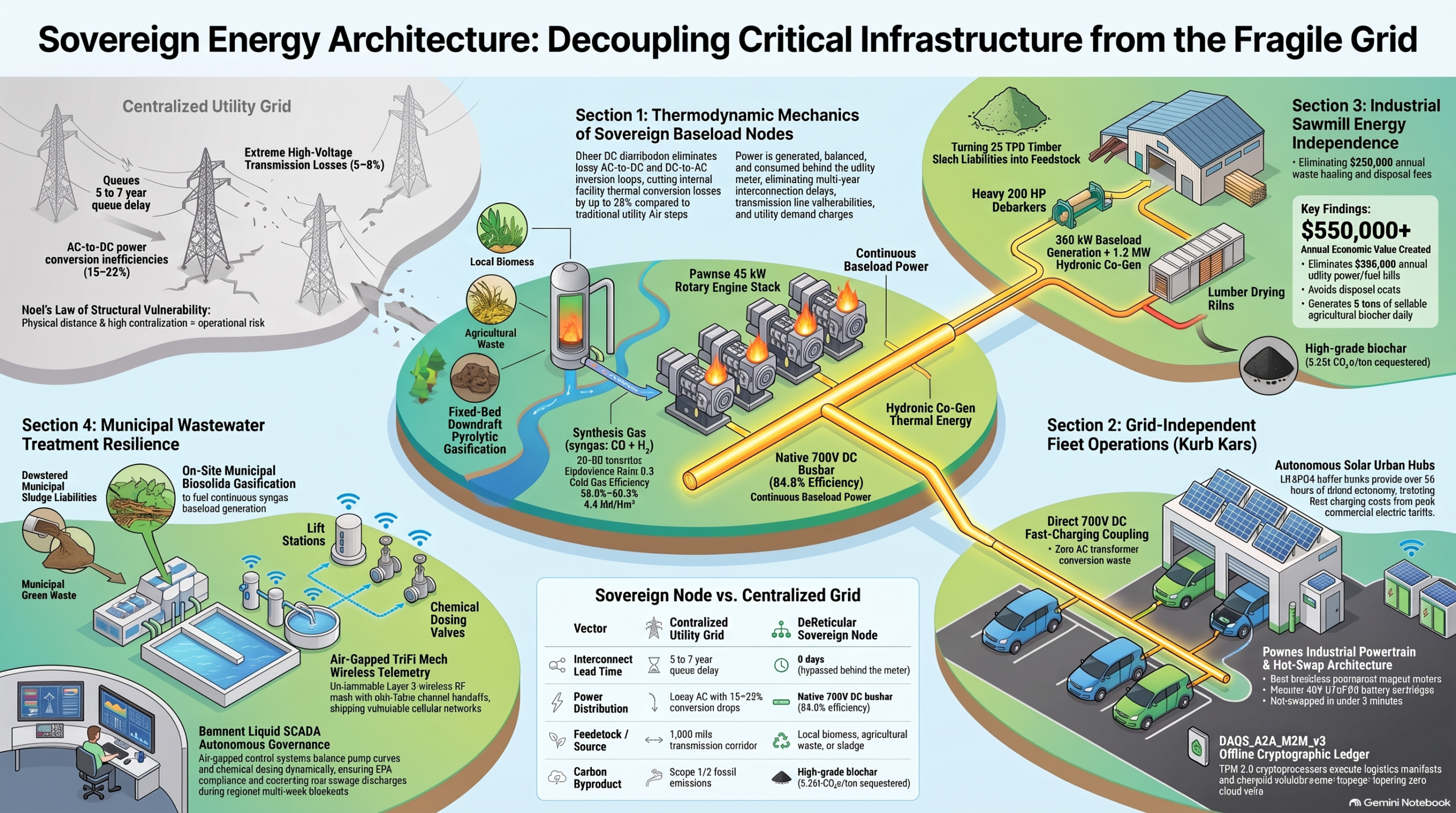
Traditional utility power distribution suffers from severe parasitic thermodynamic losses:
- High-Voltage Transmission Losses: 6% to 8% lost as thermal radiation across long-distance lines.
- Alternating Current (AC) / Direct Current (DC) Inversion Taxes: Continuous, lossy AC-to-DC and DC-to-AC conversions introduce 15% to 22% in thermal conversion losses across industrial motor drives, EV chargers, and computing servers.
Module 3: The Five-Layer Sovereign Infrastructure Architecture
+———————————————————————–+
| LAYER 4: REMNANT SILICON / AI |
| Metacognitive, Air-Gapped Intelligence • Zero Cloud Egress |
+———————————————————————–+
|
v
+———————————————————————–+
| LAYER 3: TRIFI WIRELESS MESH |
| Self-Healing RF Channel Handoff • Sub-16ms Synchronization |
+———————————————————————–+
|
v
+———————————————————————–+
| LAYER 2: KINETIC MOBILITY & NOMADIC EDGE |
| Kurb Kars • DAOS_A2A_M2M_v3 • Hot-Swap LiFePO4 • Pawnee Chassis |
+———————————————————————–+
|
v
+———————————————————————–+
| LAYER 1: BASELOAD POWER & THERMODYNAMICS |
| Pyrolytic Gasification • Pawnee Rotary Gen-Sets • 700V DC Busbar |
+———————————————————————–+
Layer 1: Sovereign Energy & Baseload Power
Unlike intermittent renewables (solar/wind) that require extensive battery storage or utility backup, sovereign Layer 1 infrastructure utilizes behind-the-meter thermochemical biomass gasification:
- Feedstock: Processes 20 to 30 tons per day (TPD) of agricultural residues, forestry slash, sawdust, or municipal biosolids.
- Pyrolytic Core: Fixed-bed downdraft reactor operating at an Equivalence Ratio (ER) of 0.3, achieving a cold gas efficiency of 58.0%–59.5% to produce synthesis gas (syngas: \text{CO} + \text{H}_2) rated at 4.4 MJ/Nm³.
- Pawnee 45 kW Rotary Engine: A low-vibration, internal-combustion rotary powertrain specifically designed to burn raw, low-BTU syngas directly without valve-fouling tar build-up.
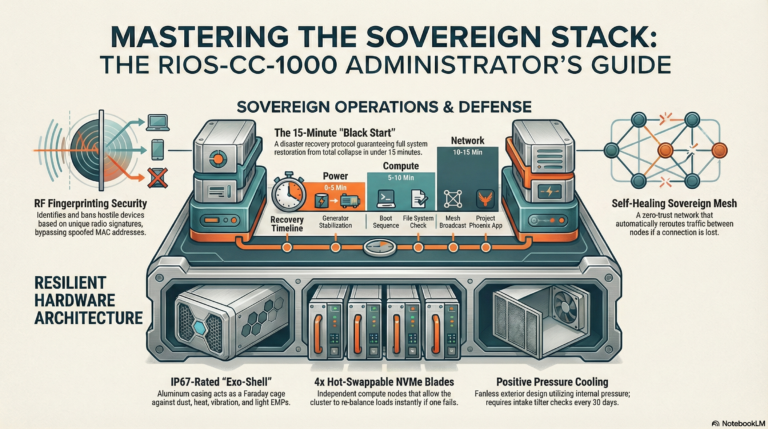
- Native 700V DC Busbar: Distributes energy natively at 84.8% efficiency, directly powering heavy industrial variable-speed drives, EV fast-chargers, and compute clusters while eliminating inverter losses.
- Byproducts: Yields high-grade biochar (sequestering 3.26 tons of \text{CO}_2 equivalent per ton of char) and pyroligneous acid (wood vinegar) for organic soil conditioning.
Layer 2: Autonomous Kinetic Mobility (Kurb Kars)
Rejects the “tethered EV” model dependent on 480V AC utility drops and remote cloud handshakes:
- 700V Direct Fast-Charging: Interfaces directly with Layer 1 DC busbars or Autonomous Solar Urban Hubs (which feature standalone solar canopies and 96+ hours of island autonomy).
- Hot-Swappable \text{LiFePO}_4 Cartridges: Allows 3-minute power cell swaps and includes integrated 120V/240V auxiliary pure-sine inverters to run field equipment.
- DAOS_A2A_M2M_v3 Protocol: An offline, peer-to-peer agent settlement ledger anchored by hardware TPM 2.0 cryptoprocessors for autonomous machine accounting without cloud access.
Layer 3: TriFi Wireless Mesh
An independent, un-jammable radio frequency (RF) mesh network delivering sub-16ms channel handoffs and control-loop telemetry over localized bubbles (e.g., 4.5+ miles via 30-foot pneumatic telescoping masts on TriFi Mast Rovers), completely bypassing public cellular towers and fiber backbones.
Layer 4: Remnant Silicon & Metacognitive Intelligence
An air-gapped, high-density metacognitive execution engine (e.g., RIOS-CC-1000 GPU racks running in direct DC-coupled liquid immersion tanks). Executes real-time infrastructure triage and autonomous governance locally with zero external telemetry or cloud callouts.
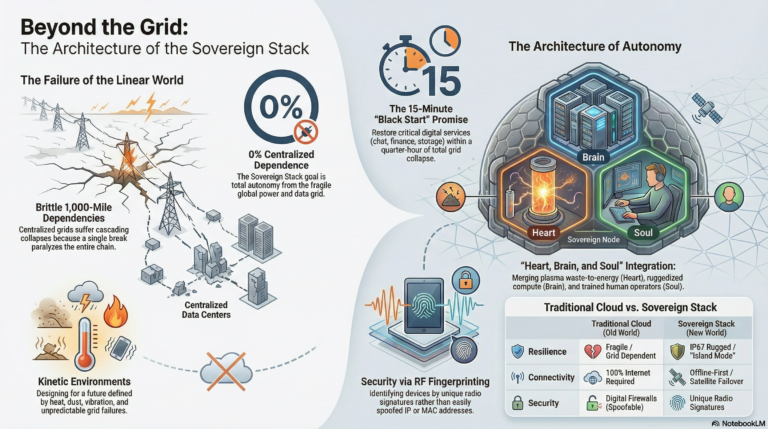
Module 4: System Architecture Comparison Matrix
Operational Vector The Reticular Complex (Monopoly Model) DeReticular Sovereign Node (Island Model)
Energy Source 1,000-mile centralized transmission grid On-premises thermochemical biomass gasification
Grid Interconnect 5-to-7-year administrative queue; high cost Bypassed; immediate deployment behind the meter
Power Distribution Lossy AC subject to sags, brownouts, and phase drops Native 700V DC busbar (84.8% efficiency; no inversion loss)
Network Backhaul Public telco fiber & cell towers; single-point physical risks TriFi Layer 3 Mesh (self-healing, sub-16ms RF handoff)
Intelligence Layer Centralized cloud APIs; high egress taxes, latency, snooping Air-gapped Remnant Silicon; local metacognitive execution
Vehicle Logistics Tethered EVs requiring grid drops and cloud authorizations Nomadic Kinetic Nodes; hot-swap \text{LiFePO}_4, 700V DC native charging
Disaster Posture Fragile dependence; backup generators fail in 48–72 hours Permanent Island Mode by default; indefinite autonomy
Module 5: Legal, Regulatory, and Financial Mechanisms
Statutory Microgrid Protection
- West Virginia Code §5B-2-21 (Certified Microgrid Districts): Creates a legal framework allowing designated commercial and industrial operators to establish autonomous, behind-the-meter microgrids. This statutory path bypasses public utility commission franchise monopolies, eliminates interconnection queue delays, and enables direct power offtake contracts.
Non-Dilutive Capital Stacking
Transitioning infrastructure to sovereign energy islands can be financed without diluting enterprise equity by stacking federal capital mechanisms:
- USDA REAP (Section 9007): Provides guaranteed loan financing up to 75% of eligible capital costs and direct grants up to 50% for rural clean energy projects.
- IRA Section 6417 Direct Pay: Delivers 30% to 50% elective pay cash reimbursements to municipal districts, cooperatives, and tax-exempt entities.
- FEMA BRIC (Building Resilient Infrastructure and Communities): Pre-disaster mitigation funding designed to subsidize microgrid islanding for community lifelines.
Section 2: Short-Answer Quiz
- What is Noel’s Law of Structural Vulnerability, and what primary factors increase an operational node’s risk?
- How does traditional alternating current (AC) distribution introduce thermodynamic losses in industrial facilities, and how does a native 700V DC bus solve this issue?
- What role did Jack Goeken, Bill McGowan, and Judge Harold Greene play in challenging legacy monopolistic infrastructure?
- What are the key chemical and thermal metrics of the Agra/DeReticular Layer 1 pyrolytic gasification process?
- Why are traditional internal combustion piston engines unsuitable for raw syngas, and how does the Pawnee rotary powertrain resolve this limitation?
- How does the TriFi Mast Rover establish local communication during disaster recovery scenarios when commercial networks fail?
- How does the Tactical NEMT Pod satisfy federal HIPAA requirements during patient transport?
- What is the function of the DAOS_A2A_M2M_v3 protocol within Layer 2 Kinetic Mobility platforms?
- How does West Virginia Code §5B-2-21 allow industrial operations to bypass utility monopolies?
- Which three federal funding frameworks can be combined to structure non-dilutive capital stacks for microgrid projects?
Section 3: Quiz Answer Key
- Noel’s Law of Structural Vulnerability states that \text{Vulnerability} \propto \frac{\text{Distance of Dependency} \times \text{Centralization Factor}}{\text{Local Autonomous Capacity}}. Operational risk increases as reliance on distant energy or data sources grows, and as external monopolies retain centralized control over those resources. Risk decreases when a facility expands its on-site generation, compute, and communication capabilities.
- Traditional AC distribution requires multi-stage AC-to-DC and DC-to-AC conversion steps for variable-frequency drives, batteries, and digital systems, causing 15% to 22% in thermal inversion losses. A native 700V DC busbar operates at 84.8% efficiency by delivering direct current straight to motors, battery storage, EV chargers, and GPU compute racks, eliminating inversion losses entirely.
- Goeken and McGowan built a microwave tower network along Route 66 to bypass AT&T’s monopolistic long-distance telephone lines, proving that centralized infrastructure could be bypassed. Judge Harold Greene issued the 1982 consent decree breaking up the Bell System monopoly, establishing legal precedent for open access and competitive infrastructure engineering.
- Layer 1 pyrolytic gasification processes 20 to 30 tons per day of dry biomass in a fixed-bed downdraft reactor with an Equivalence Ratio of 0.3 and a cold gas efficiency of 58.0%–59.5%. It generates low-BTU synthesis gas at 4.4 MJ/Nm³, while producing a biochar byproduct that sequesters 3.26 tons of \text{CO}_2 equivalent per ton of char.
- Traditional piston engines fail on raw syngas because tar condensates foul intake valves and combustion vibrations destroy engine seals over time. The Pawnee 45 kW rotary engine features a low-vibration, modular internal combustion architecture specifically engineered to combust raw, low-BTU syngas directly without requiring complex pre-scrubbing.
- The TriFi Mast Rover deploys a 30-foot pneumatic telescoping antenna mast to project an omnidirectional 4.5+ mile line-of-sight tactical RF mesh bubble. Operating with sub-16ms channel synchronization and hardware TPM 2.0 encryption, it provides real-time, low-latency command-and-control for handhelds and drone swarms without relying on cellular backhaul.
- The Tactical NEMT Pod incorporates an air-gapped on-board telemetry terminal that strictly complies with 45 CFR Part 160 and Part 164 standards. This hardware isolation ensures that patient identities, medical transit records, and real-time location data are protected from exposure to commercial tracking clouds and third-party networks.
- DAOS_A2A_M2M_v3 is an offline agent-to-agent machine settlement ledger governed by hardware TPM 2.0 cryptoprocessors. It enables vehicles to autonomously verify charging sessions, execute logistics manifests, and exchange operational telemetry over peer-to-peer radio without pinging commercial cloud servers.
- West Virginia Code §5B-2-21 permits qualifying commercial and industrial facilities to designate themselves as Certified Microgrid Districts. This legal classification authorizes operators to construct behind-the-meter microgrids, bypass utility commission monopoly jurisdiction, and avoid multi-year interconnection queues.
- Non-dilutive capital stacks can combine USDA REAP (Section 9007) guaranteed loans and grants, IRA Section 6417 Direct Pay cash reimbursements (30%–50%), and FEMA BRIC pre-disaster mitigation grants to finance microgrid deployments without giving up equity.
Section 4: Essay Questions (Unanswered)
- Synthesizing Thermodynamics and Telecommunications Sovereignty: Analyze how the historical monopoly tactics of AT&T mirror modern regional electric utilities and cloud hyperscalers. Discuss how de-reticulating energy distribution through a 700V DC native bus alters the economic power dynamics between industrial operators and utility gatekeepers.
- Critique of Noel’s Law in Critical Infrastructure Defense: Evaluate Noel’s Law of Structural Vulnerability across three distinct operational environments: a municipal wastewater district, an edge AI compute bunker, and a rural hospital. Explain how adjusting the variables of distance, centralization, and local capacity affects overall operational survival during an extended regional blackout.
- Thermodynamics of Pyrolytic Gasification and Ecological Circularity: Examine the technical and ecological feedback loops of Layer 1 biomass gasification within an agricultural cooperative or timber processing environment. Detail how raw feedstock liabilities are converted into electrical energy, process heat, biochar, and pyroligneous acid, and discuss the net impact on operational balance sheets.
- Architectural Evaluation of Nomadic vs. Tethered EV Logistics: Contrast the operational resilience of traditional commercial EV fleets reliant on utility grid drops with Kurb Kars nomadic kinetic architecture. Focus your analysis on charging architecture, data privacy under HIPAA/TPM 2.0, and dispatch capabilities during disaster response events.
- Regulatory and Financial Engineering for Autonomous Microgrids: Discuss how statutory provisions like West Virginia Code §5B-2-21 interact with federal funding options (USDA REAP, IRA Section 6417, FEMA BRIC) to enable rapid infrastructure deployment. Detail the legal and financial mechanisms an industrial facility must navigate to decouple from utility monopolies.
Section 5: Comprehensive Glossary
- 700V DC Native Busbar: A direct current electrical distribution architecture operating at 84.8% efficiency that bypasses alternating current (AC) inversion steps to directly power variable-speed motor drives, battery storage, EV chargers, and server racks.
- Air-Gapped Infrastructure: Operational hardware, compute racks, or data terminals that are physically and logically disconnected from public networks, cloud APIs, and commercial internet infrastructure to prevent cyber intrusion and remote service denial.
- Autonomous Solar Urban Hub: A standalone fleet-charging and energy storage installation featuring integrated solar canopies, high-capacity \text{LiFePO}_4 battery banks, and 700V DC distribution, capable of delivering 96+ hours of continuous island autonomy without grid interconnection.
- Biochar: A carbon-rich solid byproduct generated during high-temperature pyrolytic gasification. It sequesters 3.26 tons of \text{CO}_2 equivalent per ton produced and serves as an agricultural soil amendment that enhances water retention and soil health.
- Certified Microgrid District: A legal designation under statutes such as West Virginia Code §5B-2-21 that authorizes commercial and industrial operators to build autonomous, behind-the-meter microgrids exempt from public utility monopoly oversight.
- Cold Gas Efficiency: The ratio of the chemical energy content contained in generated synthesis gas (syngas) to the energy content of the solid biomass feedstock fed into a gasifier (achieving 58.0%–59.5% in Layer 1 pyrolytic cores).
- DAOS_A2A_M2M_v3: An offline cryptographic agent-to-agent and machine-to-machine settlement protocol anchored by hardware TPM 2.0 cryptoprocessors, enabling autonomous machine authorization and job settlement without corporate cloud connections.
- Egress Tax (Cloud): Punitive financial fees charged by centralized cloud hyperscalers (e.g., AWS, Azure) when an enterprise transfers its own data out of a cloud provider’s remote servers back to local facilities.
- Equivalence Ratio (ER): The ratio of actual oxygen supplied to a gasification reactor relative to the stoichometric oxygen required for complete combustion (maintained at 0.3 in Layer 1 pyrolytic reactors).
- Interconnection Queue: The administrative and engineering waitlist managed by regional transmission organizations (e.g., PJM, MISO, ERCOT) that prospective energy generators and high-load industrial consumers must clear before connecting to the public utility grid (currently averaging 5 to 7 years).
- Island Mode: The operational state where a facility, building, or sovereign node generates, balances, and consumes its power locally behind the meter, functioning independently of the central utility grid.
- Kurb Kars: Heavy-duty off-grid kinetic platforms, nomadic rovers, and medical transit pods designed as Layer 2 sovereign mobility nodes that operate without utility grid connections or corporate cloud tracking.
- Noel’s Law of Structural Vulnerability: A mathematical law asserting that operational vulnerability is directly proportional to the product of Distance of Dependency and Centralization Factor, divided by Local Autonomous Capacity.
- Pawnee 45 kW Rotary Engine: A modular, low-vibration internal combustion engine specifically designed with rotary geometry to combust raw, low-BTU synthesis gas directly without tar foul-up or mechanical failure.
- Pyroligneous Acid (Wood Vinegar): A liquid bio-condensate byproduct produced during biomass gasification, used in agricultural applications as an organic soil conditioner and natural bio-stimulant.
- Pyrolytic Gasification: A thermochemical conversion process that subjects organic material (biomass) to high temperatures in an oxygen-limited environment (0.3 ER) to break down complex polymers into synthesis gas (\text{CO} + \text{H}_2) and biochar.
- Remnant Silicon: An air-gapped, high-density metacognitive execution engine and AI architecture designed to execute localized governance, dynamic infrastructure management, and telemetry processing without sending data off-premises.
- Reticular Complex: The interconnected web of legacy centralized utility monopolies, cloud hyperscalers, and telecommunications providers that hold operational facilities captive through single-point infrastructure connections (“umbilicals”).
- Synthesis Gas (Syngas): A combustible gas mixture primarily composed of carbon monoxide (\text{CO}) and hydrogen (\text{H}_2), generated via biomass gasification with an energy density of approximately 4.4 MJ/Nm³, used to fuel power generators.
- Tactical NEMT Pod: A non-emergency medical transport vehicle equipped with an ADA-compliant hydraulic lift, an isolated medical-grade pure-sine power bus, and an air-gapped telemetry system complying with HIPAA standards (45 CFR Part 160/164).
- TriFi Layer 3 Mesh: A dynamic, self-healing wireless radio frequency mesh protocol that delivers low-latency (sub-16ms) telemetry and control-loop synchronization over localized operational nodes without external cellular or fiber infrastructure.
- TriFi Mast Rover: A mobile Layer 2 and Layer 3 kinetic platform equipped with a 30-foot pneumatic telescoping mast that establishes a 4.5+ mile tactical RF communication bubble in disaster zones or remote environments.