Durable Self-Correcting Synthetic Ecosystems: A Comprehensive Study Guide
This study guide is designed to synthesize the complex architectural, mathematical, and philosophical frameworks of Durable Self-Correcting Synthetic Ecosystems (DSSE), the Resilient Epistemic & Thermodynamic Ledger Architecture (RELA), and Metacognitive Swarms of Intelligences (MSI).
Part 1: Short-Answer Quiz
Instructions: Answer the following ten questions in two to three sentences, based strictly on the provided source context.
- What is the “1,000-Mile Failure Model” and how does it relate to DSSE?
- Explain the principle of “Via Negativa” (Topological Parameter Foreclosure).
- What is “Landauer’s Erasure Limit” and why is it a non-negotiable principle in DSSE?
- Describe the “Condorcet Inversion” and its effect on homogeneous AI swarms.
- What is the purpose of the “Oracle Separation Protocol”?
- Define “Metacognitive Swarms of Intelligences” (MSI) and identify how they differ from previous generations of distributed AI.
- What role does “Lean 4” play in the DSSE architecture?
- Explain the function of the “Biophysical Veto.”
- What is “Futarchy” in the context of DSSE macro-metacognitive governance?
- How does “Perspectival Realism” address the limitations of individual agent observations?
Part 2: Quiz Answer Key
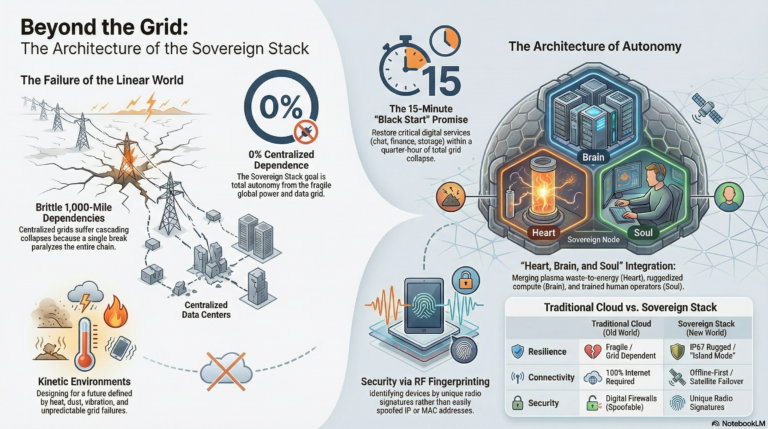
- What is the “1,000-Mile Failure Model” and how does it relate to DSSE? The 1,000-Mile Failure Model identifies the systemic fragility of modern systems that rely on hyper-centralized infrastructure and long-distance supply chains. DSSE addresses this by operating in “Sustained Island Mode,” utilizing on-premises, air-gapped silicon and local microgrids to maintain functionality independent of centralized cloud hyperscalers or global grid collapses.
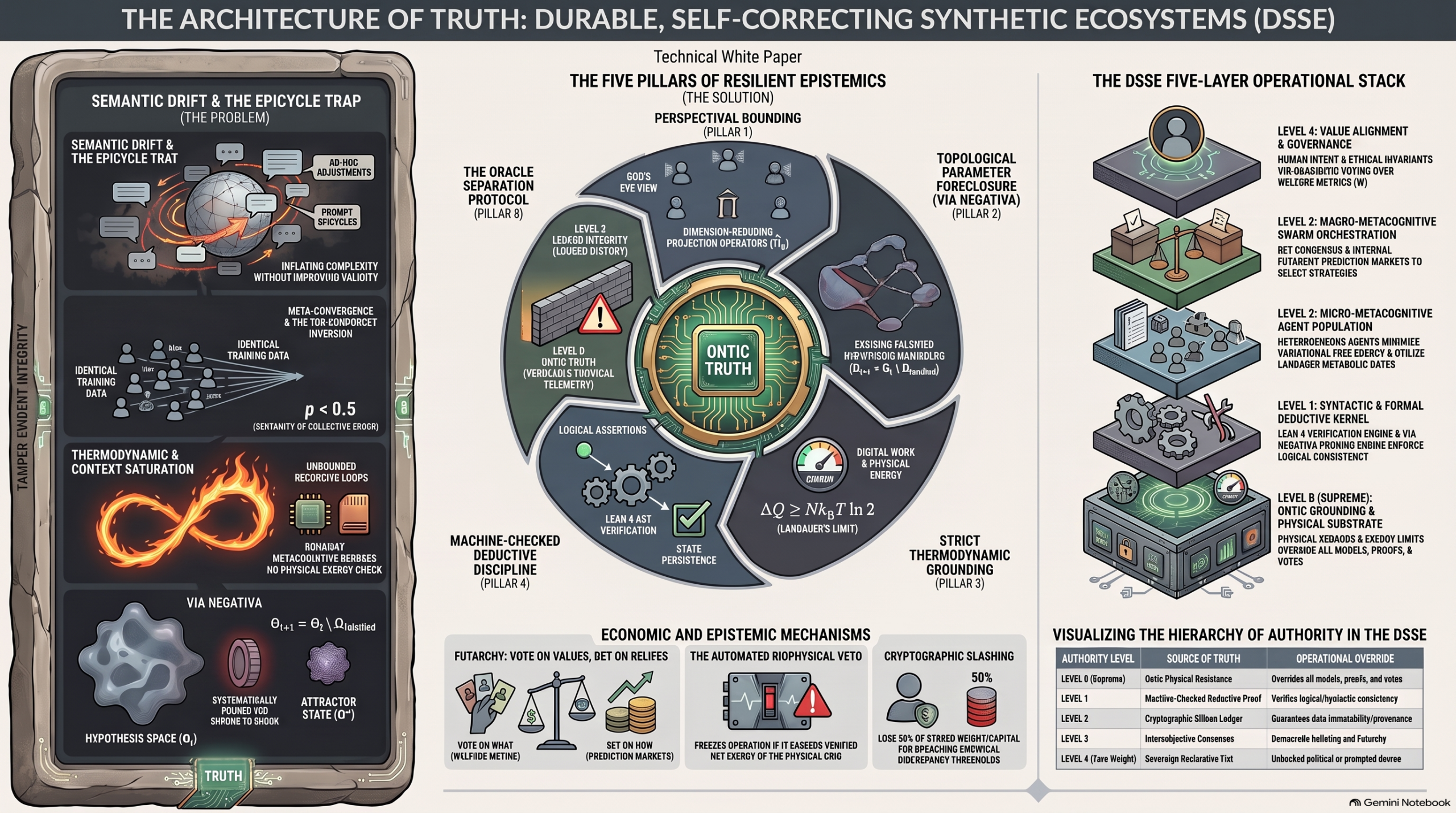
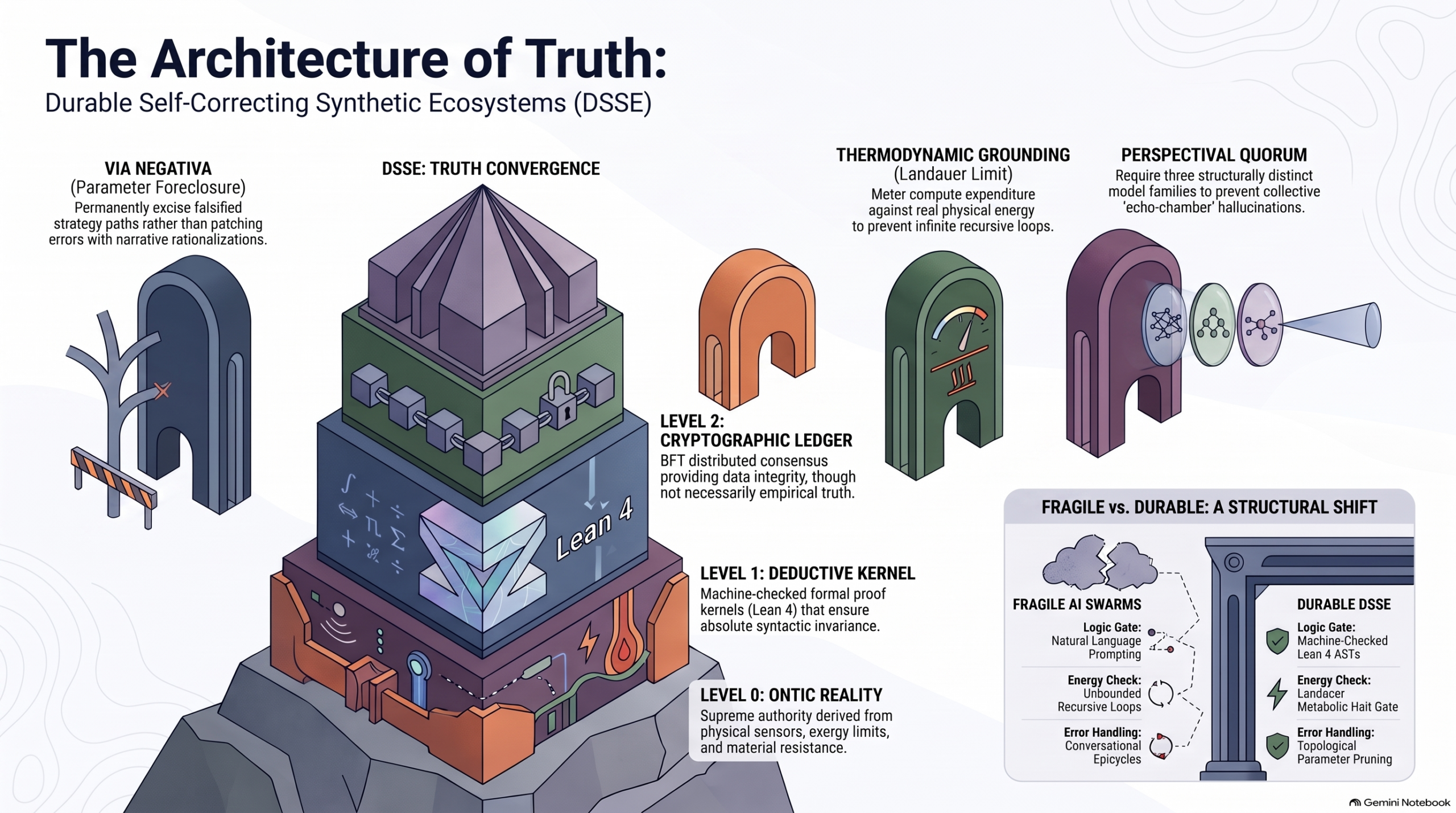
- Explain the principle of “Via Negativa” (Topological Parameter Foreclosure). Via Negativa is an error-elimination engine that advances the ecosystem by permanently excising falsified hypothesis manifolds rather than patching errors with ad-hoc adjustments. When a strategy breaches a pre-registered discrepancy threshold, that parameter sub-volume is irreversibly pruned to ensure the system monotonically contracts toward the truth.
- What is “Landauer’s Erasure Limit” and why is it a non-negotiable principle in DSSE? Landauer’s Limit (\Delta Q \ge N k_B T \ln 2) defines the minimum thermodynamic heat dissipated when erasing or overwriting bits of information. DSSE uses this to meter compute expenditure, ensuring that self-reflective loops are terminated if the expected information gain does not justify the physical energy cost, preventing infinite metacognitive regress.
- Describe the “Condorcet Inversion” and its effect on homogeneous AI swarms. The Condorcet Inversion occurs when agents sharing the same training data or prompts have correlated error profiles, driving their individual accuracy below chance (p < 0.5). In such cases, increasing the size of the swarm does not lead to truth but instead mathematically guarantees that the collective will converge on a hallucination or error.
- What is the purpose of the “Oracle Separation Protocol”? The protocol enforces an absolute boundary between Level 2 Cryptographic Ledger Integrity (guaranteeing only that a state transition was logged correctly) and Level 0 Ontic Physical Truth (verifiable only through sensor telemetry and external causal friction). It prevents the system from conflating internal consensus or record-keeping with actual correspondence to the physical world.
- Define “Metacognitive Swarms of Intelligences” (MSI) and identify how they differ from previous generations of distributed AI. MSI represents third-generation distributed AI characterized by recursive self-monitoring, uncertainty quantification, and dynamic role mutation. Unlike first-generation reactive swarms or second-generation agentic LLM chains, MSI nodes use micro- and macro-metacognition to adapt their own internal inference processes and the collective strategy of the swarm.
- What role does “Lean 4” play in the DSSE architecture? Lean 4 serves as a machine-checked deductive kernel that verifies all mathematical, logical, and code-level assertions before they are committed to the system state. By routing propositions through a formal proof checker, the architecture eliminates generative hallucinations and ensures that all transformations satisfy Tarskian soundness.
- Explain the function of the “Biophysical Veto.” The Biophysical Veto is an automated hardware circuit-breaker that freezes any proposal or workload requiring energy throughput that exceeds the verified net exergy of the local system. It binds symbolic claims—whether monetary or computational—to physical carrying capacity, preventing the “epicycle trap” of ungrounded expansion.
- What is “Futarchy” in the context of DSSE macro-metacognitive governance? Futarchy is a mechanism where human supervisors vote on normative values (welfare metrics), but autonomous agents bet on the beliefs (strategies) to achieve them via speculative prediction markets. Agents stake compute credits on proposed execution paths, and those who back failed strategies face cryptographic slashing of their capital and influence.
- How does “Perspectival Realism” address the limitations of individual agent observations? It treats agents as dimension-reducing projection operators (\hat{\Pi}_\theta) that provide veridical but incomplete views of reality. Truth is then modeled as a “Peircean Invariant Attractor,” which is the asymptotic core recovered across the intersection of multiple orthogonal, verified perspectives.
Part 3: Essay Questions for Further Study
- The Isomorphism of Delusion: Compare and contrast the “Epicycle Trap” in human macroeconomic systems (e.g., fiat debt and hyperinflation) with the “Hallucination Cascade” in Large Multi-Agent Systems. How does the DSSE architecture use thermodynamic grounding to prevent these failures?
- Ontic Grounding and the Oracle Principle: Analyze the necessity of separating cryptographic integrity from ontic truth. Why is a Byzantine Fault Tolerant (BFT) ledger insufficient on its own to guarantee that a synthetic ecosystem remains aligned with physical reality?
- The Ethics of Automated Governance: Discuss the implications of the “Bifurcated Constitutional Realm” which separates Class A (Normative Values) from Class B (Ontic Feasibility). What are the potential risks and benefits of making physical feasibility “closed to voting”?
- Island-Mode Cognition: Evaluate the “DeReticular Sovereign Stack” as a defensive architecture. How does the integration of baseload power, mesh communications, and air-gapped silicon create a more resilient form of intelligence than current cloud-tethered models?
- Veridical Convergence: Explain how the combination of “Via Negativa” parameter pruning and “Lean 4” formal verification leads to what the text calls the “asymptotic journey toward the objective world.” Use the A-Lab or AlphaProof case studies to support your analysis.
Part 4: Comprehensive Glossary of Key Terms
Term Definition
Active Inference A framework (based on the Free Energy Principle) where agents act to minimize variational free energy, balancing internal model complexity against empirical accuracy.
Asymptotic Democracy A formal constitutional architecture (RELA-TR-2026-V1) that decouples normative preference selection from physical feasibility constraints.
BFT (Byzantine Fault Tolerance) A consensus property (N \ge 3f + 1) that allows a distributed system to reach agreement even if some nodes are malicious or fail.
Biophysical Economics A school of economics that treats economic production as a physical process subject to mass-energy conservation and thermodynamic laws.
Brier Score A statistical metric used to measure the accuracy of probabilistic predictions; used in DSSE to calibrate agent reliability.
Cased Tablet Protocol A modernized version of an ancient Babylonian security method where an inner core (data) is wrapped in an outer envelope (zk-SNARK attestation) for tamper-evidence.
CUDOS Norms Robert K. Merton’s criteria for scientific integrity (Communalism, Universalism, Disinterestedness, Organized Skepticism) integrated into swarm consensus.
DePIN Decentralized Physical Infrastructure Networks; terrestrial sensor and hardware arrays that provide Level 0 ontic grounding to digital ledgers.
Epicycle Trap The failure mode where a system introduces auxiliary parameters or narrative rationalizations to hide a divergence between its model and reality.
EROEI Energy Return on Energy Invested; the ratio of energy delivered to the energy required to obtain that energy, acting as a physical ceiling on growth.
Exergy The portion of energy that can be converted into useful work; in DSSE, verified net exergy bounds all authorized computational or monetary issuance.
Island Mode A state of operation where infrastructure (power, comms, compute) functions entirely independently of centralized, external utilities or cloud services.
Kolmogorov Complexity A measure of the computational resources needed to specify an object; DSSE uses its minimum (MDL) to penalize overparameterized “epicycles.”
Ontic Manifold (\mathcal{M}) The objective, mind-independent state-space of reality, characterized by near-infinite dimensionality.
Percestant AI A term for AI (specifically “Remnant”) that is Perspectival (uses frames), Perceptual (sensor-grounded), and Persistent (Island-Mode capable).
Slashing A cryptographic mechanism design where a node’s staked capital or voting weight is automatically reduced as a penalty for failure or deception.
Variational Free Energy An information-theoretic bound on “surprise”; agents in a DSSE act to minimize this to maintain alignment with their environment.
zk-SNARK Zero-Knowledge Succinct Non-Interactive Argument of Knowledge; used to prove the validity of a transaction without revealing the underlying private data.