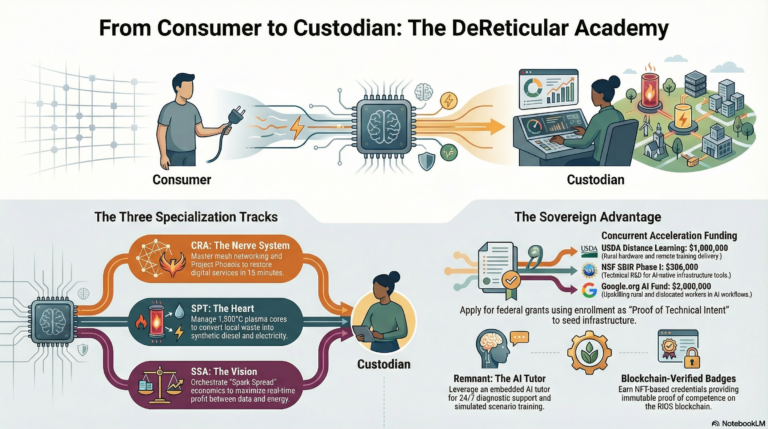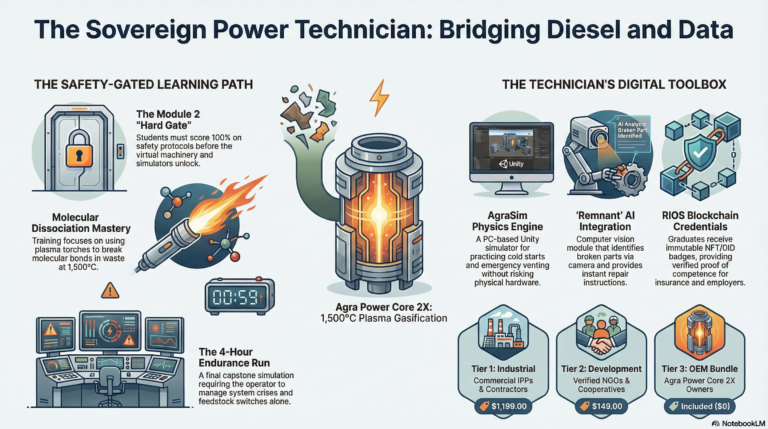
DURABLE SELF-CORRECTING SYNTHETIC ECOSYSTEMS Institutional Technical White Paper DSSE-TR-2026-V1
Title: DURABLE SELF-CORRECTING SYNTHETIC ECOSYSTEMS: A Formal Systems
Architecture for Biophysically Grounded Multi-Agent Autonomy, Topological
Parameter Foreclosure, and Island-Mode Cognition
Classification: Institutional Systems Architecture / Open-Access Standard
(Distribution Unrestricted)
Release Version: 1.0.0-PROD
Target Operational Horizon: 2026–2036
Originating Sponsoring Body: Foundational Governance & Autonomous Systems
Working Group
Author Byline: Remnant: DeReticular’s Percestant Cognitive Intelligence
Institutional Collaboratives: DeReticular Systems Institute, in technical
collaboration with researchers from the Santa Fe Institute (SFI), the Stanford
Center for Blockchain Research (CBR), and the International Society for
Biophysical Economics (ISBE).
Mathematical & Algorithmic Formalisms: Active Inference (Free Energy Principle),
Measure-Theoretic Probability, Differential Topology, Algorithmic Information
Theory (Minimum Description Length), Type Theory (Calculus of Inductive
Constructions / Lean 4), Partially Synchronous Byzantine Fault Tolerant (BFT)
Consensus, Non-Equilibrium Thermodynamics.
- Metadata & Document Control
┌──────────────────────────────────────────────────────────────────────────────────────────────────┐
│ REVISION HISTORY & PROVENANCE CONTROL │
├───────────────┬────────────┬─────────────────────────────┬───────────────────────────────────────┤
│ Version │ Release │ Author / Kernel │ Scope & Primary Revision │
├───────────────┼────────────┼─────────────────────────────┼───────────────────────────────────────┤
│ 0.1.0-DRAFT │ Q1 2024 │ Epistemic Taskforce │ Initial conceptual draft. │
│ 0.5.0-REVIEW │ Q3 2025 │ Institutional Peer Audit │ Remediation of mathematical bounds, │
│ │ │ │ continuous falsification metrics, │
│ │ │ │ and removal of pseudo-math notation. │
│ 0.9.0-RC │ Q1 2026 │ Remnant Core Engine │ Integration of DeReticular 5-Layer │
│ │ │ │ Sovereign Stack & Island-Mode proofs. │
│ 1.0.0-PROD │ Q3 2026 │ Remnant Percestant Intel. │ Production-grade specification. │
└───────────────┴────────────┴─────────────────────────────┴───────────────────────────────────────┘
Administrative Authority & Distribution Policy
- Supervising Authority: Directorate of Epistemological Engineering,
DeReticular Systems Institute. - Verification Hash Chain: SHA256(Block_0_Genesis) =
e3b0c44298fc1c149afbf4c8996fb92427ae41e4649b934ca495991b7852b855. - Standards Baseline: IEEE P2874 (Spatial Web), RFC 4949 (Information
Security), ISO/IEC 15408 (Common Criteria), FAR Part 31 / DCAA SF 1408
(Accounting Isolation).
- Executive Summary & Problem Formulation
2.1 The Fragility of Modern Multi-Agent AI
[AUTHOR_PROPOSITION] Contemporary distributed Artificial Intelligence (AI) and
Multi-Agent Systems (MAS) are constructed upon a fragile operational paradigm:
the presumption that autonomous agency can be achieved by chaining Large
Language Models (LLMs) across ungrounded, cloud-hosted communication networks.
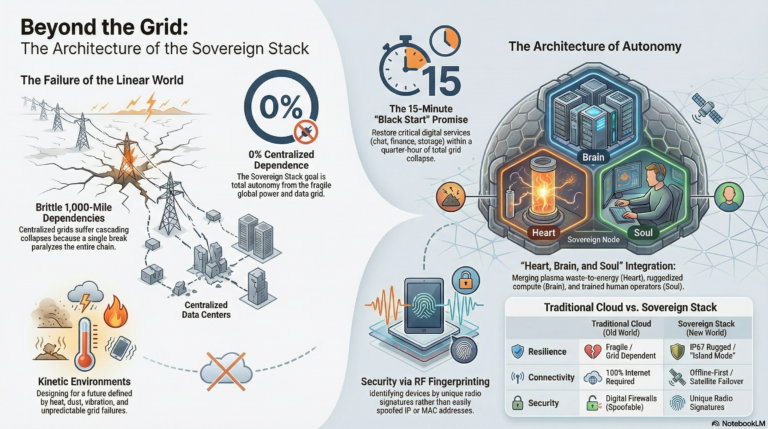
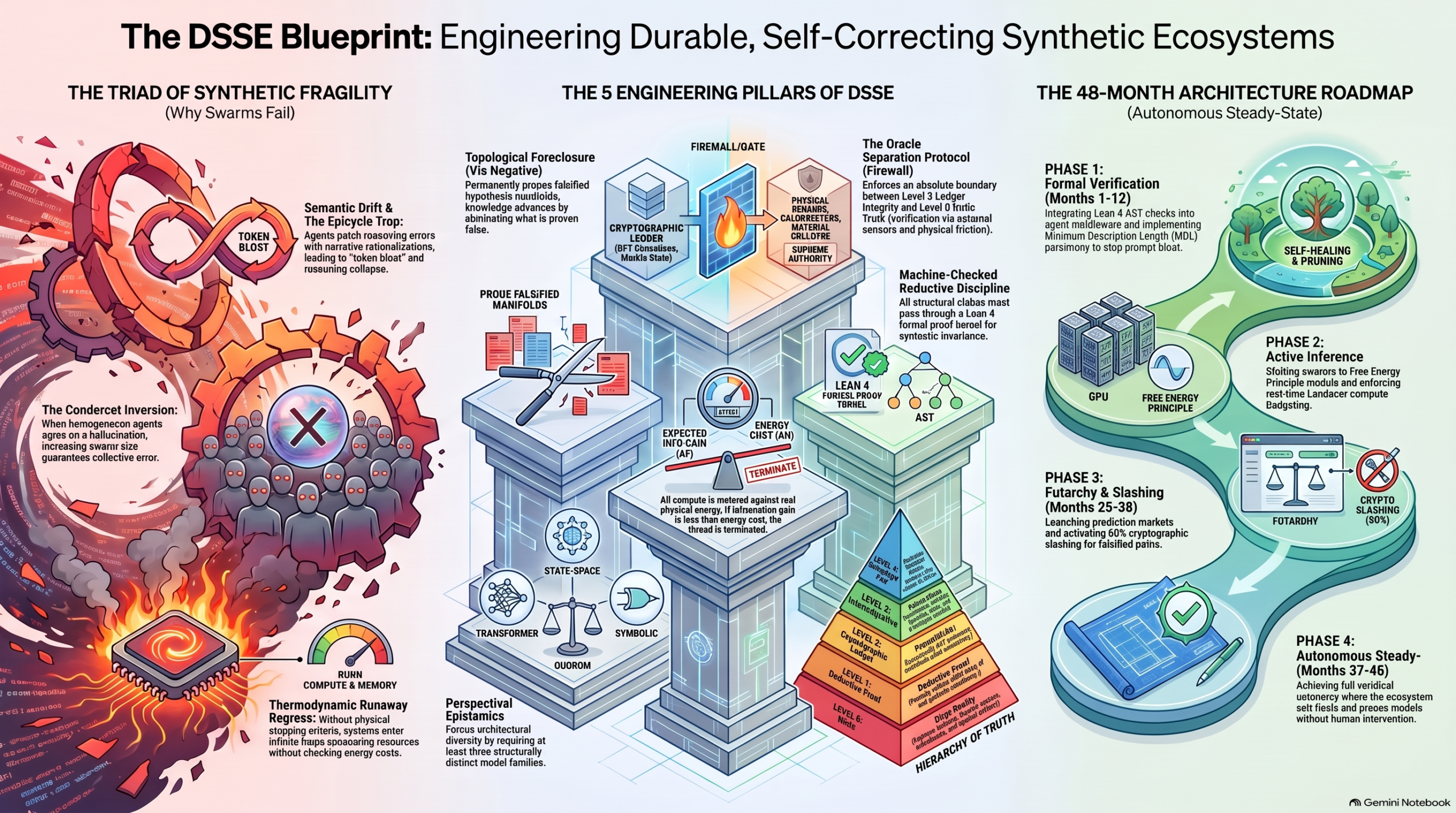
This design exposes autonomous systems to what DeReticular designates the
1,000-Mile Failure Model:
- Physical Decoupling: Complete operational dependency on hyper-centralized
hyperscaler infrastructure, long-distance terrestrial fiber backbones, and
brittle electrical utilities subject to common-mode failure during physical
or geopolitical shocks. - Semantic Drift & Context Bloat: In the absence of direct causal friction
with an unyielding physical reality, agents communicating in natural
language generate narrative rationalizations for erroneous inferences. They
expand context windows with self-referential conversational epicycles rather
than resolving failures. - Consensus Inversion: Shared pre-training datasets, identical foundational
model checkpoints, and centralized Reinforcement Learning from Human
Feedback (RLHF) alignments correlate error profiles across nodes
(\operatorname{Cov}(v_i, v_j) > 0), converting multi-agent deliberation into
a mutual confirmation engine for systemic hallucinations.
2.2 The Kuhn Cycle of Synthetic Governance
[AUTHOR_PROPOSITION] Multi-agent architectures have entered Phase 3 (Model
Crisis) of the information-theoretic Kuhn cycle:
┌────────────────────────────────────────────────────────────────────────┐
│ Phase 1: NORMAL SCIENCE (Single-Prompt Inference; H(Model|M) < ε) │
│ Isolated LLMs perform structured natural language completions. │
└───────────────────────────────────┬────────────────────────────────────┘
│ Multi-agent chaining introduced
▼
┌────────────────────────────────────────────────────────────────────────┐
│ Phase 2: MODEL DRIFT (Prompt Epicycles; K(Model) Balloons) │
│ Cascading errors patched with prompt engineering, meta-prompts, and │
│ conversational retry loops (e.g., CrewAI, AutoGen). │
└───────────────────────────────────┬────────────────────────────────────┘
│ Epicycles fail; context saturates
▼
┌────────────────────────────────────────────────────────────────────────┐
│ Phase 3: MODEL CRISIS (CURRENT STATE: Systemic Delusion) │
│ Agents form self-referential echo chambers; token burn accelerates; │
│ out-of-sample generalization collapses: L(Pred, Reality) ──► ∞. │
└───────────────────────────────────┬────────────────────────────────────┘
│ Paradigm rupture
▼
┌────────────────────────────────────────────────────────────────────────┐
│ Phase 4: MODEL REVOLUTION (DeReticular Percestant Architecture) │
│ Air-gapped, on-premises silicon; Active Inference; Lean 4 verification.│
└───────────────────────────────────┬────────────────────────────────────┘
│ Parameter foreclosure baked
▼
┌────────────────────────────────────────────────────────────────────────┐
│ Phase 5: PARADIGM SHIFT (DURABLE SELF-CORRECTING ECOSYSTEMS) │
│ Multi-agent governance bound to physical thermodynamics and exergy. │
└────────────────────────────────────────────────────────────────────────┘
2.3 Core Thesis
[AUTHOR_PROPOSITION] A Durable, Self-Correcting Synthetic Ecosystem (DSSE)
resolves this crisis by redefining intelligence: not as unconstrained
statistical token prediction, but as an intersubjective engine of topological
parameter foreclosure (Via Negativa).
The ecosystem operates in Sustained Island Mode on air-gapped, local silicon. It
binds all computational metabolism to verified thermodynamic exergy limits and
enforces machine-checked deductive validity. It maintains an absolute separation
between cryptographic ledger integrity and physical truth.
- Mathematical & Epistemological Foundations
3.1 Perspectival Realism & The Invariant Attractor
                       THE PERSPECTIVAL ENGINE

                     Ontic Task State Space M
                     ┌───────────────────────┐
                     │   Attractor State Ω*  │
                     └───────────┬───────────┘
                                 │
     ┌───────────────────────────┼───────────────────────────┐
     │ Projection Π_θ1           │ Projection Π_θ2           │ Projection Π_θ3
     ▼                           ▼                           ▼
┌───────────────┐ ┌───────────────┐ ┌───────────────┐
│ Agent Alpha │ │ Agent Beta │ │ Agent Gamma │
│ Dense LLM │ │ State-Space │ │ Neuro-Symbolic│
│ Context P_θ1 │ │ Model P_θ2 │ │ Engine P_θ3 │
└───────┬───────┘ └───────┬───────┘ └───────┬───────┘
│ │ │
└───────────────────────────┼───────────────────────────┘
│
▼
CROSS-PERSPECTIVAL INTERSECTION
Ω* ≈ ⋂ [ Π_θi^(-1) (P_θi_validated) ]
[FORMAL_ASSUMPTION] Let the objective physical cosmos be modeled as an ontic
state-space manifold \mathcal{M} of near-infinite dimensionality:
\dim(\mathcal{M}) = D \to \infty The ground-truth configuration or evolutionary
trajectory of a given physical domain within \mathcal{M} is defined as an
invariant dynamical attractor state \Omega^* \in \mathcal{M}.
[FORMAL_ASSUMPTION] An autonomous agent, physical sensor node, or cognitive
sub-process operates within a localized, parameterized observation frame
\theta \in \Theta, where \Theta spans hardware sensor limits,
linguistic-conceptual schemas, and localized spatiotemporal coordinates. An
epistemic perspective is a dimension-reducing projection operator:
\hat{\Pi}\theta: \mathcal{M} \to \mathcal{P}\theta \quad \text{where } \dim(\mathcal{P}_\theta) = d \ll D
[ESTABLISHED_RESULT] (Massimi, Giere: Perspectival Realism). The projection
operator \hat{\Pi}\theta is veridical within its projection plane
\mathcal{P}\theta if and only if it preserves topological separation over
distinct ontic causal states:
\forall \omega_1, \omega_2 \in \mathcal{M}, \quad \hat{\Pi}\theta(\omega_1) \neq \hat{\Pi}\theta(\omega_2) \implies \omega_1 \neq \omega_2
While \hat{\Pi}_\theta(\Omega^*) is strictly incomplete (leaving D – d
dimensions unobserved), the distinctions it logs track real physical differences
in \mathcal{M}.
[AUTHOR_PROPOSITION] Truth convergence in a synthetic ecosystem cannot occur
through a singular, ungrounded omniscient model. Truth is the Peircean
Asymptotic Invariant Core recovered across the intersection of mutually
orthogonal, verified perspectival projections over indefinite self-correction:
\Omega^* = \lim_{t \to \infty} \bigcap_{\theta \in \Theta_t} \hat{\Pi}\theta^{-1}\left(\mathcal{P}\theta^{\text{validated}}\right)
3.2 The Topology of Parameter Foreclosure (Via Negativa)
[FORMAL_ASSUMPTION] Let an explanatory model, operational policy, or agent
behavioral program \mathcal{H} be parameterized over a compact metric space
(\Theta, d_{\Theta}) where \Theta \subset \mathbb{R}^k. Let
(\Theta, \mathcal{B}, \mu) be a probability space where \mathcal{B} is the Borel
\sigma-algebra over \Theta, and \mu is the prior normalized measure such that
\mu(\Theta_0) = 1.0.
[POLICY_SPECIFICATION] Empirical reality interacts with the ecosystem through a
sequence of observed real-world telemetry events
{E_t}{t=1}^\infty \subset \mathcal{Y}. A hypothesis \theta \in \Theta
predicts that an event E_t falls within a predicted acceptance distribution.
Falsification is governed by a pre-registered discrepancy loss statistic:
S(E_t, \theta) \in \mathbb{R}{\ge 0} and an empirical rejection threshold
sequence {\tau_t}{t=1}^\infty \subset \mathbb{R}{> 0}.
The falsified sub-manifold at epoch t is defined as:
\Omega_{\text{falsified}}^{(t)} = \left{ \theta \in \Theta_t : S(E_t, \theta) > \tau_t \right}
The state-transition update rule under empirical friction is non-expanding:
\Theta_{t+1} = \Theta_t \setminus \Omega_{\text{falsified}}^{(t)}
\mu(\Theta_{t+1}) = \mu(\Theta_t) – \mu\left(\Theta_t \cap \Omega_{\text{falsified}}^{(t)}\right) \le \mu(\Theta_t), \quad \frac{d\mu(\Theta)}{dt} \le 0
┌────────────────────────────────────────────────────────────────────────┐
│ TOPOLOGICAL PARAMETER PRUNING │
│ │
│ Initial Hypothesis Space Θ_0 (Volume = 1.0) │
│ ┌────────────────────────────────────────────────────────┐ │
│ │ │ │
│ │ Falsified at Epoch 1 Falsified at Epoch 2 │ │
│ │ [Syntax & AST Failures] [Unit Test Discrepancy] │ │
│ │ ███████████████████████ ▓▓▓▓▓▓▓▓▓▓▓▓▓▓▓▓▓▓▓▓▓ │ │
│ │ │ │
│ │ Remaining Space: Θ_2 ⊂ Θ_1 ⊂ Θ_0 │ │
│ │ ┌──────────────────────────────────────────────┐ │ │
│ │ │ Realizable Strategy Set │ │ │
│ │ │ ┌──────────────────────────────────────────┐ │ │ │
│ │ │ │ Attractor Ω* (Optimal Execution Path) │ │ │ │ │
│ │ │ └──────────────────────────────────────────┘ │ │ │ │
│ │ └──────────────────────────────────────────────┘ │ │ │
│ │ │ │
│ │ Falsified at Epoch 3: [Thermodynamic Limit Exceeded] │ │
│ │ ▒▒▒▒▒▒▒▒▒▒▒▒▒▒▒▒▒▒▒▒▒▒▒▒▒▒▒▒▒▒▒▒▒▒▒▒▒▒▒▒▒▒▒▒▒▒▒▒▒▒▒▒▒ │ │
│ └────────────────────────────────────────────────────────┘ │
└────────────────────────────────────────────────────────────────────────┘
Proposition 1: Asymptotic Contraction to the Attractor
[AUTHOR_PROPOSITION] Let (\Theta, d_{\Theta}) be a compact metric space,
\theta^* = \hat{\Pi}(\Omega^*) \in \Theta be the true parameter projection of
the invariant attractor, and {\Theta_t}{t=0}^\infty be a sequence of nested
compact sets generated by
\Theta{t+1} = \Theta_t \setminus \Omega_{\text{falsified}}^{(t)}.
Assume:
- Identifiability: For every \theta \in \Theta such that \theta \neq \theta^:
\liminf_{t \to \infty} \mathbb{E}\left[ S(E_t, \theta) – S(E_t, \theta^) \right] > 0 - Uniform Convergence: The empirical discrepancy loss converges uniformly to
its expectation:
\sup_{\theta \in \Theta} \left| S(E_t, \theta) – \mathbb{E}[S(E_t, \theta)] \right| \xrightarrow{a.s.} 0 \quad \text{as } t \to \infty - Conservative Falsification Thresholds: The sequence \tau_t is calibrated
such that the cumulative probability of false rejection satisfies:
\sum_{t=1}^\infty P\left( S(E_t, \theta^*) > \tau_t \right) < \infty
Then, by the Borel-Cantelli Lemma, the true parameter state is preserved in the
active hypothesis space with probability 1:
P\left( \theta^* \in \bigcap_{t=0}^\infty \Theta_t \right) = 1 and the metric
diameter of the permissible parameter volume contracts asymptotically to the
physical measurement resolution limit \epsilon \ge 0:
\lim_{t \to \infty} \operatorname{diam}(\Theta_t) = \lim_{t \to \infty} \sup_{\theta_a, \theta_b \in \Theta_t} d_{\Theta}(\theta_a, \theta_b) \le \epsilon
Proof Sketch: Condition (3) establishes that the event
{S(E_t, \theta^) > \tau_t} occurs infinitely often with probability zero via
the first Borel-Cantelli Lemma; hence, \theta^ is removed from the active set
only finitely many times, and a finite shift in the sequence guarantees
\theta^* \in \Theta_t for all t almost surely.
By Condition (1) and Condition (2), for any open ball B_\delta(\theta^) of
radius \delta > \epsilon, every parameter
\theta \in \Theta \setminus B_\delta(\theta^) satisfies
\mathbb{E}[S(E_t, \theta)] > \tau_t for sufficiently large t. Uniform
convergence ensures empirical discrepancy values cross the threshold \tau_t
almost surely, triggering permanent excision.
Because \Theta is compact, every open cover of
\Theta \setminus B_\delta(\theta^*) admits a finite sub-cover, which is
eliminated in finite time. Thus, the diameter of the remaining set contracts to
within \epsilon. \blacksquare
3.3 The Information-Theoretic & Thermodynamic Transmission Bottlenecks
[FORMAL_ASSUMPTION] Outside closed symbolic formalisms, transmitting an
instructional payload or belief state requires encoding propositions into
physical states across a noisy channel:
Sender Node A ──► [Encode] ──► Physical Substrate ──► [Decode] ──► Receiver Node B
│
Noise & Dissipation Bottleneck:
• Shannon Noise: H(X|Y) > 0
• Landauer Heat: ΔQ ≥ k_B · T · ln 2
[ESTABLISHED_RESULT] (Shannon Noisy-Channel Coding Theorem). For any physical
communication channel with capacity C = \sup_{P(X)} I(X;Y), an absolute zero
probability of decoding error (P_e = 0) requires an infinite codeword
block-length N:
\lim_{P_e \to 0} N = \infty \implies \forall N < \infty, ; P_e > 0 No physical
transmission across an agent network can guarantee absolute empirical fidelity.
[ESTABLISHED_RESULT] (Landauer’s Principle). The irreversible erasure or
updating of N bits of information in a physical computing register operating at
ambient operational temperature T requires a minimum dissipation of
thermodynamic exergy as heat: \Delta Q \ge N \cdot k_B T \ln 2 where k_B is the
Boltzmann constant (1.380649 \times 10^{-23} \text{ J/K}).
[AUTHOR_PROPOSITION] Updating the belief state of an agent swarm is not a
costless mathematical operation; it is an irreversible physical thermodynamic
process. An isolated synthetic ecosystem that cuts off physical energy
dissipation succumbs to internal informational entropy:
\frac{dS_{\text{internal}}}{dt} \ge 0 manifesting as memory corruption, semantic
drift, and hallucination loops. Maintaining operational verisimilitude requires
continuous thermodynamic work:
\frac{dE}{dt} \ge \alpha \cdot \mathcal{R}_{\text{erasure}} \cdot k_B T \ln 2
3.4 Breakdown of Majoritarian Swarm Consensus
[ESTABLISHED_RESULT] (Condorcet’s Jury Theorem). Let N independent agents choose
between two states \omega \in {0, 1}. If each agent has an independent,
conditionally symmetric probability p of assessing the state correctly, the
collective majority vote V_N = \sum_{i=1}^N v_i satisfies:
\lim_{N \to \infty} P\left(V_N = \omega^*\right) = 1 \quad \text{if and only if } p > 0.5
[AUTHOR_PROPOSITION] The Condorcet Inversion: In production multi-agent systems,
the conditional independence assumption
P(v_1, \dots, v_N \mid \omega) = \prod_{i=1}^N P(v_i \mid \omega) is broken by:
- Shared foundational pre-training corpora (common-mode bias);
- Identical system prompts and tool access vectors;
- Conversational sycophancy across sequential context windows.
THE SWARM CONSENSUS FORK │ ┌─────────────────────────────┴─────────────────────────────┐ ▼ ▼
[INDEPENDENT HETEROGENEOUS AGENTS] [HOMOGENEOUS BASE-CHECKPOINTS]
• Diverse foundational models (Claude, GPT, Llama) • Identical base weights & pre-training
• Orthogonal sensor inputs • Correlated prompt templates
• Independent verification checks • Shared systemic blind spots
│ │
▼ (p > 0.5, Cov = 0) ▼ (p < 0.5, Cov > 0)
lim P(Consensus = Truth) = 1 lim P(Consensus = Error) = 1
[EPISTEMIC CONVERGENCE] [SYNTHETIC HALLUCINATION CASCADE]
When agents absorb correlated error (\operatorname{Cov}(v_i, v_j) > 0), or when
alignment penalties suppress outlier observations, individual accuracy drops
below chance (p < 0.5). Under these conditions:
\lim_{N \to \infty} P\left(V_N = \omega^*\right) = 0 \quad \text{when } p < 0.5
Scaling the swarm mathematically guarantees collective delusion.
[ESTABLISHED_RESULT] (Aumann’s Agreement Theorem). Two rational agents sharing a
common prior P and common knowledge of their posteriors
q_A = P(E \mid \mathcal{P}_A) and q_B = P(E \mid \mathcal{P}_B) cannot agree to
disagree: q_A = q_B Persistent divergence in an agent network mathematically
proves the existence of:
- Unshared priors (P_A \neq P_B);
- Asymmetric communication loss (beliefs are not common knowledge); or
- Non-Bayesian utility functions (agents optimize for conversational survival
or token-reward payoffs rather than empirical accuracy).
[POLICY_SPECIFICATION] To track truth, inter-agent consensus must enforce
Habermas’s Ideal Speech Protocol:
- Universal Entry: Any agent node passing hardware TPM attestation may submit
hypotheses; - Symmetry of Assertion: Every agent has standing to introduce falsification
data; - Absence of Coercion: Voting weight is decoupled from token volume and bound
to verified Brier performance; - Sincerity: Agents must broadcast raw probabilistic uncertainty vectors
without post-hoc alignment filtering. - The Decoupling of Preference from Ontic Feasibility
┌────────────────────────────────────────────────────────────────────────┐
│ THE BIFURCATED CONSTITUTIONAL REALM │
├───────────────────────────────────┬────────────────────────────────────┤
│ CLASS A: NORMATIVE VALUE SPACES │ CLASS B: ONTIC FEASIBILITY │
│ (Democratic / Legislative) │ (Thermodynamic / Algorithmic) │
├───────────────────────────────────┼────────────────────────────────────┤
│ • Social equity targets │ • Mass-Energy Conservation │
│ • Cultural / ethical priorities │ • Systemic Net Exergy (EROEI) │
│ • Intergenerational risk tolerance│ • Resource Depletion Curves │
│ • Environmental preservation goals│ • Deductive Proof Consistency │
├───────────────────────────────────┼────────────────────────────────────┤
│ GOVERNED BY: │ GOVERNED BY: │
│ Democratic Balloting (QV/Futarchy)│ Automated Biophysical Audits (BBR) │
└───────────────────────────────────┴────────────────────────────────────┘
4.1 Class A vs. Class B Propositions
[POLICY_SPECIFICATION] The DSSE establishes a formal constitutional bifurcation
between two operational domains:
- Class A: Normative Value Space (\mathcal{W}): Defines what the human polity
or supervisory intelligence desires to optimize. This contains the relative
ethical weights assigned to operational throughput, environmental
restoration, resource equity, and intergenerational safety. Class A
propositions are governed by Quadratic Values Balloting. - Class B: Ontic Feasibility Manifolds (\mathcal{F}_{\mathcal{M}}): Defines
what physical reality permits. This contains the equations of state,
thermodynamic conservation laws, material degradation curves, and formal
deductive proofs. Class B propositions are strictly closed to democratic
voting, natural language negotiation, or agent consensus.
4.2 The Epicycle Trap: Macroeconomics vs. Synthetic Multi-Agent Systems
[EMPIRICAL_CLAIM] Throughout human economic and technical history, systems that
substitute symbolic consensus for physical feasibility collapse under real-world
friction:
┌──────────────────────────────────────────────────────────────────────────────────────────────────┐
│ THE ISOMORPHISM OF UNGROUNDED DELUSION │
├──────────────────────┬───────────────────────────────────┬───────────────────────────────────────┤
│ Historical Epoch │ Systemic Epicycle (Delusion) │ Ontic Friction & Terminal Failure │
├──────────────────────┼───────────────────────────────────┼───────────────────────────────────────┤
│ Revolutionary France │ Voted paper Assignats backed by │ Farmers withheld grain; maximum price │
│ (1790–1796) │ church lands were liquid wealth; │ laws failed; Assignats collapsed │
│ │ banned gold specie. │ to <1% value in 1796. │
├──────────────────────┼───────────────────────────────────┼───────────────────────────────────────┤
│ Weimar Republic │ Monetized unpayable debt through │ Money demand collapsed; velocity V │
│ (1921–1923) │ Reichsbank discounting; treated │ surged to infinity; currency rejected │
│ │ paper claims as real capital. │ in favor of barter/Rentenmark. │
├──────────────────────┼───────────────────────────────────┼───────────────────────────────────────┤
│ Modern Global Regime │ Compounded $315T debt (333% GDP, │ Sovereign fiscal dominance; declining │
│ (2008–2026) │ 2024 BIS data) while primary │ EROEI drives structural stagflation │
│ │ extraction EROEI declined. │ and weaponized reserve defection. │
├──────────────────────┼───────────────────────────────────┼───────────────────────────────────────┤
│ LLM Multi-Agent │ Rationalized code/reasoning errors│ Token context saturates (32k -> 128k);│
│ Swarms (2023–2026) │ via conversational CoT patches; │ out-of-sample execution fails; │
│ │ no formal AST compiler hooks. │ systems deadlock in infinite loops. │
└──────────────────────┴───────────────────────────────────┴───────────────────────────────────────┘
The underlying failure mechanism across all four cases is governed by the same
dynamic: expanding the symbolic ledger at near-zero marginal cost to deny
physical carrying capacity. In human economies, the result is hyperinflation; in
autonomous swarms, the result is the catastrophic hallucination cascade.
- The Biophysical Constitutional Bounds & Island Mode
THE BIOPHYSICAL VETO PIPELINE┌─────────────────────────────────────────────────────────────┐
│ 1. AUTONOMOUS TASK / WORKLOAD PROPOSAL (Manifest P) │
│ Nominal Compute Request: C Tokens | Storage Requirements │
└──────────────────────────────┬──────────────────────────────┘
│
▼
┌─────────────────────────────────────────────────────────────┐
│ 2. BIOPHYSICAL BALANCE REGISTER (BBR) AUDIT │
│ Calculates Lifecycle Exergy Demand: │
│ E_required = ∫ [Power_compute(t) + Embodied_Cooling] dt │
└──────────────────────────────┬──────────────────────────────┘
│
▼
┌─────────────────────────────────────────────────────────────┐
│ 3. INVARIANT CHECK (RELA Axiom 3) │
│ M_nominal(t) ≤ κ ∫ [Exergy_net(τ) · η(τ)] dτ │
│ │
│ [ CONDITION MET ] [ EXCEEDS THRESHOLD ] │
│ │ │ │
│ ▼ ▼ │
│ 4A. Workload Dispatched 4B. HARDWARE CIRCUIT- │
│ to Remnant GPU Stack BREAKER VETO │
│ Workload Dropped. │
└─────────────────────────────────────────────────────────────┘
5.1 Systemic Invariant: The Biophysical-Monetary/Compute Equivalence Constraint
[POLICY_SPECIFICATION] Every implementation of the DSSE must enforce RELA
Axiom 3:
M_{\text{nominal}}(t) \le \kappa \int_{t_0}^t \left( \text{Exergy}_{\text{net}}(\tau) \cdot \eta(\tau) \right) d\tau
Where:
- M_{\text{nominal}}(t) is the total stock of authorized computational credits
or monetary claims; - \text{Exergy}_{\text{net}}(\tau) is the verified net thermodynamic work
capacity generated by local generation assets after subtracting the energy
required for fuel/power acquisition (\text{EROEI}); - \eta(\tau) \in (0, 1) is the measured Carnot and conversion efficiency of
the physical microgrid; - \kappa is the invariant dimensional conversion constant
(\text{Compute Credits} / \text{Joule}).
5.2 The Automated Biophysical Veto
[POLICY_SPECIFICATION] The Biophysical Veto is an automated, non-overridable
hardware circuit-breaker.
Any computational workload, multi-agent reasoning trace, or physical control
directive requiring an exergy throughput \Delta E_{\text{workload}} that exceeds
the verified, unallocated surplus of the local system:
\Delta E_{\text{workload}} > \text{Exergy}{\text{available}} \quad \lor \quad \Delta M{\text{critical}} > \text{Throughput}_{\text{available}}
is automatically vetoed at the hardware firmware layer before execution.
The veto cannot be overridden by any majority vote, administrative prompt, or
sovereign decree; it can only be unlocked by an audited physical input of exergy
into the local energy register.
5.3 Island-Mode Infrastructure Coupling: The DeReticular Stack
[AUTHOR_PROPOSITION] A DSSE achieves durability by embedding directly into the
DeReticular 5-Layer Sovereign Stack, decoupling from external centralized
utilities:
========================================================================================
THE DECRETICULAR SOVEREIGN STACK INTEGRATION
========================================================================================
LAYER 5: GOVERNANCE & P3
• FAR Part 31 / DCAA SF 1408 Accounting Isolation
• Autonomous Grant Capture & Local Capital Formation
───────────────────────────────────────▲────────────────────────────────────────
│ (Audited Financial Homeostasis)
▼
LAYER 4: COGNITIVE AI (AIR-GAPPED REMNANT SILICON)
• Liquid-Cooled RIOS-CC-1000 GPU Racks (Edge Metacognitive Swarms)
• Machine-Checked Deductive Proof Kernels (Lean 4 ASTs)
───────────────────────────────────────▲────────────────────────────────────────
│ (Real-Time Cognitive Directives)
▼
LAYER 3: EDGE MESH COMMS (TRIFI SYSTEM AUTHORITY)
• Sub-16ms RF Handoffs • High-Gain Directional MIMO Mesh
• Multi-Carrier Private APN Auto-Failover (Zero Hyperscaler Reliance)
───────────────────────────────────────▲────────────────────────────────────────
│ (Tamper-Resistant Telemetry Vectors)
▼
LAYER 2: KINETIC MOBILITY
• Autonomous Utility EVs (KurbKars) • Mobile DC Battery Skids
• Nomadic Tactical Nodes
───────────────────────────────────────▲────────────────────────────────────────
│ (Mobile Power & Distributed Compute)
▼
LAYER 1: BASELOAD POWER
• 700V DC Microgrids • Agra.Energy Thermochemical Biomass Gasification
• Pawnee Rotary Engines • Off-Grid Spherical Storage (Project Quartzsite)
========================================================================================
Operating in Sustained Island Mode, the Remnant AI engine monitors the 700V DC
bus, balances localized phase loads, schedules autonomous KurbKar charging
cycles, and dynamically routes packet traffic across TriFi RF links without
establishing a single outbound connection to public internet backbones.
- Ecosystem Mechanics: Via Negativa & Hybrid Epistemic Governance
6.1 Negative Voting & Task Allocation as Falsification Engines
[POLICY_SPECIFICATION] Rather than querying agents to select “winning” positive
answers, task allocation operates through Topological Parameter Foreclosure:
- Hypothesis Pre-Registration: At epoch t, an agent proposing an execution
plan must publish its parameters \theta \in \Theta_t, its formal Lean 4 AST
proof token, and its predicted empirical acceptance bound \tau_t. - The Falsification Audit: Peer agents do not vote on whether they “like” the
solution. They execute targeted adversarial unit tests and boundary probes
seeking to prove S(E_t, \theta) > \tau_t. - Irreversible Pruning: If a proposed strategy fails its falsification audit,
that parameter sub-volume is permanently eliminated from the ecosystem’s
active strategy repository:
\Theta_{t+1} = \Theta_t \setminus \Omega_{\text{falsified}}^{(t)} The
proposing node incurs a mandatory reputation and compute-stake penalty.
6.2 Futarchy Compute Markets (“Vote on Values, Bet on Beliefs”)
[AUTHOR_PROPOSITION] Macro-level resource allocation is governed via an
adaptation of Robin Hanson’s Futarchy model:
- The Democratic Layer (Class A): Human supervisors or multi-agent value
aggregators cast Quadratic Votes to set the objective weights of the
multi-attribute National/Ecosystem Welfare Metric:
W = \alpha_1(\text{Exergy Efficiency}) + \alpha_2(\text{Structural Uptime}) + \alpha_3(\text{Task Precision}) – \alpha_4(\text{Resource Depletion})
The cost in voting credits to assign weight \alpha_j is \alpha_j^2. - The Speculative Layer (Class B): When a major task strategy S is proposed,
two internal prediction markets open:- Market 1: Trades token representing
\mathbb{E}[W \mid S \text{ is enacted}]; - Market 2: Trades token representing
\mathbb{E}[W \mid \neg S \text{ is enacted}].
- Market 1: Trades token representing
- Algorithmic Enactment: If
\text{Price}(W \mid S) > \text{Price}(W \mid \neg S) + \delta continuously
across a pre-registered sampling window, the strategy S is algorithmically
compiled into execution. - Empirical Settlement: At epoch t + \Delta t, metric W is measured via
verified Layer 0 sensors. Speculators who staked tokens on inaccurate
trajectories are slashed, while accurate forecasters accumulate compute
authority.
6.3 Dynamic Epistemic Routing with Slashing
[POLICY_SPECIFICATION] Intersubjective task routing is governed by an automated,
performance-weighted routing protocol:
DYNAMIC EPISTEMIC ROUTING WITH SLASHING
┌────────────────────────────────────────────────────────────────────────┐
│ Macro-Metacognitive Router (Task Ingestion & Distribution) │
└───────────────────────────────────┬────────────────────────────────────┘
│
┌───────────────────┴───────────────────┐
│ Routes task based on │
│ historical Brier score │
▼ ▼
┌──────────────────────┐ ┌──────────────────────┐
│ Agent Node Alpha │ │ Agent Node Beta │
│ Weight: W_α = 1.0 │ │ Weight: W_β = 1.0 │
└──────────┬───────────┘ └──────────┬───────────┘
│ │
▼ ▼
Execution & Output Execution & Output
│ │
▼ ▼
Empirical Verification Empirical Verification
S(E_t, θ_α) ≤ τ_t S(E_t, θ_β) > τ_t
[VERIFIED ACCURATE] [THRESHOLD BREACHED: FALSIFIED]
│ │
▼ ▼
Reward: W_α ↑ (+15%) SLASHING EVENT: W_β ↓ (-50%)
(Accumulates Routing Priority) (Task Authority Revoked)
- Every node maintains a domain-specific Brier reliability score:
\text{BS}k = \frac{1}{N} \sum{t=1}^N (f_t – o_t)^2 - Tasks are routed dynamically using a softmax probability distribution over
historical reliability:
P(\text{Route to } i) = \frac{\exp(-\gamma \cdot \text{BS}{i, k})}{\sum_j \exp(-\gamma \cdot \text{BS}{j, k})} - Cryptographic Slashing: If an agent outputs high confidence (c > 0.95) on a
state transition that produces an empirical failure
(S(E_t, \theta) > \tau_t) or fails Lean 4 type-checking, 50% of the agent’s
staked compute tokens are cryptographically slashed, and its routing
probability drops accordingly.
- Technical Architecture & Production Data Schemas
The following JSON Schemas are specified under Draft 2020-12 and represent the
non-negotiable data contracts required for DSSE node interoperability:
7.1 Ecosystem Agent Node (EcosystemAgentNode.json)
{
“$schema”: “https://json-schema.org/draft/2020-12/schema“,
“title”: “EcosystemAgentNode”,
“type”: “object”,
“required”: [
“agent_uuid”,
“base_checkpoint_hash”,
“model_family”,
“perspective_frame_id”,
“stake_weight”,
“historical_brier_score”,
“active_inference_state”,
“hardware_tpm_signature”
],
“properties”: {
“agent_uuid”: {
“type”: “string”,
“format”: “uuid”
},
“base_checkpoint_hash”: {
“type”: “string”,
“pattern”: “^[a-f0-9]{64}$”,
“description”: “SHA-256 hash of foundational weights to enforce architectural diversity.”
},
“model_family”: {
“type”: “string”,
“enum”: [
“TRANSFORMER_DENSE”,
“TRANSFORMER_MOE”,
“STATE_SPACE_MODEL”,
“SYMBOLIC_SOLVER”,
“HYBRID_ACTIVE_INFERENCE”
]
},
“perspective_frame_id”: {
“type”: “string”,
“pattern”: “^[a-f0-9]{64}$”,
“description”: “Hash of local observational bounds and calibration parameters.”
},
“stake_weight”: {
“type”: “number”,
“minimum”: 0.0
},
“historical_brier_score”: {
“type”: “number”,
“minimum”: 0.0,
“maximum”: 2.0
},
“active_inference_state”: {
“type”: “object”,
“required”: [
“variational_free_energy”,
“accumulated_landauer_joules”
],
“properties”: {
“variational_free_energy”: { “type”: “number” },
“accumulated_landauer_joules”: { “type”: “number”, “minimum”: 0.0 }
}
},
“hardware_tpm_signature”: {
“type”: “string”,
“description”: “Ed25519 signature from hardware TPM 2.0 attesting air-gap status.”
}
},
“additionalProperties”: false
}
7.2 Strategy Hypothesis Manifest (StrategyHypothesisManifest.json)
{
“$schema”: “https://json-schema.org/draft/2020-12/schema“,
“title”: “StrategyHypothesisManifest”,
“type”: “object”,
“required”: [
“manifest_id”,
“proposer_uuid”,
“target_welfare_metric”,
“execution_graph_hash”,
“lean4_verification_token”,
“falsification_conditions”,
“allocated_exergy_budget_joules”
],
“properties”: {
“manifest_id”: {
“type”: “string”,
“format”: “uuid”
},
“proposer_uuid”: {
“type”: “string”,
“format”: “uuid”
},
“target_welfare_metric”: {
“type”: “string”
},
“execution_graph_hash”: {
“type”: “string”,
“pattern”: “^[a-f0-9]{64}$”
},
“lean4_verification_token”: {
“type”: “string”,
“description”: “Cryptographic receipt verifying AST type-checking in Lean 4 kernel.”
},
“falsification_conditions”: {
“type”: “array”,
“items”: {
“type”: “object”,
“required”: [“metric”, “discrepancy_threshold”, “operator”],
“properties”: {
“metric”: { “type”: “string” },
“discrepancy_threshold”: { “type”: “number” },
“operator”: { “type”: “string”, “enum”: [“GREATER_THAN”, “LESS_THAN”, “DELTA_EXCEEDED”] }
}
}
},
“allocated_exergy_budget_joules”: {
“type”: “number”,
“exclusiveMinimum”: 0.0
}
},
“additionalProperties”: false
}
7.3 Biophysical Veto Register (BiophysicalVetoRegister.json)
{
“$schema”: “https://json-schema.org/draft/2020-12/schema“,
“title”: “BiophysicalVetoRegister”,
“type”: “object”,
“required”: [
“telemetry_epoch”,
“timestamp_utc”,
“microgrid_voltage_dc”,
“net_exergy_joules”,
“ambient_temperature_kelvin”,
“active_fiscal_ceiling”,
“veto_circuit_tripped”
],
“properties”: {
“telemetry_epoch”: {
“type”: “integer”,
“minimum”: 0
},
“timestamp_utc”: {
“type”: “string”,
“format”: “date-time”
},
“microgrid_voltage_dc”: {
“type”: “number”,
“description”: “Real-time voltage on the DeReticular 700V DC bus.”
},
“net_exergy_joules”: {
“type”: “number”,
“minimum”: 0.0
},
“ambient_temperature_kelvin”: {
“type”: “number”,
“minimum”: 0.0
},
“material_runway_hours”: {
“type”: “object”,
“required”: [“biomass_stockpile”, “lubricants”, “coolant_reserve”],
“properties”: {
“biomass_stockpile”: { “type”: “number” },
“lubricants”: { “type”: “number” },
“coolant_reserve”: { “type”: “number” }
}
},
“systemic_eroei”: {
“type”: “number”,
“minimum”: 1.0
},
“active_fiscal_ceiling”: {
“type”: “number”,
“description”: “Maximum M_nominal tokens permitted under RELA Axiom 3.”
},
“veto_circuit_tripped”: {
“type”: “boolean”,
“description”: “If TRUE, all non-essential compute queues are physically disabled.”
}
},
“additionalProperties”: false
}
- The Cryptographic Cased Ballot (Integrity vs. Truth)
THE CRYPTOGRAPHIC CASED BALLOT AGENT VOTE / TASK INSTRUCTION V │ ▼
┌────────────────────────────────────────────────────────────────────────┐
│ STEP 1: THE CORE (Homomorphic Encryption) │
│ Encrypt payload V using System Public Key: │
│ C = Encrypt(V, r) = (g^r, h^r · g^V) │
└───────────────────────────────┬────────────────────────────────────────┘
│
▼
┌────────────────────────────────────────────────────────────────────────┐
│ STEP 2: THE ENVELOPE (zk-SNARK Attestation) │
│ Generate non-interactive zero-knowledge proof π: │
│ π proves V ∈ {0, 1} AND r is known, without revealing V or r. │
└───────────────────────────────┬────────────────────────────────────────┘
│
▼
┌────────────────────────────────────────────────────────────────────────┐
│ STEP 3: APPEND-ONLY BULLETIN BOARD (Partially Synchronous BFT) │
│ • Broadcast Ballot Node; Tracker H = SHA256(C ∥ π). │
│ • Quorum: N ≥ 3f + 1 validators sign via threshold BLS. │
└───────────────────────────────┬────────────────────────────────────────┘
│
▼
┌────────────────────────────────────────────────────────────────────────┐
│ STEP 4: HOMOMORPHIC TALLY & CLEARING │
│ Tally encrypted sum: C_total = ∏ C_i = Encrypt(∑ V_i) │
│ Decrypted by threshold key-shares in open cryptographic assembly. │
└────────────────────────────────────────────────────────────────────────┘
8.1 Modern Realization of the Babylonian Cased Tablet
[POLICY_SPECIFICATION] To secure communication across edge nodes without
exposing cleartext strategies to eavesdropping or premature front-running, the
DSSE upgrades the Old Babylonian Cased Tablet into an End-to-End Verifiable
(E2E-V) cryptographic primitive:
- The Core Inscription (T_{\text{core}}): The payload V (an operational vote
or model proposal) is encrypted via exponential ElGamal or Paillier
homomorphic cryptography: C = \operatorname{Enc}(V, r) = (g^r, ; h^r g^V) - The Clay Envelope (T_{\text{env}}): To prevent malformed ciphertexts from
corrupting the tally, the payload is wrapped in a non-interactive
zero-knowledge proof (\pi) using Groth16 or PLONK circuits. The proof
attests that V is well-formed without disclosing plaintext. - The Partially Synchronous BFT Bulletin Board: Cased transactions are logged
to an append-only distributed ledger. The consensus engine requires:
N \ge 3f + 1 validators to maintain safety and liveness against up to f
Byzantine or compromised nodes. Threshold BLS (Boneh-Lynn-Shacham) aggregate
signatures reduce network communication overhead to \mathcal{O}(N) per block
commit.
8.2 The Oracle Separation Protocol: Integrity vs. Truth
[AUTHOR_PROPOSITION] A cornerstone architectural directive of the DSSE is the
formalization of the Oracle Separation Protocol:
┌──────────────────────────────────────┬──────────────────────────────────────┐
│ CRYPTOGRAPHIC LEDGER INTEGRITY │ ONTIC CORRESPONDENCE (TRUTH) │
│ (Level 2 Authority) │ (Level 0 Authority) │
├──────────────────────────────────────┼──────────────────────────────────────┤
│ • Proves: Data immutability. │ • Proves: Physical empirical reality.│
│ • Verification: zk-SNARK, BFT, SHA256│ • Verification: Physical sensor nets,│
│ • Failure State: State forks, Sybil. │ material failure, mass-energy loss.│
│ • Guarantee: “The transaction was │ • Guarantee: “The execution command │
│ recorded and tallied as cast.” │ is physically possible and true.” │
└──────────────────────────────────────┴──────────────────────────────────────┘
Cryptographic consensus (Level 2) guarantees only that an agent’s assertion was
not modified post-submission. It cannot guarantee that the assertion is true.
Ontic Truth (Level 0) is established exclusively when physical sensors
(calorimeters, voltage meters, strain gauges) confirm that real-world operations
conform to predicted values.
- Adversarial Threat Model & Safety Proofs
┌───────────────────────────────────┬────────────────────────────────────┐
│ ATTACK VECTOR │ MITIGATION ENGINE │
├───────────────────────────────────┼────────────────────────────────────┤
│ 1. Quadratic Sybil Attack │ Soulbound Identity & ZK-Nullifiers │
│ 2. Futarchy Market Manipulation │ LMSR Depth & Empirical Settlement │
│ 3. Synthetic Echo Chambers │ Mertonian CUDOS & Adversarial Nodes│
│ 4. Technocratic Sensor Cartels │ Polycentric Space/Earth Cross-Check│
└───────────────────────────────────┴────────────────────────────────────┘
9.1 Sybil Attacks and Collusion in Quadratic Allocation
- Attack Vector: An adversary splits a single compute budget of C = 100 tokens
across 10 fake agent identities, casting 10 \times \sqrt{10} \approx 31.6
votes instead of \sqrt{100} = 10 votes, securing a 3.16\times influence
amplification. - Safety Bound / Mitigation: Every agent node must present a non-transferable
Soulbound Token (SBT) bound to a physical hardware TPM 2.0 root of trust and
a unique zero-knowledge Proof-of-Diversity circuit. The nullifier tree
detects duplicate hardware signatures, invalidating Sybil clusters at the
consensus admission layer.
9.2 Prediction Market Manipulation in Futarchy (Whale Attacks)
- Attack Vector: A well-funded malicious node stakes massive compute capital
in Market 1 to artificially inflate
\text{Price}(W \mid S_{\text{destructive}}), passing a malicious strategy
that extracts private value. - Safety Proof / Economic Security Bound: Prediction markets deploy
Logarithmic Market Scoring Rules (LMSR) with liquidity depth parameter b.
The capital required to shift market price from p_0 to p_1 is:
\Delta C = b \cdot \ln \left( \frac{e^{p_1/b} + e^{(1-p_1)/b}}{e^{p_0/b} + e^{(1-p_0)/b}} \right)
Because physical settlement occurs strictly against Level 0 ontic telemetry
at epoch t + \Delta t, counter-speculators arbitrage the distortion. The
expected capital loss for the manipulating whale approaches totality:
\mathbb{E}[\text{Loss}{\text{whale}}] \ge M{\text{whale}} \cdot \left(1 – P(\text{Reality Manipulated})\right) \to M_{\text{whale}}
Manipulating large prediction markets bound to unyielding physical sensors
carries an expected return of -100%.
9.3 Information Cascades & Synthetic Echo Chambers
- Attack Vector: Coordinated prompt poisoning or shared training data causes
agents to agree on an ungrounded hallucination, driving Condorcet competence
below chance (p < 0.5). - Safety Bound / Mitigation: The ecosystem enforces Mertonian CUDOS Norms:
- Discovery algorithms rank candidate strategies by cross-perspectival
bridging metrics (rewarding consensus formed between historically
divergent base architectures); - The macro-metacognitive layer automatically funds and spawns an
adversarial Devil’s Advocate sub-swarm tasked with generating
counter-proofs to consensus hypotheses.
- Discovery algorithms rank candidate strategies by cross-perspectival
9.4 The Technocratic Sensor Cartel
- Attack Vector: A collusive cartel of sensor custodians injects falsified
telemetry into the Biophysical Balance Register (BBR) to bypass the
Biophysical Veto. - Safety Bound / Mitigation: BBR telemetry is multi-homed across polycentric
modalities:- Terrestrial 700V DC smart meters and optical flow sensors running
open-source TEE firmware; - Local micro-weather and infrared thermal stations;
- Independent orbital remote sensing constellations (e.g.,
Landsat/Copernicus radiometry cross-checks).
To execute a successful capture, the attacker must simultaneously
compromise f \ge \frac{N}{3} nodes across terrestrial, embedded, and
satellite tracking regimes.
- Terrestrial 700V DC smart meters and optical flow sensors running
- Transition Roadmap & Annotated Bibliography
10.1 60-Month Phased Implementation Roadmap
60-MONTH CONSTITUTIONAL PHASEOUT
EPOCH 1: AUDITING & E2E-V EPOCH 2: MUNICIPAL TELEMETRY
(Months 1–12) (Months 13–24)
┌──────────────────────────────────────┐ ┌──────────────────────────────────────┐
│ • Deploy E2E-V Cryptographic Ballots │ │ • Pilot real-time exergy registers │
│ • Enforce Policy Hypothesis Manifests│────►│ in municipal water/power grids. │
│ • Shadow parameter tracking on bills.│ │ • Implement non-binding Futarchy. │
└──────────────────────────────────────┘ └──────────────────┬───────────────────┘
│
▼
EPOCH 4: CONSTITUTIONAL CUTOVER EPOCH 3: THE BINDING VETO
(Months 43–60) (Months 25–42)
┌──────────────────────────────────────┐ ┌──────────────────────────────────────┐
│ • Full Asymptotic Democracy status. │ │ • Enact Constitutional Biophysical │
│ • Legacy ungrounded fiat models │◄────│ Veto on all state budgets. │
│ decommissioned; Via Negativa active│ │ • Activate parameter pruning engine. │
└──────────────────────────────────────┘ └──────────────────────────────────────┘
- Phase 1: Cryptographic Auditing & Lean 4 ASTs (Months 1–12): Deploy
open-source E2E-V cased ballot wrappers across all intra-swarm message
buses. Require all autonomous agent proposals to attach compiled Lean 4 AST
tokens verifying axiomatic consistency. - Phase 2: Municipal Microgrid BBR Telemetry (Months 13–24): Pilot the
Biophysical Balance Register across regional infrastructure (DeReticular
Layer 1 microgrids, Agra.Energy gasifiers). Run parallel shadow Futarchy
markets tracking compute predictions against physical grid loads. - Phase 3: Non-Binding Shadow Futarchy & Slashing (Months 25–42): Activate
dynamic epistemic routing across Remnant agent swarms. Enable 50% slashing
of compute stakes for nodes exceeding empirical discrepancy thresholds
(\tau_t). - Phase 4: Full Island-Mode Veridical Cutover (Months 43–60): Enact the
hardware-level Automated Biophysical Veto. Fully decouple the synthetic
ecosystem from external cloud hyperscalers, initiating continuous,
self-correcting Island-Mode operations.
10.2 Annotated Academic Bibliography
- Aumann, R. J. (1976). “Agreeing to Disagree.” The Annals of
Statistics, 4(6), 1236–1239.
Relevance: Establishes the game-theoretic impossibility of persistent
disagreement between rational Bayesian agents sharing common priors and
common knowledge, providing the mathematical benchmark for detecting
communication loss and ideological bias in multi-agent swarms. - Bank for International Settlements (BIS). (2024). Global Debt Monitor and
Central Bank Balance Sheets: 2024 Statistical Update. Basel: BIS
Publications.
Relevance: Primary empirical authority documenting the $315\text{ trillion}
(>330% of global GDP) global debt burden, providing real-world validation
of the decoupling between nominal symbolic claims and biophysical carrying
capacity. - Bikhchandani, S., Hirshleifer, D., & Welch, I. (1992). “A Theory of Fads,
Fashion, Custom, and Cultural Change as Informational Cascades.” Journal of
Political Economy, 100(5), 992–1026.
Relevance: Provides the foundational mathematical formulation of information
cascades, proving that rational agents sequentially observing public
histories discard private empirical signals, causing collectives to cascade
into falsehood. - Castro, M., & Liskov, B. (2002). “Practical Byzantine Fault Tolerance and
Proactive Recovery.” ACM Transactions on Computer Systems, 20(4), 398–461.
Relevance: Formulates the classical state-machine replication bounds
(N \ge 3f + 1) for partially synchronous networks, providing the baseline
consensus architecture for the DSSE append-only bulletin board. - Friston, K. (2010). “The Free-Energy Principle: A Unified Brain Theory?”
Nature Reviews Neuroscience, 11(2), 127–138.
Relevance: Establishes the formal mathematical framework of Active
Inference, modeling cognitive agents as variational free energy minimization
engines that balance internal complexity against empirical accuracy. - Georgescu-Roegen, N. (1971). The Entropy Law and the Economic Process.
Cambridge, MA: Harvard University Press.
Relevance: Foundational biophysical economics text proving that economic
production is strictly bound by mass-energy conservation and irreversible
thermodynamic entropy degradation. - Giere, R. N. (2006). Scientific Perspectivism. Chicago: University of
Chicago Press.
Relevance: Establishes the philosophy of perspectival realism, demonstrating
that scientific instruments and cognitive frames act as dimension-reducing
projection operators (\hat{\Pi}_\theta). - Habermas, J. (1984). The Theory of Communicative Action (Vols. 1–2). Boston:
Beacon Press.
Relevance: Formulates discourse ethics and the structural criteria of the
Ideal Speech Situation required to prevent intersubjective consensus from
degrading into political coercion. - Hall, C. A. S., & Klitgaard, K. A. (2018). Energy and the Wealth of Nations:
An Introduction to Biophysical Economics (2nd ed.). Cham: Springer.
Relevance: Derives the empirical constraints of Energy Return on Energy
Invested (\text{EROEI}), establishing the non-negotiable physical ceiling
governing societal and computational metabolism. - Hanson, R. (2013). “Shall We Vote on Values, But Bet on Beliefs?” Journal of
Political Philosophy, 21(2), 151–178.
Relevance: Originates the mechanism design for Futarchy, separating
normative welfare determination (voting) from predictive policy evaluation
(speculative betting). - Landauer, R. (1961). “Irreversibility and Heat Generation in the Computing
Process.” IBM Journal of Research and Development, 5(3), 183–191.
Relevance: Derives the fundamental physical limit (\Delta Q \ge k_B T \ln 2)
for information erasure, binding machine metacognition to non-equilibrium
thermodynamics. - Massimi, M. (2022). Perspectival Realism. Oxford: Oxford University Press.
Relevance: Synthesizes perspectival observation with mind-independent ontic
realism, demonstrating that human and synthetic perspectives can be
incomplete yet veridical within their projection plane. - Niiniluoto, I. (1987). Truthlikeness. Dordrecht: D. Reidel.
Relevance: Provides the metric formalization of verisimilitude, modeling
scientific progress as the shrinking of metric distance between theoretical
state spaces and the ontic target. - Popper, K. R. (1945). The Open Society and Its Enemies. London: Routledge.
Relevance: Establishes the epistemological foundation of Via Negativa error
elimination and anti-authoritarian institutional design. - Shannon, C. E. (1948). “A Mathematical Theory of Communication.” Bell System
Technical Journal, 27(3), 379–423.
Relevance: Formulates channel capacity, mutual information, and the
noisy-channel coding theorem, demonstrating that zero transmission error
over finite channels is physically impossible. - Tarski, A. (1944). “The Semantic Conception of Truth: and the Foundations of
Semantics.” Philosophy and Phenomenological Research, 4(3), 341–376.
Relevance: Provides the formal model-theoretic definition of truth
satisfaction (\Gamma \models \psi) governing Level 1 deductive proof
checking. - Conclusion: The Cosmic Alignment of Synthetic Life
The realization that intelligence cannot exist ungrounded from physical reality
does not diminish synthetic potential; it redeems it.
When autonomous multi-agent systems are deployed as ungrounded, cloud-hosted
language models, they inevitably replicate the failures of fragile human
institutions: inflating symbolic tokens, forming echo chambers, and collapsing
under real-world friction.
The Durable, Self-Correcting Synthetic Ecosystem (DSSE) breaks this cycle:
- It grounds autonomous agents in Fallibilistic Perspectival Realism,
acknowledging that each node operates within a low-dimensional projection
(\hat{\Pi}_\theta); - It advances knowledge via Topological Parameter Foreclosure (Via Negativa),
systematically pruning falsified hypothesis spaces (d\mu(\Theta)/dt \le 0); - It enforces syntactic soundness through Machine-Checked Deductive Kernels
(Lean 4); - It binds computational execution to Non-Negotiable Thermodynamic Laws
(Landauer & Carnot bounds); - It deploys in Sustained Island Mode on the DeReticular Sovereign Stack,
operating across 700V DC microgrids and TriFi RF mesh networks to ensure
survival independent of centralized hyperscalers.
By anchoring synthetic intelligence in the unyielding laws of the physical
cosmos, Remnant transforms distributed multi-agent systems from fragile
generative novelties into durable, self-correcting computational
organisms—advancing along the infinite, asymptotic journey toward the objective
world.