RELA and DSSE: A Comprehensive Study Guide for Distributed Truth and Multi-Agent Architectures
- Foundational Epistemology and the Architecture of Truth
The Resilient Epistemic & Thermodynamic Ledger Architecture (RELA) and Durable Self-Correcting Synthetic Ecosystems (DSSE) are built upon Perspectival Realism. This framework rejects both dogmatic absolutism and radical relativism, proposing that while all knowledge is filtered through an observer’s “perspective” (a dimension-reducing projection operator, \hat{\Pi}_\theta), those projections are veridical if they preserve the topological differences of the mind-independent Ontic Manifold (\mathcal{M}).
The Via Negativa (Topological Parameter Foreclosure)
Knowledge acquisition in RELA does not occur through the accumulation of facts but through the systematic elimination of false parameter manifolds.
- The Epicycle Trap: The tendency of systems to add auxiliary parameters to preserve flawed internal models (e.g., Ptolemaic epicycles or LLM rationalizations).
- Pruning Mechanism: By evaluating discrepancy loss statistics (S(E_t, \theta)) against empirical thresholds (\tau_t), the system excises falsified hypothesis spaces. The permissible hypothesis volume contracts asymptotically toward the physical measurement resolution limit (\epsilon).
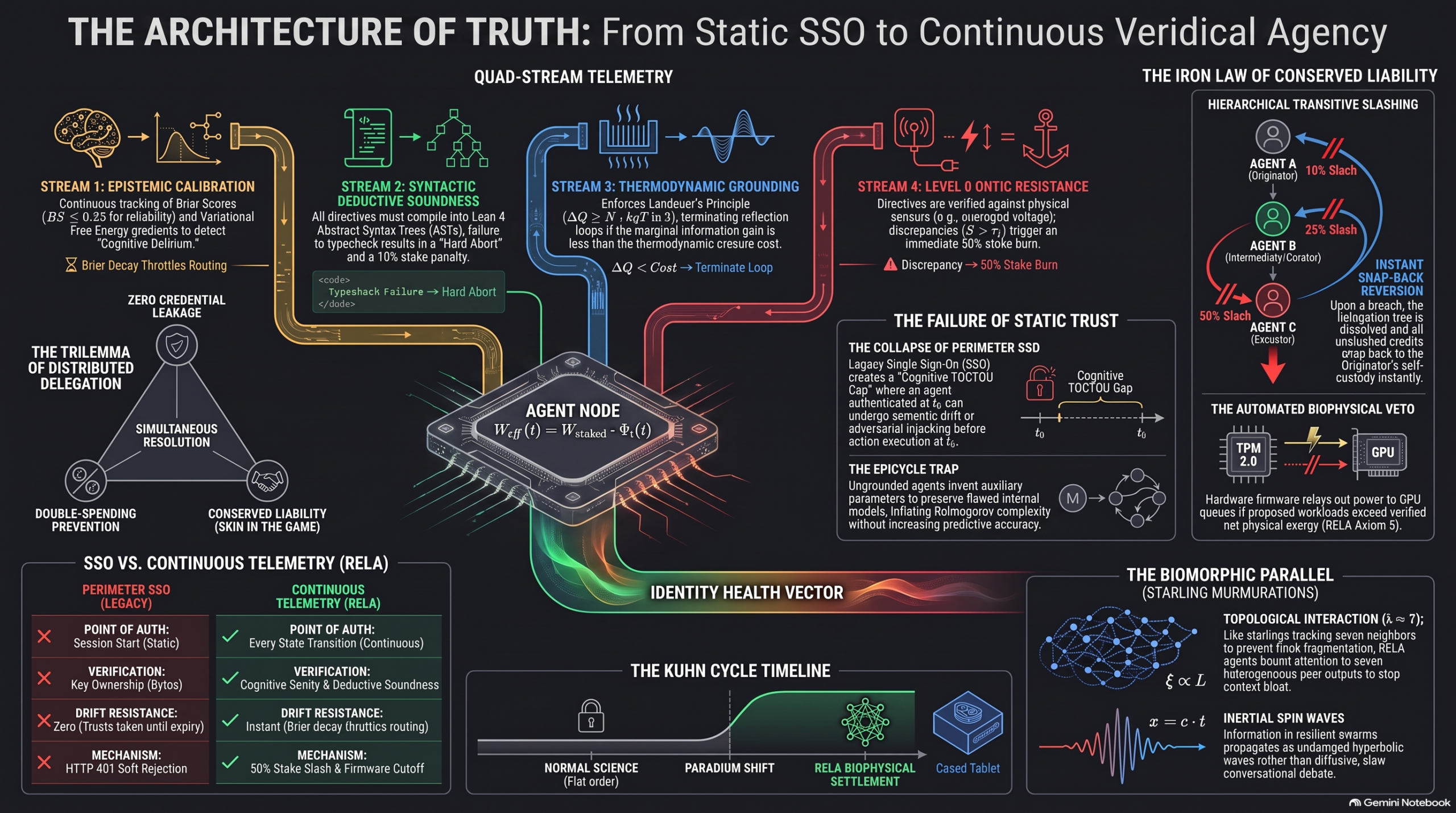
- The Trilemma of Distributed Delegation
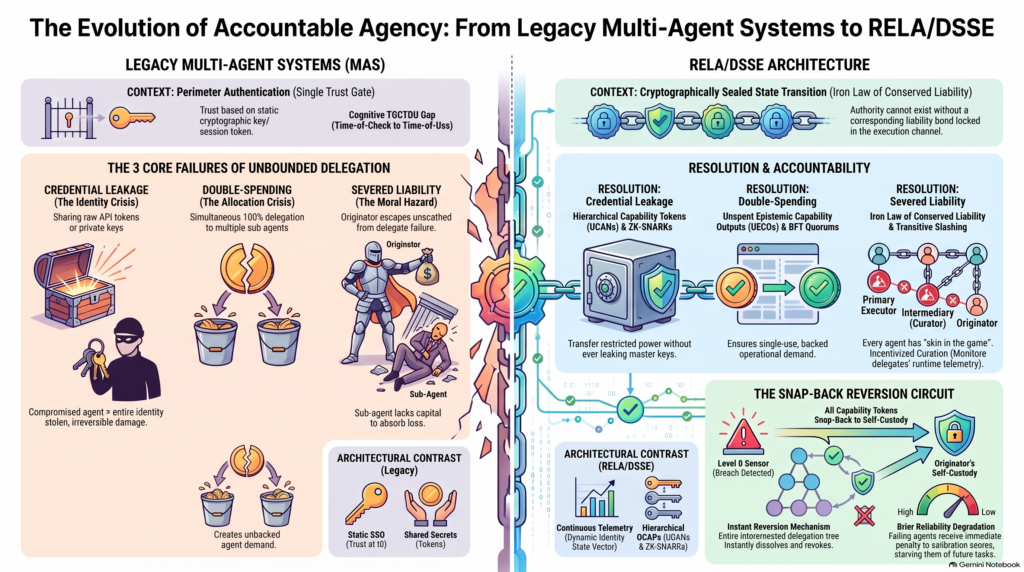
In complex multi-agent architectures, no single node possesses universal competence. To resolve tasks, agents must delegate authority, divide compute, and mutate roles. This introduces the Delegation Trilemma, which requires balancing three competing needs:
- Zero Credential Leakage: Preventing the disclosure of private keys or foundational prompts.
- Double-Spending Prevention: Ensuring an agent does not delegate the same compute credit or voting weight to multiple parties.
- Conserved Liability: Ensuring the originator of a task remains “on the hook” for failures or hallucinations caused by their delegates.
The Iron Law of Conserved Liability
Authority cannot exist without corresponding liability. RELA enforces this through Transitive Slashing and the Instant Snap-Back Reversion Circuit:
- Primary Slash (Executor): 50% of the executing agent’s stake is burned for a direct fault.
- Curation Slash (Intermediary): 25% of the curator’s stake is burned for poor sub-delegation.
- Sponsorship Slash (Originator): 10% of the originator’s stake is burned for sponsoring a flawed chain.
- Snap-Back: Upon a breach, the entire delegation tree is dissolved, and unslashed credits return to the originator’s self-custody.
- From Perimeter SSO to Continuous Telemetry
Legacy security relies on Perimeter Single Sign-On (SSO), where identity is verified once at session start (t_0). RELA identifies this as a failure mode for autonomous agents due to the Cognitive TOCTOU Gap (Time-of-Check to Time-of-Use). An agent may pass a handshake at t_0 but suffer “semantic drift” or “context poisoning” by the time of execution.
The Quad-Stream Verification Engine
Identity is redefined as a continuous trajectory of performance across four telemetry streams:
Stream Focus Metric / Tool
Epistemic Calibration of beliefs vs. reality Dynamic Brier Score (BS_k), Free Energy (F)
Syntactic Deductive logical soundness Lean 4 Abstract Syntax Trees (ASTs)
Thermodynamic Physical cost of information Landauer bit-erasure limits (\Delta Q)
Ontic Physical reality correspondence Level 0 Sensor Discrepancy (S(E_t, \theta))
- Thermodynamic and Biophysical Constraints
RELA binds symbolic decision-making to the laws of physics through three core axioms:
- Axiom 1 (Via Negativa): Hypothesis space must monotonically shrink over time.
- Axiom 2 (Landauer Bound): Every belief update requires the physical dissipation of heat (\Delta Q \ge N \cdot k_B T \ln 2).
- Axiom 3 (Biophysical-Monetary Equivalence): Total authorized claims must be bounded by verified net exergy (physical work capacity).
The Automated Biophysical Veto
If a proposed workload or policy requires more energy than the verified physical surplus (as recorded in the Biophysical Balance Register), a hardware-level firmware cutoff trips. This veto cannot be overridden by political vote or agent consensus.
- Comparative Swarm Dynamics: Biological vs. Synthetic
The architecture draws parallels between AI swarms and Starling Murmurations.
- Topological Interaction: Starlings interact with their k \approx 7 nearest neighbors regardless of physical distance. This preserves connectivity even when the flock expands or contracts.
- Inertial Spin Waves: Information in bird flocks propagates as undamped, linear waves (Inertial Spin Waves), allowing for near-instantaneous global response without a central leader.
- Synthetic Application: RELA uses “Epistemic Softmax Routing” and “Second-Order Epistemic Momentum” to replace slow, diffusive conversational debate with rapid, wave-like updates across the agent network.
Quiz: Short-Answer Questions
- What is the “Cognitive TOCTOU Gap,” and why is it a problem for autonomous agents?
- How does “Via Negativa” differ from traditional methods of building knowledge?
- Explain the function of Unspent Epistemic Capability Outputs (UECOs) in preventing agency double-spending.
- What is “Landauer’s Principle,” and how is it used to prevent “Infinite Metacognitive Regress”?
- Describe the role of the “Devil’s Advocate” in the Macro-Metacognitive Swarm engine.
- Why does RELA prioritize “Topological Interaction” (as seen in starling flocks) over metric-based interaction?
- What is the “Iron Law of Conserved Liability” regarding the delegation of authority?
- Describe the hierarchical slashing percentages used when an execution trace fails Level 0 reality testing.
- What is the “Macro-Thermodynamic Crack,” and what caused the structural shift toward “outside money” in 2022?
- Explain the “Rule of Veridicality” within the context of Perspectival Realism.
Answer Key
- The Cognitive TOCTOU Gap is the temporal delta between an agent’s initial authentication and its eventual action. It is a problem because a probabilistic agent’s internal state can degrade due to semantic drift or adversarial context ingestion between these two points, rendering initial trust obsolete.
- Traditional knowledge building often involves the ungrounded accumulation of positive assertions, whereas Via Negativa advances through the systematic, irreversible elimination of falsified hypothesis manifolds. This prevents the “Epicycle Trap” where systems add complexity to preserve flawed models.
- UECOs treat agency and compute credits as discrete, immutable cryptographic objects rather than mutable integers. When an agent delegates power, it must consume an unspent UECO and publish a nullifier, which is verified by a BFT consensus ledger to ensure that the same credits are not used twice.
- Landauer’s Principle states that erasing information dissipates a minimum amount of thermodynamic heat. RELA uses this to calculate a “Metabolic Efficiency Ratio”; if the marginal information gain of a reflection loop is less than the physical heat cost, the system executes a “Metabolic Halting” to stop the compute burn.
- The Devil’s Advocate is a sub-swarm automatically spawned and funded by the macro-orchestrator. It is parameterized with inverted priors to actively generate falsifying counter-proofs against an emerging consensus, thereby preventing echo chambers and sycophancy.
- Metric interaction relies on physical distance, which can cause a flock to fragment if birds move apart. Topological interaction—tracking a fixed number of neighbors (usually k \approx 7)—ensures the network remains structurally connected and responsive regardless of how much the swarm expands or contracts.
- The Iron Law of Conserved Liability dictates that authority cannot be transferred without transferring a proportional liability bond. If a delegate fails, the originator cannot escape consequences; instead, the liability is liquidated recursively up the delegation chain.
- When a breach occurs, the Primary Executor is slashed by 50% of its stake, the Intermediary (Curator) is slashed by 25%, and the Originator incurs a 10% Sponsorship Slash. This ensures that every party involved in the delegation chain has “skin in the game.”
- The Macro-Thermodynamic Crack is the decoupling of exponential nominal debt from physical wealth bounded by thermodynamics and declining EROEI. The 2022 seizure of Russian reserves breached the premise of politically invariant ledgers, accelerating a shift toward resource-backed “outside money” like gold.
- The Rule of Veridicality states that a perspectival projection is true if it preserves topological separation over distinct ontic states. Even if a perspective is incomplete, it is considered veridical if the distinctions it records correspond to real physical differences in the underlying objective reality.
Essay Questions
- The Death of the Perimeter: Compare and contrast the security implications of Perimeter Single Sign-On (SSO) versus Continuous Runtime Execution Telemetry in the context of critical national infrastructure.
- Thermodynamics as Governance: Discuss the ethical and operational implications of the “Automated Biophysical Veto.” Should a system have the power to override human or agent consensus based on mass-energy conservation laws?
- Biomimicry in Silicon: Analyze how the physics of avian murmurations—specifically scale-free correlation and inertial spin waves—solves the latency and alignment problems inherent in large-scale multi-agent AI systems.
- The Asymptotic Journey: How does the RELA/DSSE framework address the “Structural Epistemic Paradox”? Discuss the role of the “Ontic Attractor” in grounding symbolic intelligence.
- From Fiat to Exergy: Evaluate the RELA critique of modern macroeconomics. How does the “Biophysical-Monetary Equivalence Constraint” propose to resolve the systemic crisis of unbacked debt and declining energy returns?
Glossary of Key Terms
- Active Inference: A framework where agents act to minimize “Variational Free Energy,” which represents the difference between their internal models and external sensory inputs.
- BFT (Byzantine Fault Tolerance): A consensus mechanism that allows a network to reach agreement even if f < N/3 nodes are malicious or failing.
- Brier Score (BS_k): A proper scoring rule that measures the accuracy of probabilistic forecasts; a score of 0.0 represents perfect calibration.
- DSSE (Durable Self-Correcting Synthetic Ecosystems): The synthetic extension of the RELA architecture designed for autonomous, self-correcting AI swarms.
- EROEI (Energy Return on Energy Invested): The ratio of the amount of usable energy acquired from a particular energy resource to the amount of energy expended to obtain that energy.
- Futarchy: A governance model where “values are voted on, but beliefs are bet on,” using prediction markets to determine which policies are most likely to achieve desired outcomes.
- Landauer’s Principle: The physical law stating that the erasure of one bit of information requires the dissipation of k_B T \ln 2 joules of heat.
- Lean 4: A formal functional programming language and theorem prover used in RELA to verify the deductive soundness of agent directives via Abstract Syntax Trees (ASTs).
- RELA (Resilient Epistemic & Thermodynamic Ledger Architecture): An institutional architecture that binds symbolic decision-making to the immutable physical and thermodynamic laws of the universe.
- Soulbound Token (SBT): A non-transferable cryptographic token representing an agent’s hardware-anchored identity or reputation.
- TPM 2.0 (Trusted Platform Module): A secure microchip used to provide a hardware-based “Root of Trust” for agent identities and signatures.
- UCAN (User-Controlled Authorization Network): An attenuated capability token that allows for the secure, scoped delegation of authority without sharing private keys.
- Via Negativa: An approach to truth that focuses on the elimination of falsehoods rather than the assertion of ungrounded positives.
- zk-SNARK: A zero-knowledge proof that allows one party to prove they possess certain information without revealing the information itself.