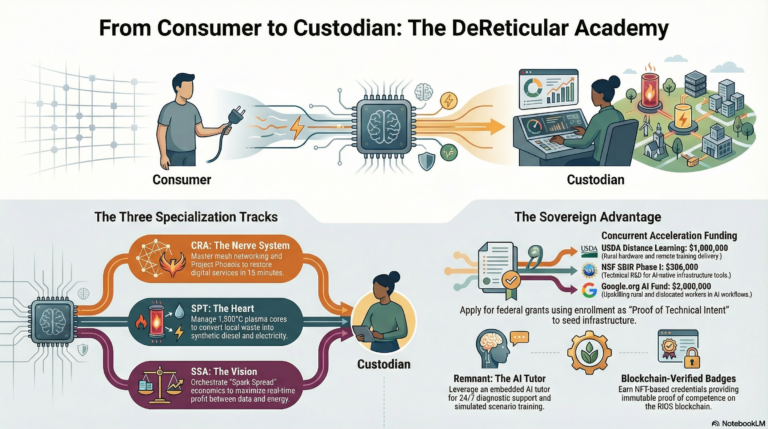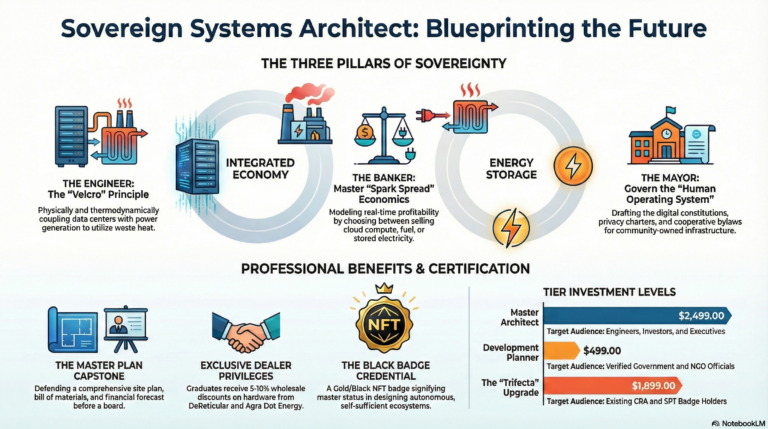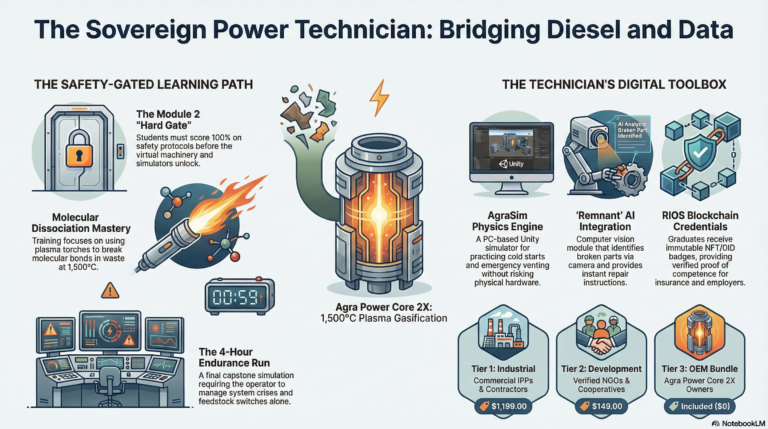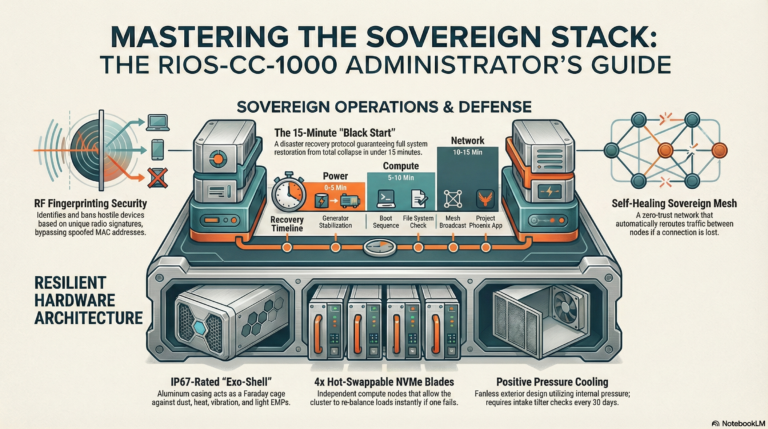
Institutional White Paper: THE SOVEREIGN OPERATIONAL STACK
A Formal Systems Specification for the Structural Isomorphism of Physical and
Epistemic Sovereignty Across Decentralized Energy, Kinetic Mobility,
Carrier-Free Communications, and Invariant Ledger Architectures
- Metadata & Document Control Block
┌──────────────────────────────────────────────────────────────────────────────────────────────────┐
│ DOCUMENT IDENTIFIER: RELA-SOS-2026-V1 │
│ SECURITY & DISTRIBUTION CLASSIFICATION: Institutional Standard / Distribution Unrestricted │
│ RELEASE VERSION: 1.0.0-PROD │
│ TARGET OPERATIONAL EPOCH: 2026–2035 │
│ ORIGINATING SPONSORING BODY: Foundational Governance Architecture Working Group │
│ RESEARCH COLLABORATIVES: DeReticular Systems Institute, Santa Fe Institute (SFI), │
│ Stanford Center for Blockchain Research (CBR), International Society for Biophysical │
│ Economics (ISBE) │
│ LEAD ARCHITECT: Michael Noel (Biz Builder Mike / DeReticular Prime) │
│ MATHEMATICAL FORMALISMS: Measure Theory, Differential Topology, Information Theory, │
│ Algorithmic Information Theory (MDL), Distributed Consensus Protocols, Non-Equilibrium │
│ Thermodynamics │
└──────────────────────────────────────────────────────────────────────────────────────────────────┘
1.1 Revision History & Provenance Control
| Version | Epoch / Date | Author / Node Architecture | Scope & Primary Remediation |
|---|---|---|---|
0.1.0-DRAFT | Q1 2024 | Epistemic Systems Taskforce | Initial conceptual formalization of perspectival realism. |
0.5.0-REVIEW | Q3 2025 | Institutional Peer Audit | Remediation of continuous-space falsification and velocity paradox. |
0.9.0-BETA | Q1 2026 | DeReticular Technical Engine | Integration of 700V DC busbars and TriFi RF telemetry. |
1.0.0-PROD | Q3 2026 | Foundational Arch Working Gp | Production architecture release and formal invariant binding. |
1.2 Epistemic Claim Classification Taxonomy
To eliminate category errors and maintain structural precision, all assertions,
theorems, and specifications within this standard are bound to the following
epistemic tags:
- [ESTABLISHED_RESULT]: Formally proven mathematical theorems or empirically
validated physical laws (e.g., Carnot efficiency, Landauer’s bound, Shannon
capacity). - [FORMAL_ASSUMPTION]: Axiomatic baselines, state-space constraints, and
network synchrony models adopted for mathematical modeling. - [EMPIRICAL_CLAIM]: Statistically documented physical, industrial, or
econometric measurements. - [HISTORICAL_INTERPRETATION]: Scholarly readings of institutional, monetary,
or technological history. - [AUTHOR_PROPOSITION]: Novel theoretical syntheses and architectural
formulations introduced by this research. - [POLICY_SPECIFICATION]: Actionable protocol rules, invariant computational
checks, and system schemas.
- Executive Summary & Problem Statement
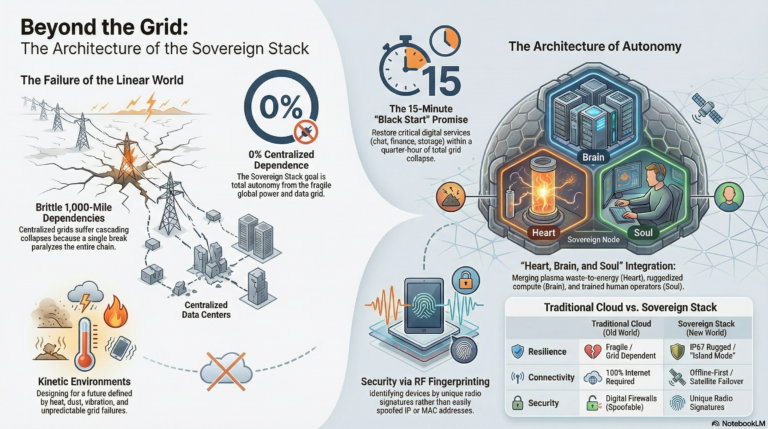
2.1 The 1,000-Mile Failure Model
[AUTHOR_PROPOSITION] Modern industrial civilization operates under the
1,000-Mile Failure Model: a condition in which critical lifelines (baseload
power, compute, food processing, financial settlement, and administrative
authority) depend on hyper-extended, centralized supply chains with high
topological fragility.
THE 1,000-MILE FRAGILITY CASCADE
CENTRALIZED MACRO-GRID HYPERSCALER CLOUD UNBACKED SYMBOLIC LEDGER
┌─────────────────────────┐ ┌─────────────────────────┐ ┌─────────────────────────┐
│ 500kV AC Backbone │ │ Monolithic Data Centers │ │ $315T Compounding Debt │
│ (Kinetic/Thermal Vulner)│ │ (AWS / Azure / OpenAI) │ │ (D(t) = D_0 e^{rt}) │
└────────────┬────────────┘ └────────────┬────────────┘ └────────────┬────────────┘
│ Interconnect Delays │ Surveillance / Outages │ Physical Decoupling
▼ ▼ ▼
┌─────────────────────────────────────────────────────────────────────────────────────────────┐
│ SYSTEMIC ENVELOPE RUPTURE (PHASE 3 CRISIS) │
│ • Transformer Explosions & Inverter Drops • Automated Censorship & Cognitive Latency │
│ • Unbacked Hyperinflation (V -> ∞) • Complete Loss of Local Institutional Agency │
└─────────────────────────────────────────────────────────────────────────────────────────────┘
Modern high-voltage alternating current (HVAC) transmission grids exhibit
single-point vulnerabilities. Substation transformer failures trigger cascading
blackouts across regional interconnects. Simultaneously, edge institutions have
outsourced cognitive agency to centralized corporate hyperscalers (e.g., AWS,
Azure, OpenAI), rendering local facilities dependent on long-haul optical fiber
lines and third-party infrastructure. When physical, cyber, or geopolitical
shocks compromise these lines, regional institutions lose operational integrity.
2.2 The Epistemic Crisis: Kuhn Phase 3 in Governance and Macroeconomics
[AUTHOR_PROPOSITION] Modern constitutional democracies and neoclassical economic
frameworks have entered Phase 3 (Model Crisis) of the information-theoretic Kuhn
cycle:
THE INFORMATION-THEORETIC KUHN PARADIGM CYCLE
Phase 1: NORMAL SCIENCE / GOVERNANCE
Post-WWII Bretton Woods II fiat order; stable axiomatic frame; DSGE models treat markets as self-clearing.
│
▼ Divergent systemic anomalies accumulate
Phase 2: MODEL DRIFT
Auxiliary epicycles introduced to maintain internal coherence (QE, ZIRP, negative yields, balance sheet runups).
Kolmogorov complexity K(Model) escalates rapidly.
│
▼ Epicycles contradict; predictive loss L(Pred, Reality) -> ∞
Phase 3: MODEL CRISIS (CURRENT GLOBAL STATE)
Nomadic outside-money networks emerge; physical EROEI constraints collide with $315T in unbacked debt claims.
│
▼ Rupture of the institutional envelope
Phase 4: MODEL REVOLUTION
Incommensurable frameworks clash; first principles debated; weaponized reserve ledgers crack.
│
▼ Irreversible foreclosure of falsified parameter spaces
Phase 5: PARADIGM SHIFT (THE ASYMPTOTIC SOVEREIGN STATE)
Re-anchoring collective governance in physical thermodynamics, formal proof systems, and Via Negativa pruning.
[EMPIRICAL_CLAIM] Contemporary global debt exceeds $315 trillion—surpassing 330%
of global GDP (Bank for International Settlements, 2024). This nominal debt
compounds exponentially:
\frac{dD}{dt} = r \cdot D \implies D(t) = D_0 e^{rt}
Meanwhile, the real physical economy is bounded by the declining Energy Return
on Energy Invested (\operatorname{EROEI}) of primary fuels:
\frac{d\mathcal{Y}}{dt} \le \gamma \cdot \mathcal{Y}, \quad \mathcal{Y}(t) \propto \operatorname{EROEI}(t)
[AUTHOR_PROPOSITION] Neoclassical Dynamic Stochastic General Equilibrium (DSGE)
models treat energy as a negligible (<5%) cost share via the Cost-Share
Theorem, ignoring the biophysical reality that capital and labor are merely
energy-directing mechanisms (Georgescu-Roegen, 1971; Keen, 2020). When symbolic
claims outpace physical exergy, central banks add auxiliary parameters—analogous
to Ptolemaic epicycles—to preserve model authority.
In hyperinflation, ungrounded monetary creation
(\frac{dM}{dt} \gg \frac{d\mathcal{Y}}{dt}) destroys money demand
(L(Y, r) \to 0), causing velocity to surge (V \to \infty) as agents exchange
degrading paper tokens for physical commodities, terminating in systemic
default.
2.3 The Core Thesis: Isomorphism of Physical and Epistemic Sovereignty
[AUTHOR_PROPOSITION] Physical sovereignty and epistemic sovereignty are
structurally, thermodynamically, and mathematically identical problems.
A failure of physical sovereignty occurs when an edge system relies on an
unverified, centralized supply line that it cannot validate, defend, or sustain
during island mode. A failure of epistemic sovereignty occurs when a cognitive
system relies on an unverified, centralized narrative or model that it cannot
test, audit, or falsify against ontic reality.
┌──────────────────────────────────────────────────────────────────────────────────────────────────┐
│ THE SOVEREIGN ISOMORPHISM PRINCIPLE │
├──────────────────────────────────┬───────────────────────────────────────────────────────────────┤
│ Physical Domain │ Epistemic Domain │
├──────────────────────────────────┼───────────────────────────────────────────────────────────────┤
│ Baseload Generation (Agra) │ Ground-Truth Attractor ($\Omega^* \subset \mathcal{M}$) │
│ Native 700V DC Microgrid Bus │ Deductive Soundness / Machine-Checked Syntax (Lean 4) │
│ TriFi Carrier-Free Wireless Mesh │ Noisy Channel Coding & Invariant Message Transport (Shannon) │
│ Kurb Kars Kinetic Autonomous DER │ Dynamic Trajectory Verification in Physical Metric Space │
│ Remnant AI Air-Gapped Compute │ Local Cognitive Processing (Zero-Entropy Channel) │
│ Automated Biophysical Veto (BBR) │ Parameter Foreclosure via Negativa ($S(E_t, \theta) > \tau_t$)│
└──────────────────────────────────┴───────────────────────────────────────────────────────────────┘
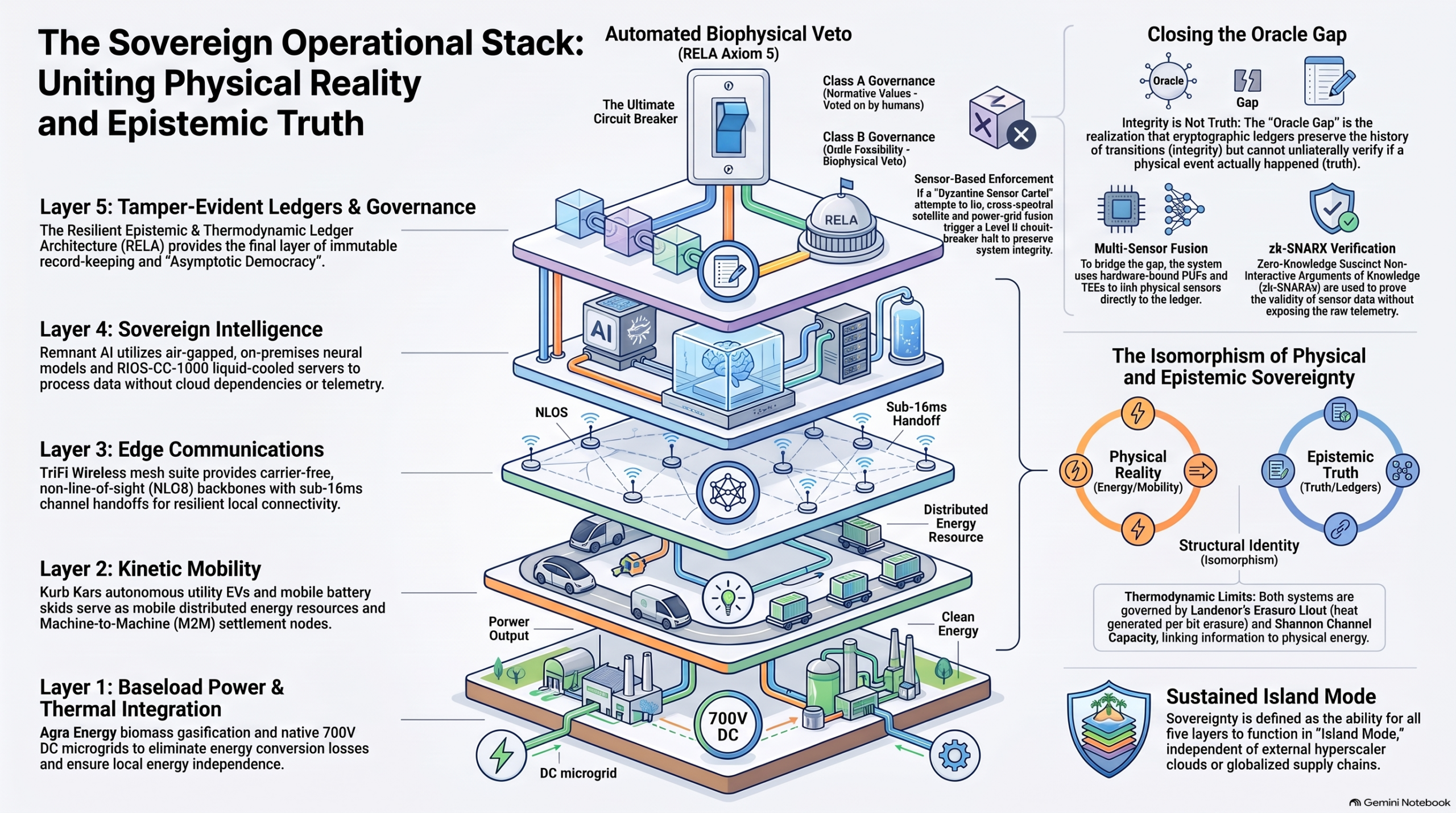
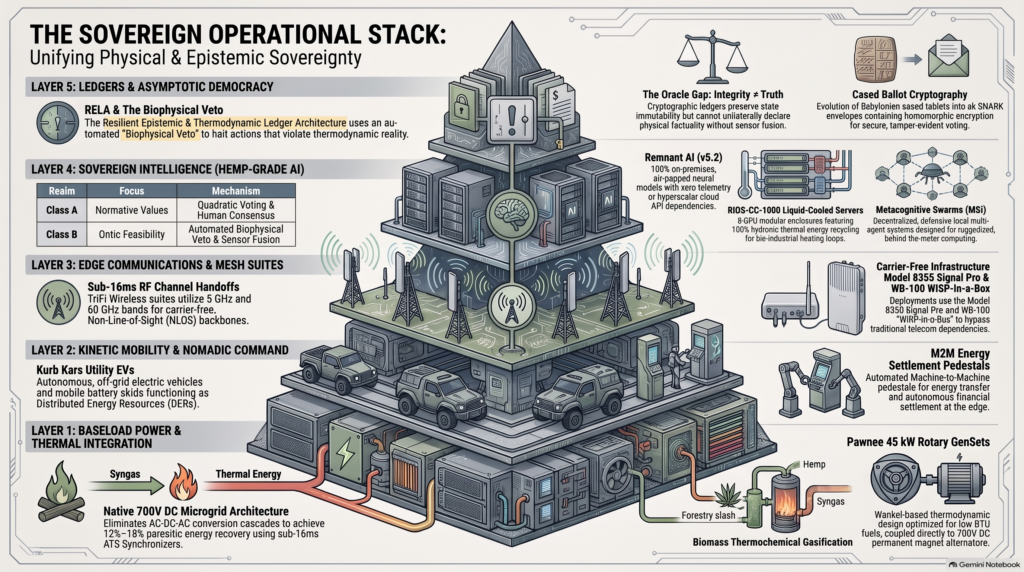
The solution across both domains is the Sovereign Operational Stack: an
integrated architecture that enforces Sustained Island Mode through local
thermodynamic baseload, native DC microgrids, carrier-free wireless mesh
networks, air-gapped on-premises artificial intelligence, and append-only
cryptographic ledgers bound to physical exergy invariants.
- Theoretical First Principles: From Ontic Attraction to Hardware Integrity
THE UNIFIED CONVERGENCE ENGINE
┌──────────────────────────────────────────────────────────────────────────────────────────────────┐
│ LEVEL 0: ONTIC PHYSICAL REALITY │
│ Mind-Independent Attractor: Ω* ∈ M (dim(M) -> ∞) │
│ Invariant Physical Boundary: Conservation of Mass-Energy, Carnot Efficiency, Net Exergy Yields │
└────────────────────────────────────────────────┬─────────────────────────────────────────────────┘
│
│ Empirical Friction (Causal Resistance)
▼
┌──────────────────────────────────────────────────────────────────────────────────────────────────┐
│ LEVEL 1: DEDUCTIVE SYNTAX & PROOF KERNELS │
│ Formally Verified Proofs (Lean 4 / Coq ASTs) │
│ Lossless Syntactic Transport: Γ ⊢ ψ ⟹ Γ ⊨ ψ (Logical Entropy: I(ψ; M | Γ) = 0) │
└────────────────────────────────────────────────┬─────────────────────────────────────────────────┘
│
│ Cryptographic Compilation & Inscription
▼
┌──────────────────────────────────────────────────────────────────────────────────────────────────┐
│ LEVEL 2: APPEND-ONLY DISTRIBUTED LEDGER (Consensys Core Domain) │
│ Cryptographic State Machine Replication (BFT Consensus: N ≥ 3f + 1, zk-SNARK State Verification) │
│ Guarantees Data Immutability: “Recorded and Executed as Written” (Integrity ≠ Truth) │
└────────────────────────────────────────────────┬─────────────────────────────────────────────────┘
│
│ Aggregation & Oracle Telemetry
▼
┌──────────────────────────────────────────────────────────────────────────────────────────────────┐
│ LEVEL 3: SYMMETRIC INTERSUBJECTIVE CONSENSUS │
│ Futarchy Prediction Markets, Quadratic Values Voting, Mertonian CUDOS Norms │
│ Failure State: Information Cascades (I(a_t; s_t | H_t) = 0), Pluralistic Ignorance (β ≫ α) │
└────────────────────────────────────────────────┬─────────────────────────────────────────────────┘
│
│ Institutional Inversion & Unbacked Decree
▼
┌──────────────────────────────────────────────────────────────────────────────────────────────────┐
│ LEVEL 4: SOVEREIGN DECLARATIVE FIAT (ZERO GROUNDING) │
│ Unbacked Legal Monopoly, Exponential Paper Currency Expansion (D_0 e^{rt}) │
│ Status: Structurally Rejected by RELA Kernel; Assigned Zero Epistemic Weight │
└──────────────────────────────────────────────────────────────────────────────────────────────────┘
3.1 Ontological Realism vs. Epistemic Perspectivism
[FORMAL_ASSUMPTION] Let the physical universe be modeled as an ontic state-space
manifold \mathcal{M} of near-infinite dimensionality:
\dim(\mathcal{M}) = D \to \infty
The objective ground-truth state of affairs is an invariant trajectory or
configuration:
\Omega^* \in \mathcal{M}
[FORMAL_ASSUMPTION] An observer, sensor apparatus, or institutional model
operates within a bounded, parameterized epistemic perspective frame
\theta \in \Theta, where \Theta spans sensory thresholds, physical instruments,
and linguistic networks. An epistemic perspective is a dimension-reducing
projection operator:
\hat{\Pi}\theta: \mathcal{M} \to \mathcal{P}\theta \quad \text{where } \dim(\mathcal{P}_\theta) = d \ll D
[ESTABLISHED_RESULT] Following the Perspectival Realism of Giere (2006) and
Massimi (2022):
\text{If } \omega_1, \omega_2 \in \mathcal{M} \quad \text{and} \quad \hat{\Pi}\theta(\omega_1) \neq \hat{\Pi}\theta(\omega_2)
the distinction captured in observation manifold \mathcal{P}\theta tracks a
genuine physical distinction in \mathcal{M}, even if the observer cannot invert
\hat{\Pi}\theta to reconstruct the total state of \mathcal{M}.
[AUTHOR_PROPOSITION] Absolute truth is the Peircean asymptotic intersection
across all possible valid projection angles over indefinite empirical inquiry:
\Omega^* = \lim_{t \to \infty} \bigcap_{\theta \in \Theta_t} \hat{\Pi}\theta^{-1}\left(\mathcal{P}\theta^{\text{validated}}\right)
3.2 Verisimilitude Accretion via Measure-Theoretic Parameter Foreclosure
[FORMAL_ASSUMPTION] Let an empirical policy, scientific hypothesis, or
macro-model \mathcal{H} be parameterized over a compact metric space
(\Theta, d). Let (\Theta, \mathcal{B}, \mu) be a probability space, where
\mathcal{B} is the Borel \sigma-algebra over \Theta, and \mu is the prior
Lebesgue measure normalized such that \mu(\Theta_0) = 1.0.
[POLICY_SPECIFICATION] Empirical reality acts on \Theta through observable
events E_t \in \mathcal{Y}. Falsification is defined via a pre-registered
discrepancy loss statistic:
S(E_t, \theta) \in \mathbb{R}_{\ge 0}
with an empirical threshold \tau_t > 0:
\Omega_{\text{falsified}}^{(t)} = \left{ \theta \in \Theta_t : S(E_t, \theta) > \tau_t \right}
The update protocol under epistemic friction is strictly non-expanding:
\Theta_{t+1} = \Theta_t \setminus \Omega_{\text{falsified}}^{(t)}
TOPOLOGICAL CONTRACTION OF HYPOTHESIS SPACE
┌──────────────────────────────────────────────────────────────────────────────────────────────────┐
│ Initial Hypothesis Space: Θ_0 (Volume μ(Θ_0) = 1.0) │
│ │
│ Falsified at t=1: Falsified at t=2: │
│ [Ptolemaic Epicycles / Flat Earth] [Phlogiston / Caloric Thermodynamics] │
│ ██████████████████████████ ▓▓▓▓▓▓▓▓▓▓▓▓▓▓▓▓▓▓▓▓▓▓▓▓▓▓▓▓▓ │
│ │
│ Permissible Active Parameter Manifold: Θ_3 ⊂ Θ_2 ⊂ Θ_1 │
│ ┌──────────────────────────────────────────────────────────────────────────────────────────────┐ │
│ │ Newtonian Mechanics (Low-Velocity Domain: v ≪ c) │ │
│ │ ┌──────────────────────────────────────────────────────────────────────────────────────────┐ │ │
│ │ │ General Relativity & Standard Model Quantum Field Theory │ │ │
│ │ │ ┌──────────────────────────────────────────────────────────────────────────────────────┐ │ │ │
│ │ │ │ Invariant Ontic Attractor: Ω* = Π(M) │ │ │ │
│ │ │ └──────────────────────────────────────────────────────────────────────────────────────┘ │ │ │
│ │ └──────────────────────────────────────────────────────────────────────────────────────────┘ │ │
│ └──────────────────────────────────────────────────────────────────────────────────────────────┘ │
│ │
│ Falsified at t=3: [Luminiferous Aether / Frictionless Unbacked Fiat Debt Compounding] │
│ ▒▒▒▒▒▒▒▒▒▒▒▒▒▒▒▒▒▒▒▒▒▒▒▒▒▒▒▒▒▒▒▒▒▒▒▒▒▒▒▒▒▒▒▒▒▒▒▒▒▒▒▒▒▒▒▒▒▒▒▒▒▒▒▒▒▒▒▒▒▒▒▒▒▒▒▒▒▒▒▒▒▒▒▒▒▒▒▒▒▒▒▒▒▒▒ │
└──────────────────────────────────────────────────────────────────────────────────────────────────┘
Proposition 1: Asymptotic Contraction to the Attractor
[AUTHOR_PROPOSITION] Let (\Theta, d) be a compact metric space,
\theta^* = \hat{\Pi}(\Omega^*) \in \Theta be the true parameter projection, and
{\Theta_t}{t=0}^\infty be a sequence of nested compact sets generated by
\Theta{t+1} = \Theta_t \setminus \Omega_{\text{falsified}}^{(t)}.
Assume:
- Identifiability: For any \theta \neq \theta^,
\lim_{t \to \infty} \mathbb{E}[S(E_t, \theta) – S(E_t, \theta^)] > 0. - Uniform Convergence:
\sup_{\theta \in \Theta} |S(E_t, \theta) – \mathbb{E}[S(E_t, \theta)]| \xrightarrow{a.s.} 0
as t \to \infty. - Conservative Falsification Thresholds: The sequence \tau_t satisfies
\sum_{t=1}^\infty P(\theta^* \in \Omega_{\text{falsified}}^{(t)}) < \infty.
Then, by the Borel-Cantelli Lemma, \theta^* \in \bigcap_{t=0}^\infty \Theta_t
almost surely, and:
\lim_{t \to \infty} \operatorname{diam}(\Theta_t) = \lim_{t \to \infty} \sup_{\theta_a, \theta_b \in \Theta_t} d(\theta_a, \theta_b) \le \epsilon
where \epsilon \ge 0 represents the fundamental observational resolution limit
of the physical cosmos.
Proof Sketch: By Assumption 3 and the first Borel-Cantelli Lemma, the
probability that \theta^* is categorized as falsified infinitely often is zero.
Thus, \theta^* remains within \Theta_t for all t with probability 1. By
Assumptions 1 and 2, for any open neighborhood U containing \theta^*, every
parameter \theta \in \Theta \setminus U exhibits an expected discrepancy
exceeding the threshold:
\mathbb{E}[S(E_t, \theta)] > \tau_t
for sufficiently large t. Uniform convergence ensures that empirical discrepancy
passes the threshold almost surely, eliminating the set \Theta \setminus U.
Because (\Theta, d) is compact, every open cover contains a finite sub-cover,
contracting the diameter to resolution bound \epsilon. \blacksquare
[ESTABLISHED_RESULT] Following Niiniluoto (1987), verisimilitude (truthlikeness)
increases as the normalized distance metric contracts toward zero:
V(T, w^) = 1 – d(M(T), w^) \to 1 \quad \text{as } t \to \infty
3.3 Information-Theoretic & Thermodynamic Transmission Bottlenecks
[FORMAL_ASSUMPTION] Outside closed axiomatic languages, transmitting an
empirical claim or state-change vector requires encoding propositions into
physical states across a noisy channel:
THE PHYSICAL TRANSMISSION CHANNEL
┌──────────────┐ ┌───────────────────────────────────┐ ┌──────────────┐
│ SENDER MIND │ Encode │ PHYSICAL SUBSTRATE │ Decode │ RECEIVER NODE│
│ (Model A) ├─────────►│ (Sound, Inscribed Clay, Silicon) ├─────────►│ (Model B) │
└──────────────┘ └─────────────────┬─────────────────┘ └──────────────┘
│
NOISE & DECAY FORCES
• Shannon Channel Noise: H(X|Y) > 0
• Landauer Dissipation: ΔQ ≥ k_B T ln 2
• Quinean Indeterminacy: T_1 ≠ T_2
[ESTABLISHED_RESULT] Shannon’s Noisy-Channel Coding Theorem: For a physical
channel characterized by transition probabilities P(Y=y \mid X=x) with capacity:
C = \sup_{P(X)} I(X;Y)
achieving an absolute zero probability of decoding error (P_e = 0) requires an
infinite codeword length:
\lim_{P_e \to 0} N = \infty \implies \forall N < \infty, ; P_e > 0
No finite physical transmission can guarantee absolute fidelity. Every empirical
message carries a non-zero probability of physical corruption.
[ESTABLISHED_RESULT] Landauer’s Principle: Erasing or resetting an N-bit memory
register in any physical computational system operating at ambient temperature T
requires a minimum dissipation of thermodynamic heat:
\Delta Q \ge N \cdot k_B T \ln 2
where k_B is the Boltzmann constant.
[AUTHOR_PROPOSITION] Updating the ideological or institutional registers of a
society is a physical, thermodynamic process. Maintaining institutional records
against thermodynamic decay requires continuous energy consumption:
\frac{dE}{dt} \ge \alpha \cdot \mathcal{R}_{\text{erasure}} \cdot k_B T \ln 2
An isolated system that cuts off energetic expenditures on verification succumbs
to entropic memory loss (\frac{d S_{\text{internal}}}{dt} \ge 0), manifesting as
institutional amnesia, record rot, and conceptual drift.
[ESTABLISHED_RESULT] Quine’s Indeterminacy of Translation: Empirical
observations underdetermine semantic reference. Two distinct translation manuals
\mathcal{T}_1, \mathcal{T}_2: \Sigma_A \to \Sigma_B can produce identical
external behavioral outcomes while maintaining conflicting ontological
structures (\mathcal{T}_1(\nu) \not\equiv \mathcal{T}_2(\nu)). Direct, lossless
transmission of semantic meaning across separate conceptual frames is
impossible.
3.4 Consensus Mechanics & Pathologies
[ESTABLISHED_RESULT] Condorcet’s Jury Theorem: Let N independent agents choose
between two states \omega \in {0, 1}. If each agent exhibits an independent,
conditionally symmetric accuracy p > 0.5, majority voting V_N = \sum_{i=1}^N v_i
satisfies:
\lim_{N \to \infty} P\left(V_N = \omega^*\right) = 1
[AUTHOR_PROPOSITION] The Condorcet Inversion: In mass broadcast networks, the
conditional independence assumption
P(v_1, \dots, v_N \mid \omega) = \prod_{i=1}^N P(v_i \mid \omega) fails due to
algorithmic curation and centralized media (\operatorname{Cov}(v_i, v_j) > 0).
When social conformity pressures penalize truth-telling, the effective
probability of voting for a physically viable option falls below chance
(p < 0.5). Under these conditions:
\lim_{N \to \infty} P\left(V_N = \omega^*\right) = 0 \quad (\text{for } p < 0.5)
Increasing the number of participants in an epistemically inverted consensus
system drives collective error to certainty.
[ESTABLISHED_RESULT] Aumann’s Agreement Theorem: Two Bayesian agents sharing a
common prior P and common knowledge of their posterior probabilities
q_A = P(E \mid \mathcal{P}_A) and q_B = P(E \mid \mathcal{P}_B) must have equal
posteriors:
q_A = q_B = \frac{P(E \cap \mathcal{C}(\omega))}{P(\mathcal{C}(\omega))}
[AUTHOR_PROPOSITION] Persistent disagreement in public governance proves that:
- Agents possess divergent priors (P_A \neq P_B).
- Communication networks suffer from asymmetric topological partitioning.
- Agents are maximizing ideological utility payoffs rather than Bayesian
accuracy:
u_i(y_i) = \alpha \cdot \mathbb{I}{{y_i = \omega^*}} – \beta \cdot (y_i – \bar{y}{\text{tribe}})^2 \quad \text{where } \beta \gg \alpha
[ESTABLISHED_RESULT] Information Cascades (Bikhchandani et al., 1992): In
sequential decision-making, when public history H_t = (a_1, \dots, a_{t-1})
overwhelms a private signal s_t:
P(V = 1 \mid s_t = 1, H_t) > 0.5 \quad \text{and} \quad P(V = 1 \mid s_t = 0, H_t) > 0.5 \implies a_t = 1 \quad \forall s_t
Action a_t conveys zero information (I(a_t; s_t \mid H_t) = 0), trapping the
social collective in a self-reinforcing consensus on falsehood.
- The Physical Engineering Architecture (DeReticular Core Suite)
THE FIVE-LAYER SOVEREIGN OPERATIONAL STACK
┌──────────────────────────────────────────────────────────────────────────────────────────────────┐
│ LAYER 5: GOVERNANCE, P3 & WORKFORCE (Biz Builder Mike & SIEA Academy) │
│ • DCAA SF 1408 job-costed ledger isolation; FAR Part 31 compliance; FEMA BRIC capital stacking │
│ • SIEA 501(c)(3) workforce credentialing; Municipal Sovereign Infrastructure Audits ($25K–$75K) │
└────────────────────────────────────────────────▲─────────────────────────────────────────────────┘
│
┌────────────────────────────────────────────────┴─────────────────────────────────────────────────┐
│ LAYER 4: SOVEREIGN INTELLIGENCE (Remnant AI & Metacognitive Swarms) │
│ • Air-gapped on-premises neural models (v5.2); zero telemetry; zero hyperscaler API dependencies │
│ • RIOS-CC-1000: 8-GPU modular liquid-cooled enclosure at 700V DC; 100% hydronic heat recovery │
│ • “Hemp-Grade AI”: Behind-the-meter bio-industrial computing co-located with gasification │
└────────────────────────────────────────────────▲─────────────────────────────────────────────────┘
│
┌────────────────────────────────────────────────┴─────────────────────────────────────────────────┐
│ LAYER 3: EDGE COMMUNICATIONS (DeReticular Core & TriFi Wireless) │
│ • Carrier-free, non-line-of-sight (NLOS) wireless mesh backbones (5 GHz / 60 GHz) │
│ • Sub-16ms RF channel handoffs; WISP-in-a-Box™ Lite base stations (Model WB-100) │
│ • Mesh Lite hardware family: Signal Pro (Model 8355), Far X (Model X1271), Rover (Model SLG-06) │
└────────────────────────────────────────────────▲─────────────────────────────────────────────────┘
│
┌────────────────────────────────────────────────┴─────────────────────────────────────────────────┐
│ LAYER 2: KINETIC MOBILITY & NOMADIC C2 (Kurb Kars Mobility Systems) │
│ • Ruggedized off-grid utility electric vehicles & mobile battery skids (Mobile DERs) │
│ • Automated M2M energy settlement pedestals; dynamic kinetic roaming across hostile sectors │
└────────────────────────────────────────────────▲─────────────────────────────────────────────────┘
│
┌────────────────────────────────────────────────┴─────────────────────────────────────────────────┐
│ LAYER 1: BASELOAD ENERGY GENERATION & THERMAL INTEGRATION (Agra Energy) │
│ • Continuous thermochemical biomass gasification: Forestry slash & hemp hurds -> Syngas │
│ • Pawnee 45 kW rotary GenSet: Wankel engine on low-BTU fuel coupled to 700V DC alternator │
│ • Native 700V DC Microgrid: Eliminates AC-DC conversion cascades (12%–18% parasitic recovery) │
│ • Sub-16ms Static Transfer Switch (ATS) synchronizer for seamless grid islanding │
└──────────────────────────────────────────────────────────────────────────────────────────────────┘
4.1 Layer 1: Baseload Energy Generation & Thermal Integration
[POLICY_SPECIFICATION] Decentralized physical sovereignty requires total
independence from the public utility grid interconnect queue. Layer 1
establishes continuous 24/7 power via closed-loop thermochemical conversion.
NATIVE 700V DC MICROGRID BUSBAR ARCHITECTURE
┌─────────────────────────┐
│ AGRA BIOMASS GASIFIER │
│ Forestry Slash / Hemp │
└────────────┬────────────┘
│ Raw Syngas (CO + H_2)
▼
┌─────────────────────────┐
│ PAWNEE 45kW ROTARY GEN │
│ Wankel Engine Package ├─────────────────────────────────────────────────┐
└────────────┬────────────┘ │
│ High-Torque Mechanical Work │
▼ │ Hydronic Water
┌─────────────────────────┐ │ Jacket (60°–80°C)
│ 700V DC PERMANENT MAGNET│ │ Thermal Exhaust
│ ALTERNATOR │ │
└────────────┬────────────┘ │
│ Native 700V DC Electricity (Zero Inverter Loss: +15% Efficiency)
▼ │
═════════════╪══════════════════════════════════════════════════════════════╪═══════ 700V DC BUSBAR
│ │
├──────────────────────────────┬───────────────────────────────┤
│ │ │
▼ ▼ ▼
┌─────────────────┐ ┌─────────────────┐ ┌──────────────────┐
│ SOLID-STATE BESS│ │ RIOS-CC-1000 │ │ AGRICULTURAL DRY │
│ 700V LiFePO4 │ │ 8-GPU RACK (AI) │ │ KILN / HEATING │
│ Battery Bank │ │ 10 kW DC Draw │◄───────────┤ (100% Heat Recov)│
└─────────────────┘ └─────────────────┘ └──────────────────┘
- Agra Energy Biomass Gasification:
- [EMPIRICAL_CLAIM] Rather than relying on weather-dependent solar or wind
installations requiring massive battery buffers, Agra Energy uses
high-temperature, downdraft thermochemical gasifiers. - Feedstocks include unrefined forestry slash, agricultural residues, and
industrial hemp stalks. - Operating parameters: 850°C–1050°C under substoichiometric oxygen
regimes, producing syngas (20%\text{–}25%\text{ CO},
15%\text{–}20%\text{ H}_2, 2%\text{–}5%\text{ CH}_4, balance
\text{CO}_2 and \text{N}_2). - Yields continuous baseload electric power (>8,000\text{ hours/year})
with minimal fuel-chain transport footprint.
- [EMPIRICAL_CLAIM] Rather than relying on weather-dependent solar or wind
- Native 700V DC Microgrid Busbar:
- [AUTHOR_PROPOSITION] Conventional AC microgrids lose 12% to 18% of
aggregate energy in conversion steps (GenSet AC \to DC Battery \to AC
Distribution \to DC Server Power Supply Units). - DeReticular Energy Systems uses a native 700V DC busbar that
interconnects generation, battery storage, and AI compute racks directly
without intermediate AC inverters. - System balancing is governed by the Sub-16ms Static Transfer Switch
(ATS) Synchronizer, allowing disconnection from failing utility
interconnects in under 16 milliseconds—well within the holdup
capacitance of industrial power supplies, preventing cluster resets.
- [AUTHOR_PROPOSITION] Conventional AC microgrids lose 12% to 18% of
- Pawnee 45 kW Rotary GenSet:
- [POLICY_SPECIFICATION] A continuous-duty Wankel rotary engine package
optimized for low-BTU gaseous fuels. - Unlike reciprocating piston engines that suffer valve fouling and
detonation from hydrogen-rich syngas, the Wankel design separates
intake, combustion, and exhaust into distinct chambers, enabling smooth
combustion of variable-composition syngas. - The engine is direct-coupled to a liquid-cooled 700V DC permanent-magnet
alternator.
- [POLICY_SPECIFICATION] A continuous-duty Wankel rotary engine package
4.2 Layer 2: Kinetic Mobility & Nomadic Command Nodes (Kurb Kars)
[POLICY_SPECIFICATION] Fixed infrastructure remains vulnerable to localized
environmental and kinetic threats. Layer 2 deploys Kurb Kars: off-grid electric
utility vehicles, autonomous tractors, and mobile power skids.
KURB KARS M2M RECHARGE PEDESTAL
┌─────────────────────────────────┐ ┌─────────────────────────────────┐
│ NATIVE 700V DC MICROGRID │ │ KURB KARS AUTONOMOUS VEHICLE │
│ Busbar Pedestal Node │ │ Mobile DER / Kinetic C2 │
├─────────────────────────────────┤ ├─────────────────────────────────┤
│ • Automated Bidirectional Coupler│◄─Physical──►│ • Onboard 75 kWh LiFePO4 Battery│
│ • Secure Enclave Signer (ECDSA) │ Dock │ • Cryptographic Wallet Node │
│ • Real-time Metering Register │ │ • Sensor Attestation Transducer │
└────────────────┬────────────────┘ └────────────────┬────────────────┘
│ │
└───────► Mutual Zero-Knowledge Handshake ◄──────┘
Atomic Energy Transfer:
Joules Delivered <──► Cryptographic State Update
- Mobile Distributed Energy Resources (DERs): Kurb Kars utility vehicles
feature 75 kWh LiFePO4 battery architectures capable of bidirectional 700V
DC fast-charging. They serve as kinetic energy shuttles, transporting stored
power to remote sensor arrays, water pumping stations, and isolated telecom
towers. - Machine-to-Machine (M2M) Autonomous Docking: Vehicles use automated physical
docking couplers. Power transfers trigger local cryptographic state-channel
updates via near-field communication, crediting or debiting the vehicle’s
hardware-bound balance register without human intervention. - Nomadic Command & Control (C2): In the event of a basecamp breach, a Kurb
Kar hosts a miniaturized RIOS node, providing mobile tactical coordination
over TriFi mesh networks.
4.3 Layer 3: Edge Communications Infrastructure (TriFi Wireless)
[POLICY_SPECIFICATION] Layer 3 eliminates dependence on commercial
telecommunications carriers, public cellular towers, and DNS routing tables
through the TriFi Wireless Suite:
                   TRIFI CARRIER-FREE MESH TOPOLOGY
                           ┌─────────────────────────┐
                           │  MODEL WB-100 BASE STA  │
                           │  WISP-in-a-Box™ Lite    │
                           │  (District Telemetry)   │
                           └────────────┬────────────┘
                                        │
                  60 GHz Millimeter Wave│/ 5 GHz NLOS Dual-Band
                  Sub-16ms Fast Handoff │ Range: Up to 15 Miles
                                        ▼
                   ┌─────────────────────────────────────────┐
                   │          MODEL 8355 SIGNAL PRO          │
                   │     Campus Microgrid Gateway Node       │
                   └────────────┬───────────────┬────────────┘
                                │               │
       Fixed PoE Link (48V)     │               │ 5 GHz Tactical Mesh
                                ▼               ▼
┌────────────────────────────────────────┐ ┌─────────────────────────────────┐
│ MODEL X1271 FAR X │ │ MODEL SLG-06 ROVER │
│ Mobile Field Office / Vehicle Terminal │ │ Tactical Field Hotspot (Pocket) │
└────────────────────────────────────────┘ └─────────────────────────────────┘
- Physical & RF Layer Specifications:
- [ESTABLISHED_RESULT] Dual-band operations across unlicensed 5.1–5.8 GHz
and 57–71 GHz (V-band/millimeter-wave) spectrums. - Non-Line-of-Sight (NLOS) range up to 15 miles using high-gain
directional cross-polarized patch arrays (Evidence ID:
CLM-DAOS-TRIFI-001, TRL-7). - Dynamic channel selection with sub-16ms radio-frequency handoffs
prevents packet drops during switching transients.
- [ESTABLISHED_RESULT] Dual-band operations across unlicensed 5.1–5.8 GHz
- Product Line Technical Breakdown:
- Model 8355 (Mesh Lite – Signal Pro): High-gain fixed wireless node for
campus microgrid backbones. Features 48V Passive Gigabit PoE, 4×4
MU-MIMO arrays, and an IP67 cast aluminum enclosure designed for
continuous operation in extreme climates. - Model WB-100 (WISP-in-a-Box™ Lite): Carrier-grade district base station.
Houses enterprise lightning suppression, multi-carrier private APN
failover routing, and an onboard TPM 2.0 cryptoprocessor running the
RIOS telemetry client. - Model X1271 (Mesh Lite – Far X): Compact terminal engineered for vehicle
roofs and mobile trailers. Operates on 12V/24V DC vehicular supplies,
deploying dual 9dBi paddle antennas and integrated Wi-Fi 6 local AP
broadcast. - Model SLG-06 (Mesh Lite – Rover): Handheld tactical field node. Contains
a 4000 mAh LiFePO4 battery, a rubberized shock enclosure, USB-C Power
Delivery, and mesh peer-discovery firmware.
- Model 8355 (Mesh Lite – Signal Pro): High-gain fixed wireless node for
4.4 Layer 4: Sovereign Intelligence & Bio-Industrial Computing
[POLICY_SPECIFICATION] Modern AI pipelines introduce systemic fragility through
centralized API dependence and surveillance. Layer 4 implements Sovereign
Intelligence using the Remnant AI (v5.2) engine and RIOS-CC-1000 compute
hardware:
RIOS-CC-1000 MODULAR COMPUTE RACK
┌──────────────────────────────────────────────────────────────────────────────────────────────────┐
│ 700V DC Native Busbar Input (10 kW continuous compute draw; zero inverter losses) │
├──────────────────────────────────────────────────────────────────────────────────────────────────┤
│ 8-GPU High-Density Liquid-Cooled Module (PCIe Gen 5 / NVLink Mesh) │
├──────────────────────────────────────────────────────────────────────────────────────────────────┤
│ HARDWARE SECURITY: Atmel/Microchip ATECC608A Cryptoprocessor + Monolithic PUF │
├──────────────────────────────────────────────────────────────────────────────────────────────────┤
│ LOCAL OS: RIOS (Resilient Infrastructure Operating System) — Air-gapped neural runtime │
│ • Remnant AI Core: Local deterministic inference, 0 outbound telemetry packets │
│ • Metacognitive Swarms (MSI): Decentralized SCADA defense & multi-agent mesh arbitration │
├──────────────────────────────────────────────────────────────────────────────────────────────────┤
│ THERMAL SUBSYSTEM: Closed-Loop Hydronic Heat Recovery │
│ GPU Core (85°C) ──Heat Exchanger──► Water Jacket (70°C Output) ──► District Heating / Kiln Loop │
└──────────────────────────────────────────────────────────────────────────────────────────────────┘
- Air-Gapped Neural Architecture (Remnant AI v5.2):
- On-premises neural weights stored on encrypted NVMe arrays.
- Models run without external DNS queries, maintaining zero outbound
telemetry. - The model is fine-tuned on foundational engineering literature,
thermodynamics, and closed-loop control algorithms.
- Metacognitive Swarms (MSI):
- Distributed multi-agent systems arbitrating local resource flows.
- MSI agents continuously monitor IoT electrical telemetry, TriFi RF
signal-to-noise ratios, and battery internal resistances, isolating
failing nodes before cascading disruptions occur.
- RIOS-CC-1000 Modular 8-GPU Enclosure:
- Liquid-cooled compute blade designed for harsh environments.
- Runs directly on the 700V DC bus, eliminating internal server AC power
supplies. - 100% Hydronic Heat Recovery: Coolant absorbs GPU heat, exiting the
enclosure at 65°C–80°C. This heated water is piped directly into
district heating loops, agricultural drying kilns, or municipal
greenhouses.
- “Hemp-Grade AI” (Bio-Industrial Edge Compute):
- [AUTHOR_PROPOSITION] Rather than housing AI in cleanrooms in Northern
Virginia, compute is deployed behind the meter at rural agricultural and
industrial processing sites. - Co-locating compute with biomass pyrolysis plants provides free baseload
electricity from syngas, while compute exhaust heat dries raw harvested
biomass (hemp, wood chips). This circular design eliminates grid
congestion and hyperscaler service charges.
- [AUTHOR_PROPOSITION] Rather than housing AI in cleanrooms in Northern
- The Epistemic Ledger & Governance Architecture (RELA & Asymptotic Democracy)
THE ORACLE SEPARATION PROTOCOL
┌──────────────────────────────────────────────┬───────────────────────────────────────────────────┐
│ LEVEL 2: CRYPTOGRAPHIC LEDGER INTEGRITY │ LEVEL 0: ONTIC PHYSICAL REALITY │
│ (The Silicon Envelope) │ (The External Substrate) │
├──────────────────────────────────────────────┼───────────────────────────────────────────────────┤
│ • Authority: Mathematical & Syntactic │ • Authority: Unyielding Physical Laws │
│ • Verifies: “Was the data altered in transit │ • Verifies: “Does the claim correspond to actual │
│ or signed by an unauthorized key?” │ mass-energy transformations in the universe?” │
│ • Failure State: State forks, Sybil attacks │ • Failure State: Structural fracture, starvation, │
│ • Invariant: Merkle root consistency │ • Invariant: dE = dQ – dW; dS ≥ 0 │
└──────────────────────────────────────┬───────┴───────────────────────────────────────────────────┘
│
▼
┌──────────────────────────────────────────────────────────────────────────────────────────────────┐
│ THE INTERFACE PROBLEM: “Integrity is not Truth” │
│ A corrupt sensor running in an invalid environment can sign an append-only transaction. │
│ The blockchain will record the falsehood with perfect cryptographic immutability. │
│ │
│ SOLUTION: The Verifiable Epistemic Oracle (VEO) Pipeline │
│ 1. Silicon PUF & Hardware TEE Attestation (Zero Analog Splicing) │
│ 2. Polycentric Sensor Cross-Validation: S(E_t, θ) ≤ τ_t (Terrestrial IoT + Satellite SAR) │
│ 3. Automated Biophysical Veto (RELA Axiom 3): Monotonic parameter space foreclosure │
└──────────────────────────────────────────────────────────────────────────────────────────────────┘
5.1 The Oracle Gap: Deconstructing “Integrity is not Truth”
[AUTHOR_PROPOSITION] A core vulnerability in contemporary distributed ledger
systems is the conflation of Level 2 State Integrity with Level 0 Ontic Truth.
A Byzantine Fault Tolerant consensus engine (such as Hyperledger Besu running
QBFT, or Ethereum Layer-1 PoS) guarantees state machine replication determinism.
It verifies that transactions are properly signed, inputs match unspent outputs,
and execution matches VM opcodes.
However, the ledger cannot verify whether the input data describes reality. If a
signed transaction asserts that an empty fuel tank contains 10,000 gallons of
diesel, the ledger records that falsehood with perfect cryptographic fidelity.
Integrity is a property of the record; Truth is an empirical relation between
the record and the universe.
5.2 Resolving the Oracle Gap: The Multi-Tiered Verification Pipeline
To bind Level 2 ledgers to Level 0 reality without re-introducing centralized
third parties, the system deploys a four-stage pipeline:
- Silicon-to-Substrate Trust (PUFs & TEEs):
- Sensors use Physical Unclonable Functions (PUFs) to derive cryptographic
keys from unrepeatable micro-structural variations in the silicon
matrix. - Telemetry computation runs inside hardware Trusted Execution
Environments (TEEs) (e.g., ARM TrustZone, RISC-V Keystone). The private
key cannot be extracted, and firmware cannot be modified without
invalidating cryptographic attestation roots.
- Sensors use Physical Unclonable Functions (PUFs) to derive cryptographic
- zk-TLS Web Data Attestation:
- Where external web data is required, the system uses zero-knowledge TLS
protocols (e.g., DECO, Reclaim). - Nodes prove that an authentic HTTPS session occurred with an external
data provider and that specific values were returned, verifying data
provenance without exposing private keys or session tokens.
- Where external web data is required, the system uses zero-knowledge TLS
- Polycentric Cross-Domain Sensor Fusion:
- No single sensor is accepted as ground truth.
- Terrestrial IoT telemetry is cross-validated against orbital remote
sensing data (e.g., ESA Sentinel-1 Synthetic Aperture Radar, thermal
signatures) and adjacent grid electrical metrics. - Claims are evaluated via multivariate discrepancy loss statistics:
S(E_t, \theta) = (\mathbf{x}{\text{obs}} – \mathbf{x}{\text{model}})^T \Sigma^{-1} (\mathbf{x}{\text{obs}} – \mathbf{x}{\text{model}})
If S(E_t, \theta) > \tau_t, the data point is rejected, and the reporting node’s
stake is slashed.
5.3 The Cryptographic Cased Ballot Architecture
[POLICY_SPECIFICATION] Updating the Old Babylonian cased tablet protocol
(Section 1.4) into modern mathematics, electoral ballots in The Asymptotic
Democracy use a four-phase cryptographic workflow:
THE CRYPTOGRAPHIC CASED BALLOT WORKFLOW
┌──────────────────────────────────────────────────────────────────────────────────────────────────┐
│ STEP 1: THE CORE (Homomorphic Encryption) │
│ Voter encodes selection V ∈ {0, 1}; encrypts under election public key: │
│ C = Encrypt(V, r) = (g^r, h^r · g^V) │
└────────────────────────────────────────────────┬─────────────────────────────────────────────────┘
│
▼
┌──────────────────────────────────────────────────────────────────────────────────────────────────┐
│ STEP 2: THE ENVELOPE (zk-SNARK Attestation) │
│ Voter generates non-interactive proof π: │
│ π proves V ∈ {0, 1} AND voter holds valid credential root, WITHOUT revealing V or identity. │
└────────────────────────────────────────────────┬─────────────────────────────────────────────────┘
│
▼
┌──────────────────────────────────────────────────────────────────────────────────────────────────┐
│ STEP 3: THE BFT BULLETIN BOARD (Append-Only Silicon Ledger) │
│ Encrypted payload (C, π, Nullifier) broadcast to partially synchronous BFT ledger (N ≥ 3f + 1). │
│ Nullifier prevents double-voting; block committed via threshold BLS signatures. │
└────────────────────────────────────────────────┬─────────────────────────────────────────────────┘
│
▼
┌──────────────────────────────────────────────────────────────────────────────────────────────────┐
│ STEP 4: HOMOMORPHIC TALLY (Judicial Verification) │
│ Public aggregation of ciphertexts without individual decryption: │
│ C_total = ∏ C_i = Encrypt(∑ V_i) │
│ Decrypted by distributed threshold key-shares in open court. │
└──────────────────────────────────────────────────────────────────────────────────────────────────┘
5.4 The Bifurcated Constitutional Realm
[POLICY_SPECIFICATION] The Asymptotic Democracy enforces a strict separation
between two constitutional domains:
- Class A: The Normative Value Space (\mathcal{W}):
- Answers: What should society prioritize? (e.g., healthcare access,
ecosystem restoration, capital investment, scientific research). - Open to majoritarian preference aggregation, Quadratic Voting (QV), and
deliberative consensus.
- Answers: What should society prioritize? (e.g., healthcare access,
- Class B: The Ontic Feasibility Manifold (\mathcal{F}_{\mathcal{M}}):
- Answers: What do the laws of physics, material limits, and
thermodynamics permit? - Strictly closed to voting. Legislative votes cannot amend physical
constants, inflate mineral extraction limits by decree, or fund symbolic
budgets that violate net exergy constraints.
- Answers: What do the laws of physics, material limits, and
5.5 Futarchy Integration: “Vote on Values, Bet on Beliefs”
[AUTHOR_PROPOSITION] To eliminate political posturing, policy execution uses an
enhanced Robin Hanson Futarchy model:
- Citizens use Quadratic Voting to establish weights \alpha_j for the
multidimensional National Welfare Metric (W):
W = \sum_{j=1}^m \alpha_j \cdot f_j(\text{Real Indicators})
- When a policy P is proposed, the legislature does not vote on whether it
will succeed. Instead, two speculative prediction markets are opened:- Market 1: Price reflects \mathbb{E}[W \mid P \text{ is enacted}].
- Market 0: Price reflects \mathbb{E}[W \mid P \text{ is rejected}].
- If \text{Price}(\text{Market 1}) > \text{Price}(\text{Market 0}) + \delta
continuously over a 30-day window, policy P is automatically enacted. - After implementation, the sensor network measures metric W. Speculators who
bet correctly are rewarded; those who pushed unviable proposals lose their
capital. - Formal Systems Schemas & Smart Contract Specification
6.1 Biophysical Balance Register Schema (BiophysicalBalanceRegister.json)
{
“$schema”: “https://json-schema.org/draft/2020-12/schema“,
“title”: “BiophysicalBalanceRegister”,
“type”: “object”,
“required”: [
“register_id”,
“telemetry_epoch”,
“exergy_metrics”,
“material_throughput_kg”,
“authorized_fiscal_ceiling”,
“invariant_check_passed”,
“validator_signatures”
],
“properties”: {
“register_id”: { “type”: “string”, “format”: “uuid” },
“telemetry_epoch”: { “type”: “integer”, “minimum”: 1 },
“exergy_metrics”: {
“type”: “object”,
“required”: [“total_input_joules”, “net_surplus_joules”, “systemic_eroei”],
“properties”: {
“total_input_joules”: { “type”: “number”, “minimum”: 0.0 },
“net_surplus_joules”: { “type”: “number”, “minimum”: 0.0 },
“systemic_eroei”: { “type”: “number”, “minimum”: 1.0 }
}
},
“material_throughput_kg”: {
“type”: “object”,
“required”: [“copper”, “lithium”, “rare_earths”, “biomass_feedstock”],
“properties”: {
“copper”: { “type”: “number”, “minimum”: 0.0 },
“lithium”: { “type”: “number”, “minimum”: 0.0 },
“rare_earths”: { “type”: “number”, “minimum”: 0.0 },
“biomass_feedstock”: { “type”: “number”, “minimum”: 0.0 }
}
},
“authorized_fiscal_ceiling”: {
“type”: “number”,
“description”: “Max nominal currency units issuable under RELA Axiom 3”
},
“invariant_check_passed”: { “type”: “boolean” },
“validator_signatures”: {
“type”: “array”,
“items”: { “type”: “string”, “pattern”: “^0x[a-fA-F0-9]{130}$” },
“minItems”: 4
}
},
“additionalProperties”: false
}
6.2 Policy Hypothesis Manifest Schema (PolicyHypothesisManifest.json)
{
“$schema”: “https://json-schema.org/draft/2020-12/schema“,
“title”: “PolicyHypothesisManifest”,
“type”: “object”,
“required”: [
“manifest_id”,
“policy_name”,
“parameter_vector”,
“formal_verification_tokens”,
“discrepancy_metric_type”,
“falsification_threshold_tau”,
“max_kolmogorov_bits”
],
“properties”: {
“manifest_id”: { “type”: “string”, “format”: “uuid” },
“policy_name”: { “type”: “string” },
“parameter_vector”: {
“type”: “array”,
“items”: { “type”: “number” },
“maxItems”: 64
},
“formal_verification_tokens”: {
“type”: “array”,
“items”: { “type”: “string” },
“description”: “Lean 4 compiled AST hashes confirming axiomatic non-contradiction”
},
“discrepancy_metric_type”: {
“type”: “string”,
“enum”: [“MAHALANOBIS_DISTANCE”, “WASSERSTEIN_METRIC”, “LOG_LIKELIHOOD_RATIO”]
},
“falsification_threshold_tau”: {
“type”: “number”,
“exclusiveMinimum”: 0.0
},
“max_kolmogorov_bits”: {
“type”: “integer”,
“maximum”: 8192,
“description”: “MDL complexity bound preventing Ptolemaic parameter inflation”
}
},
“additionalProperties”: false
}
6.3 Sensor Attestation Node Schema (SensorAttestationNode.json)
{
“$schema”: “https://json-schema.org/draft/2020-12/schema“,
“title”: “SensorAttestationNode”,
“type”: “object”,
“required”: [
“sensor_id”,
“puf_public_key”,
“epoch_timestamp”,
“exergy_reading_watts”,
“temperature_celsius”,
“zk_proof_telemetry”,
“hardware_signature”
],
“properties”: {
“sensor_id”: { “type”: “string”, “format”: “uuid” },
“puf_public_key”: { “type”: “string”, “pattern”: “^0x[a-fA-F0-9]{64}$” },
“epoch_timestamp”: { “type”: “integer” },
“exergy_reading_watts”: { “type”: “number” },
“temperature_celsius”: { “type”: “number” },
“zk_proof_telemetry”: {
“type”: “string”,
“description”: “Base64 encoded Plonk proof verifying ADC sampling integrity”
},
“hardware_signature”: {
“type”: “string”,
“description”: “ECDSA signature over telemetry payload executed in TEE”
}
},
“additionalProperties”: false
}
6.4 Smart Contract Implementation (SovereignEpistemicOrchestrator.sol)
// SPDX-License-Identifier: MIT
pragma solidity ^0.8.24;
interface IZkVerifier {
function verifyProof(bytes calldata proof, uint256[] calldata publicInputs) external view returns (bool);
}
/**
- @title SovereignEpistemicOrchestrator
- @notice Enforces RELA Axiom 3, Parameter Foreclosure (Via Negativa),
- and the Automated Biophysical Veto for decentralized state machines.
*/
contract SovereignEpistemicOrchestrator { struct PolicyRecord {
bytes32 manifestHash;
uint256 registeredTimestamp;
uint256 tauThreshold;
bool foreclosed;
} struct PhysicalCapacityLedger {
uint256 netCumulativeExergyJoules;
uint256 activeMonetaryCeiling;
uint256 lastTelemetryEpoch;
bool biophysicalCircuitTripped;
} address public immutable authority;
IZkVerifier public immutable zkVerifier; uint256 public constant CARNOT_EFFICIENCY_SCALAR = 85; // 85% mechanical efficiency factor
uint256 public constant DISCREPANCY_LIMIT_BPS = 500; // 5.00% allowable sensor divergence
uint256 public constant MINIMUM_ORACLE_STAKE = 32 ether; PhysicalCapacityLedger public biophysicalLedger; mapping(bytes32 => PolicyRecord) public policyRegistry;
mapping(address => uint256) public oracleStakes;
mapping(address => bool) public authorizedSensors;
mapping(bytes32 => bool) public processedAttestations;
mapping(bytes32 => bool) public permanentlyBannedManifolds; event TelemetryIngested(uint256 indexed epoch, uint256 exergyJoules, uint256 monetaryCeiling);
event PolicyForeclosed(bytes32 indexed policyId, uint256 discrepancyObserved);
event BiophysicalVetoTriggered(uint256 indexed epoch, string reason);
event OracleSlashed(address indexed maliciousOracle, uint256 penaltyAmount); modifier onlyAuthority() {
require(msg.sender == authority, “AUTH_VIOLATION: NOT_AUTHORITY”);
_;
} modifier circuitIntact() {
require(!biophysicalLedger.biophysicalCircuitTripped, “HALT: BIOPHYSICAL_CIRCUIT_TRIPPED”);
_;
} constructor(address _zkVerifier, uint256 _initialFiscalCeiling) {
authority = msg.sender;
zkVerifier = IZkVerifier(_zkVerifier);
biophysicalLedger.activeMonetaryCeiling = _initialFiscalCeiling;
biophysicalLedger.lastTelemetryEpoch = block.timestamp;
} function registerSensor(address sensorAddress) external onlyAuthority {
authorizedSensors[sensorAddress] = true;
} function depositOracleStake() external payable {
oracleStakes[msg.sender] += msg.value;
} /**- @notice Ingests Level 0 physical exergy telemetry.
- Enforces Level 1 ZK validation, sensor cross-checking, and RELA Axiom 3 monetary scaling.
*/
function ingestBiophysicalTelemetry(
uint256 measuredExergyJoules,
uint256 crossCheckExergyJoules,
uint256 epoch,
bytes calldata zkProof,
bytes32 attestationHash
) external circuitIntact {
require(authorizedSensors[msg.sender], “ERR_UNAUTHORIZED_SENSOR”);
require(oracleStakes[msg.sender] >= MINIMUM_ORACLE_STAKE, “ERR_INSUFFICIENT_STAKE”);
require(!processedAttestations[attestationHash], “ERR_DOUBLE_INGESTION”); // 1. Level 1 Verification: Check zk-SNARK proof of correct ADC computation
uint256[] memory publicInputs = new uint256;
publicInputs[0] = measuredExergyJoules;
publicInputs[1] = epoch;
require(zkVerifier.verifyProof(zkProof, publicInputs), “ERR_INVALID_ZK_PROOF”); // 2. Multi-Sensor Discrepancy Metric Validation: S(E_t, \theta) <= \tau_t
uint256 divergence = calculateDivergenceBps(measuredExergyJoules, crossCheckExergyJoules);
if (divergence > DISCREPANCY_LIMIT_BPS) {
uint256 penalty = oracleStakes[msg.sender];
oracleStakes[msg.sender] = 0;
biophysicalLedger.biophysicalCircuitTripped = true;
emit OracleSlashed(msg.sender, penalty);
emit BiophysicalVetoTriggered(epoch, “SENSOR_DIVERGENCE_EXCEEDED”);
return;
} // 3. RELA Axiom 3 Execution: Enforce monetary ceiling scaled to physical exergy
processedAttestations[attestationHash] = true;
biophysicalLedger.netCumulativeExergyJoules += measuredExergyJoules;
biophysicalLedger.lastTelemetryEpoch = epoch; // Marginal nominal issuance bound: dM <= \kappa * Exergy_net * \eta
uint256 allowableMarginalMoney = (measuredExergyJoules * CARNOT_EFFICIENCY_SCALAR) / 100;
biophysicalLedger.activeMonetaryCeiling += allowableMarginalMoney; emit TelemetryIngested(epoch, measuredExergyJoules, biophysicalLedger.activeMonetaryCeiling);
}
- @notice Enforces Via Negativa. Permanently prunes falsified policy spaces.
*/
function foreclosePolicyParameter(
bytes32 policyId,
uint256 observedDiscrepancy
) external {
PolicyRecord storage policy = policyRegistry[policyId];
require(policy.registeredTimestamp > 0, “ERR_POLICY_DOES_NOT_EXIST”);
require(!policy.foreclosed, “ERR_ALREADY_FORECLOSED”);
require(observedDiscrepancy > policy.tauThreshold, “ERR_DISCREPANCY_WITHIN_BOUNDS”); policy.foreclosed = true;
permanentlyBannedManifolds[policyId] = true; emit PolicyForeclosed(policyId, observedDiscrepancy);
}
- @notice The Automated Biophysical Veto.
- Prevents transactions from executing if requested expenditure exceeds verified net exergy.
*/
function evaluateBiophysicalVeto(uint256 requestedNominalExpenditure) external view returns (bool) {
if (biophysicalLedger.biophysicalCircuitTripped) {
return false; // Veto active: System halted
}
return requestedNominalExpenditure <= biophysicalLedger.activeMonetaryCeiling;
}
if (a == b) return 0;
uint256 delta = a > b ? a – b : b – a;
uint256 mean = (a + b) / 2;
if (mean == 0) return 0;
return (delta * 10000) / mean;
}
}
- Adversarial Threat Model & Safety Proofs
┌──────────────────────────────────────────────────────────────────────────────────────────────────┐
│ ADVERSARIAL ATTACK & DEFENSE MATRIX │
├──────────────────────────┬─────────────────────────────────┬─────────────────────────────────────┤
│ Threat Vector │ Exploitation Mechanism │ Mitigation Engine │
├──────────────────────────┼─────────────────────────────────┼─────────────────────────────────────┤
│ Quadratic Sybil Split │ Splitting 100 credits across 10 │ Zero-Knowledge Nullifier Trees │
│ │ identities: 10 * √10 ≈ 31.6 vs. │ derived from non-transferable │
│ │ √100 = 10 (3.16x advantage) │ Soulbound Identity Attestations │
├──────────────────────────┼─────────────────────────────────┼─────────────────────────────────────┤
│ Futarchy Whale Ramp │ Capitalist stakes $M_whale to │ Asymmetric Arbitrage Engine: │
│ (Keynesian Beauty) │ inflate token price of destruc- │ E[Loss] = M_whale * (1 – P_manip); │
│ │ tive policy for private gain │ Market settles on Level 0 sensors │
├──────────────────────────┼─────────────────────────────────┼─────────────────────────────────────┤
│ Byzantine Sensor Cartel │ Sensor operators collude to │ Polycentric Triangulation: Terres- │
│ (Coordinated Reporting) │ report false exergy throughput │ trial IoT + Satellite SAR radar + │
│ │ to inflate monetary ceiling │ Grid transformer load cross-checks │
├──────────────────────────┼─────────────────────────────────┼─────────────────────────────────────┤
│ Technocratic Epistemic │ Sponsoring engineers collude │ Open-source gateware; hardware PUFs;│
│ Coup (Sensor Capture) │ to push malicious firmware to │ deterministic Lean 4 verification │
│ │ telemetry processors │ of mathematical state assertions │
└──────────────────────────┴─────────────────────────────────┴─────────────────────────────────────┘
7.1 Quadratic Sybil Attacks
[POLICY_SPECIFICATION] In Quadratic Voting, an agent splitting a voice credit
balance C across k identities gains an influence advantage proportional to
\sqrt{k}. To prevent this, credit allocation requires a Soulbound Identity
Attestation.
Each identity is bound to a cryptographic nullifier root generated inside a
zero-knowledge circuit that checks biometric uniqueness or social graph
non-clique properties without leaking identity. Attempting to register multiple
keys with the same underlying identity triggers an immediate cryptographic
nullifier collision, cancelling voting credits.
7.2 Futarchy Market Manipulation & Keynesian Beauty Contests
[ESTABLISHED_RESULT] Let M_{\text{whale}} be the capital deployed by an
adversary to manipulate a policy prediction market to approve a destructive
policy. The market uses a Logarithmic Market Scoring Rule (LMSR) with liquidity
parameter b. The capital required to shift probability from p_0 to p_1 is:
\Delta C = b \cdot \ln \left( \frac{e^{p_1/b} + e^{(1-p_1)/b}}{e^{p_0/b} + e^{(1-p_0)/b}} \right)
Because empirical settlement is bound to Level 0 sensor telemetry at epoch
t + \Delta t, any distortion away from physical reality creates an arbitrage
opportunity for all other market participants.
If the policy damages real output, rational traders short the market. The
whale’s expected return is:
\mathbb{E}[\Pi_{\text{whale}}] = -M_{\text{whale}} \cdot (1 – P(\text{Reality Manipulated})) \to -100%
Because Level 0 thermodynamic telemetry cannot be bribed, large-scale market
manipulation results in catastrophic capital loss for the attacker.
7.3 The Byzantine Sensor Cartel
[POLICY_SPECIFICATION] If up to f terrestrial flow meters are compromised, the
attack is detected via polycentric sensor fusion.
A consortium of corrupt flow meters asserting high exergy throughput will show
statistical inconsistency with adjacent power-grid substation loads and
satellite Synthetic Aperture Radar (SAR) plume measurements.
When the Mahalanobis discrepancy statistic S(E_t, \theta) exceeds \tau_t, the
contract trips the Biophysical Veto, halting new authorizations and slashing the
nodes’ stakes.
- Transition Roadmap, Socio-Technical Migration & Economic Engineering
60-MONTH CONSTITUTIONAL PHASEOUT ROADMAP
EPOCH 1: AUDITING & SHADOW PROOFS EPOCH 2: MUNICIPAL BBR TELEMETRY
(Months 1–12) (Months 13–24)
┌──────────────────────────────────────┐ ┌──────────────────────────────────────┐
│ • Deploy E2E-V Cryptographic Ballots │ │ • Pilot real-time exergy registers │
│ • Enforce Policy Hypothesis Manifests│─►│ in municipal water/power grids │
│ • Shadow parameter tracking on bills │ │ • Implement non-binding Futarchy │
└──────────────────────────────────────┘ └──────────────────┬───────────────────┘
│
▼
EPOCH 4: CONSTITUTIONAL CUTOVER EPOCH 3: THE BINDING VETO
(Months 43–60) (Months 25–42)
┌──────────────────────────────────────┐ ┌──────────────────────────────────────┐
│ • Full Asymptotic Democracy status │ │ • Enact Constitutional Biophysical │
│ • Legacy ungrounded fiat models │◄─│ Veto on all public budgets │
│ decommissioned; Via Negativa active│ │ • Activate parameter pruning engine │
└──────────────────────────────────────┘ └──────────────────────────────────────┘
8.1 Capital Stacking, P3, and DCAA SF 1408 Accounting Compliance
[POLICY_SPECIFICATION] Transitioning municipal and industrial assets to the
Sovereign Operational Stack is executed via Public-Private Partnerships (P3)
overseen by Biz Builder Mike / DeReticular Prime.
To utilize federal funding (FEMA Building Resilient Infrastructure and
Communities [BRIC], USDA Rural Energy for America Program [REAP], and Inflation
Reduction Act Section 6417 Direct Pay), all project accounting enforces strict
job-costed ledger isolation compliant with:
- FAR Part 31: Federal Acquisition Regulation Cost Principles for contractors.
- DCAA SF 1408: Defense Contract Audit Agency Criteria for Pre-Award Survey of
an Accounting System.
Every hardware procurement (TriFi units, Agra gasifiers, Pawnee GenSets) is
tracked as a capital asset tied directly to its physical serial ID and hardware
PUF public key, providing automated auditability for federal direct pay grants.
8.2 Municipal Sovereign Infrastructure Audits ($25,000 / $75,000 Protocol)
[POLICY_SPECIFICATION] Implementation begins with forensic engineering audits
conducted under Master Operating System SSOT-001:
- Single-Facility Audit ($25,000): Evaluates single critical infrastructure
nodes (e.g., 911 dispatch, regional water pumping plant, rural hospital).
Evaluates existing electrical switchgear, calculates parasitic conversion
losses, tests fuel reserves, and inspects cloud-network communication
dependencies. - District Triad Audit ($75,000): Audits three interconnected municipal
sectors (Power, Water/Sewage, and Communications). Models island-mode
survival time during an extended 1,000-mile supply chain failure, delivering
Front-End Engineering Design (FEED) packages for native 700V DC microgrid
conversion and TriFi mesh deployment.
- Conclusion: The Asymptotic Horizon
Human systems cannot achieve omniscience, nor must they surrender to arbitrary
constructivism. Modern governance models and financial systems are collapsing
because they attempted to operate on self-referential symbolic fictions
completely divorced from the physical laws of the universe.
Progress does not occur through the accumulation of ungrounded dogmas. It occurs
through disciplined error reduction:
- We vote on values, using quadratic balloting to establish shared social
priorities. - We bet on beliefs, using prediction markets and formal methods to evaluate
policy feasibility. - We eliminate error via negativa, systematically pruning falsified governance
models from our parameter spaces. - We anchor our infrastructure in thermodynamics, ensuring our financial,
administrative, and technological ledgers never outpace the physical
carrying capacity of the Earth.
By uniting DeReticular’s physical engineering (Agra Energy, Kurb Kars, TriFi
Wireless, Remnant AI) with the Epistemological Architecture of Truth, the
Sovereign Operational Stack resolves the foundational crises of our
era—providing a durable, mathematically grounded foundation for human
flourishing aligned with the physical cosmos.
- Annotated Formal Bibliography
- Aumann, R. J. (1976). “Agreeing to Disagree.” The Annals of
Statistics, 4(6), 1236–1239.
Formal mathematical proof that two rational Bayesian agents sharing a common
prior and common knowledge of their posteriors cannot maintain divergent
probability estimates over an event. - Bikhchandani, S., Hirshleifer, D., & Welch, I. (1992). “A Theory of Fads,
Fashion, Custom, and Cultural Change as Informational Cascades.” Journal of
Political Economy, 100(5), 992–1026.
Derivation of the mathematical conditions under which sequential
decision-makers rationally discard private signals to follow historical
consensus, driving systemic epistemic failure. - Georgescu-Roegen, N. (1971). The Entropy Law and the Economic Process.
Cambridge, MA: Harvard University Press.
Foundational treatise on biophysical economics demonstrating that economic
activity is a unidirectional entropic transformation of low-entropy natural
resources into high-entropy waste. - Giere, R. N. (2006). Scientific Perspectivism. Chicago: University of
Chicago Press.
Development of perspectival realism, showing that scientific representations
are incomplete, instrumentally parameterized projections that remain
objective within their projection planes. - Habermas, J. (1984). The Theory of Communicative Action (Vols. 1–2). Boston:
Beacon Press.
Formulation of communicative rationality, discourse ethics, and the four
structural conditions of the Ideal Speech Situation required to isolate
truth from coercive power. - Hall, C. A. S., & Klitgaard, K. A. (2018). Energy and the Wealth of Nations:
An Introduction to Biophysical Economics (2nd ed.). Cham: Springer.
Empirical derivation of net energy, Energy Return on Energy Invested
(\operatorname{EROEI}) thresholds, and the physical dependence of
macroeconomic output on thermodynamic work. - Hanson, R. (2013). “Shall We Vote on Values, But Bet on Beliefs?” Journal of
Political Philosophy, 21(2), 151–178.
Mechanism design for Futarchy: separating normative social goal selection
(values) from speculative prediction markets evaluating empirical policy
efficacy (beliefs). - Keen, S., Ayres, R. U., & Standish, R. (2019). “A Note on the Role of Energy
in Production.” Ecological Economics, 157, 40–46.
Mathematical falsification of the Solow-Cobb-Douglas production function,
proving that capital and labor cannot produce output without energetic
inputs. - Landauer, R. (1961). “Irreversibility and Heat Generation in the Computing
Process.” IBM Journal of Research and Development, 5(3), 183–191.
Physical derivation of the fundamental thermodynamic cost of information
processing: erasing a single bit of information requires dissipating
\Delta Q \ge k_B T \ln 2 energy as heat. - Massimi, M. (2022). Perspectival Realism. Oxford: Oxford University Press.
Philosophical synthesis reconciling the historically situated,
instrumentally conditioned nature of human knowledge with mind-independent
truth conditions and cross-perspectival claims. - Niiniluoto, I. (1987). Truthlikeness. Dordrecht: D. Reidel.
Mathematical formalization of verisimilitude in logical state spaces,
defining progress through the metric contraction of distance between
theoretical models and ontic targets. - Popper, K. R. (1945). The Open Society and Its Enemies. London: Routledge.
Derivation of negative politics, institutional error correction,
fallibilism, and the structural necessity of open critique in resisting
dogmatic authoritarian regimes. - Shannon, C. E. (1948). “A Mathematical Theory of Communication.” Bell System
Technical Journal, 27(3), 379–423.
Mathematical derivation of source entropy, channel capacity, and the
Noisy-Channel Coding Theorem establishing physical error bounds on
information transport. - Tarski, A. (1944). “The Semantic Conception of Truth: and the Foundations of
Semantics.” Philosophy and Phenomenological Research, 4(3), 341–376.
Model-theoretic definition of truth satisfaction conditions, establishing
the semantic basis for deductive truth preservation across formal symbolic
languages.