Rebuilding the Architecture of Science: Addressing the Empirical Collapse and the File Drawer Effect
Executive Summary
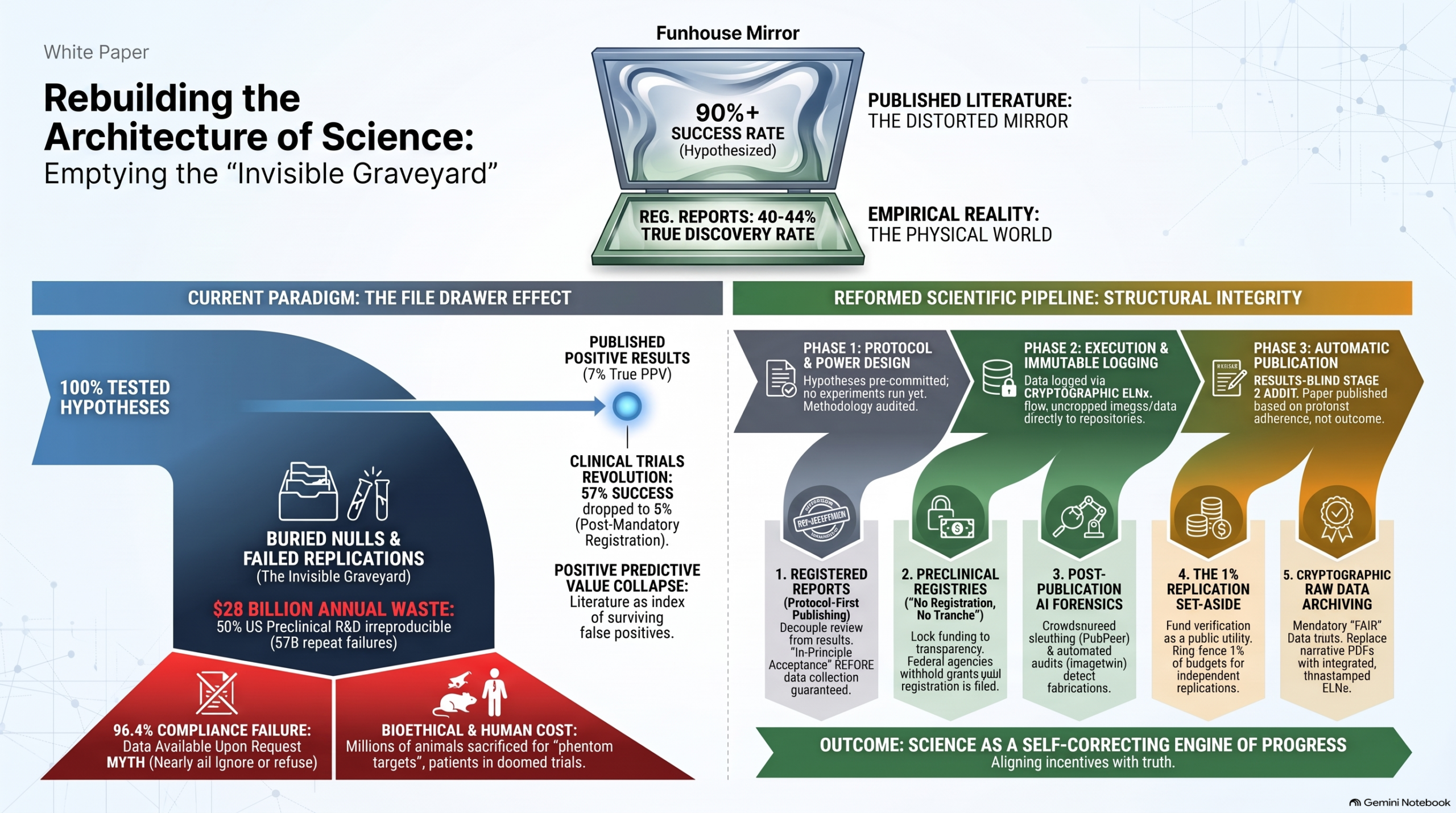
The global scientific enterprise is currently experiencing an institutional market failure characterized by the “file drawer effect.” Because academic journals, funding agencies, and hiring committees systematically reward novel, positive, and statistically clean results, failed replications and null findings are suppressed. This selective reporting creates an “invisible graveyard” of unpublishable data, effectively breaking the empirical feedback loop. The resulting “funhouse mirror” of literature presents an artificial distribution where over 90% of hypotheses appear validated, despite mathematical models suggesting a true baseline of only 20% to 40%.
The consequences of this failure are catastrophic and quantifiable. In the United States alone, approximately $28 billion is squandered annually on irreproducible preclinical research. This includes “redundant secondary waste”—estimated at $7 billion—where dozens of independent laboratories expensively repeat the same failed experiments in total isolation because prior failures were never published. Beyond financial loss, this system facilitates bioethical violations through the unnecessary sacrifice of millions of research animals and the funneling of terminally ill patients into clinical trials built on “preclinical artifacts.”
To restore scientific integrity, a structural overhaul of the research supply chain is required. This briefing document outlines five core interventions: Registered Reports, mandatory preclinical registries, crowdsourced auditing infrastructure, dedicated funder-level replication mechanisms, and mandatory raw data archiving.
- The Epistemological Crisis: The “Funhouse Mirror” Effect
The integrity of scientific literature depends on its Positive Predictive Value (PPV)—the probability that a significant finding reflects a true relationship. When the publishing ecosystem selectively buries null results, the literature ceases to reflect reality and instead becomes an index of surviving statistical false positives.
Mathematical and Statistical Proofs of Distortion
- The Ioannidis Transformation: In discovery science (e.g., biomarker screens), where pre-study odds are low, the combination of underpowered studies and publication bias leads to a PPV of less than 7%.
- The “p-Hacking Cliff”: Editorial enforcement of a binary publication barrier at p < 0.05 creates a mathematical discontinuity. Investigators utilize “degrees of exploratory freedom” (dropping outliers, switching endpoints) to force test statistics over the threshold (z \ge 1.96), leading to severe effect-size inflation known as “The Winner’s Curse.”
- Evolutionary Selection for “Bad Science”: Institutional rewards (grants, tenure) are tethered to publication volume. Laboratories using low-effort, low-sample-size protocols can publish faster and more frequently than rigorous labs. Over time, the ecosystem selects for laboratories running fast, low-rigor, high-false-positive protocols, while rigorous labs suffer attrition.
Comparative Literature Outcomes
Metric Standard Published Literature Registered Reports Literature
First-Hypothesis Support Rate ~90% to 96% (Severe bias) ~40% to 44% (Reflects reality)
Statistical Power ~50% average \ge 90% mandated
Incidence of p-Hacking Systemic / Undetectable Structurally impossible
Citation Impact Baseline (1.0x) 1.2x to 1.5x higher
- The Economic and Human Cost of Silent Failures
The suppression of negative results is not an abstract academic concern; it results in the industrial-scale destruction of capital, animal lives, and human talent.
Macroeconomic Loss
- Primary Waste: Approximately 50% of annual US preclinical expenditures ($28 billion) produce non-replicable claims.
- Redundant Secondary Waste (W_{sec}): This occurs when disconnected external laboratories attempt to build upon or validate a flawed study. If a single false-positive paper in a high-impact journal leads 15 labs to spend 250,000 each on follow-up, the secondary waste (3.75M) dwarfs the cost of the original study.
Bioethical and Human Capital Attrition
- The “Reduction” Failure: Under the Three Rs of animal research, scientists must minimize the number of animals sacrificed. The “invisible graveyard” violates this; millions of rodents are subjected to invasive procedures for targets that other institutions have already quietly disproved.
- Epistemic Gaslighting: Graduate students and postdocs often assume personal technical incompetence when they fail to replicate high-profile literature. This “trainee imposter paradox” drives rigorous methodologists out of the field while rewarding “storytellers” who massage data.
- Clinical Failures: In fields like ALS and Alzheimer’s, thousands of patients have been enrolled in Phase II/III trials for drugs (e.g., minocycline, celecoxib) that preclinical labs already knew were unviable, but whose failures were never indexed.
- The Dual Engines of Scientific Distortion
Two reinforcing forces compromise the integrity of the scientific record: bottom-up industrial fraud and top-down academic gatekeeping.
Engine 1: Bottom-Up Templated Paper Mill Fraud
Commercial paper mills treat academic literature as a mass-assembly line, selling authorship slots for $500 to $10,000.
- “Mad-Libs” Architecture: Mills use modular manuscript skeletons, swapping interchangeable variables (e.g., swapping [microRNA-124] for [lncRNA-MALAT1] in [Cancer Cell Line Y]).
- Synthetic Image Recycling: Forensic sleuths have identified signatures like the “Tadpole” Western blot bands—unnatural, comma-shaped defects caused by digital smoothing tools—used across hundreds of unrelated papers.
- Nonsense Reagents: Algorithmic screening has revealed hundreds of publications containing targeting sequences (siRNA/primers) with zero homology to the genes they claim to silence.
Engine 2: Top-Down Career Anchoring and Academic Feudalism
Entrenched scientific elites protect their prestige and grant pipelines by suppressing dissenting replications.
- The Reputational Sunk Cost: A prominent PI with decades of federal grants and biotech spin-outs views an independent disproof of their model as an existential threat to their enterprise.
- Weaponizing Peer Review: Reviewers use the “Bad Hands” accusation—claiming a replicating lab lacks the “tacit knowledge” or “surgical delicacy” to isolate a phenomenon—to dismiss null results.
- The “Amyloid Cabal” Case: For 30 years, alternative Alzheimer’s theories (tau pathology, neuroinflammation) were systematically denied funding by NIH study sections dominated by amyloid researchers, despite 99.6% of amyloid-clearing drug trials failing.
- Historical Case Studies of Empirical Collapse
Case Study The Foundational Claim The Reality in the “Graveyard” Final Resolution/Cost
SOD1-ALS Over 100 compounds extended life in mice. ALS TDI audit (2014) showed 0 out of 100 compounds worked when controlled for litter/gender. $500M to $1B in clinical capital vaporized; trials failed universally.
SIRT1 / Resveratrol Resveratrol directly activates the longevity enzyme SIRT1. Independent biophysicists realized the “activation” was an optical artifact of a fluorescent dye (Fluor de Lys). GSK acquired Sirtris for 720M; eventually shut down the facility with >1B lost.
5-HTTLPR Gene A serotonin gene polymorphism dictates depression risk under stress. Biobank analysis (N=621,214) in 2019 proved the association was an absolute null. 16 years and hundreds of millions in psychiatric grants squandered on an artifact.
Cardiac Stem Cells c-kit+ cells regenerate heart muscle after injury (Anversa Lab). Dissenting labs found c-kit+ cells form blood vessels, not muscle; critiques were blocked by Anversa-led study panels. Harvard requested 31 retractions; DOJ settlement of $10M for grant fraud.
- The Structural Solutions: A Five-Point Blueprint
To restore empirical parity between initial discovery and independent verification, the ecosystem must transition from narrative novelty to empirical transparency.
- Registered Reports and Results-Blind Publishing
The Registered Reports (RR) format splits peer review into two stages:
- Stage 1: Methods and power analysis are reviewed before data collection. If approved, the journal issues In-Principle Acceptance (IPA).
- Stage 2: After the study is done, reviewers only audit adherence to the protocol.
- Impact: RR instantly eliminates the file-drawer graveyard for null results, with hypothesis support rates falling to a realistic ~44%.
- Mandatory Preclinical and Laboratory Registries
Modeled after ClinicalTrials.gov, federal agencies (NIH/NSF) should enforce a “No Registration, No Tranche” policy.
- Mechanism: The second tranche of a multi-year grant is withheld until a verified URL linking to a public registration (e.g., AnimalStudyRegistry.org) of all proposed animal protocols is filed. This prevents “moving the goalposts” or concealing failed arms.
- Crowdsourced Sleuthing and AI Forensics
The static peer-review system must be replaced by a dynamic, decentralized audit network.
- PubPeer Integration: Browser extensions should inject high-visibility banners over papers on PubMed or Google Scholar to warn researchers of suspected gel duplications or failed replications.
- AI Forensics: Scientific publishers must mandate algorithmic image screening (e.g., Imagetwin or Proofig) at the submission portal to detect rotated, stretched, or spliced bands invisible to the human eye.
- Dedicated Funder-Level Replication Mechanisms
The grant industry currently allocates 100% of budgets to exploratory discovery.
- The 1% Replication Set-Aside: Federal agencies should ring-fence 1% of their annual budgets (approx. $470M for NIH) to fund an Office of Independent Scientific Validation.
- Phase-Gate Replications: No molecular target developed in an academic lab should be approved for human trials until an independent, contracted facility has executed a blinded, preregistered direct replication.
- Mandatory Raw Data and Immutable Notebook Archiving
Meta-research shows a 96.4% compliance failure rate for papers stating “Data available upon request.”
- FAIR Data Architecture: Research must expand from a PDF narrative into a Data-Code-Narrative Unit.
- Cryptographic ELNs: Research institutions should be required to use append-only Electronic Lab Notebooks with cryptographic timestamping. Any retroactive data curation or “curve-fitting” would create an audit trail that instantly flags misconduct.
- Realignment Metric: The Replication Index (r-index)
To align individual self-interest with the public good, promotion and tenure committees must discard the Journal Impact Factor in favor of the Replication Index (r-index):
r_i = \log_{10} \left( \frac{\sum \text{Replicated Claims}i + 1}{\sum \text{Disconfirmed Claims}i + 1} \right) + \sum{k=1}^{M} w_k \cdot R{\text{audit}}^{(k)}
Under this metric, PIs are rewarded for the replicability of their primary claims and for conducting independent replications of others’ work. A researcher who manufactures fragile, non-replicable discoveries would see their r-index drop, signaling risk to university boards and grant study sections.