1. Architectural Vision: Transitioning to Spherical Resilience
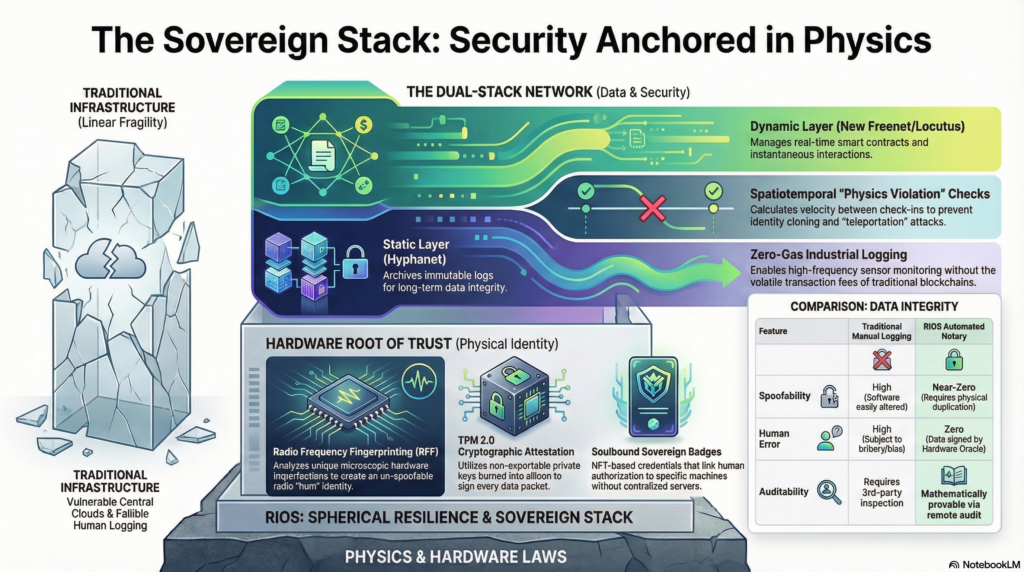
The current industrial paradigm is defined by “Linear Fragility”—a systemic dependence on brittle, long-distance power lines and centralized data centers that constitute single points of failure. The Rural Infrastructure Operating System (RIOS) executes a shift toward “Spherical Resilience,” where infrastructure is deconstructed into self-sustaining nodes capable of autonomous operation. By establishing decentralized, sovereign nodes, RIOS ensures that critical utility and data functions remain viable even when national backbones are severed.
This resilience is operationalized through the Trinity Stack, a tripartite framework governing the survival of decentralized civilization:
- Electrons (Agra Energy): Waste-to-energy plasma gasification providing unbreakable base-load power.
- Intelligence (RIOS): The decentralized logic kernel and intelligence layer managing secure mesh communication.
- Logistics (DeReticular Academy/Mobility): The orchestration of human capital and autonomous transit, such as Kurb Kar pods, to move goods across the mesh.
The core objective of the Sovereign Stack is to resolve the “Oracle Problem.” In decentralized systems, the digital ledger is often blind to physical reality; RIOS solves this by anchoring digital truth in physical atoms, utilizing the laws of physics as the ultimate notary for industrial data.
2. Layer 0: The Hardware Root of Trust (HRoT)
In decentralized industrial environments, software-based identity is insufficient to prevent Sybil attacks. RIOS establishes a Hardware Root of Trust (HRoT) that binds identity to the immutable physical properties of silicon and radio circuitry.
Radio Frequency Fingerprinting (RFF)
RIOS utilizes Radio Frequency Fingerprinting (RFF) to create an un-spoofable digital passport for every hardware device. Using Software Defined Radio (SDR), the node captures raw I/Q samples of incoming signals to perform spectral fingerprinting. The system analyzes the “Turn-On Transient” (the first few microseconds of transmission) and measures microscopic manufacturing imperfections, such as carrier frequency offset, modulation errors, and oscillator drift. These “Radio Accents” are unique to specific analog components and cannot be replicated by software, providing a forensic-level hardware hash.
TPM 2.0 Attestation
Data integrity is reinforced via TPM 2.0 Attestation. Each node contains a Trusted Platform Module (TPM) with a non-exportable private key (K_{priv}) burned into the silicon at the factory. This hardware-bound key is used to sign all data payloads, providing mathematical certainty that the information originated from a specific, physically verified device.
| Parameter | Traditional Software Identity | RIOS Hardware Identity |
| Spoofability | High; software credentials easily duplicated. | Near-Zero; requires physical replication of analog physics. |
| Human Bias | High; subject to manual error or bribery. | Zero; data is signed by the “Hardware Oracle.” |
| Auditability | Requires 3rd-party physical verification. | Mathematically provable via remote cryptographic audit. |
Hardware physics acts as the ultimate notary, ensuring a Trustless Chain of Custody from the point of ingestion before data ever reaches the broader network.
3. Layer 1: Bifurcated Network Topology (The Dual-Stack)
Industrial infrastructure requires a balance between immutable archival history and low-latency state management. RIOS implements a “Dual-Stack” approach, running two distinct decentralized protocol daemons in parallel.
- Stack A: Hyphanet (Legacy Freenet): Acts as the “Static Layer” or system “Hard Drive.” It provides high-redundancy, censorship-resistant storage for firmware binaries, repair manuals, and audit logs. It utilizes Content Hash Keys (CHKs), ensuring that even a single-bit change in a file renders it invalid, thus protecting the system against malicious firmware injections.
- Stack B: New Freenet (Locutus/2023): Acts as the “Dynamic Layer” or system “CPU.” This layer utilizes WebAssembly (Wasm) smart contracts for real-time state management, including voltage logs, energy credits, and active user sessions.
The New Freenet operates on a Zero-Gas Model. By eliminating the volatile transaction fees that define the “Plutocracy” of traditional blockchains, RIOS remains economically accessible to small-scale rural producers while allowing for the high-frequency logging required for industrial compliance.
4. Identity Architecture: The Human-Machine Orchestration
RIOS utilizes a “Dual-Entity Model” to distinguish between the rigid reliability of machines and the fluid intent of human operators.
The Automated Notary (Machine Identity)
The machine is the rigid actor. Every data packet is signed by the TPM and verified against the device’s RFF signature. This ensures that when a node reports energy generation, the market can verify the origin without human interference.
The Sovereign Badge (Human Identity)
Human operators utilize Sovereign Badges, which are Soulbound NFTs (RIOS-721 standard) issued by the DeReticular Academy. These badges are locked to the individual’s cryptographic wallet and cannot be traded, serving as proof of certified competence.
The Human-Machine Handshake
Accessing a RIOS node requires a 5-phase handshake:
- Discovery: The operator’s tablet discovers the node via a BLE or Local WiFi beacon.
- Channel: A secure WebSocket channel is established.
- Challenge: The node issues a cryptographic nonce.
- Approval: The operator provides biometric approval (FaceID/Fingerprint) on their tablet to access the private key stored in the Secure Enclave.
- Verification: The tablet signs the nonce, and the node verifies the signature and Sovereign Badge against the revocation list on Freenet.
This creates a Dual-Signed Object. For example, a maintenance shutdown creates a “Signed Silence” log, where the downtime is authorized by both the machine’s TPM and the human’s Sovereign Badge, preserving the trustless chain of custody for global markets.
5. Spatiotemporal Logic and Global Identity Polling
RIOS applies the laws of physics to prevent “Physical Double-Spending,” where a hardware identity is spoofed to appear in two locations simultaneously.
Global Identity Polling
RIOS manages identity uniqueness via Distributed State Contracts on the New Freenet (Locutus) Distributed Hash Table (DHT). When a device attempts to connect, the node queries the specific peers maintaining that identity’s hash to verify its current state (e.g., “Active” or “Locked”).
Physics Violation Detection
If an identity is active at a remote node, RIOS performs a spatiotemporal check using the Haversine distance (\Delta d) and the Time Delta (\Delta t): V_{req} = \Delta d / \Delta t If the required velocity (V_{req}) exceeds the maximum believable velocity (V_{max}), the system detects a Physics Violation (impossible travel) and locks the identity. To prevent Wormhole Attacks (tunneling traffic between nodes), RIOS utilizes Verifiable Delay Functions (VDFs) to enforce a computational cost on signal propagation.
Exit Visa and Provenance
RIOS enforces Topology Awareness through an Exit Visa system. When a device leaves a node’s range, that node signs a cryptographic “exit visa.” The next node verifies this visa to ensure a contiguous physical path. RIOS utilizes Zero-Knowledge Proofs (specifically zk-SNARKs) to prove this path integrity without exposing the user’s full GPS history.
6. Operational Resilience: “Island Mode” and Compliance
The architecture is designed for “Island Mode,” maintaining functionality when the global internet is severed.
Fallback Protocol
During mesh partitioning, nodes utilize cached provenance logs and regional keys. Once connectivity is restored, local state changes are merged with the global contract using Conflict-Free Replicated Data Types (CRDTs).
Strategic Compliance
RIOS satisfies the “non-repudiation” mandates of Global Transparency Standards, such as the EU Deforestation Regulation (EUDR). Because logs are published to Hyphanet’s static layer, they cannot be retroactively altered or deleted. By linking RFF/TPM signatures to GPS data, RIOS transforms the “Oracle Problem” into a hardware-based solution for global trade.
7. Strategic Risk Analysis and Deployment Roadmap
The RIOS Sovereign Stack represents the frontier of decentralized infrastructure, though it currently utilizes alpha-stage protocols.
SWOT Analysis
- Strengths: Resolves the Oracle Problem; Zero-Gas economic model; “Island Mode” resilience.
- Weaknesses: Reliance on experimental software (Locutus/2023); high technical complexity for initial setup.
- Opportunities: Critical fit for EUDR and DePIN sectors; potential to set the standard for “Physical Truth.”
- Threats: Regulatory hostility toward decentralized encryption; AI-driven Deepfake RFF spoofing as signal processing advances.
Implementation Gaps
- The “Empty OS” Problem: A lack of diverse user-facing applications at the current stage.
- HMI Complexity: The need to simplify cryptographic key management for non-technical rural users.
- Hardware Fragility: Physical identity is subject to analog drift over time; sensors may require recalibration to maintain RFF integrity.
The “Flood the Forge” initiative is the primary strategic vehicle for closing the developer gap. By anchoring digital intelligence in the immutable laws of physics, the RIOS Dual-Stack Architecture establishes the “Physical Truth” necessary for the next iteration of industrial civilization.