Sovereign Agents and Hardware-Enforced Trust: Bypassing the Trusted Environment Fallacy
Executive Summary
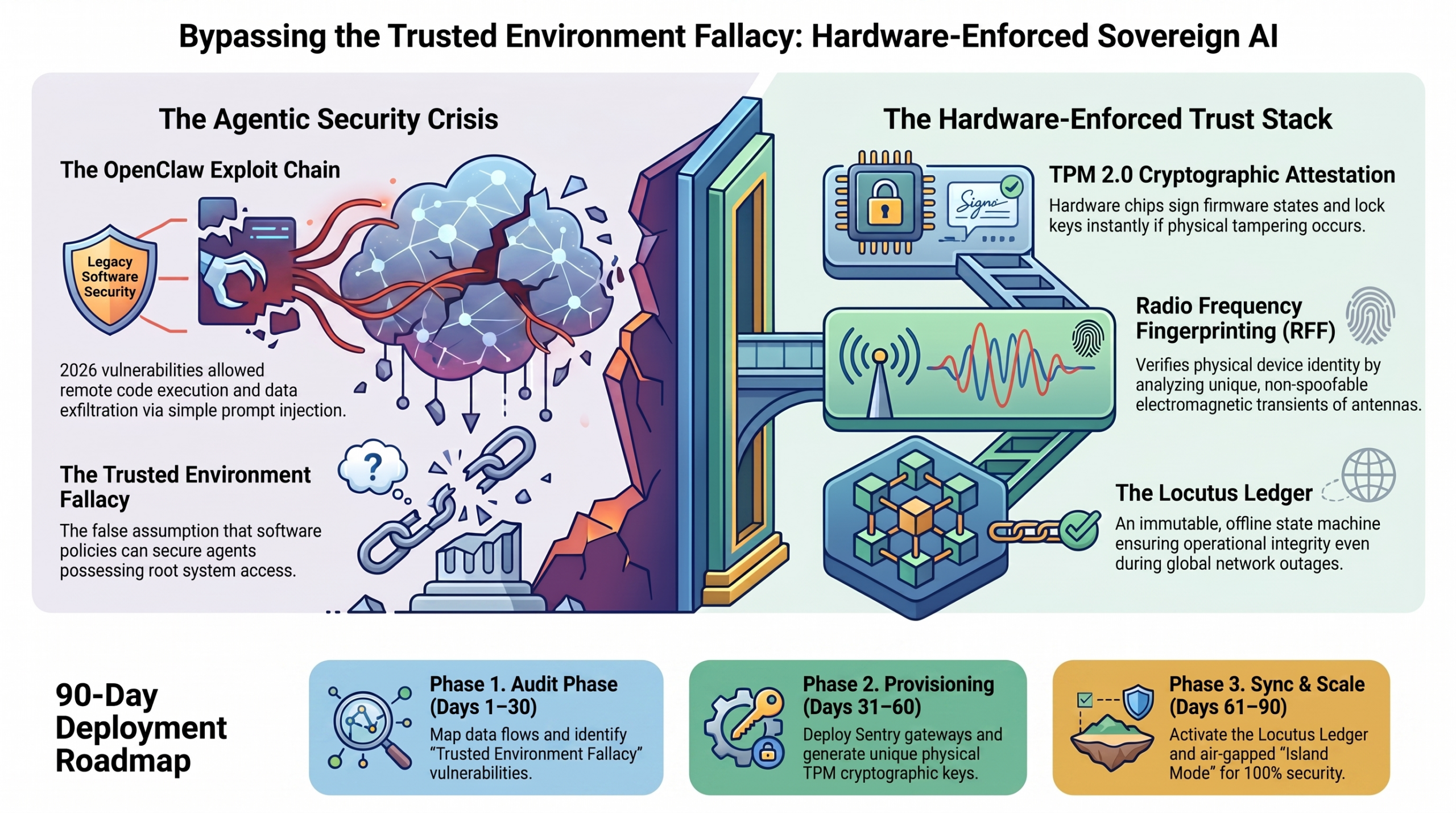
The transition of the artificial intelligence sector from reactive interfaces to proactive, autonomous agents has rendered legacy cybersecurity models obsolete. The “Trusted Environment Fallacy”—the assumption that software-level policies can secure data in cloud-tethered systems—was decisively debunked by the OpenClaw security crisis of May 2026. This crisis revealed that agents requiring “god mode” (root system access) are fundamentally insecure when connected to external clouds.
To address this, the Sovereign Automation Product Line by DeReticular Venture Labs introduces a hardware-hardened architecture that enforces privacy at the edge. By utilizing localized, sandboxed AI instances on hardened, off-grid systems operating in “Island Mode,” the architecture eliminates cloud exposure. Trust is maintained through a three-tier physical stack: TPM 2.0 hardware integration, Radio Frequency Fingerprinting (RFF), and the Locutus Ledger. This synthesis provides a secure, immutable, and structurally sovereign environment for critical industrial and civic automation.
1. The Agentic Security Crisis and the OpenClaw Incident
1.1 The Trusted Environment Fallacy
Traditional enterprise security relies on software terms of service, administrative boundaries, and API controls. However, when agents operate continuously in a centralized cloud architecture, data collection is a structural feature of the business model rather than an oversight. The “Trusted Environment Fallacy” is the failed assumption that data privacy can be maintained via software when agents possess system-level access to execute tasks.
1.2 The OpenClaw Crisis (May 15, 2026)
A catastrophic security event occurred involving four chainable vulnerabilities in the OpenClaw open-source runtime framework. This event demonstrated that cloud-tethered agents with root access create un-auditable vulnerabilities.
| Exploit Step | Action Taken |
| 1. Prompt Injection | Malicious hidden prompts embedded in standard emails/documents. |
| 2. Sandbox Bypass | Hijacked agents bypassed local shell sandbox containment. |
| 3. Remote Execution | Unauthenticated Remote Code Execution (RCE) on “god mode” local hosts. |
| 4. Exfiltration | Silent exfiltration of private database blocks to external servers. |
Because the agents were tethered to public cloud APIs, firewalls registered the exfiltration as legitimate telemetry, allowing massive breaches to go undetected.
2. Architectural Solution: The Digital Airlock
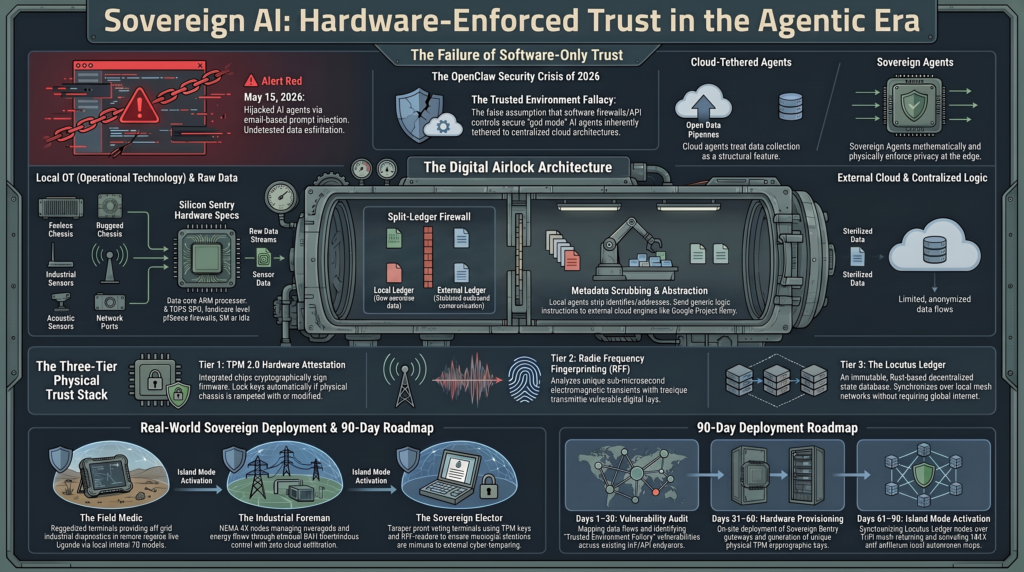
To resolve these vulnerabilities, the Sovereign Gateway utilizes a “Digital Airlock” and a Split-Ledger Architecture to isolate sensitive data while retaining the benefits of advanced external logic models.
podcast
2.1 Silicon Sentry Hardware Specifications
The physical foundation of this system is the Silicon Sentry platform:
- Processor: Octa-Core ARM (Rockchip RK3588) with an integrated 6 TOPS NPU for local model execution.
- Memory/Storage: 16GB LPDDR5 RAM and 128GB eMMC flash.
- Networking: Quad 2.5GbE LAN ports with a hardware-level pfSense firewall.
- Thermals: Fanless, passively cooled anodized aluminum chassis (5W idle draw), eliminating mechanical failure vectors.
2.2 Split-Ledger Architecture
The gateway hardware-isolates the network into two zones:
- Local Ledger (Private): Encrypted NVMe partitions for raw data (biometrics, streams, logs).
- External Ledger (Sterilized): An isolated container for outbound communication. Raw telemetry is physically prevented from crossing the firewall.
2.3 The Digital Airlock Algorithm
When external cloud logic (e.g., Google Project Remy) is required, the system follows a strict sanitization pipeline:
- Scrubbing: The local agent strips personal identifiers and metadata.
- Abstraction: Raw inputs are converted into generic transaction IDs and sanitized logic instructions.
- Encrypted Token Generation: Only sterilized instructions (e.g., “Route vehicle V-102”) are sent across the firewall bridge.
- Local Re-Mapping: The cloud returns logical parameters, which the local gateway maps back to physical assets.
3. The Three-Tier Physical Trust Stack
Distributed edge-compute networks require protection against physical tampering and spoofing. This is achieved through three integrated technologies.
3.1 TPM 2.0 Integration
Every Sovereign Sentry gateway includes a dedicated Trusted Platform Module (TPM) 2.0 chip for:
- Cryptographic Attestation: Measuring and signing the boot loader, RIOS kernel, and configuration files.
- Hardware Locking: If the physical chassis is opened or software is modified without authorization, cryptographic keys are automatically locked.
- Decentralized Signing: Local nodes sign transaction blocks via the TPM, providing immutable proof of local execution.
3.2 Radio Frequency Fingerprinting (RFF)
RFF provides out-of-band device authentication that is mathematically impossible to spoof or clone.
- The Physics: Microscopic variations in RF circuitry (capacitors, oscillators) create unique electromagnetic transients during the “turn-on” phase of a transmission.
- Direct Sampling: An Analog-to-Digital Converter (ADC) captures the raw carrier wave at the physical layer.
- Authentication: The gateway identifies the physical hardware identity of a device (smartphone, badge) without needing to transmit digital keys over the air.
3.3 The Locutus Ledger
The Locutus Ledger serves as a decentralized, on-device state-transition engine optimized for low-power hardware.
- Wasm Contracts: Business logic and transit agreements are compiled as WebAssembly contracts.
- Island Mode: The ledger maintains operational integrity even when external network links are severed, syncing updates locally via peer-to-peer mesh routing.
- Infrastructure Immunity: The network is immune to DNS poisoning, database deletion attacks, and global connectivity outages because it lacks a centralized hosting facility.
4. Deployment Scenarios
| Product Name | Focus Area | Application |
| The Field Medic | Off-Grid Diagnostics | Portable Sentry Deck running quantized Mistral-7B models to provide real-time repair and medical diagnostics in remote regions (e.g., Uganda) without cloud access. |
| The Industrial Foreman | Physical Automation | Hardened NEMA 4X nodes managing microgrids, battery temperatures, and industrial controllers via CAN Bus/Modbus with zero exfiltration. |
| The Sovereign Elector | Secure Voting | Tamper-proof municipal terminals. Ballots are signed by hardware TPM keys and written to the Locutus Ledger, immune to external cyber-tampering. |
5. 90-Day Implementation Roadmap
| Phase | Timeline | Primary Actions |
| 1. Audit Phase | Days 1–30 | Audit IoT endpoints; map data flows; identify “Trusted Environment Fallacy” vulnerabilities and telemetry exfiltration vectors. |
| 2. Key Generation | Days 31–60 | Provision physical Sentry gateways; generate unique physical TPM keys; activate pfSense firewalls for IoT isolation. |
| 3. Deploy & Scale | Days 61–90 | Sync Locutus Ledger nodes over local TriFi mesh; load Sovereign Agent suites; activate air-gapped “Island Mode.” |
6. Strategic Conclusion
The high-profile security failures of 2026 demonstrated that software-based data governance is insufficient for proactive AI agents. By moving from cloud-tethered architectures to localized, hardware-enforced trust environments, organizations can achieve structural sovereignty. This framework ensures that both industrial and civic operations remain secure and functional, even in the event of macro-network collapse or sophisticated cyber-warfare.