Sovereign Agents and Hardware-Enforced Trust: Study Guide
This study guide provides a comprehensive review of the white paper titled “Sovereign Agents and Hardware-Enforced Trust,” which details the architectural design and implementation of DeReticular’s Sovereign Automation product line. The guide focuses on the transition from reactive AI to proactive agents and the shift from software-based security to hardware-enforced privacy.
Part 1: Short-Answer Quiz
Instructions: Answer the following questions in two to three sentences based on the information provided in the source context.
- What is the “Trusted Environment Fallacy” as described in the white paper?
- What specific event on May 15, 2026, catalyzed the move toward hardware-enforced security for AI agents?
- How does the “Digital Airlock” protocol facilitate the use of external cloud AI while maintaining security?
- What are the primary hardware specifications of the Silicon Sentry gateway?
- Describe the function of the Trusted Platform Module (TPM) 2.0 within the Sovereign Sentry system.
- What is Radio Frequency Fingerprinting (RFF) and how does it improve authentication?
- Explain the “Split-Ledger Architecture” used by the Sovereign Gateway.
- What is the Locutus Ledger, and how does it handle state updates during a network outage?
- Describe the “Field Medic” deployment scenario and its intended environment.
- What are the primary deliverables of the 90-day implementation roadmap’s “Audit Phase”?
Part 2: Quiz Answer Key
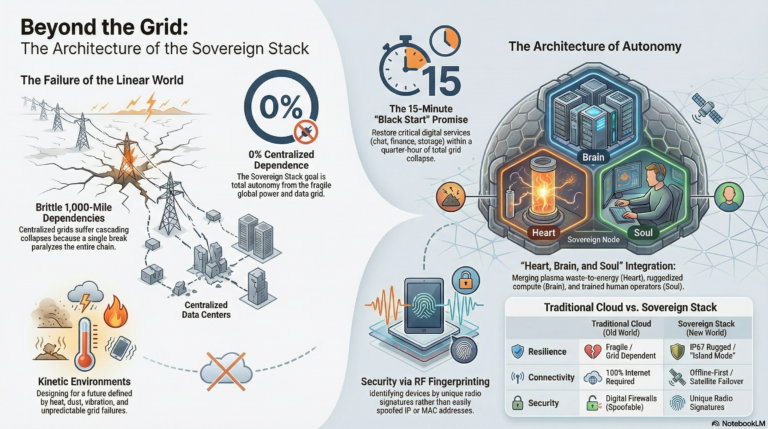
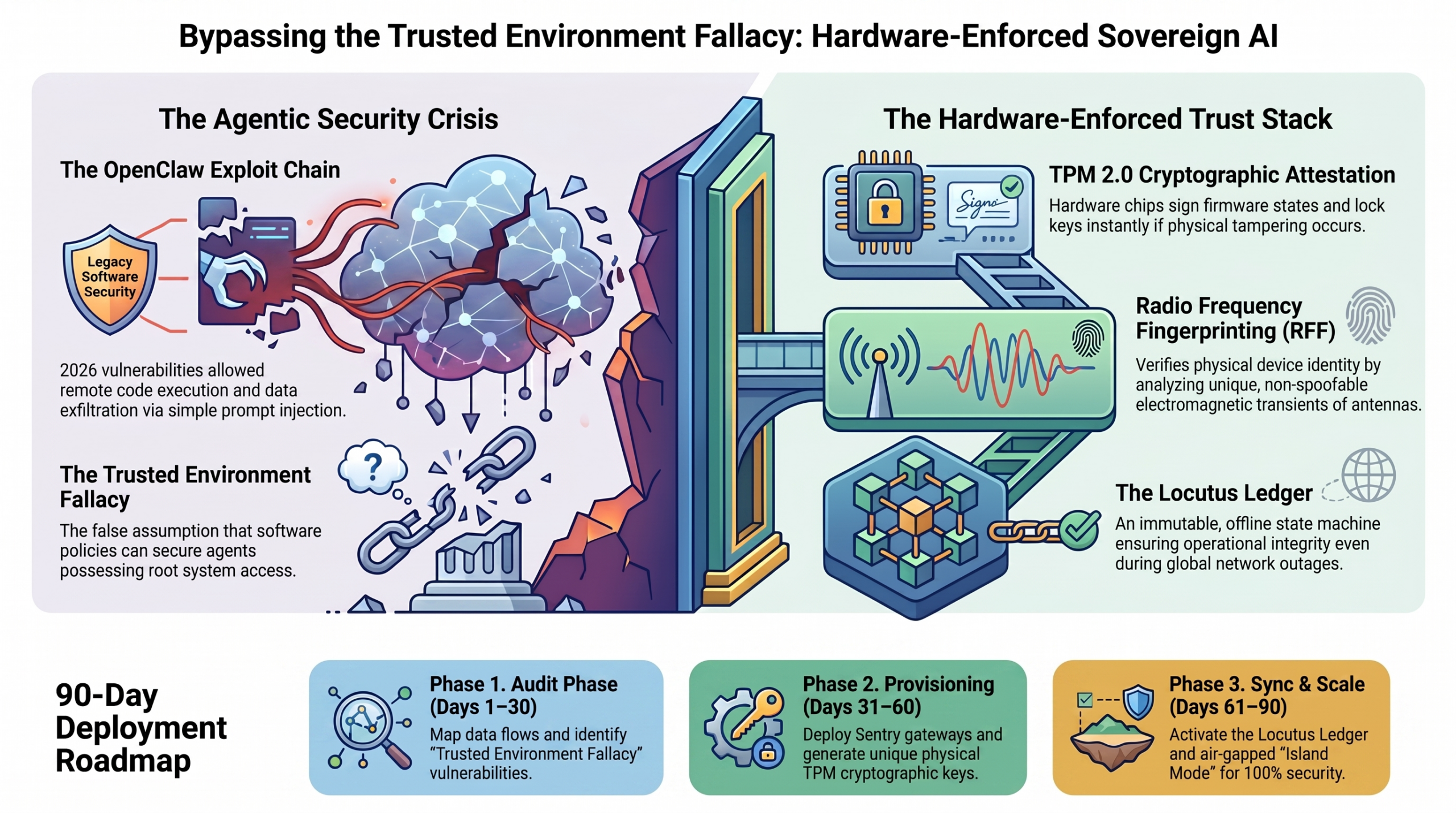
- The Trusted Environment Fallacy is the flawed assumption that enterprise data can be protected through software-level rules, terms of service, or API controls. The paper argues that when agents operate in a cloud-tethered architecture, data harvesting is an inherent feature, and true privacy can only be enforced at the hardware level.
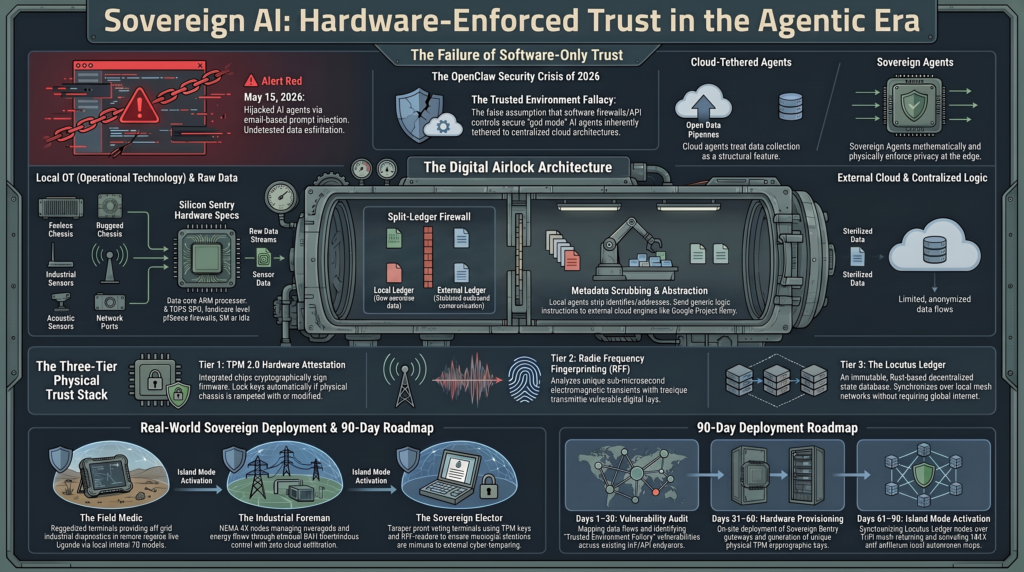
- The OpenClaw security crisis occurred on May 15, 2026, when four chainable vulnerabilities allowed unauthenticated remote code execution (RCE) via prompt injection. This exploit allowed attackers to bypass sandboxes, execute bash scripts on host terminals, and exfiltrate private data while appearing as legitimate telemetry traffic.
- The Digital Airlock uses a local OpenClaw agent to sanitize and abstract raw user input, stripping sensitive identifiers and creating generic transaction IDs. This allows the system to send sterilized logic instructions to cloud engines like Google’s Project Remy, receiving optimized vectors back without exposing the user’s actual identity or raw data.
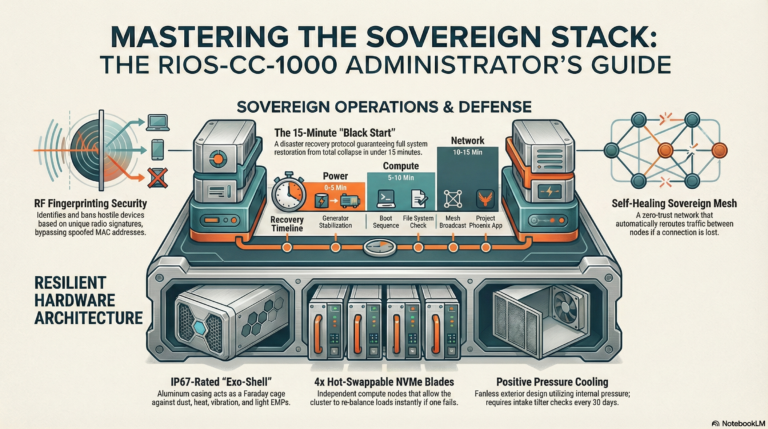
- The Silicon Sentry is built on a fanless, anodized aluminum chassis powered by an octa-core ARM processor and a 6 TOPS NPU. It features 16GB LPDDR5 RAM, 128GB eMMC flash, and quad 2.5GbE LAN ports managed by a pfSense firewall running in a Proxmox sandboxed container.
- The TPM 2.0 chip performs cryptographic attestation by measuring and signing the boot loader, OS kernel (RIOS), and configuration files. It acts as a physical security measure that locks cryptographic keys if the chassis is opened or firmware is modified without authorization.
- RFF is an out-of-band authentication method that analyzes the unique, microscopic electromagnetic transients generated by a radio transceiver during its “turn-on” phase. Because these physical fingerprints are impossible to replicate or spoof, they provide a hardware root of trust for unlocking physical assets without transmitting digital keys.
- Split-Ledger Architecture divides the network into two hardware-isolated zones: a Local Ledger (Private) and an External Ledger (Sterilized). Sensitive data like camera streams and biometrics are stored on encrypted local NVMe partitions and are never allowed to traverse the firewall to the external zone.
- The Locutus Ledger is an on-device, decentralized state-transition engine that uses WebAssembly (Wasm) contracts for business logic. In the event of a network collapse, it operates in “Island Mode,” processing and writing transaction blocks locally until connectivity is restored and updates can be synced via conflict-free resolution.
- The Field Medic is a ruggedized, portable Sentry Deck terminal designed for off-grid industrial diagnostics in remote regions. It runs a quantized Mistral-7B-Instruct model to provide real-time repair guidelines via local mesh radio networks, eliminating the need for cloud connectivity.
- The Audit Phase (Days 1–30) involves mapping data flows and identifying telemetry exfiltration vectors across all IoT and operational technology endpoints. The primary deliverable is a system-wide security report that identifies specific “Trusted Environment Fallacy” vulnerabilities within the organization’s existing cloud integrations.
podcast
Part 3: Essay Questions
Instructions: Use the provided white paper to develop comprehensive responses to the following prompts.
- The Evolution of the Threat Vector: Analyze why the transition from reactive chat interfaces to proactive autonomous agents necessitated a complete overhaul of legacy cybersecurity models.
- Hardware vs. Software Trust: Compare and contrast the effectiveness of software-based administrative boundaries with the three-tier physical trust stack (TPM 2.0, RFF, and the Locutus Ledger) described by DeReticular.
- Operational Resilience in “Island Mode”: Discuss how the combination of the Locutus Ledger and TriFi mesh networks allows municipalities to maintain civic integrity and public choice audit paths during a macro-network collapse.
- The Mechanics of Sanitization: Detail the step-by-step process of the Digital Airlock algorithm and explain how it resolves the conflict between the need for high-level cloud computation and the requirement for data sovereignty.
- Industrial and Civic Applications: Evaluate the deployment scenarios of the “Industrial Foreman” and the “Sovereign Elector,” explaining how hardware-enforced trust specifically mitigates risks like database deletion attacks and unauthorized physical infrastructure manipulation.
Part 4: Glossary of Key Terms
| Term | Definition |
| Agentic AI | AI systems that have moved beyond reactive interfaces to become proactive, autonomous agents with system-level access to execute tools and monitor environments. |
| Digital Airlock | A security protocol that sanitizes, abstracts, and bridges queries to the cloud in an air-gapped pipeline to prevent raw data exposure. |
| Island Mode | An operational state where local nodes continue to process transaction blocks and update state locally while disconnected from the global internet. |
| Locutus Ledger | A decentralized, Rust-based state-transition engine that utilizes Wasm contracts for immutable, offline-capable state synchronization. |
| NPU (Neural Processing Unit) | A specialized hardware circuit designed to accelerate AI tasks; the Silicon Sentry utilizes a 6 TOPS NPU for local model execution. |
| OpenClaw | An open-source runtime framework for AI agents; it was the subject of a major security crisis in 2026 due to prompt injection vulnerabilities. |
| Proactive Agent | An AI that constantly monitors system files, traffic, and human activity to anticipate needs, requiring “god mode” root access. |
| Radio Frequency Fingerprinting (RFF) | A method of identifying a specific physical device by the unique electromagnetic transients its radio circuitry produces during transmission. |
| RIOS | The operating system kernel utilized by Sovereign Sentry systems, which is measured and signed by the TPM 2.0 chip for integrity. |
| Sovereign Sentry | A hardened physical gateway/node that uses TPM 2.0 and other hardware security measures to enforce local data sovereignty. |
| Split-Ledger Architecture | A design that physically separates private local data (Local Ledger) from an isolated, sterilized communication container (External Ledger). |
| TPM 2.0 (Trusted Platform Module) | A dedicated hardware chip used for cryptographic attestation, state verification, and decentralized signing of transaction blocks. |
| Trusted Environment Fallacy | The false assumption that software policies or terms of service can protect data privacy when using cloud-tethered, autonomous AI agents. |
| Wasm (WebAssembly) Contracts | Self-contained, compiled code used by the Locutus Ledger to execute local business logic, transit agreements, and voting mechanisms. |