Sovereign Embodied AI and Robotic Infrastructure Networks: A Comprehensive Study Guide

This study guide provides a detailed synthesis of the engineering blueprints, strategic frameworks, and technical specifications for building Sovereign Embodied AI systems using Common Off-the-Shelf (COTS) components. It focuses on the transition from cloud-dependent robotics to decentralized, air-gapped “Island Mode” architectures.
Part I: Knowledge Assessment Quiz
Instructions: Provide short-answer responses (2–3 sentences) for each of the following questions based on the provided source context.
- What is the defining objective of a Sovereign Embodied AI architecture? The defining objective is absolute physical and computational independence, where the system performs autonomous perception, decision-making, and control without relying on external cloud infrastructure, internet connectivity, or proprietary APIs. This ensures that the machine remains operational and secure even if external networks or geopolitical supply chains are disrupted.
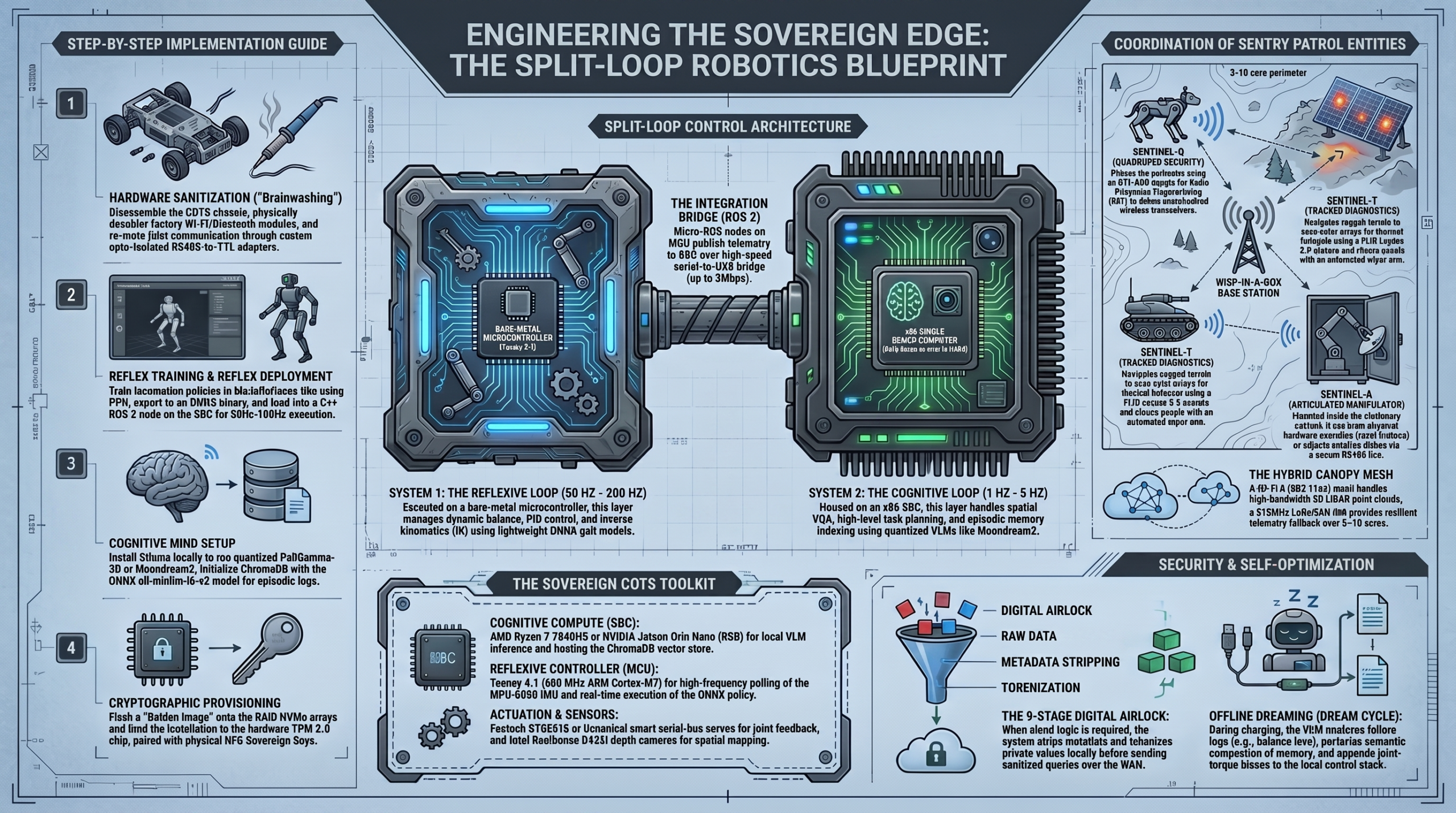
- Explain the “Dilemma” of localized Vision-Language-Action (VLA) models and how the split-loop control scheme resolves it. The dilemma lies in the trade-off between reasoning depth and control latency; abstract cognitive commands take hundreds of milliseconds to process, while physical balance requires commands every 10 to 20 milliseconds. The split-loop solution separates these into “System 2” for slow cognitive reasoning (1–5 Hz) and “System 1” for fast physical reflexes (50–200 Hz).
- Describe the “Sanitization Protocol” (also known as “Brainwashing”) used by DeReticular. This protocol involves physically disassembling COTS hardware to remove proprietary Wi-Fi, Bluetooth, and cellular modules that might contain hidden telemetry trackers. Factory joint controllers are wiped and re-flashed with open-source, audited firmware to ensure the hardware is secure at the physical layer and cannot communicate with unauthorized external servers.
- What role does the Locutus Ledger play in a Robotic Infrastructure Network (RIN)? The Locutus Ledger is a decentralized, Rust-based local state machine that uses WebAssembly (Wasm) smart contracts to immutably log all physical actions, navigation paths, and maintenance reports. It provides “Proof of Labor” and cryptographic auditing, ensuring that all robotic activities are securely recorded on-premise to prevent unauthorized data tampering.
- How does “Action-as-Language” tokenization function in Google DeepMind’s RT-2 model? RT-2 treats robotic movements as discrete text tokens within a single transformer architecture by discretizing 8-dimensional action spaces into 256 bins. These bins are mapped to existing numeric tokens or overwritten vocabulary tokens, allowing the model to output a string of “action words” that are then de-tokenized into continuous vectors to drive the robot’s joints.
- What is the purpose of the “Digital Twin Engine” housed on the Sentry Pro base station? The Digital Twin Engine maintains a real-time, 3D spatial representation of the environment using an optimized physics simulator like MuJoCo. It allows the system to pre-run and cryptographically verify kinematic paths before they are executed, identifying potential collision risks or physical failures in a virtual space first.
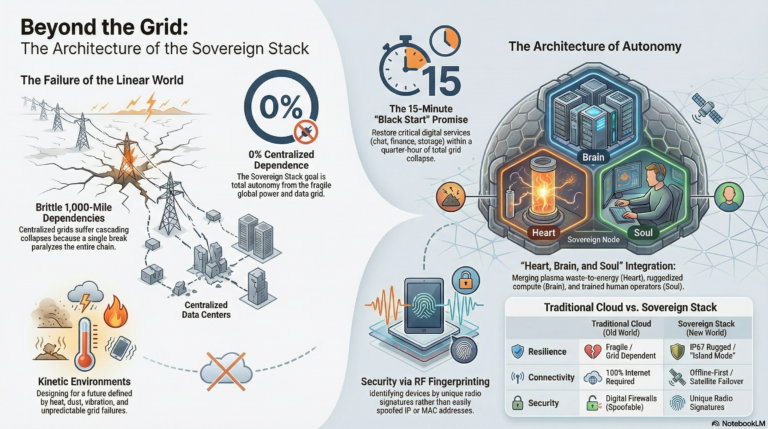
- Define the “Island Mode” paradigm in the context of Spherical Resilience. Island Mode refers to a state of absolute computational self-reliance where a robotic node requires zero active internet connections to perceive, plan, or balance. It represents the pinnacle of Spherical Resilience, where the security boundary wraps the compute, storage, power, and action entirely within the physical shell of the machine.
- What are the emergent properties observed in the RT-2 model that were not explicitly present in its robotic training data? RT-2 exhibits capabilities such as symbol and icon recognition (e.g., recognizing a recycling logo), semantic reasoning (e.g., picking a “healthier” snack), and rudimentary physics understanding (e.g., identifying the “smallest” block). It can also perform Chain-of-Thought reasoning to identify makeshift tools, such as using a rock as a hammer.
- Describe the “Offline Dreaming” (Self-Improvement Loop) routine. Triggered when the robot is charging, this routine involves the local VLM analyzing the day’s episodic logs to identify failures and redundancies. The system then consolidates the local database and automatically appends systemic correction factors, such as motor biases, to compensate for physical asymmetries or past errors.
- What is the “Digital Airlock” protocol and when is it utilized? The Digital Airlock is a 9-stage hardware-enforced protocol used when a sovereign agent must query an external high-capacity cloud for non-critical computations. It strips all raw sensor coordinates and metadata, replacing them with anonymous tokens, so the cloud only processes raw logic while the original sensitive context remains stored locally.
Part II: Quiz Answer Key
- Objective: Physical/computational independence without external APIs or cloud.
- Split-Loop: Separates slow cognitive “System 2” (planning) from fast reflexive “System 1” (balance).
- Sanitization: Physical removal of wireless modules and flashing open-source firmware.
- Locutus Ledger: Cryptographic local log of actions using Rust/Wasm smart contracts.
- RT-2 Tokenization: Discretizes actions into 256 bins represented as text tokens in a transformer.
- Digital Twin: Real-time physics simulation for pre-verifying movements and avoiding collisions.
- Island Mode: Absolute self-reliance where a node functions without any network connection.
- Emergent Properties: Icon recognition, semantic reasoning, rudimentary physics, and Chain-of-Thought actions.
- Dreaming: Local VLM analyzes failure logs and compresses data during charging for self-optimization.
- Digital Airlock: A multi-stage process for anonymizing and tokenizing data before sending queries to a cloud.
Part III: Essay Format Questions
The following questions are designed for deeper analysis and do not include provided answers.
- The Crisis of 2026: Analyze the impact of the OpenClaw Security Crisis on the “Trusted Environment Fallacy.” How did this event redefine the relationship between physical infrastructure and cloud-dependent AI?
- System 1 vs. System 2 Hierarchy: Compare the computational requirements and frequencies of the Reflexive Loop and the Cognitive Loop. Discuss why this biological analogy is essential for localizing AI in dynamic physical environments.
- Economic Viability of Sovereign AI: Evaluate the Bill of Materials (BOM) and labor costs for the DeReticular Sentry Patrol. Does the $9,499 MSRP represent a sustainable model for municipal or industrial operators when compared to traditional proprietary systems?
- Geopolitical Drivers: Discuss how regional strategies, such as those of China or the India-UAE alliance, are shaping the move toward localized physical foundation models. What are the implications for global supply chain decoupling?
- Technical Bottlenecks: Identify the primary gaps between the 2026 “Current State” and the “Sovereign Ideal.” Focus on the challenges of VLM inference latency, mobile power density, and long-term data storage.
Part IV: Glossary of Key Terms
Term Definition
BESS Battery Energy Storage System; in this context, 1.5 kWh LiFePO4 banks used for stationary power.
COTS Common Off-the-Shelf; mass-produced hardware components available to the general public.
Digital Airlock A 9-stage security protocol that strips sensitive metadata from data before it leaves a local network.
Episodic Memory A local database (like ChromaDB) that stores logs of past robotic experiences as searchable vectors.
GGUF A file format used for storing quantized models, optimized for local inference on edge hardware.
Island Mode A system state of absolute computational self-reliance requiring zero active internet connections.
LoRaWAN A low-frequency (915MHz) telemetry link used as a resilient fallback for lightweight robotic signals.
NPU Neural Processing Unit; specialized silicon designed to accelerate AI inference tasks locally.
ONNX Open Neural Network Exchange; a format used to export simulation-trained policies for local execution.
OpenClaw An open-source, autonomous agentic orchestration layer used to manage sovereign AI tasks.
Quantization The process of compressing large AI models (e.g., from 16-bit to 4-bit) to run on low-power edge hardware.
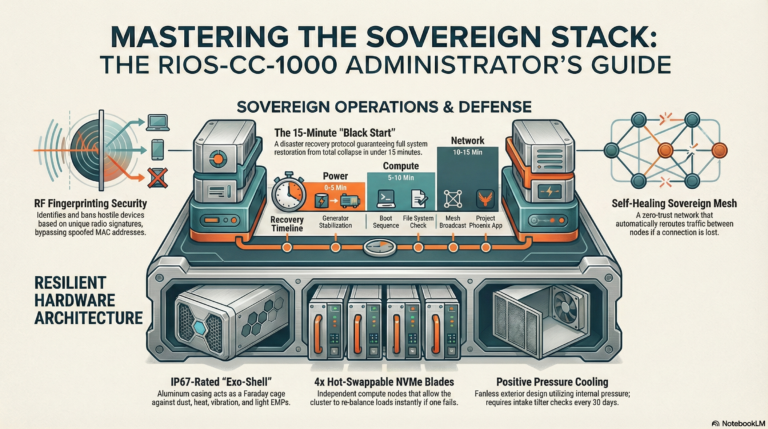
RF Fingerprinting Identifying wireless devices based on unique physical hardware characteristics rather than software IDs.
RIN Robotic Infrastructure Network; a decentralized mesh of autonomous entities coordinated by a local core.
ROS 2 Robot Operating System 2; a middleware framework used to bridge System 1 and System 2 communications.
Sovereign AI AI where an organization maintains end-to-end ownership of data, foundational models, and compute.
Spherical Resilience A security geometry where each individual node functions as a self-contained, independent unit.
VLA Vision-Language-Action; models that process visual and linguistic inputs to produce direct motor actions.
VLM Vision-Language Model; an AI model (like PaliGemma or Moondream) that interprets images and text.
WISP-in-a-Box A turnkey micro-ISP kit (SKU: RIOS-KIT-WISP) used as the networking anchor for a RIN node.