White Paper – The Architecture of Ecological Integrityy A Technical and Strategic White Paper on the Global Carbon Credit Industry and the Sovereign Stack
podcast
- Executive Summary & Abstract
Abstract
This white paper analyzes the systemic trust and operational structural gaps
within the global carbon credit market. It outlines a technological blueprint to
transition the environmental commodity market from unverified, model-derived
emission avoidance credits to hardware-secured, mathematically verified physical
carbon removals.
The current voluntary carbon market (VCM) is constrained by a “trust deficit”
driven by opaque monitoring, verification loopholes, and centralized database
vulnerabilities [16, 21]. This paper introduces the Sovereign Stack—an
integrated ecosystem of edge hardware, localized artificial intelligence, and
decentralized cryptographic ledgers—as a structural solution [8].
Through empirical evaluation of physical attestation frameworks, real-time edge
computing on neural processing units (NPUs), and decentralized physical
infrastructure networks (DePIN), we demonstrate a method for establishing
un-spoofable ecological integrity [8, 17, 26].
Finally, this paper analyzes the regulatory divergence between United States
federal de-regulatory actions and state-level compliance frameworks, positioning
localized cryptographic verification as the only viable mechanism for
institutional-grade risk mitigation [16].
video
TRADITIONAL VCM vs. THE SOVEREIGN STACKTraditional MRV (Fragile, Retrospective)
[Physical Crop] ──► [Manual Audit] ──► [Satellite Proxy] ──► [Central Cloud DB]
│
Vulnerable to tampering
Sovereign Stack (Resilient, Attested)
[Physical Crop] ──► [Sovereign Deck + AI] ──► [TPM 2.0 Sign] ──► [Locutus P2P Ledger]
│
Cryptographically Secure
- The Macroeconomic Foundations: Why the Carbon Credit Industry Exists
Macroeconomic Theory and Negative Externalities
At its economic foundation, carbon pricing is a policy mechanism designed to
resolve a fundamental market failure: the unpriced negative externality of
greenhouse gas (GHG) emissions. When an industrial process emits carbon dioxide
(\text{CO}_2) or methane (\text{CH}_4), it imposes a social cost (climate
degradation, public health impacts, infrastructure damage) that is not reflected
in the private cost of production.
According to Pigou (1920), resolving this externality requires a corrective tax
equal to the marginal social cost of the damage, thereby forcing polluters to
internalize the externality
(MC_{\text{social}} = MC_{\text{private}} + \text{Tax}).
Conversely, Coase (1960) posited that if property rights are well-defined and
transaction costs are zero, private parties can bargain to achieve an efficient
allocation of resources regardless of the initial allocation of property rights.
The cap-and-trade system operates as a hybrid Coasain-Pigouvian mechanism:
regulators establish a legally binding emissions cap (defining property rights
for a limited volume of pollution allowances) and permit a market to discover
the marginal cost of abatement through trading.
\text{Social Cost} = \int_{0}^{Q} (MC_{\text{private}} + \text{Marginal External Cost}) \, dQ
Compliance vs. Voluntary Markets: 2026 Structural Realities
The global carbon credit industry is structured into two distinct market
systems:
Compliance Carbon Markets (CCMs) Voluntary Carbon Market (VCM)
• Scale: $107B+ (2025 Metric) • Scale: ~$1.68 Billion
• Price: Globally Divergent • Pricing: Bifurcated by Quality
– Global Avg: ~$21/tCO2e • Legacy Avoidance: <$5/tonne
– Europe: ~$68/tCO2e • Nature Removals (ARR): $22-$35/tonne
– North America: ~$43/tCO2e • Blue Carbon: $20-$60/tonne
• Coverage: 29% of global emissions • Engineered CDR: $115-$1,000+/tonne
The compliance carbon market (CCM)—comprising Emissions Trading Systems (ETS)
and carbon taxes—is the primary engine of global carbon finance. CCMs generated
over $107 billion in revenue, covering 29% of global GHG emissions across 87
active policies [16].
Within compliance markets, the pricing of emissions is highly divergent [16].
The global average compliance carbon price sits at ~21/tCO_2\text{e} [16].
Regionally, however, the disparity is stark: the European Union ETS commands an
average price of ~68/tCO_2\text{e}, driven by strict cap reductions and the
phase-in of the Carbon Border Adjustment Mechanism (CBAM) [16]. North American
markets (such as the California Cap-and-Trade program and the Regional
Greenhouse Gas Initiative) average ~43/tCO_2\text{e}, while the Asia-Pacific
region averages ~19/tCO_2\text{e} [16].
In contrast, the Voluntary Carbon Market (VCM) operates globally without
government-mandated caps, valued at approximately $1.68 billion [16]. The VCM is
currently undergoing a “flight to quality” bifurcation [16].
Legacy avoidance credits—derived from projects that claim to prevent
deforestation (REDD+) or support early-stage grid-connected renewable
energy—have experienced a collapse in buyer confidence, with prices dropping
below $5/tonne due to integrity concerns [16].
Conversely, high-integrity nature-based removals, such as Afforestation,
Reforestation, and Revegetation (ARR), command premiums of $22 to
35/tonne** [16]. Blue Carbon credits (derived from coastal mangrove and salt marsh restoration) trade at **20
to $60/tonne [16].
Engineered Carbon Dioxide Removal (CDR) pathways, which provide high permanence,
trade from $115 to over $1,000/tonne depending on the technology [16].
The Transition from Avoidance to Removal
The structural bifurcation of the VCM reflects a macroeconomic shift: the market
is recognizing that carbon avoidance credits are fundamentally different assets
than carbon removal credits. Avoidance credits rely on counterfactual baselines
(estimating emissions that would have occurred without the project). This
introduces substantial subjectivity, model manipulation, and impermanence risks.
True climate stabilization requires carbon removal—the physical extraction of
\text{CO}_2 from the atmosphere and its long-term isolation from the carbon
cycle.
For the global environmental commodity market to mature, accounting frameworks
must treat one ton of physically captured and geologically or biophysically
stored carbon as the only valid unit of carbon credit.
- The Structural Gaps: Deconstructing the “Trust Deficit” & Sourcing Bottlenecks
The Verification Chasm (Traditional MRV vs. dMRV)
The integrity of the carbon credit market is constrained by its dependency on
traditional Monitoring, Reporting, and Verification (MRV) protocols.
Conventional MRV is a retrospective, manual, and paper-based process [16, 21].
Forestry audits, for example, typically rely on manual plot sampling (using
measuring tapes to estimate tree diameter) conducted at 5-year intervals by
third-party auditors. These localized measurements are then extrapolated across
vast project boundaries using satellite-derived canopy height proxies.
This model introduces several vulnerabilities:
- High Measurement Uncertainty: Satellite imagery cannot accurately measure
under-canopy biomass, forest degradation, or soil organic carbon. - Temporal Latency: Because audits are conducted retrospectively, credit
over-issuance, tree mortality, or fraud is often discovered years after the
offsets have been retired. - High Administrative Costs: The overhead of manual validation can consume up
to 30% of project revenues, rendering small-scale, community-led projects
financially unviable.
Digital MRV (dMRV) aims to close this chasm by using automated, high-frequency,
on-site telemetry, IoT sensors, and edge-based optical computing [8, 16, 21].
However, dMRV requires a trusted hardware layer to ensure that the data captured
at the physical source has not been altered before it reaches the registry [21].
The Linear Fragility Gap
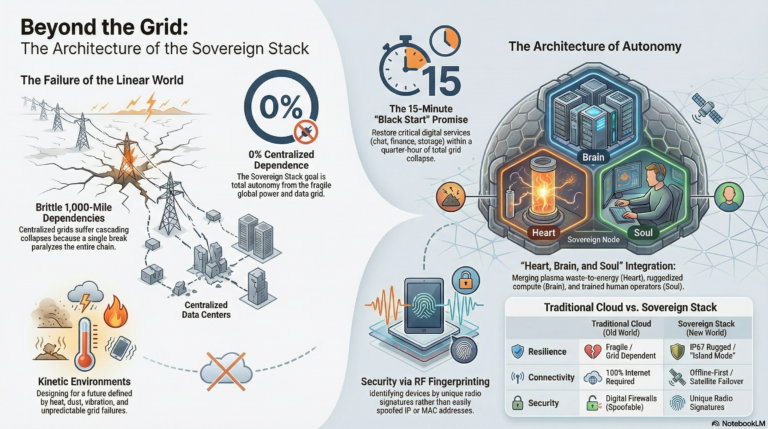
Most compliance and voluntary carbon registries are built on centralized,
cloud-dependent databases. This architecture introduces a vulnerability we
define as linear fragility:
[Central Cloud Database] ──► Subject to insider database manipulation.
──► Vulnerable to DNS hijacking & spoofing.
──► Single point of failure during regional internet blackouts.
If the centralized database or its host server is compromised, the ledger’s
integrity collapses. Administrative databases are vulnerable to retroactive
editing by corrupt actors, allowing retired credits to be duplicated or
double-spent.
Furthermore, DNS hijacking can reroute buyers to replica registries, resulting
in false transaction logs.
For projects in remote, off-grid regions (such as Sub-Saharan Africa or the
Amazon Basin), continuous cloud access is frequently interrupted by telecom
failures or state-directed internet shutdowns, isolating local developers from
global verification networks [8].
The Sourcing Bottleneck (Feedstock Integrity in BCR & BECCS)
The shift toward high-durable engineered removals has created an acute sourcing
bottleneck [16, 24]. Biochar Carbon Removal (BCR) and Bioenergy with Carbon
Capture and Storage (BECCS) systems command premium prices ($115 to $220/tonne)
because they physically lock carbon into stable forms [16, 24]. However, these
systems are highly sensitive to feedstock origin [24].
FEEDSTOCK VERIFICATION METRICSSustainable Organic Waste (Compliant) Virgin Forest Wood (Non-Compliant)
• Agricultural residues (Hemp hurd) • Illegal logging
• High carbon density • Carbon-neutral baseline violated
• Verified zero-carbon input • Major reputational risk to buyer
If a biochar pyrolysis kiln processes illegally logged timber or wood sourced
from clear-cut virgin forests, the net lifecycle emissions of the credit become
positive, violating carbon-neutral baselines and exposing the buyer to severe
reputational and legal risks.
Furthermore, processing contaminated feedstocks (such as construction wood
treated with copper, chromium, or arsenic) produces toxic biochar that pollutes
agricultural soils.
Traditional paper-manifest tracking is easily falsified, and retrospective lab
testing of biochar cannot reliably identify the specific origin of the inputs,
creating a critical bottleneck at the industrial intake point.
The Capital Access Gap
Under current market structures, carbon finance rarely reaches the local
smallholders and Indigenous Peoples and Local Communities (IPLCs) who manage
carbon-sequestering land [16]. This is driven by high entry barriers,
centralized financial intermediaries, and a lack of collateral.
Agricultural communities in developing nations produce millions of tonnes of
carbon-rich agricultural waste (such as corn stover, bagasse, and hemp stalks)
[23]. If left to decompose, this biomass releases methane and carbon dioxide,
returning zero economic value to the farmer.
Because commercial banks do not accept piles of agricultural biomass as
collateral, this potential carbon-negative resource remains dead capital.
Without localized, off-grid financial infrastructure that can verify and
monetize biomass on-site, the capital allocated for carbon offsets remains
concentrated in the hands of international brokers and project developers [16].
- The Sovereign Stack: A Technological Blueprint for Hard Physical Attestation
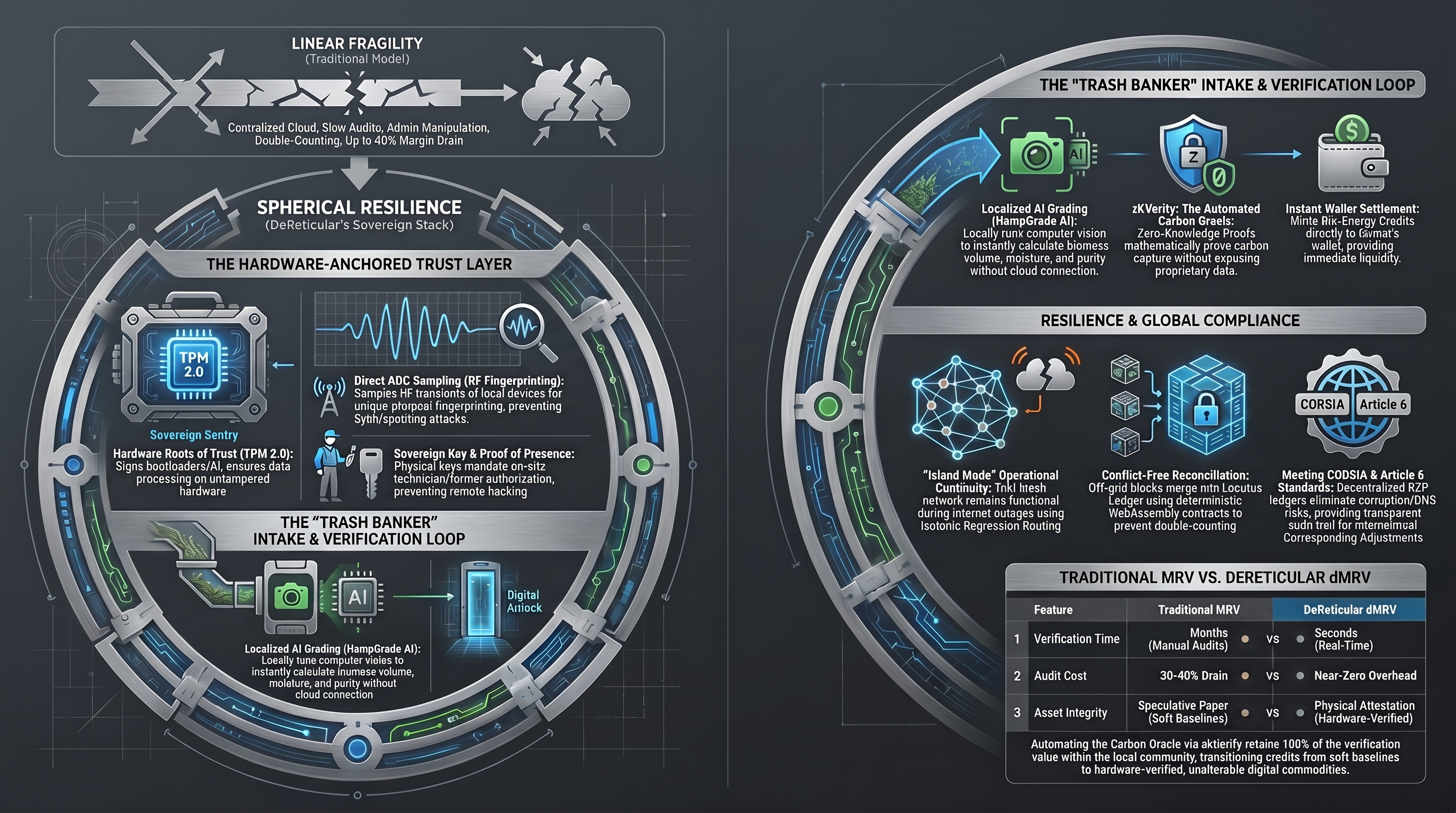
DeReticular’s Sovereign Stack is designed to address these systemic
vulnerabilities by integrating edge hardware, decentralized ledger networks, and
cryptographic security [8].
CRYPTOGRAPHIC DATA AUTHENTICATION[Edge Input: Biomass Camera Scan]
│
▼ (Raw Frame & Metadata)
[HempGrade AI Inference (6 TOPS NPU)] ──► Local validation of crop grade/volume.
│
▼ (TPM 2.0 Kernel Measurement)
[System State Attestation] ─────────────► Verifies RIOS software integrity.
│
▼ (Operator Touch-Auth)
[Sovereign Key Signature] ──────────────► Binds physical presence to transaction.
│
▼ (WebAssembly State Contract)
[Locutus Ledger (Freenet P2P)] ─────────► Immutable state entry on-chain.
The Local Sensing Layer: Sovereign Deck & HempGrade AI
The Sovereign Stack’s local verification layer begins with the Sovereign Deck
(Field Terminal) running HempGrade AI [21].
- The Hardware: The Sovereign Deck is an IP65-rated, ruggedized industrial
tablet equipped with an Intel Celeron N5100 processor, 8GB DDR4 RAM, and an
integrated Software Defined Radio (SDR). - The Software: Running a hardened Kali Linux (Field Edition) operating
system, the Deck executes HempGrade AI locally [21]. - The Edge Inference: To avoid reliance on cloud APIs, HempGrade AI uses
lightweight neural networks (compiled in TensorFlow Lite format) to perform
real-time optical analysis of agricultural biomass directly on the device
[21].
The model analyzes macro-images of harvested biomass (such as hemp hurd or
agricultural waste) to determine:
- Volumetric Space Density: Calculates the spatial volume of the feedstock.
- Moisture Concentration: Estimates water-weight fractions to determine the
exact dry-matter mass. - Contamination Detection: Scans for non-organic foreign matter (plastics,
stones, metal).
This edge-computed analysis allows the Deck to determine the precise carbon
fraction and overall grade of the crop on-site, operating entirely in “Island
Mode” without cellular or cloud connectivity [8].
The Hardware Trust Anchor: TPM 2.0 & Sovereign Badge
To ensure the integrity of edge-computed data, the Sovereign Stack implements a
hardware-enforced trust anchor [19, 21].
TPM 2.0 ATTESTATION LOOP[Power On] ──► [TPM 2.0 measures BIOS & Bootloader]
│
▼
[RIOS Kernel Booted] ──► [TPM 2.0 measures Kernel State]
│
▼
[HempGrade AI Executed] ──► [TPM 2.0 measures model weights]
│
▼
[Attestation Key (AK) signs system state measurement hashes]
Every Sovereign Deck and Sentry Pro node integrates a physical Trusted Platform
Module (TPM) 2.0 security chip [19].
- Cryptographic Attestation: Upon boot, the TPM 2.0 measures the system
firmware, bootloader, and the RIOS kernel state, storing these hashes in
platform configuration registers (PCRs). When HempGrade AI generates a
biomass reading, the TPM 2.0 cryptographically signs the measurement payload
along with the PCR states using its unique Attestation Identity Key (AIK).
This proves that the measurement was run on a secure, untampered operating
system with verified, unmodified model weights. - Sovereign Badge Authentication: To bind a physical operator to the
transaction, the terminal requires a physical tap from the operator’s
Sovereign Badge. This IP68-rated transponder contains an on-board Secure
Element (ATECC608B) storing the operator’s private Sovereign Key.
When tapped, the badge performs a cryptographic challenge-response protocol with
the terminal. The resulting Quality Certificate contains the biomass grade,
dry-weight calculation, GPS coordinates, and timestamp, all signed by the
TPM 2.0 and the operator’s Sovereign Key—establishing a tamper-proof “Hard
Physical Attestation” of the carbon asset [19, 21].
The P2P Ledger & Resilient Routing: Locutus Ledger & TriFi Mesh
Once a Quality Certificate is generated, it must be published to a registry
without relying on centralized databases. The Sovereign Stack utilizes the
Locutus Ledger (built on the Freenet/Hyphanet protocol) [8, 25].
- WebAssembly (Wasm) Contracts: Freenet operates as a decentralized key-value
store where the keys are WebAssembly (Wasm) contracts and the values
represent the contract state (ownership and verification logs of the carbon
assets) [25]. Written in Rust and compiled to Wasm, these contracts enforce
strict, unalterable rules for state transitions [25]. A carbon credit
contract, for example, will reject any state transition (transfer or
retirement) unless it is accompanied by a valid cryptographic signature from
the current owner’s Sovereign Key and the original TPM-signed Quality
Certificate [19, 21]. - TriFi Mesh Routing: In off-grid scenarios, Sovereign nodes communicate using
a local TriFi Mesh network [8]. The mesh utilizes performance-aware Isotonic
Regression routing to optimize packet transmission over low-bandwidth,
high-latency peer-to-peer radio connections [8]. This routing algorithm
dynamically prioritizes data streams based on real-time link quality,
ensuring that critical transaction updates are synchronized across the local
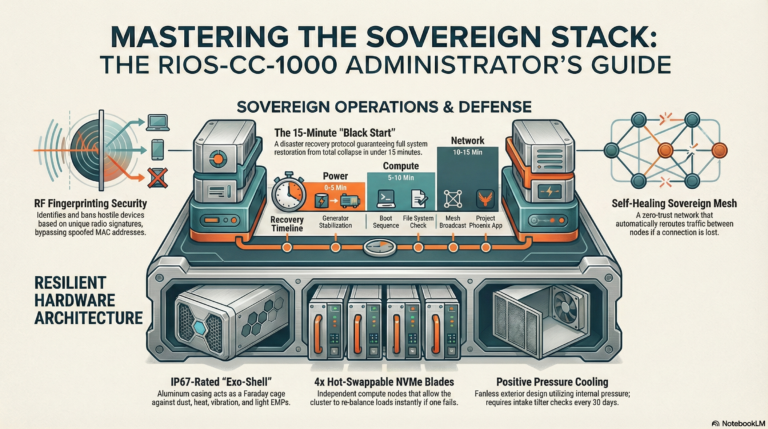
network without a direct internet connection [8]. - Direct ADC Sampling (Sybil Resistance): To protect the off-grid mesh from
Sybil attacks, the Sovereign Sentry Pro utilizes Direct Analog-to-Digital
Converter (ADC) Sampling of radio frequency carrier waves. Because every
radio transmitter has microscopic physical variations in its analog
circuitry, it produces a unique electromagnetic transient when transmitting.
The Sentry Pro samples this raw transient at the physical layer, generating
an un-copyable hardware fingerprint for each node in the mesh, preventing
virtual nodes from spoofing identity. - Conflict-Free State Resolution: When local networks operate in “Island Mode”
during a telecom outage, they process and store transactions locally on
their respective nodes [8]. When macro-network connectivity is restored, the
“islands” merge their off-grid transactions back into the global Locutus
Ledger using conflict-free state resolution [8]. Because every transaction
is a deterministic, Wasm-enforced contract state transition, the ledger
reconciles conflicting updates based on verified hardware timestamps,
natively eliminating double-spending and database desynchronization risks
[8].
- Localized DePIN Infrastructure: The “Trash Banker” at Node 4
Architectural Case Study: Project Umoja (Node 4)
To demonstrate the practical integration of this architecture, we analyze
Project Umoja (Node 4), a carbon-negative industrial park located in the Kaabong
District of northern Uganda [5, 23]. Kaabong is a remote, arid region
characterized by a fragile grid, high diesel costs, and zero access to
conventional financial banking.
Project Umoja was designed to bypass these infrastructural limits using
DeReticular’s Sovereign Stack [5, 23].
PROJECT UMOJA (NODE 4) OPERATIONAL TOPOLOGY┌─────────────────────────┐ ┌─────────────────────────┐ ┌─────────────────────────┐
│ 1. The Muscle │ │ 2. The Motion │ │ 3. The Mind │
│ (Agra Dot Energy) │ │ (Kurb Kars) │ │ (DeReticular RIOS) │
├─────────────────────────┤ ├─────────────────────────┤ ├─────────────────────────┤
│ Advanced Plasma │ │ Autonomous Logistics │ │ Sentry Pro Nodes │
│ Gasifiers. │ │ & Material Handling. │ │ & TriFi Mesh. │
└─────────────────────────┘ └─────────────────────────┘ └─────────────────────────┘
The industrial park combines three technical pillars [5, 23]:
- The Muscle (Agra Dot Energy): Employs high-temperature Plasma Gasification
systems to convert agricultural waste (specifically hemp hurd and corn
residues) into syngas, delivering 24/7 carbon-negative baseload power [23]. - The Motion (Kurb Kars): Utilizes small, autonomous, off-road logistics
vehicles to handle and transport raw biomass within the industrial zone. - The Mind (DeReticular RIOS): Controls the facility’s power microgrid,
logistics scheduling, and carbon asset accounting using Sovereign Sentry Pro
nodes and localized TriFi Mesh networking.
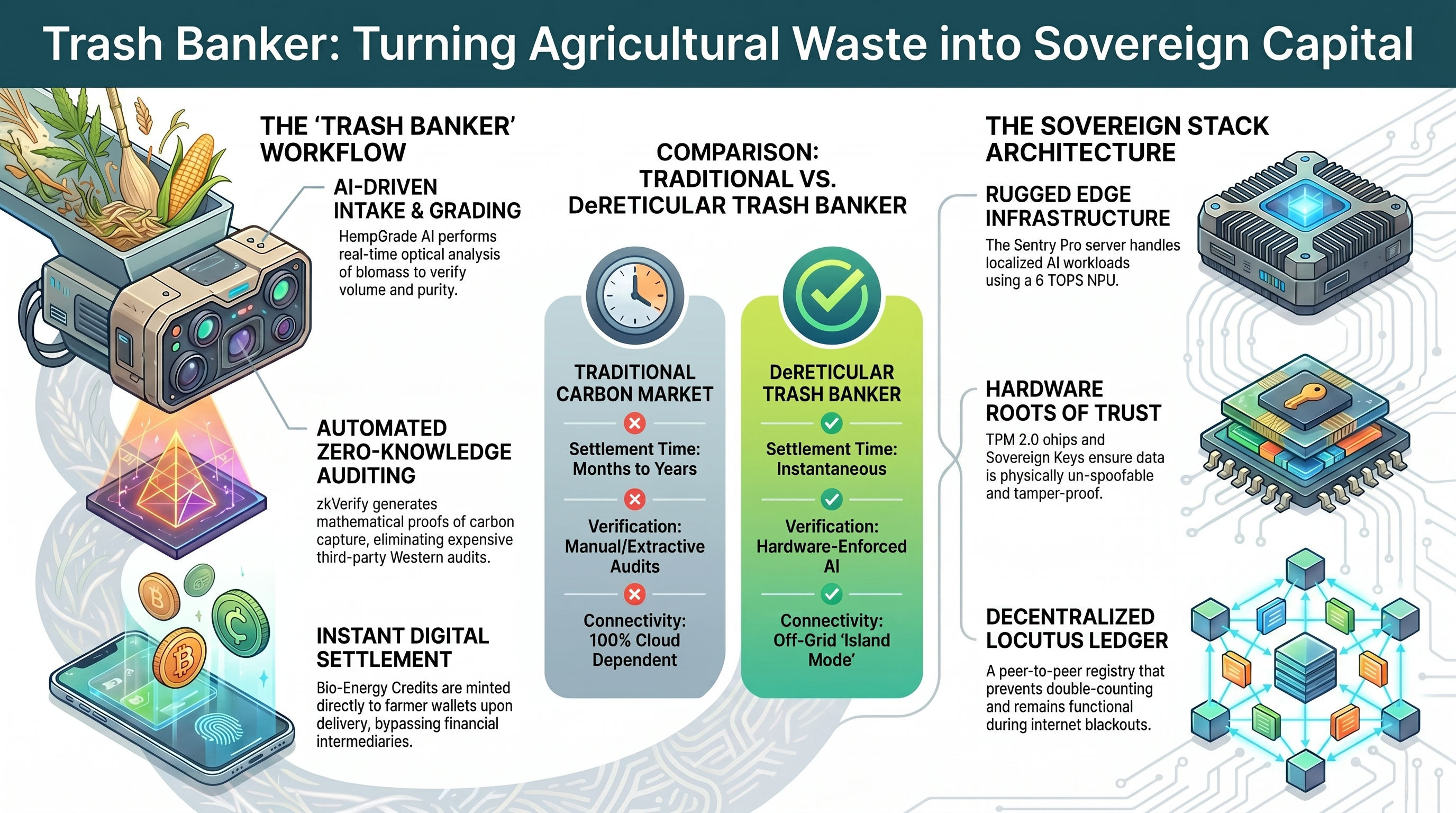
The “Trash Banker” Loop
The “Trash Banker” is the economic mechanism deployed at Node 4 to turn
agricultural crop waste into liquid financial assets for local smallholders
[23, 26].
THE "TRASH BANKER" TRANSACTING LOOP[Smallholder Farmer] ──► Delivers cart of raw agricultural hemp hurd (trash).
│
▼
[Intake Point Hopper] ───► Scanned by Sentry Pro running Industrial Foreman AI.
│
▼
[HempGrade AI Vision] ───► Verifies dry mass, quality, & carbon-negative potential.
│
▼
[Direct Settlement] ─────► Mints “Bio-Energy Credits” directly to farmer’s wallet.
- Biomass Delivery: A farmer brings a load of harvested agricultural waste to
the intake hopper at Node 4. - Optical Scanning & Grading: As the waste enters the hopper, the Industrial
Foreman AI (running on the Sentry Pro’s 6 TOPS NPU) scans the payload
[17, 24]. HempGrade AI analyzes the scan in real-time, verifying the volume,
grading the quality, and calculating the dry-weight carbon-negative
potential of the biomass. - Instant Wallet Settlement: Once verified, the system’s local smart contract
mints “Bio-Energy Credits” (utility tokens backed directly by the clean
energy output of the plasma gasifier) and deposits them into the farmer’s
off-grid digital wallet via the local TriFi mesh network.
This process transforms physical “trash” into direct, liquid financial assets,
allowing the farmer to purchase electricity, clean water, or organic biochar
fertilizer from the industrial park without requiring cash or central bank
accounts [23].
Automated Auditing: zkVerify (Zero-Knowledge Carbon Oracle)
To eliminate the high overhead and latency of traditional third-party carbon
audits, Node 4 integrates zkVerify directly into the RIOS stack:
- The Thermodynamic Input: Continuous physical sensors monitor the exact
biomass mass input (verified by HempGrade AI), the operational temperatures
of the plasma gasifier, and the clean megawatt-hours generated. - The Cryptographic Proof: Utilizing zkVerify, the local Sovereign Sentry Pro
compiles these physical parameters and generates a Zero-Knowledge Proof
(ZKP). This proof mathematically proves that a specific volume of biomass
was processed and a corresponding volume of carbon was captured and offset,
without exposing the proprietary engineering data of the gasifier. - Continuous On-Chain Auditing: The resulting proof is published directly to
the global Locutus Ledger [25]. Because ZKPs can be verified on-chain in
milliseconds, global registries and institutional buyers receive continuous,
mathematically certain proof of the project’s carbon sequestration,
eliminating the need for retrospective manual audits.
- The Geopolitical & Legislative Matrix (U.S. Federal vs. State Divergence)
The United States has emerged as a deeply fragmented landscape for environmental
commodity markets, characterized by a direct conflict between federal
de-regulatory actions and progressive state-level compliance frameworks [16].
THE U.S. REGULATORY SCHISM (2026)Federal & Conservative States Progressive States (California / NY)
• Repeal of federal climate laws • Expansion of compliance markets
• OBBBA of 2025 (45Z & 45Q cutbacks) • California AB 1305 (Disclosures)
• EPA May 2026 Endangerment Rescission • California AB 1207 (Cap-and-Invest)
• Proposed SEC Climate Rule Rescission • NY Climate Corporate Accountability Act
• State-level Anti-ESG pension bans • Offset emissions placed “under the cap”
U.S. Federal De-regulation
At the federal level, legislative and executive actions have systematically
dismantled the regulatory foundations of the domestic carbon market:
- The “One Big Beautiful Bill” Act (OBBBA) of 2025 (H.R. 1): Signed into law
on July 4, 2025, this sweeping legislation rolled back core tax incentives
established under the 2022 Inflation Reduction Act. The Section 45Z Clean
Fuels Production Credit’s expiration was accelerated to December 31, 2029
(originally 2031), while restricting the eligibility of foreign feedstocks. Importantly, Section 45Q Carbon Sequestration credits were restructured to
grant equal financial subsidization ($85/tonne for industrial capture,
$180/tonne for Direct Air Capture) to Enhanced Oil Recovery (EOR) projects,
redirecting federal capital toward fossil fuel extraction. - EPA Rescission of the GHG Endangerment Finding (May 2026): On May 12, 2026,
the EPA finalized its rescission of the 2009 Endangerment Finding, stripping
the federal government of its core legal authority to regulate greenhouse
gas emissions as air pollutants under the Clean Air Act. - Proposed Rescission of the SEC Climate Disclosure Rules (May 2026):
Following an administrative freeze on legal defense, the SEC proposed the
complete rescission of its corporate climate-related disclosure rules on
May 29, 2026, declaring the mandates outside the agency’s statutory
jurisdiction. - DOJ Crackdown on State Carbon Laws: Under an April 2025 executive order,
Attorney General Pam Bondi directed the DOJ to challenge state-level climate
laws in court, initiating litigation against New York and Vermont to block
their polluter-pays “Climate Superfund” laws, alongside challenges to
state-level cap-and-trade networks.
Progressive State Defenses
In response to the federal retreat, progressive states have enacted aggressive
environmental compliance and anti-greenwashing laws:
- California’s AB 1305 (Voluntary Carbon Market Disclosures Business
Regulation Act): This law imposes strict disclosure mandates on any entity
operating in California that markets, sells, or purchases voluntary carbon
offsets to support public climate-related claims. Entities must publicly
disclose the specific project type, geographic location, third-party
verification protocols, and carbon durability timeline. Non-compliance
results in significant penalties under deceptive practices laws, forcing
corporate buyers to either verify their offset portfolios or retract public
sustainability claims. - California’s Cap-and-Invest Restructuring (AB 1207 / SB 840): California
extended its emissions cap program to 2045, rebranding it as the California
Cap-and-Invest Program. To prevent emissions dilution, the new rules mandate
that for every offset credit surrendered for compliance (limited to 6%), an
equivalent number of allowances must be permanently retired from the state’s
future allowance budget. This places offsets “under the cap”, ensuring they
cannot be used to artificially inflate emission limits. - Conservative State Anti-ESG Bans: In parallel, conservative-led states have
passed legislation prohibiting state public pension funds from considering
ESG factors or carbon credits in their investment decisions, and restricting
state business with financial institutions that manage carbon-abatement
targets.
The Cryptographic Resolution to Regulatory Risk
For institutional carbon buyers, this regulatory division creates significant
compliance risks: reporting structures built on subjective corporate policies
expose companies to litigation in progressive states, while tracking ESG metrics
can trigger penalties in conservative states.
The Sovereign Stack resolves this fragmentation by anchoring environmental
metrics in Zero-Knowledge Proofs (ZKPs).
Because ZKPs prove physical, thermodynamic on-site sequestration without
disclosing the sensitive ESG or corporate data of the producer, they establish a
politically neutral, mathematically certain audit trail.
A corporate buyer can present these ZKPs to satisfy California’s AB 1305 or
European CSRD requirements, while remaining compliant with federal and
conservative state laws by avoiding political ESG frameworks.
- Ecological Integrity & The Tech-Integration Partner Landscape
The transition to high-integrity carbon removals is supported by a growing
network of technology firms, standard-setters, and registries:
CARBON TECHNOLOGY INTEGRATION PARTNERS┌─────────────────────────┐ ┌─────────────────────────┐ ┌─────────────────────────┐
│ Puro.earth │ │ Sylvera │ │ Carbonfuture │
├─────────────────────────┤ ├─────────────────────────┤ ├─────────────────────────┤
│ Nasdaq registry & │ │ Terrestrial LiDAR and │ │ Digital trust │
│ dMRV Connect API │ │ Biomass Atlas reduces │ │ infrastructure to │
│ integrates sensor data. │ │ forest measurement err. │ │ track CDR supply chains.│
└─────────────────────────┘ └─────────────────────────┘ └─────────────────────────┘
- Puro.earth: Dedicated exclusively to durable, engineered carbon dioxide
removal (CDR), Puro.earth operates the Nasdaq-powered Puro Registry. To
automate verification, the registry launched the Puro dMRV Connect API. This
interface allows third-party digital monitoring systems to import sensor and
telemetry data directly into the certification pipeline, accelerating the
issuance of CO₂ Removal Certificates (CORCs) without compromising auditing
rigor. - Sylvera: Sylvera independently rates and audits voluntary carbon credits
using high-frequency remote sensing, satellite telemetry, and terrestrial
laser scanning (LiDAR). Its Biomass Atlas utilizes multi-scale LiDAR and
machine learning across five continents to measure aboveground biomass,
reducing forest measurement errors to under 10% and replacing manual
plot-sampling methods. - Carbonfuture: Carbonfuture provides a dedicated digital trust infrastructure
designed to track durable CDR pathways (such as biochar and mineral
carbonation) from physical carbon capture to credit issuance and retirement.
This end-to-end data tracking provides buyers with traceable,
transaction-level documentation, ensuring that every credit is backed by a
verified carbon removal event. - Verra & SustainCERT: Verra, the world’s largest carbon registry, partnered
with SustainCERT to approve its first-ever digital MRV (dMRV) pilot for
high-frequency issuances (a grid-connected solar farm in the Comoros).
SustainCERT conducted an entirely digital verification of real-time
electricity generation telemetry, importing the data directly into the Verra
Project Hub to enable automated, continuous credit issuance.
- Strategic Conclusion & Industry Outlook
The global carbon credit industry is transitioning away from manual, paper-based
reporting systems toward hardware-secured, automated digital verification. As
compliance standards tighten and buyers navigate structural regulatory risks,
the market can no longer rely on unverified carbon avoidance credits [16, 21].
To secure ecological integrity and achieve institutional scaling, the carbon
credit industry must prioritize three technological transitions:
CORE RECOMMENDATIONS FOR DECARBONIZATION- Mandate dMRV ─────────────► Transition from manual, retrospective audits to
hardware-secured edge sensing (Sovereign Deck) [19, 21]. - Adopt P2P Ledgers ────────► Replace centralized registries with peer-to-peer
ledgers (Locutus Ledger) to prevent double-counting [8, 25]. - Deploy DePIN ─────────────► Implement direct-to-wallet benefit-sharing (Trash Banker)
to turn biomass into liquid assets for IPLCs [23, 26].
By adopting this integrated architectural blueprint, the carbon credit industry
can eliminate the trust deficit, streamline verification times, and ensure that
environmental finance directly rewards local communities—transforming the
environmental commodity market into a robust, scalable engine of global
decarbonization [16, 26].
Technical Appendix: Architectural Specifications
Sovereign Sentry Pro Interface Pinout & Diagnostic Map (Modbus RTU / CAN Bus)
[Pin 01] VCC (12-24V DC Input) [Pin 05] Modbus A (RS485+)
[Pin 02] GND (System Ground) [Pin 06] Modbus B (RS485-)
[Pin 03] CAN_H (CAN High Bus) [Pin 07] TPM_Reset (Hardware Reset)
[Pin 04] CAN_L (CAN Low Bus) [Pin 08] RF_Aux (SDR Input Stage)
References
- – Pigou, A. C. (1920). The Economics of Welfare. Macmillan and Co.
- – Coase, R. H. (1960). The Problem of Social Cost. Journal of Law and
Economics, 3, 1-44. - – World Bank. (2025). State and Trends of Carbon Pricing 2025. World Bank
Group [16]. - – Integrity Council for the Voluntary Carbon Market (ICVCM). (2025). Core
Carbon Principles Assessment Framework. ICVCM [16]. - – DeReticular AI Research & Venture Studio. (2025). The RIOS and Sovereign
Stack Core Specifications Manual. DeReticular Press [8]. - – United Nations Framework Convention on Climate Change (UNFCCC). (2025).
Guidance on the operationalization of Article 6.4 of the Paris
Agreement. United Nations [16].