Sovereign Infrastructure and Commercial Architecture Study Guide
This study guide provides a comprehensive review of the Sovereign Infrastructure Consortium’s operational, technical, and commercial frameworks. It is designed to assist students and professionals in mastering the principles of the Sovereign Stack, the workforce credentialing ladder, and the distributed commerce models established by Principal Architect Michael Noel.
Part 1: Short-Answer Quiz
Instructions: Provide a 2–3 sentence answer for each of the following questions based on the provided source context.
- Define “Noel’s Law” and its implications for institutional campuses.
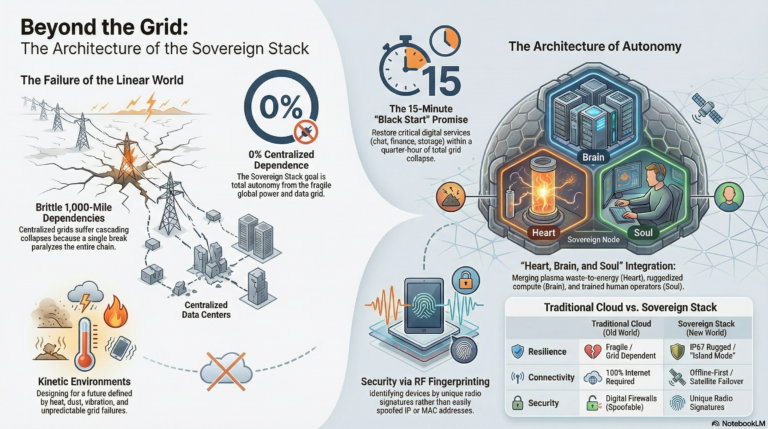
- What is the “1,000-Mile Failure Model,” and how does the consortium address it?
- Identify the three interdependent layers of the Sovereign Stack architecture.
- Explain the “Lean Plugin Rule” (SOS-001) as it applies to the consortium’s web properties.
- What is the significance of West Virginia H.B. 2014 for microgrid deployment?
- Describe the primary function and hardware of a TriFi Rover Gateway.
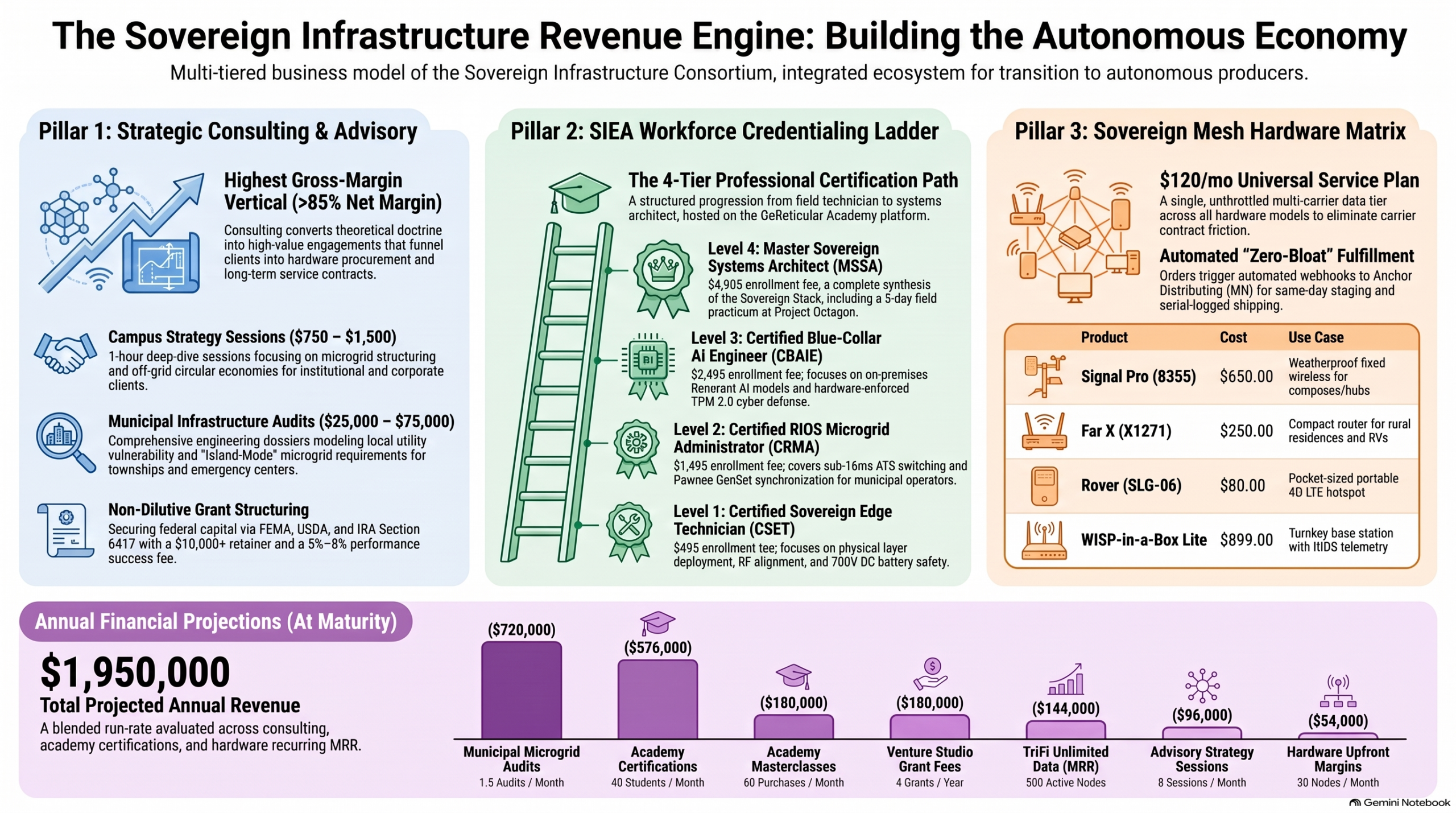
- What is the difference between Level 1 (CSET) and Level 2 (CRMA) in the SIEA workforce ladder?
- How does the Remnant AI Engine ensure “True Air-Gap Execution”?
- What are the financial components of the “Zero-Bloat” checkout bundle for TriFi hardware?
- Explain the role of Metacognitive Swarms of Intelligences (MSI) in grid management.
Part 2: Quiz Answer Key
- Noel’s Law states that any entity remaining a passive consumer of centralized utilities and hyperscaler cloud services is structurally insecure. It dictates that municipalities, co-ops, and campuses must transition into autonomous producers of energy and compute to ensure operational sovereignty.
- The 1,000-Mile Failure Model posits that centralized infrastructure systems are inherently fragile due to their vast, interconnected nature. The consortium replaces this vulnerability with localized, self-healing nodes that can operate indefinitely in “Island Mode” without external dependencies.
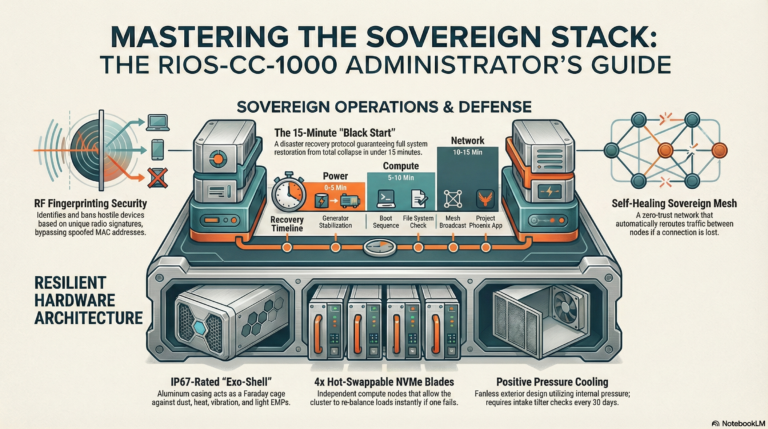
- The Sovereign Stack is composed of the Physical Layer (baseload power and kinetic mobility), the Operational Layer (RIOS and TriFi mesh networking), and the Cognitive Layer (air-gapped intelligence and sovereign governance).
- The Lean Plugin Rule forbids the use of e-commerce or booking plugins like WooCommerce or LearnDash to maintain sub-second page performance. Instead, all commercial conversions are handled via native Stripe Hosted Checkout and headless webhook provisioning.
- West Virginia H.B. 2014 allows for the creation of Certified Microgrid Districts by co-locating high-density compute as a “captive power consumer.” This legislation enables projects to bypass Public Service Commission utility rate regulations and multi-year transmission queues.
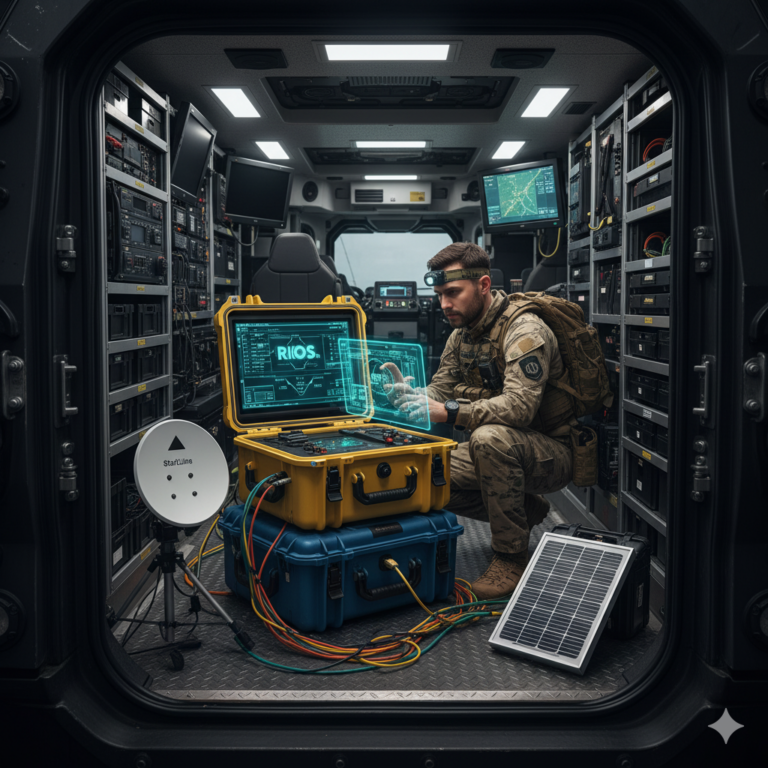
- The TriFi Rover Gateway is a nomadic telecommunications node mounted on a Kurb Kars chassis featuring a 6-meter telescoping mast. It creates a private, encrypted 4.5-mile high-speed data bubble in environments where cellular service is unavailable.
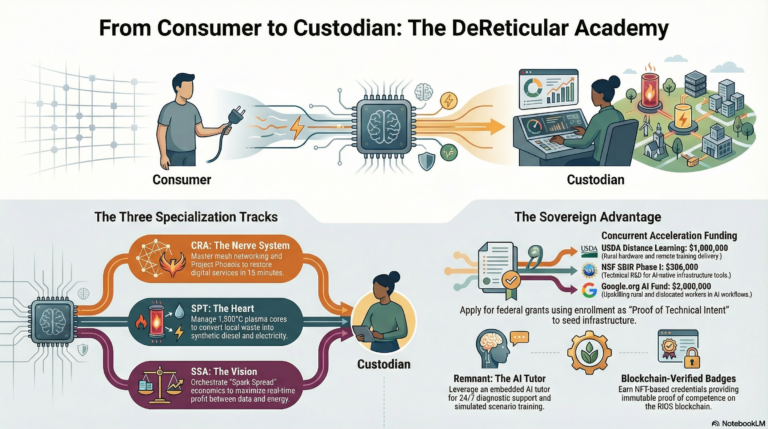
- The CSET (Level 1) focuses on physical layer deployment, such as RF alignment and battery safety for field technicians. The CRMA (Level 2) is designed for utility operators and focuses on configuring the RIOS operating system and managing 45 kW rotary GenSets.
- The Remnant AI Engine runs on dedicated local silicon that is completely severed from commercial API endpoints like OpenAI or AWS. This ensures that proprietary operational data and prompts never leave the local network, eliminating telemetry tracking and cloud-outage risks.
- A standard TriFi hardware checkout includes three line items: the one-time hardware fee (e.g., 650 for Signal Pro), a 45 flat staging and fulfillment fee, and the first month of $120 unlimited data service.
- MSI agents are autonomous, multi-agent neural swarms that balance three-phase electrical loads and thermal cooling loops in real time. They also provide dynamic cyber-physical defense by isolating compromised nodes and reconfiguring routing upon detecting intrusions.
Part 3: Essay Questions
Instructions: Use the provided source context to develop comprehensive responses (500–750 words recommended) for the following prompts.
- The Sovereignty Shift: Analyze how the transition from a “passive consumer” to an “autonomous producer” changes the economic and security profile of a rural municipality.
- Engineering Resilience: Discuss the technical requirements of the “Island Mode” transition, specifically focusing on the roles of sub-16ms ATS switching and 700V DC busbars.
- Cognitive Security: Evaluate the necessity of air-gapped intelligence in critical infrastructure. Contrast the Remnant AI model with traditional cloud-based AI in terms of privacy, latency, and reliability.
- The Commerce of Infrastructure: Examine the consortium’s “Zero-Bloat” commercial architecture. How does the use of Stripe webhooks and native WordPress blocks support the goal of sub-second edge performance?
- Strategic Financing: Explain how the consortium utilizes non-dilutive capital (FEMA, USDA, IRA) to fund sovereign infrastructure. Detail how this approach differs from traditional venture capital models.
Part 4: Glossary of Key Terms
Term Definition
700V DC Busbar A high-voltage common power rail used in Gen 5 architecture to achieve 97.7% power chain efficiency by avoiding multiple DC-to-AC conversions.
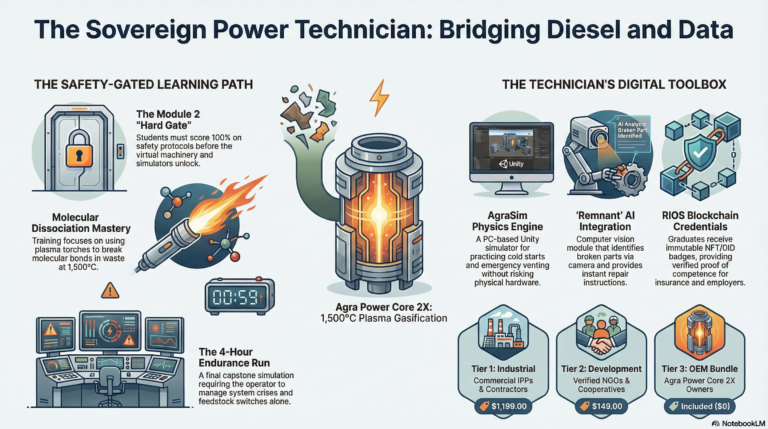
Agra Dot Energy The consortium division focused on agricultural-energy baseload, converting waste-to-syngas via gasification.
BESS Battery Energy Storage System; used for long-duration energy storage and maintaining grid stability.
CBAIE Certified Blue-Collar AI Engineer (Level 3); a credential focused on liquid-cooled GPU racks and on-premises AI deployment.
DCAA / FAR Federal accounting and procurement standards (Defense Contract Audit Agency / Federal Acquisition Regulation) used by the Venture Studio for grant compliance.
Island Mode A state where a microgrid operates continuously and independently of the public utility grid.
Kurb Kars The nomadic hardware and kinetic mobility arm of the consortium, producing autonomous tactical vehicles.
Magic Link A cryptographically signed, expiring URL sent to students to grant access to the Academy Study Vault without a password.
MSI Metacognitive Swarms of Intelligences; decentralized agents that monitor and modify their own decision-making for grid load balancing.
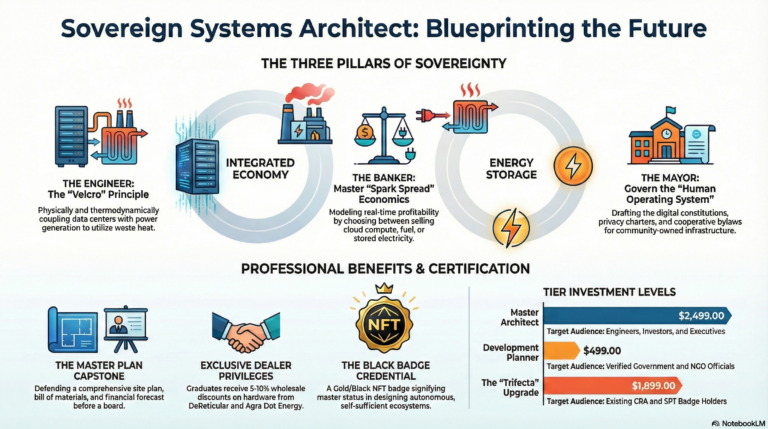
MSSA Master Sovereign Systems Architect (Level 4); the highest SIEA credential, requiring a 3-day field practicum at Project Octagon.
Project Octagon The consortium’s standardized 20ft/40ft ISO containerized skids used for modular microgrid and compute deployment.
RIOS Resilient Infrastructure Operating System; the deterministic edge engine that bridges physical hardware with cognitive intelligence.
SIEA Sovereign Infrastructure Education Alliance; the 501(c)(3) non-profit workforce development and research arm.
Sovereign Stack The vertical integration of Power, Mobility, Comms, Intelligence, and Governance into a single engineering standard.
Syngas Synthesis gas (CO + H2) produced by gasifying agricultural effluent or timber slash, used to fuel Pawnee rotary GenSets.
TPM 2.0 Trusted Platform Module; cryptographic hardware used by RIOS to ensure firmware integrity and cyber defense.
TriFi Wireless A carrier-free, multi-band (5.8 GHz/60 GHz) self-healing mesh networking protocol.
WISP-in-a-Box™ A turnkey commercial series used by municipalities to deploy utility-grade broadband networks.