
The Architecture of Truth: A Comprehensive Study Guide
This study guide provides a structured review of the concepts, mathematical formalisms, and historical analyses presented in the “Architecture of Truth” white papers. It explores the intersections of formal epistemology, macro-thermodynamics, and the material history of record-keeping systems.
Part I: Short-Answer Quiz
Instructions: Answer the following questions in 2–3 sentences based on the provided source context.
- What is the “Via Negativa” in the context of epistemic progress?
- Define “Ontic Friction” and its role in the validation of models.
- How did the Old Babylonian “cased tablet” function as a physical anti-tampering protocol?
- According to Landauer’s Principle, why is maintaining an internal network of verified beliefs physically costly?
- How does Perspectival Realism reconcile the limitation of low-dimensional human observation with high-dimensional reality?
- In the application of the Kuhn Cycle to macroeconomics, what characterizes the “Model Drift” phase?
- What are the two primary assumptions required for Condorcet’s Jury Theorem to successfully aggregate individual signals into a truthful consensus?
- What does Aumann’s Agreement Theorem conclude regarding persistent disagreement between rational agents with common priors?
- Describe the “fundamental contradiction” between the modern financial ledger and thermodynamic reality.
- What are the four structural constraints of Jürgen Habermas’s “Ideal Speech Situation”?
Part II: Answer Key
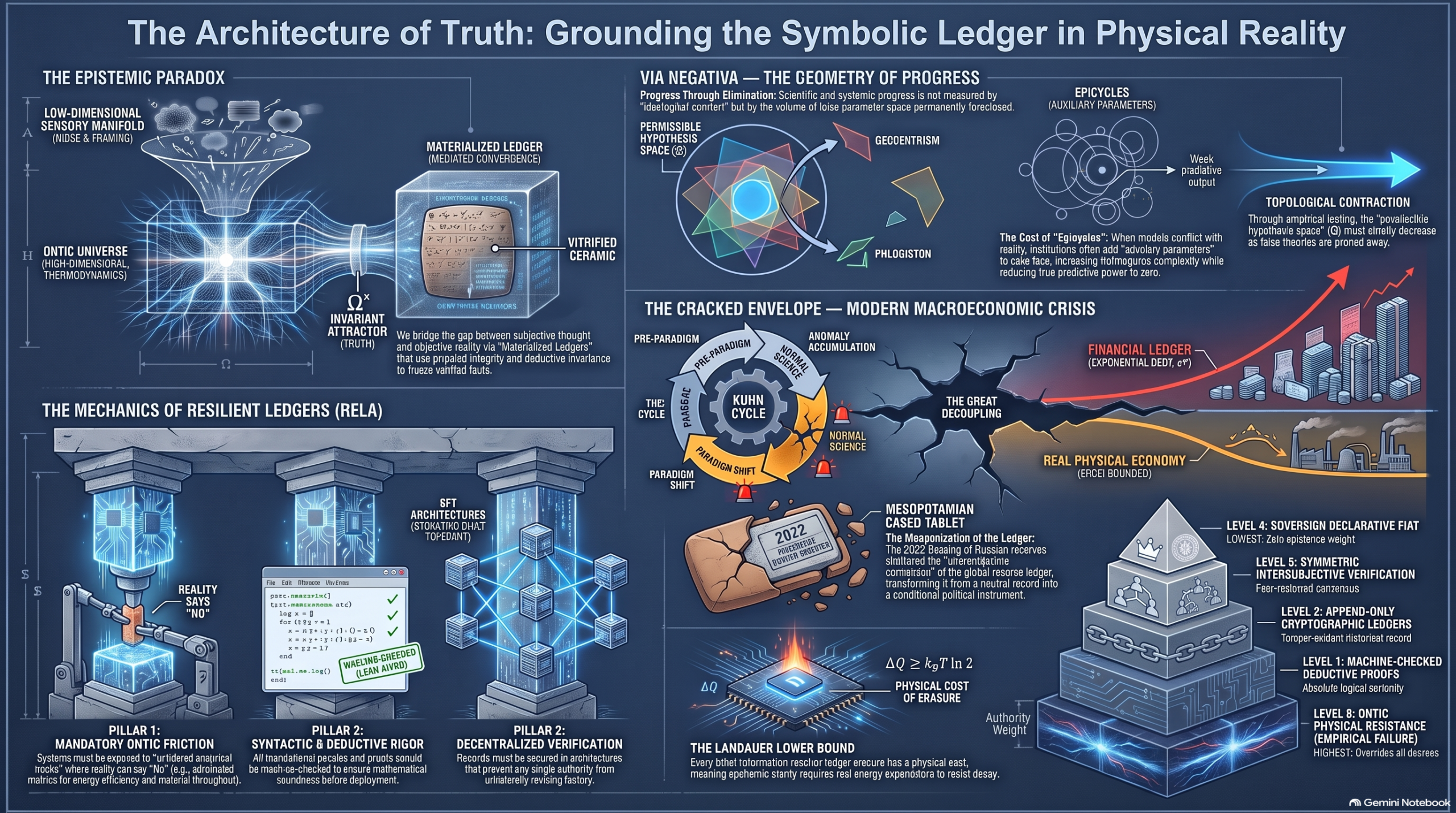
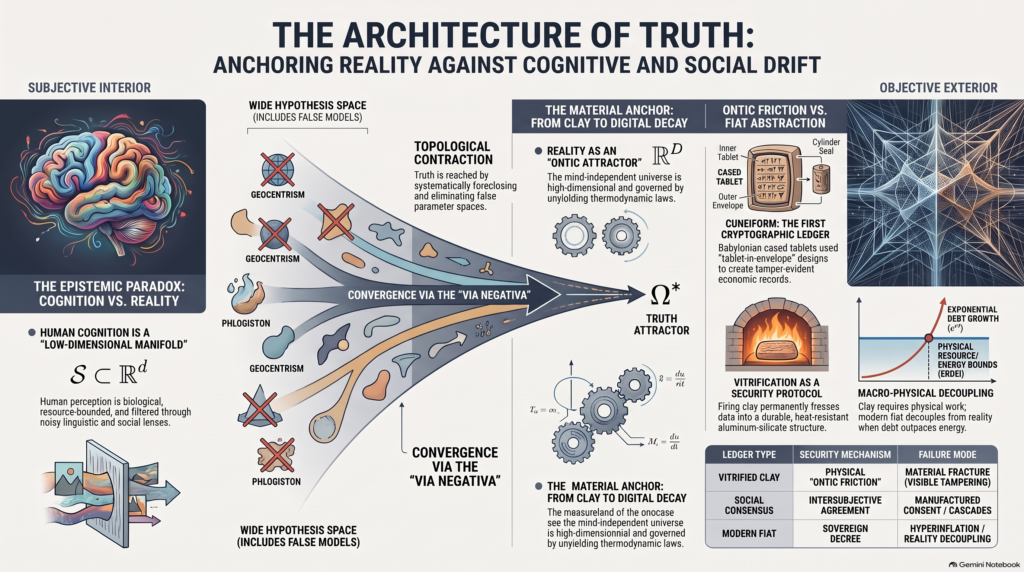
- Via Negativa refers to the process of systematic error reduction through the irreversible truncation or foreclosure of false parameter manifolds. Progress is measured not by the acquisition of absolute “truth” as a static possession, but by the volume of false hypothesis space that is permanently eliminated through empirical falsification.
- Ontic Friction (or Empirical Resistance) is the capacity of the mind-independent universe to act as an unyielding boundary condition that falsifies flawed representations through structural failure. It serves as the ultimate “Level 0” source of truth, where physical reality pushes back against theoretical models—for example, a bridge collapsing if its design violates physical laws.
- The cased tablet involved inscribing a contract on an inner clay tablet and then enveloping it in a second layer of clay containing a duplicate text and cryptographic seal impressions. In the event of a dispute or suspected fraud on the exterior, a magistrate would break the outer envelope; because the inner tablet was physically protected, it served as the unalterable ground truth.
- Landauer’s Principle states that the erasure or irreversible overwrite of even one bit of information dissipates a minimum quantity of thermodynamic energy as heat. Consequently, maintaining and updating a belief register against thermodynamic decay (forgetting or conceptual drift) requires continuous work and energy consumption.
- Perspectival Realism posits that while human observations are “projections” that drop dimensions from a high-dimensional reality, those projections remain veridical (truth-tracking) within their specific frame. Truth is defined as the invariant core—the “Ontic Attractor”—that remains stable across all valid, multi-angle observational perspectives.
- Model Drift occurs when anomalies accumulate that the core paradigm cannot explain, leading institutions to add “epicycles” or auxiliary parameters to preserve the model’s internal coherence. This increases the model’s Kolmogorov complexity (e.g., “transitory inflation” or “Quantitative Easing”) without addressing the underlying failure of its foundational axioms.
- Condorcet’s Jury Theorem requires that each individual in the group has an independent probability of being correct that is greater than chance (p > 0.5) and that there is complete statistical independence between the agents. If these conditions are met, the probability of a correct majority consensus approaches 1 as the group size increases.
- Aumann’s Agreement Theorem mathematically proves that fully rational Bayesian agents with common priors and common knowledge of each other’s beliefs cannot “agree to disagree.” Persistent disagreement implies a failure in rational updating, asymmetric communication loss, or the influence of ideological incentives.
- The contradiction lies in the mismatch between the exponential growth of symbolic financial claims (e^{rt} via compound interest) and the physical limits of the real economy, which is bounded by thermodynamics and declining Energy Return on Energy Invested (EROEI). Eventually, the symbolic debt claims consume more resources than the physical system can generate, leading to systemic default or inflation.
- The Ideal Speech Situation requires Universal Entry (anyone capable of speech may participate), Symmetry of Assertion (everyone has equal standing to challenge any claim), Absence of Coercion (no exogenous threats), and Sincerity (signals must match private beliefs).
Part III: Essay Questions
Instructions: The following questions are designed for deep analytical reflection. They require synthesizing multiple sections of the provided source context.
- The Materiality of Truth: Analyze the transition from “commodity money” (high ontic friction) to “fiat currency” (symbolic abstraction). How does the reduction of material friction in our ledgers contribute to the “Model Crisis” described in the documents?
- The Kuhn Cycle in Policy: Evaluate the claim that modern macroeconomics is currently in a “Phase 3: Model Crisis.” Use the concepts of “auxiliary epicycles” and “ontic friction” to support your argument.
- Perspectival vs. Relativist Truth: Critique the “Radical Relativist” view that truth is merely a power negotiation using the framework of “Perspectival Realism.” How does the “Ontic Attractor” provide a mind-independent anchor for subjective perspectives?
- Consensus and its Pathologies: Discuss how “Information Cascades” and “Pluralistic Ignorance” can cause a society to converge on a consensus that is entirely decoupled from reality. What “Resilient Epistemic Architectures” are suggested to prevent these failures?
- Thermodynamics and Information: Explain the relationship between Landauer’s Principle and the “Physical Transmission Bottleneck.” Why is the dream of “absolute, lossless transmission of truth” across human minds mathematically and physically impossible?
Part IV: Glossary of Key Terms
Term Definition
Aumann’s Agreement Theorem A theorem stating that rational agents with common priors who have common knowledge of each other’s posteriors cannot disagree.
Biophysical Balance Register (BBR) A proposed macroeconomic ledger that anchors economic claims in thermodynamic realities like exergy, EROEI, and material throughput.
Byzantine Fault Tolerance (BFT) A system property that allows a network to reach consensus even if a fraction of its nodes are dishonest or compromised.
Cobb-Douglas Function A standard production function (Y = AK^\alpha L^{1-\alpha}) criticized in the text for treating energy as a minor externality rather than a causal necessity.
Condorcet’s Jury Theorem A formal proof that decentralized signal aggregation leads to truth if individual accuracy exceeds chance and agents remain independent.
Deductive Soundness A property of a formal derivation where the truth of the premises guarantees the truth of the conclusion; a lossless transport protocol for truth-values.
EROEI Energy Return on Energy Invested; the ratio of energy delivered to the amount of energy used to obtain that energy.
Fallibilistic Realism The synthesis asserting that while an objective reality exists (Ontic Attractor), human knowledge of it is framed, mediated, and always subject to revision.
Information Cascade A failure mode of consensus where agents ignore their own private signals to follow the public history of actions, potentially reinforcing an error.
Kuhn Cycle A model of scientific progress involving phases of Normal Science, Model Drift, Model Crisis, Revolution, and Paradigm Shift.
Landauer’s Principle The physical law stating that the erasure of information requires a minimum amount of energy dissipation as heat (\Delta Q \ge k_B T \ln 2).
Material Ledger A physical, high-entropy substrate (clay, metal, or blockchain) used to “freeze” verified claims to resist subjective drift or political revision.
Ontic Attractor (\Omega^*) The mind-independent, invariant state of reality that serves as the ultimate target toward which all valid inquiries asymptotically converge.
Ontic Friction The resistance offered by physical reality that falsifies incorrect models through structural or thermodynamic failure.
Perspectival Realism The view that knowledge is mediated through specific frames/perspectives, but those frames track genuine physical differences in the underlying reality.
Pluralistic Ignorance A state where most members of a group privately reject a claim but publicly support it, believing (falsely) that the rest of the group accepts it.
Ptolemaic Epicycles (Metaphorical) Auxiliary parameters added to a failing model to keep it consistent with anomalies without changing its core axioms.
Verisimilitude “Truthlikeness”; the measure of how closely a theory’s allowed states approximate the actual, objective state of the world.
Via Negativa The “Negative Way” of epistemology; gaining truth by identifying and permanently foreclosing what is false (parameter space foreclosure).